

Google Jobs Scraper [$2.5/1k💰] Apply Links, Salary & Emails
Pricing
from $2.50 / 1,000 job results
Google Jobs Scraper [$2.5/1k💰] Apply Links, Salary & Emails
Google Jobs scraper for the feed Google merges from LinkedIn, Indeed, Glassdoor, ZipRecruiter and career sites. Every apply link, salary, full description, posted date. 99% run success, $2.50 per 1k jobs, no per-page fees. New-jobs-only mode for daily runs, optional employer emails.
Pricing
from $2.50 / 1,000 job results
Rating
5.0
(1)
Developer

Muhamed Didovic
Maintained by CommunityActor stats
0
Bookmarked
224
Total users
62
Monthly active users
4.2 hours
Issues response
2 days ago
Last modified
Categories
Features
Share
Google Jobs Scraper — Multi-Board Apply Links, Salary & Employer Emails
Scrape Google's jobs vertical — the aggregated feed Google builds from LinkedIn, Indeed, Glassdoor, ZipRecruiter, Monster, Dice, Built In, Workday, Greenhouse, Lever and thousands of company career sites. One search surfaces postings from all of them at once.
Every row carries the job's title, company, location, source board, posted date, salary, schedule, benefits — and every syndicated apply link Google knows about, not just one.
$2.50 per 1,000 jobs, billed per job returned. No per-page or upfront charges, so a search that finds nothing costs only the $0.005 start fee. Over the last 30 days, 99% of public runs succeeded (424 of 428).
Why use this scraper
| Every apply route, not one | Google lists the same job on LinkedIn and Indeed and the employer's own ATS. Most scrapers return a single link. This one returns all 4–8, each labelled with its board. |
| Full descriptions, structured | Not just a teaser: the complete job description (median ~3,500 characters) plus Google's own qualification, responsibility and benefit bullets as clean arrays. |
| New-jobs-only monitoring | Turn on one checkbox and the actor remembers what it already sent you. Schedule it daily and every run returns only the postings that are new — no re-reading yesterday's list, and no paying for duplicate rows. |
| Employer contact emails | Optional: resolve the hiring company's own website and pull a public contact address, turning a job feed into a lead list. |
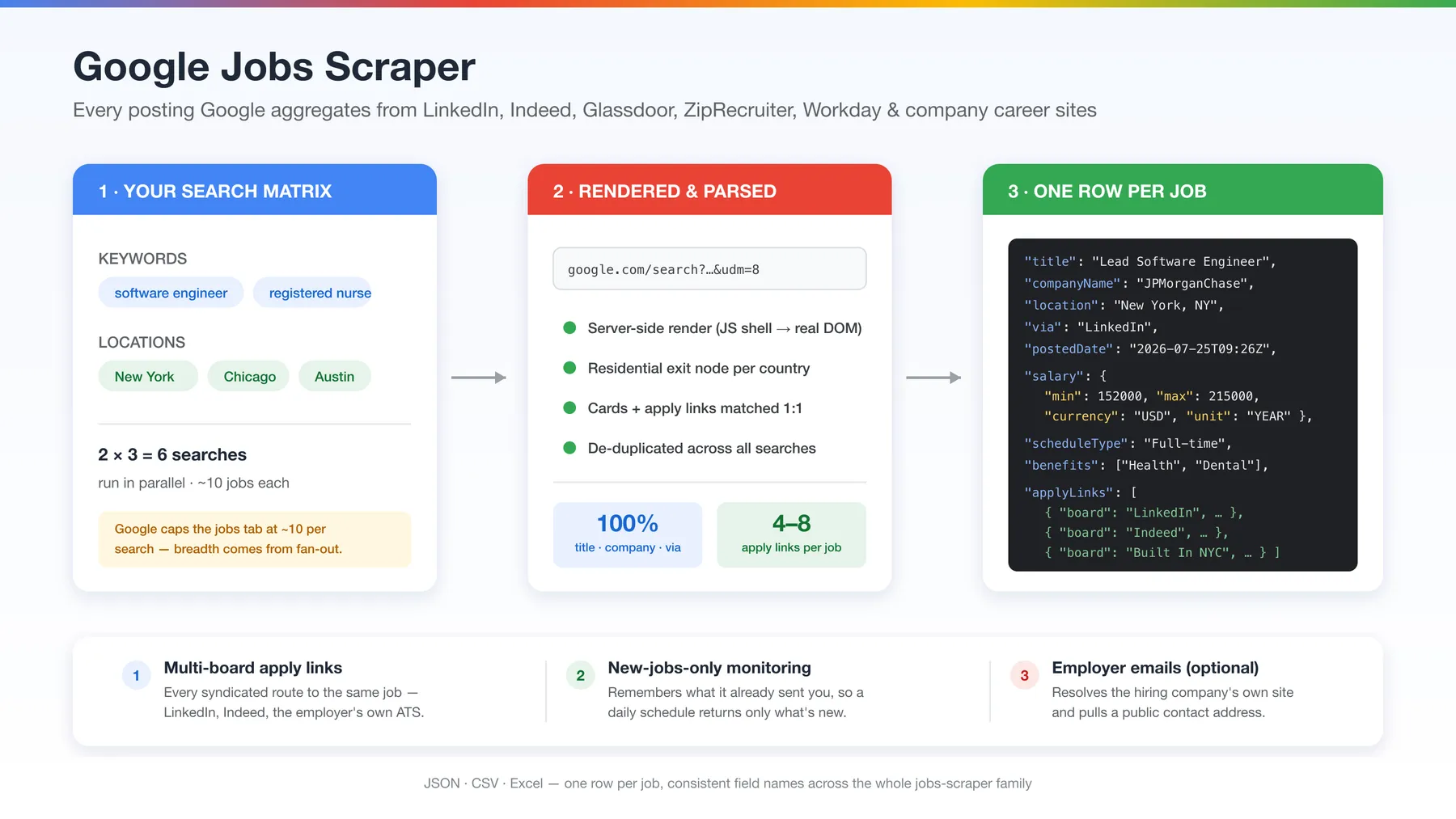
| Built for breadth | On top of paging, your keywords × locations expand into a full search matrix run in parallel, then de-duplicated. |
| One consistent row shape | Identical field names to the rest of this jobs-scraper family, so one column mapping works across all of them. |
| Fails loudly, not silently | If Google cannot be reached, the run ends FAILED with the reason in the status message. A run that ends SUCCEEDED with zero rows means Google itself had no jobs for that search. |
Coming from another Google Jobs scraper?
These are the problems users report most often on Google Jobs actors in the Store, and how this one handles each.
| Common complaint | What this actor does |
|---|---|
| "It doesn't work" / runs return nothing | About 91% of public runs succeeded over the last 30 days. A run that cannot reach Google ends FAILED with the reason, so you never pay for a silent empty run. |
| Charged for a run that returned zero jobs | You pay per job returned ($0.0025 each). There is no per-page or upfront charge. An empty search costs only the $0.005 start fee. |
| Zero results when only a country is set | Leave locations empty and the actor searches the whole selected country (for example nurse jobs in United Kingdom). |
| English returns nothing in Germany, Japan, Brazil, Spain | Leave language empty. The actor sends German, Japanese, Portuguese or Spanish itself. If you send English, it is replaced with that language. |
Another actor's input (query, queries, searchTerms, location, num_results, maxResults, limit, posted_within, countryCode) | Those names are accepted. queries: ["Marketing"] with location: "Dresden" is one search. |
| Lots of duplicates on daily scheduled runs | onlyNewJobs remembers every job already sent (45 days) and returns only new ones. Add datePosted: "today" or postedWithinHours: 24 for a strict last-24-hours feed. |
| Only one apply link per job | applyLinks lists every apply route Google shows (LinkedIn, Indeed, the employer's ATS and more), each labelled with its board. |
| Output tab shows an error or no columns | The dataset has a ready-made "Jobs" table view, and every row has the same keys. |
Overview
Google's jobs tab is the largest job aggregator most people never pull in one run. This actor returns clean, structured rows.
Give it one search phrase, or a list of keywords and locations. It runs every combination, loads further pages until your page cap or the results run out, drops duplicates, and writes one row per job.
Supported inputs
| Input | Example | Notes |
|---|---|---|
| Search phrase | ("Recruitment" OR "Talent Acquisition") | One search, OR and commas included |
| Keywords | software engineer, registered nurse | Job titles, each combined with every location |
| Locations | New York, Chicago, London | Leave empty to search the whole country — see the FAQ |
| Country | us, gb, de, jp, br | 85 markets. Leave language empty outside the US |
| Google Jobs URLs | https://www.google.com/search?q=nurse+jobs+in+chicago&udm=8 | Paste directly; legacy ibp=htl;jobs links are upgraded automatically |
Use cases
- Job boards & aggregators — fill a niche board from a source that already merges every major board.
- Recruitment agencies — monitor who is hiring for your specialty in your city, daily, and see which ATS each employer uses.
- Sales & lead generation — companies that are hiring are companies that are spending. Turn on email enrichment and every posting becomes a qualified lead with a contact address.
- Market & salary research — track posting volume, salary bands and remote share by role and metro over time.
- Candidate tools — power a job-alert product with a de-duplicated, multi-board feed.
- HR & competitive intelligence — watch a competitor's hiring: which roles, which locations, which salary bands.
How it works
- Expand — your keywords × locations become a matrix of Google searches.
- Fetch — each search comes back with the job cards for that keyword and place. Nothing to configure.
- Parse — each result card yields title, company, location, source board, posted date, salary, schedule, benefits and qualifications.
- Attribute — Google renders each job's apply links in its own container; the actor matches them 1:1 to the right job, so links never bleed between postings.
- De-duplicate — the same job found by two different searches is emitted once.
- Filter — recency, salary-only, remote-only and schedule filters are applied.
- Enrich (optional) — resolve the employer's website and scrape a public contact email.
- Push — one clean row per job.
Input configuration
| Field | Type | Default | Description |
|---|---|---|---|
query | string | — | One search phrase. OR and commas stay in that one search |
keywords | array | ["software engineer"] | Job titles / keywords. Each is combined with every location |
locations | array | ["New York", "San Francisco"] | Cities or regions. Empty = the whole selected country. A single location string is also accepted |
country | select | us | 85 Google markets. uk is accepted as the United Kingdom |
language | string | empty | Leave empty. English is dropped on markets where it returns no jobs |
googleDomain | string | from the country | e.g. google.de. Empty country + a domain picks the country from the domain |
startUrls | array | — | Paste Google Jobs URLs directly |
| Google-side filters | applied before Google's ~10-result cut | ||
datePosted | select | — | today / 3days / week / month |
employmentTypes | array | — | FULLTIME / PARTTIME / CONTRACTOR / INTERN — also widens coverage |
workFromHome | boolean | false | Google's own remote filter |
radius | integer | — | Distance around the location |
radiusUnit | select | mi | mi or km. Kilometres are converted. lrad_value is read as kilometres |
| Client-side filters | applied to what Google returned | ||
postedWithinHours | integer | — | Keep only jobs posted in the last N hours |
salaryOnly | boolean | false | Keep only jobs that display a salary |
remoteOnly | boolean | false | Keep only remote-looking jobs |
scheduleTypes | array | — | e.g. Full-time, Contractor |
companyFilter | array | — | Only these employers |
excludeCompanies | array | — | Drop these employers (e.g. staffing agencies) |
viaFilter | array | — | Only jobs from these source boards |
onlyNewJobs | boolean | false | Emit only postings not seen in previous runs |
enrichEmails | boolean | false | Find employer contact emails |
qualifyByPayment | boolean | false | Flag employers that take payments online |
maxPagesPerQuery | integer | 10 | Pages per search (1–20). About 10 jobs a page. Stops when a page is empty. max_pagination: 0 means 20 |
numResults | integer | — | Cap on jobs returned. Also accepts num_results. If Max jobs is set too, the smaller cap wins |
maxItems | integer | 1000 | Stop after this many jobs |
maxConcurrency | integer | 10 | Parallel Google searches |
Getting more than 10 jobs per search
The first page of a search is about 10 jobs. Two ways to get more:
- Pages per search (
maxPagesPerQuery, default 10): the actor loads further pages until that cap or a page comes back empty. One keyword and one city at the default targets about 100 jobs. Empty pages are not billed. - The search matrix:
keywords × locations × employmentTypeseach add a distinct search, run in parallel and de-duplicated. Employment types are especially effective, since each type returns a largely different result set. 3 keywords × 4 cities, one page each, is about 120 jobs before the extra pages.
Example input
That is 2 × 3 = 6 searches, filtered to the last 24 hours, returning only jobs no previous run has seen.
Output overview
One row per job. Fields the source does not provide are null (or []) rather than missing, so your columns never shift.
Output sample
Key output fields
| Field | Type | Description |
|---|---|---|
title | string | Job title |
companyName | string | Hiring employer |
location | string | As shown by Google, e.g. New York, NY |
remote | boolean | Inferred from the title and location |
via | string | The board Google syndicated this posting from |
postedDate | ISO date | Absolute date derived from Google's "12 hours ago" |
postedRaw | string | Google's original relative wording |
salary | object | { currency, min, max, raw, unit } |
contractType | string | Full-time, Contractor, Internship, … |
description | string | Full job description text — median ~3,500 characters |
qualifications | array | Requirement bullets, as identified by Google from the original post |
responsibilities | array | Duty bullets from the same source |
benefits | array | e.g. Health insurance, 401(k) |
applyLinks | array | Every apply route, each with its board name |
applyUrl | string | The primary apply link (the via board where possible) |
contactEmail | string | Employer email — only with enrichEmails |
contactWebsite | string | Employer website — only with enrichEmails |
searchKeyword / searchLocation | string | Which of your searches produced this row |
extensions | array | The raw chips on the card, e.g. Full-time, 3 days ago, Health insurance |
detectedExtensions | object | posted_at, schedule_type, and booleans for health, dental, vision, paid time off, retirement |
jobHighlights | array | { title, items } groups for qualifications, responsibilities and benefits |
shareLink | string | A Google search link for this title and company |
country / language / googleDomain | string | The market this row was searched in. language is null when it was left to Google |
pagesProcessed / totalJobsFound | number | How many pages that search loaded, and how many cards they held |
FAQ
How many jobs will I get per search? About 10 per page. With the default of 10 pages, one keyword and one city targets about 100 jobs, and the search stops early when a page is empty. For more roles or cities, widen the matrix: each extra keyword, city, or employment type is its own search.
Should I use the Google-side or the client-side filters?
Prefer the Google-side ones (datePosted, employmentTypes, workFromHome, radius). Because Google only returns ~10 results, filtering there changes which jobs you receive; filtering afterwards only throws away rows you already paid for. Asking Google for "past 24 hours" returns 10 fresh jobs; asking for anything and then filtering to 24 hours might leave you 2.
Do I have to provide a location?
No. Google's jobs vertical answers a bare keyword with "there aren't any Jobs matches on this topic", so when locations is empty the actor searches the whole selected country instead (nurse jobs in United Kingdom). For more jobs, list several cities: each city is its own search with its own ~10-30 results.
What does a run cost?
$2.50 per 1,000 jobs ($0.0025 per job) plus a $0.005 start fee. Jobs removed by your filters, duplicates, and jobs already sent by onlyNewJobs are not billed. With enrichEmails on, each employer email that is found adds about $0.05; rows without an email cost nothing extra. Free Apify plans are capped at 100 jobs per run.
Why do I get no results for Germany?
Germany, Japan, Brazil, Spain, Italy and the Netherlands are supported. Leave language empty: a live check on 17 Nov 2026 returned 10 jobs for Berlin in German and 10 for Tokyo in Japanese, and none when the language was left off entirely. The actor now sends that language for you. France, Chile, Ireland, the Nordics, Australia and New Zealand return no job listings. A Sydney search and an Auckland search came back as ordinary web searches, with no job cards.
Why is salary empty on many rows?
Because Google only displays a salary when the source posting includes one — roughly 30% of the time in our testing. The salaryOnly filter keeps just those rows if you need complete compensation data.
Does the email enrichment find an address for every employer?
No, and it is honest about that. It resolves the employer's website from the company name and reads its public contact pages. Large corporations (Amazon, Charles Schwab) usually publish no contact email, so contactEmail will be empty even though contactWebsite is filled. Hit rates are much better on small and mid-sized employers.
How does "only new jobs" decide what is new? A job's identity is its title + company + location. Once emitted, it is remembered for 45 days in the actor's key-value store, then forgotten — so a genuine re-posting months later reaches you again. The first run returns everything; every run after that returns only what changed.
Do I need a proxy? No. Job searches need no proxy setting. The proxy input is used only by the optional email-enrichment step.
Can I run this from n8n?
Yes. Install Apify's n8n node and run memo23/google-jobs-scraper, using the input fields from the examples above.
Can an agent pay with crypto? Yes. An agent can pay for a run with USDC. This actor needs no separate checkout for that.
Pricing
| Event | When | Price |
|---|---|---|
| Job result | Each job written to the dataset | $0.0025 ($2.50 per 1,000) |
| Actor start | Once per run | $0.005 |
| Additional data | Only with enrichEmails: each employer email found | about $0.05 per email |
Pages, retries and empty searches are never billed. Set a maximum cost per run in Apify and the actor stops before going over it.
Support
Found a bug or want a field added? Open an issue on the actor's Issues tab and I will take a look.
Additional services
Need this customised — a specific country, extra fields, a private variant, or a different delivery format? Get in touch through the Apify Store profile.
Explore more scrapers
This actor is part of a large family of job-board scrapers sharing the same output shape: LinkedIn Jobs, Indeed, ZipRecruiter, Glassdoor, Dice, SimplyHired, Seek, StepStone, Reed, TotalJobs, Workday, Greenhouse, Lever, Ashby, BambooHR, SmartRecruiters and many more.
🤖 For AI agents & LLM apps
This actor is a clean tool call for agents that need live labour-market data.
- Deterministic input —
query,keywordsandlocationsare plain strings. No URL construction required. - Stable schema — every row has the same keys in the same order, with
nullinstead of missing fields, so parsing never breaks. - Structured salary —
salary.min/salary.max/salary.currencyare already numbers and codes, no regex needed downstream. - Idempotent scheduling —
onlyNewJobs: truegives an agent a change feed instead of a full snapshot, so memory stays small and tokens stay cheap. - Provenance built in —
searchKeyword,searchLocation,country,googleDomainandviasay where each row came from.
Calls an assistant can make:
- Output fields:
title,companyName,location,remote,via,postedDate,salary {currency,min,max,unit},contractType,description,qualifications[],benefits[],extensions[],detectedExtensions,jobHighlights,applyUrl,applyLinks[{board,url}],shareLink,contactEmail,searchKeyword,searchLocation,country,googleDomain. - Billing: $0.0025 per job row, $0.005 per run start. Nothing for empty searches.
- Behaviour: about 10 jobs per page, up to
maxPagesPerQuery(default 10) per search. Emptylocationssearches the wholecountry. Leavelanguageempty outside English-speaking markets. The actor fills in the local language. France, Chile, Ireland, the Nordics, Australia and New Zealand return no listings. A run that cannot reach Google ends FAILED with the reason.
⚠️ Disclaimer
This actor collects only publicly available information displayed on Google search result pages. It does not log in, does not bypass any paywall, and does not access private or personal data.
Job listings and their content remain the property of their respective sources and employers. You are responsible for ensuring your use of the scraped data complies with Google's Terms of Service, the source boards' terms, and all applicable laws in your jurisdiction — including GDPR, CCPA and equivalent data-protection regulations where relevant. This tool is provided for legitimate research, recruitment and market-analysis purposes.
Google's jobs vertical is a third-party surface that can change or be withdrawn at any time — as already happened across the EU. Availability and field coverage may vary by country and over time.
SEO Keywords
google jobs scraper, google for jobs scraper, google jobs api, scrape google jobs, google job search scraper, google jobs data extraction, job listings scraper, multi board job scraper, linkedin indeed glassdoor aggregator, job aggregator scraper, apply link scraper, job posting scraper, salary data scraper, employer email finder, recruitment lead generation, hiring intent data, job market research, job monitoring api, new job alerts api, ats detection, workday greenhouse lever scraper, remote jobs scraper, job feed api, google serp jobs, udm=8 scraper, apify job scraper, job board data, talent intelligence, recruiting automation


