

Google Search Scraper — SERP, AI Overview, Ads & Operators
Pricing
from $3.00 / 1,000 serp pages
Google Search Scraper — SERP, AI Overview, Ads & Operators
Scrape Google Search SERP — organic results, paid ads, related queries, People Also Ask, knowledge panels — with built-in anti-block defenses (AdsBot UA, udm=14, multi-selector parsing, dual-engine HTTP).
Pricing
from $3.00 / 1,000 serp pages
Rating
5.0
(1)
Developer

Muhamed Didovic
Maintained by CommunityActor stats
0
Bookmarked
99
Total users
21
Monthly active users
4 days ago
Last modified
Categories
Share
Google Search Results Scraper
Scrape Google Search result pages (SERPs) and get clean, structured JSON — organic results, related searches, People Also Ask, knowledge panels, and total result counts — for any query, country, and language.
Built for reliability: a dual-engine HTTP fetcher with real browser TLS impersonation, an 8-deep self-healing selector chain that survives Google's layout rotations, and structural soft-block detection that won't false-reject a valid SERP.
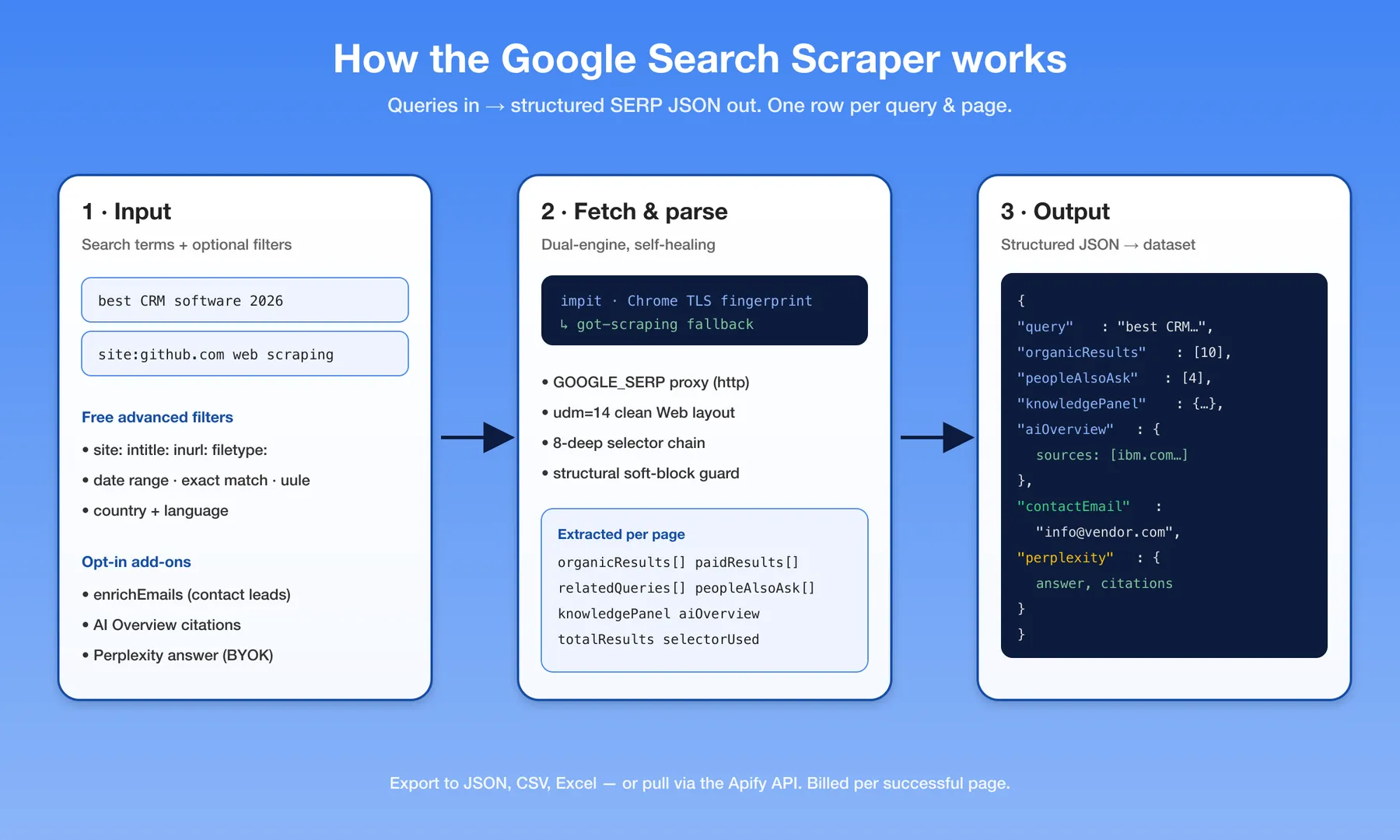
What it extracts
- Organic results — position, title, URL, displayed URL, description, date, emphasized keywords, sitelinks, and inline product info (rating / reviews / price)
- Related searches — the "people also search for" / bottom-of-page queries
- People Also Ask — the expandable Q&A questions (with answer text when present)
- Knowledge panel — title, subtitle, description, fact attributes (Born, Died, Address, Height, …), and source link
- AI Overview — detection + the cited source domains for GEO/AEO tracking (the generated prose itself is not available over the proxy — see Limitations)
- Total results — the "About N results" count
- Contact emails (opt-in) — turn a SERP into leads: scrape each result's own site for a contact email + people. See Lead enrichment below.
- Perplexity AI answer (opt-in, BYOK) — a grounded AI answer with citations per query, via Perplexity's official API with your key. See Perplexity AI answer.
Input
| Field | Type | Default | Notes |
|---|---|---|---|
queries | string[] | — | One or more search terms. Required. |
maxPagesPerQuery | integer | 1 | Pages to fetch per query (~10 results each). |
resultsPerPage | integer | 10 | See the note under Limitations — Google caps this at ~10. |
countryCode | string | US | Two-letter country (sets the Google domain + gl). |
languageCode | string | en | Interface/results language (hl). |
safeSearch | off/medium/high | off | SafeSearch level. |
includeRelated | boolean | true | Extract related searches + People Also Ask. |
includeKnowledgePanel | boolean | true | Extract the knowledge panel. |
includeAiOverview | boolean | true | Detect AI Overview + extract its cited sources. Needs appendUdm14: false. |
includeAds | boolean | true | Attempt paid-ad extraction (see Limitations). |
appendUdm14 | boolean | true | Use Google's clean "Web" layout. Set false to see AI Overviews. Recommended on for max organic stability. |
useAdsBotUA | boolean | false | Send the AdsBot-Google user agent. |
maxConcurrency | integer | 5 | Parallel requests. |
maxRequestRetries | integer | 5 | Retries per page before giving up. |
proxy | object | GOOGLE_SERP | Proxy config. Leave default — see Limitations. |
Advanced search filters
Google search operators exposed as structured fields (all folded into the query /
URL — you can also type the operators directly inside a queries entry):
| Field | Type | Operator / param | Notes |
|---|---|---|---|
site | string | site: | Restrict to one site. Wins over relatedToSite. |
relatedToSite | string | related: | Pages related to a site. |
wordsInTitle | string[] | intitle: | Multi-word entries auto-quoted. |
wordsInText | string[] | intext: | Words required in body text. |
wordsInUrl | string[] | inurl: | Words required in the URL. |
fileTypes | string[] | filetype: | OR-combined (pdf, docx, …). |
forceExactMatch | boolean | "…" | Wrap the query in quotes. |
searchLanguage | string | lr=lang_XX | Results language (distinct from hl). |
locationUule | string | uule= | Exact location code. |
quickDateRange | string | tbs=qdr: | Relative recency: h, d10, w, m6, y1. |
afterDate / beforeDate | string | tbs=cdr: | Absolute bounds (YYYY-MM-DD or MM/DD/YYYY). |
includeUnfilteredResults | boolean | filter=0 | Include Google's omitted near-duplicates (off by default). |
saveHtml | boolean | — | Attach raw SERP HTML to each row under html (large). |
saveHtmlToKeyValueStore | boolean | — | Save HTML to the KV store; add htmlSnapshotUrl to each row. |
Lead enrichment (opt-in)
Turn search results into leads. When enrichEmails: true, the top business domains
in each SERP get their own site scraped for a contact email + people; the hits
are attached to those organic results as contactEmail and emailEnrichment.
| Field | Type | Default | Notes |
|---|---|---|---|
enrichEmails | boolean | false | Enable contact-email enrichment. |
maxEnrichedDomainsPerPage | integer | 3 | Cap unique business domains enriched per page. |
- Best on business-intent queries (
"commercial plumbers chicago","B2B SaaS vendors"). - Non-business domains (search engines, social, Wikipedia, big marketplaces) are skipped; domains are de-duped per page.
- Best-effort and free (direct site scrape) — enrichment never fails a scrape.
Perplexity AI answer (opt-in, bring-your-own-key)
Attach a Perplexity (Sonar) AI answer to each query — grounded, with citations.
This calls Perplexity's official API with your own key, so you are billed by
Perplexity per request (it is not scraping). The answer lands on the page-1 row
under perplexity { answer, model, citations, searchResults?, relatedQuestions? }.
| Field | Type | Default | Notes |
|---|---|---|---|
perplexitySearch | boolean | false | Enable the Perplexity answer. |
perplexityApiKey | string (secret) | — | Your key from docs.perplexity.ai. Required. |
perplexitySearchRecency | day/week/month/year | — | Restrict grounding to recent content. |
perplexityRelatedQuestions | boolean | false | Also return follow-up questions. |
Inert unless both the toggle is on and a key is supplied; a Perplexity error never breaks the SERP scrape.
Example input
Output
One dataset item per (query, page):
selectorUsed tells you which parser variant matched — handy for spotting future
Google layout drift.
How it works
- Dual-engine fetch — tries
impit(Rust, real Chrome TLS + HTTP/2 fingerprint) first, falling back togot-scraping. Two independent fingerprints = two chances against bot detection. udm=14clean layout — by default the scraper requests Google's "Web" tab, which strips the AI Overview and returns stable, parseable markup.- Self-healing selectors — organic results run through an 8-deep selector chain
(2026 containers first, classic layouts as fallback, plus a class-agnostic
a:has(h3)structural net), so a single Google class rename won't zero out a run. - Structural soft-block detection — a page is only treated as blocked if it
doesn't structurally look like a SERP, so benign
/sorry/footer links never cause a false "blocked".
Limitations & notes
-
Use the default GOOGLE_SERP proxy. Google aggressively blocks datacenter and residential IPs for SERP scraping (JS-challenge / CAPTCHA interstitials). This actor is built around Apify's GOOGLE_SERP proxy group, which is purpose-built for Google and applied automatically. Overriding
proxyto RESIDENTIAL or datacenter groups will fail with soft-blocks — leave the proxy at its default. -
Paid ads (
paidResults) are usually empty. Google does not serve ads to SERP-proxy IP ranges, so the ads container comes back empty regardless of theincludeAdstoggle. Reliable ad capture requires a separate ad-specialized proxy with retries, which this actor does not include. TreatincludeAdsas best-effort. (Organic results, related searches, PAA, and knowledge panels are unaffected.) -
AI Overview prose is not available over the proxy. Google server-renders the AI Overview shell (label + citation cards) but generates the answer text client-side, so a no-JS request receives a placeholder.
aiOverviewtherefore returnsdetected+ the citedsources(useful for GEO/AEO — which domains Google cites) withtextAvailable: false. The prose itself needs a JS-rendering path, the same wall as paid ads. RequiresappendUdm14: false(the defaultudm=14strips AI Overviews entirely). -
resultsPerPageis effectively ~10. Google ignores thenumparameter on most modern SERP layouts and returns ~10 results per page. To collect more, raisemaxPagesPerQueryrather thanresultsPerPage. Pagination always steps by the real page size, so no results are skipped if you set a larger value. -
Knowledge-panel images are lazy-loaded by Google's JS, so
imageUrlmay be absent even when the panel is otherwise fully populated. -
People Also Ask answers are only present when Google pre-expands the card; for most queries you'll get the question and destination URL but no answer text.
-
AI Overview is intentionally excluded by
appendUdm14: true. Set it tofalseif you want the default SERP layout (which can include the AI Overview and more ad/PAA surfaces), at the cost of slightly less stable organic markup.
Tips
- Keep
appendUdm14on for the most reliable organic extraction. - For deep coverage, set
maxPagesPerQuery(e.g. 5) instead ofresultsPerPage. - Use
countryCode+languageCodetogether for accurate localized results (e.g.DE+de,JP+ja). - Google search operators work inside
queries(site:,intitle:,"exact",OR,-exclude,filetype:).
🤖 For AI Agents & LLM Apps
Compact reference for AI agents calling this actor via the Apify MCP server or the Apify API (actor: memo23/google-search-scraper).
Purpose: Scrape structured Google SERPs for any query, country and language — organic results, related searches, People Also Ask, knowledge panel, AI-Overview cited sources and total counts — with a self-healing selector chain that survives Google's layout rotations.
Minimal input:
Output: one row per (query, page) — query, page, searchUrl, organicResults {type, position, title, url, displayedUrl, description, siteLinks}, paidResults, relatedQueries {title, url}, peopleAlsoAsk {question, answer, url}, knowledgePanel, aiOverview {detected, textAvailable, sources {url, domain}}, totalResults, selectorUsed, scrapedAt.
Behaviors an agent should know:
queriesis the only required field; one row per query × page. To collect more results, raisemaxPagesPerQuery(default 1) — Google capsresultsPerPageat ~10 regardless of the value set.- Leave
proxyat its default GOOGLE_SERP group; overriding to residential/datacenter groups fails with soft-blocks. appendUdm14(default true) gives stable organic markup but strips AI Overview; set it false (withincludeAiOverview) to get the AI-Overviewsources— the generated prose is never available over the proxy.paidResultsis usually empty (Google does not serve ads to SERP-proxy IPs); treatincludeAdsas best-effort.enrichEmails(opt-in, best-effort, free) scrapes top business domains' own sites forcontactEmail;perplexitySearch(opt-in, bring-your-own-key) attaches a Perplexity answer and is billed by Perplexity, not this actor.- Pay-per-event billing — see the Pricing tab on the actor page.
⚠️ Disclaimer
This Actor is an independent tool and is not affiliated with, endorsed by, or sponsored by Google LLC or any of its subsidiaries. All trademarks mentioned, including Google and Google Search, are the property of their respective owners.
The scraper accesses only publicly available Google search results pages — no authenticated endpoints, paid features, or content behind any google.com login wall. Users are responsible for ensuring their use complies with google.com's Terms of Service, applicable data-protection law (GDPR, CCPA, etc.), and any contractual obligations of their own organization.
SEO Keywords
google search scraper, scrape google, google serp scraper, google search API, google.com scraper, Apify google, serp scraper, search results scraper, organic results scraper, seo rank tracking, keyword research data, competitor serp analysis, ai overview extraction, people also ask data, search engine intelligence, serp data export, marketing analytics data


![Autotrader.com.au [$1💰] Australia Search & Details Scraper🇦🇺 avatar](https://images.apifyusercontent.com/pCkelbtHnioCVauMT6DM9tGYD81m-FmuhD-rXFDHMC4/rs:fill:76:76/cb:1/aHR0cHM6Ly9hcGlmeS1pbWFnZS11cGxvYWRzLXByb2QuczMudXMtZWFzdC0xLmFtYXpvbmF3cy5jb20vbmduOHZSRVNUa3NleVdFNnAtYWN0b3ItYWFINGlJOWIwc2dNNkNWeVMtanhmc2ZZeEVBWi1hdXRvdHJhZGVyLWF1cy5wbmc.webp)


![Collecting Cars [$3💰] | 33k SOLD prices + live bids avatar](https://images.apifyusercontent.com/Hbn_LDWbVTHAyPL8k_edq8GAZOEin7g5i4_bFf2WimM/rs:fill:76:76/cb:1/aHR0cHM6Ly9hcGlmeS1pbWFnZS11cGxvYWRzLXByb2QuczMudXMtZWFzdC0xLmFtYXpvbmF3cy5jb20vbmduOHZSRVNUa3NleVdFNnAtYWN0b3ItRm1EYVRESkEyWGNYU0s4N24tVkJhU3V5RENuYi1Db2xsZWN0aW5nX0NhcnMud2VicA.webp)

