Google SERP & AEO Scraper
Pricing
from $0.26 / 1,000 organic-result-scrapeds
Google SERP & AEO Scraper
Scrape Google organic SERP with geo targeting, search operators, and flat SEO export. Match Google ranks vs ChatGPT and other LLM citations in one dataset. Includes a Google Sheets template — run scans from a spreadsheet, no code required.
Pricing
from $0.26 / 1,000 organic-result-scrapeds
Rating
5.0
(1)
Developer

Morph Coder
Maintained by CommunityActor stats
0
Bookmarked
2
Total users
1
Monthly active users
3 months ago
Last modified
Categories
Share
Apify Actor for automated Google Search scraping with GOOGLE_SERP proxy, manual search operators, country targeting, ads detection, flat SEO export, and optional LLM visibility comparison.
Differentiator: includes a Google Sheets workflow — run SERP + AEO scans from a spreadsheet (keywords, settings, results, run cost) with no coding after a 5-minute setup.
Google Sheets workflow
Run this Actor from Google Sheets — most users never touch the API.
| Copy template (fastest) | Make a copy |
| Install guide | morph-coder/google-serp-aeo-scraper |
Quick start
- Activate the Actor in your Apify account.
- Copy the template spreadsheet → SERP Tools → Configure Apify token.
- Add keywords on the Keywords sheet → SERP Tools → Run SERP scan → results land in Results, LLM Summary, and Run Log (
costUsdper run).
Prefer your own spreadsheet? Paste Code.gs via Extensions → Apps Script — step-by-step in the Sheets install guide. Review the script with your AI assistant before authorizing Google permissions.
Screenshots
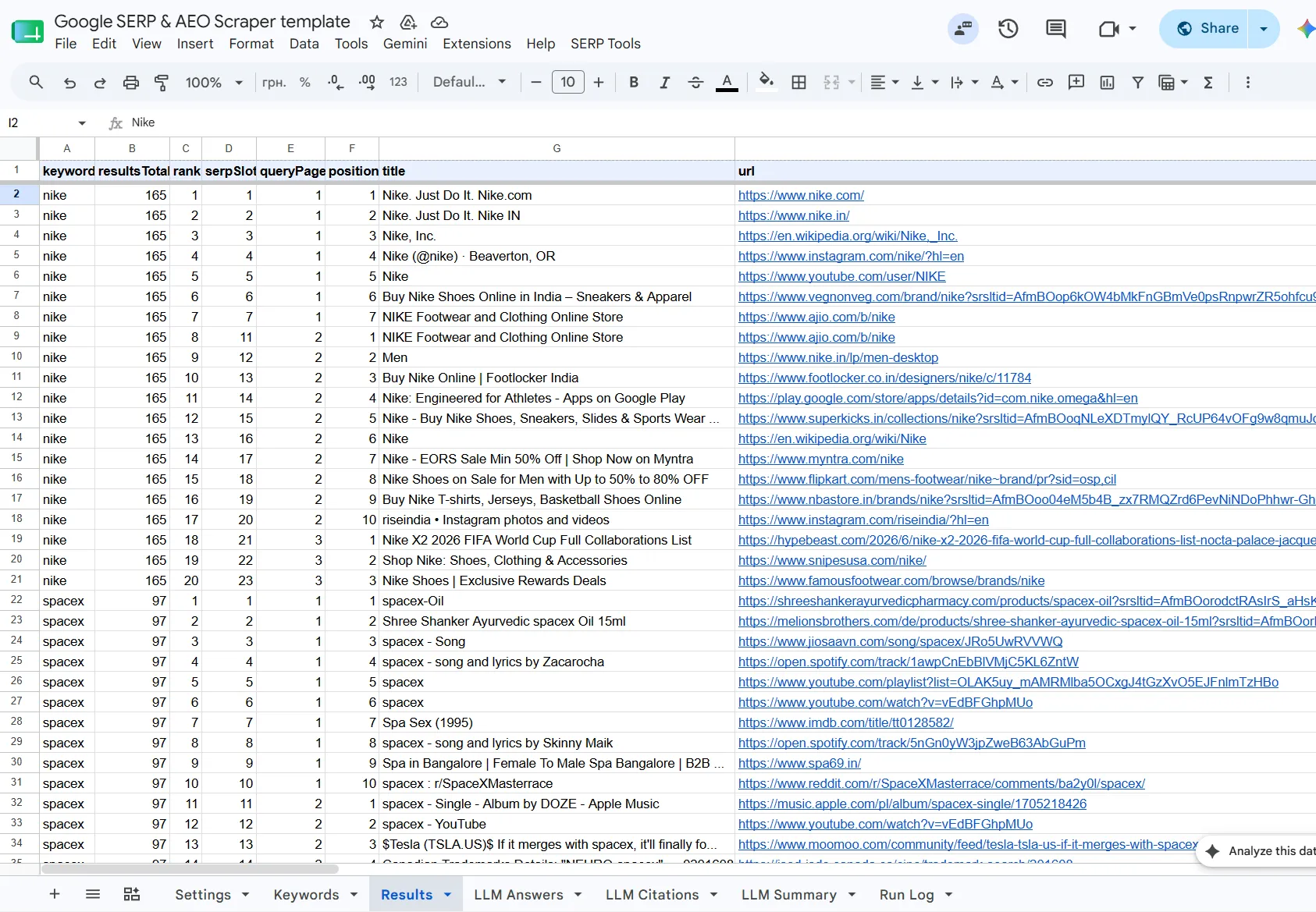
Results — flat SERP rows (rank, URL, resultsTotal, LLM citation flags):
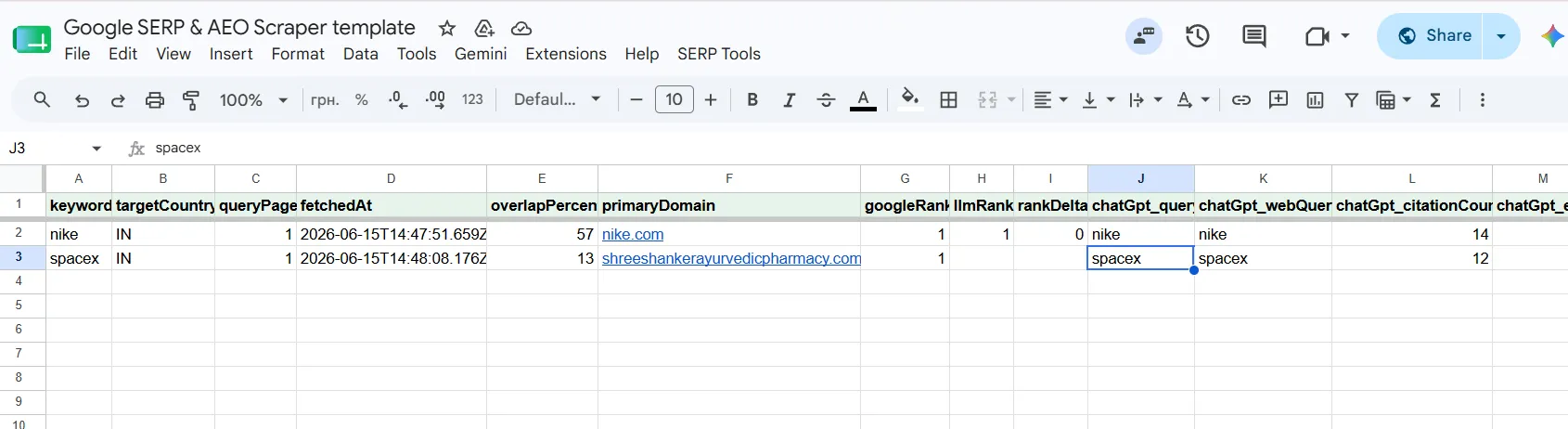
LLM Summary — visibility overlap and ranks per keyword:
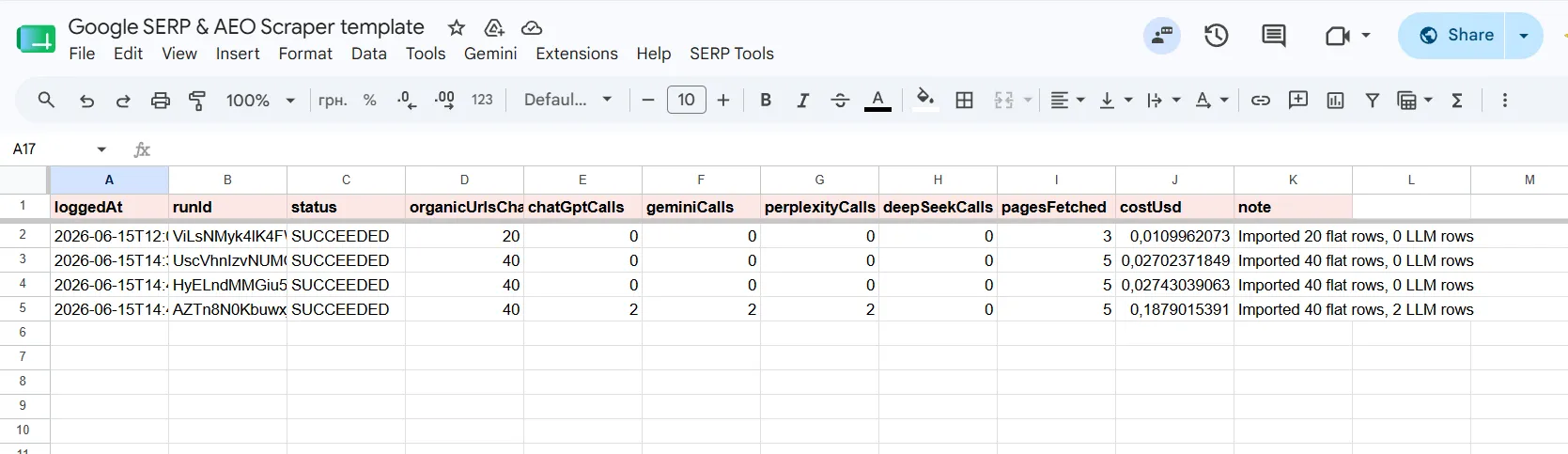
Run Log — organic counts, LLM calls, and costUsd per run:
Features
- Google SERP via Apify GOOGLE_SERP proxy + CheerioCrawler
- Search operators:
site:,related:,intitle:, date filters, file types, exact match - Country / language / UULE geo targeting (
countryCode→google.{tld}+ GOOGLE_SERP proxy country, with fallback to global SERP pool) - Pagination:
maxResultsPerQuery(per keyword),maxTotalResults(whole-run cap), ormaxPagesPerQuery(fixed pages). See Limit priority below. - Output formats: page (Apify-compatible), flat (Sheets/Zapier), both
- Paid ads + shopping ads parsing, PAA, related queries, AI Overview
- Optional LLM add-ons (API): ChatGPT, Gemini, Perplexity, DeepSeek, Copilot
- Google Sheets — template + Apps Script (workflow)
Input example
Single keyword, top-20:
Multiple keywords (one dataset, filter by keyword):
→ up to 60 organic rows (20 × 3 keywords). Leave maxTotalResults unset for full per-keyword depth.
Limit priority
When several limits are set, they apply in this order:
| Priority | Setting | Scope |
|---|---|---|
| 1 | maxTotalResults | Hard cap on all keywords combined. When set, keywords run one by one; the first keyword(s) consume the budget. |
| 2 | maxResultsPerQuery | Target top-N per keyword (may be cut short if global cap runs out). |
| 3 | maxPagesPerQuery | Used only when maxResultsPerQuery is not set. |
| — | Empty SERP page (organicOnCurrentPage === 0) | No more rows — stop even if start= could advance. |
| — | Missing Google "Next" link | Not a stop when maxResultsPerQuery is set — actor continues via start= until target or empty page. |
Example — 2 keywords, maxResultsPerQuery: 20, maxTotalResults: 34:
To get 20 + 20 = 40 rows, either omit maxTotalResults or set it ≥ 40 (e.g. queries.length × maxResultsPerQuery).
The run ends with usage_summary.billing.organicByKeyword so you can see per-keyword counts vs limits.
Cap total billing with maxTotalResults (optional):
→ 20 rows total (first keyword(s) until cap), not 200.
Legacy API: queries may also be a newline-separated string.
Output
Page record — one row per SERP page with organicResults[], paidResults[], etc.
Flat record (recordType: flat) — one row per SERP result:
keyword, resultsTotal (Google estimate, e.g. About 1,230,000,000 results — same on all rows for that keyword), rank, serpSlot, queryPage, position, title, url, type, isPaid, targetCountry, llm*Cited, llm*UrlRank, …
| keyword | rank | serpSlot | queryPage | position | title | url | isPaid |
|---|
LLM record (recordType: llm) — one row per keyword/page when AI add-ons are enabled and outputFormat is flat. Contains chatGptSearchResult, geminiSearchResult, visibilityCompare, etc. Use dataset view LLM answers or ?view=llm_results.
With outputFormat: page or both, LLM fields live on the page record instead.
resultsTotal— Google’s estimated match count from the SERP header (About X results). Parsed from page 1 and copied to all flat rows for that keyword. Approximate — not the same as rows you scrape.rank— sequential 1…N for analytics (top-20, charts). No gaps.serpSlot— estimated Google slot(page−1)×10+position; may skip numbers when a page has <10 organic results.queryPage+position— where on the SERP page the result appeared.
API export (no flat rows needed):
Local development
Pay-per-event billing
Pricing model: Pay per event (active from June 15, 2026). Dataset rows are free — apify-default-dataset-item = $0.
Apify displays prices per 1,000 events in the Console. Below are the published rates from Monetization settings.
Platform usage: User pays platform usage costs (proxy, compute, memory) on top of PPE events. usageTotalUsd in Run Log includes both.
Competitive context
| Actor / tier | Unit | Effective $ / 1,000 URLs* |
|---|---|---|
| apify/google-search-scraper | $2.50 / 1,000 pages | ~$0.25 (≈10 organic/page) |
| Budget scrapers on Store | per URL | ~$0.05–0.15 |
| This Actor (organic, base tier) | per delivered URL | $0.40 |
| This Actor (Bronze Apify plan) | per delivered URL | $0.30 |
*Example: 50 keywords × top-20 = 1,000 URLs → Apify scraper ≈ $0.25 SERP; us $0.40 (base) or $0.30 (Bronze) + platform usage.
| Model | Apify official scraper | This Actor |
|---|---|---|
| SERP unit | Per page fetched | Per organic URL delivered |
| Sparse page (6 results) | Full page price | Only rows you get |
| Output | SERP JSON | Flat rows + optional LLM citations + visibility compare |
Organic pricing uses Apify plan tier discounts (Bronze / Silver / Gold). LLM add-ons are flat per provider.
Event prices (Console)
| Event | Price / 1,000 | Per unit | Notes |
|---|---|---|---|
organic-result-scraped | $0.40 (base) | $0.0004 / URL | Tiered — see below |
| ↳ Bronze discount | $0.30 | $0.0003 / URL | Apify Bronze plan |
| ↳ Silver discount | $0.28 | $0.00028 / URL | Apify Silver plan |
| ↳ Gold discount | $0.26 | $0.00026 / URL | Apify Gold plan |
chatgpt-search-scraped | $25.00 | $0.025 / call | Successful web search only |
gemini-search-scraped | $25.00 | $0.025 / call | |
perplexity-search-scraped | $30.00 | $0.03 / call | |
copilot-search-scraped | $25.00 | $0.025 / call | |
deepseek-search-scraped | $20.00 | $0.02 / call | Experimental — chat only, no web citations |
ads-scraped | $0.25 | $0.00025 / ad | Only when focusOnPaidAds: true |
apify-actor-start | — | $0.0005 / run | Actor start event |
Failed LLM calls (missing API key, API error) are not charged.
LLM add-ons require a paid Apify plan (free-tier runs ignore LLM flags and scrape Google SERP only).
Pricing examples
PPE only (base organic tier). Add platform usage on top — see usageTotalUsd in Run Log.
Bulk SEO — 50 keywords, top-20 organic, SERP only (1,000 flat rows)
1 keyword, top-20 organic, ChatGPT + Gemini + Perplexity + DeepSeek (~3 SERP pages fetched)
Light — 1 keyword, top-10 organic, ChatGPT only
Typical — 2 keywords, top-10 organic, ChatGPT
SEO batch — 5 keywords, top-20 organic, ChatGPT
Formula (PPE only, base organic tier):
Margin notes (for Actor owner)
| Item | ~API cost | PPE price (base) | ~margin |
|---|---|---|---|
| Organic URL | proxy/compute (platform → user) | $0.0004 | PPE margin; platform passed through |
| ChatGPT / Gemini / Copilot | ~$0.01/call | $0.025 | ~150% |
| Perplexity | ~$0.01/call | $0.03 | ~200% |
| DeepSeek | ~$0.01/call | $0.02 | ~100% |
| Dataset rows | — | $0 | Sheets workflow |
usageTotalUsd in Run Log (Sheets) and Apify Console is the source of truth for what the user paid (PPE + platform). API dashboards track your LLM COGS separately.
Google SERP — per organic URL
| Event | When | Count |
|---|---|---|
organic-result-scraped | Each organic result row saved | 1 per URL |
You pay for delivered organic URLs, not for SERP pages fetched. Capped by maxResultsPerQuery and maxTotalResults.
Estimate:
Paid ads (optional)
| Event | When |
|---|---|
ads-scraped | Each paid ad row when focusOnPaidAds: true |
LLM add-ons — per API call
| Event | When | Count |
|---|---|---|
chatgpt-search-scraped | Successful ChatGPT web search | 1 per keyword (perQuery) or per SERP page (perPage) |
gemini-search-scraped | Successful Gemini call (with citations) | same |
perplexity-search-scraped | Successful Perplexity call | same |
deepseek-search-scraped | Successful DeepSeek chat completion | same — experimental |
copilot-search-scraped | Successful Copilot call | same |
ai-mode-result-scraped | AI Mode add-on | not implemented — do not charge |
LLM billing is per request, not per citation. Failed calls are not charged.
Estimate:
Run audit row
The dataset ends with recordType: usage_summary:
pagesFetched is informational only — not used for client billing.
LLM secrets (Actor environment variables)
| Variable | Provider |
|---|---|
OPENAI_API_KEY | ChatGPT (Responses API + web_search) |
GEMINI_API_KEY | Gemini |
PERPLEXITY_API_KEY | Perplexity |
DEEPSEEK_API_KEY | DeepSeek |
AZURE_OPENAI_* | Copilot |
ChatGPT uses OpenAI Responses API with the hosted web_search tool. Gemini uses google_search grounding on the Generative Language API (gemini-2.5-flash by default). Set OPENAI_MODEL / GEMINI_MODEL in Actor secrets.
DeepSeek (experimental): plain chat completion only — lowest API token cost, but no web search or citation URLs yet. Useful for testing narrative/brand mentions; not recommended for AEO rank tracking until a search API is added. Priced at $0.02/call ($20 / 1,000) in Console.
LLM input options
| Field | Default | Purpose |
|---|---|---|
llmQueryMode | sameAsKeyword | Send exact Google keyword to LLM web search |
llmApplyTo | brandLike | Skip commercial/long-tail keywords for LLM |
llmSearchScope | perQuery | One LLM call per keyword (page 1) |
visibilityCompare.rankedComparison maps googleRank vs llmRank per URL. rankedComparisonByDomain uses the best rank per domain (handles different paths and utm_* params). targetDomainRanks defaults to Google #1 domain when targetDomains is not set.
Each LLM result includes usage (inputTokens, outputTokens, totalTokens, optional webSearchCalls) and model for your internal margin tracking. See usage_summary.billing for PPE totals per run.
Clients do not pass API keys in input — LLM API cost is included in LLM PPE events.
Google Sheets (more detail)
The Google Sheets workflow section at the top covers copy-template setup. Additional notes:
- Apify token is stored in Script Properties, not in cells — sent only to
api.apify.com. - Results / LLM sheets refresh each run; Run Log is append-only history with
costUsd(usageTotalUsdfrom Apify).
| Sheet | Contents |
|---|---|
| Results | Flat organic SERP + LLM citation columns per URL |
| LLM Summary | Visibility KPIs + citation counts per provider |
| LLM Answers | Full LLM answer text (one row per keyword × provider) |
| LLM Citations | Parsed citations (rank, url, title) |
| Run Log | Organic counts, LLM calls, costUsd per run |
Install from scratch: integrations/google-sheets/README.md.
Disclaimer
Use responsibly. Comply with Google Terms of Service and applicable laws.