AI Dealflow Analysis: investment memo in minutes
Pricing
$12,000.00 / 1,000 analysis completes
AI Dealflow Analysis: investment memo in minutes
Upload a pitch deck and get a full investment memo in minutes: unit economics, valuation, market sizing, competition, team verification and red flags. Every claim is cross-checked against live web sources, and the report comes back structured for your investment committee. By MrBridge

🎯 AI Dealflow Analysis
AI Dealflow Analysis is an AI agent that processes a startup pitch deck (PDF, PPTX, DOCX, XLSX) and produces a complete investment memo with cross-checked financials, market sizing, competition, team verification, and red flags. A seven-agent reasoning pipeline (Analyst, CFO, CRO, Investigator, Challenger, Writer, Director) replicates the work of a junior IC team in 15 to 30 minutes per deal.
- 🔍 Extracts entities, financials, traction, team, and claims from the deck
- 🧠 Cross-checks every claim against public web sources (Google, company sites, LinkedIn, Crunchbase, press)
- 💲 Audits unit economics, valuation, TAM/SAM/SOM, competitive landscape, and pricing
- 🎯 Returns a publishable Markdown / DOCX memo plus a structured JSON for deal screening
Features
Each stage of the pipeline hands a concrete deliverable to the next one, and you get the end products of the run:
- 📄 Document extraction: text, tables, and figures from PDF, PPTX, DOCX, and XLSX files, turned into structured input
- 🗂️ Analyst fact sheet: a strict JSON of named entities (company, founders, investors), financials (MRR, ARR, burn, runway, valuation), traction metrics, and pricing model
- 💰 CFO audit: unit economics (CAC, LTV, LTV/CAC, payback), valuation, bear / base / bull projections, burn, and runway
- 🌍 CRO audit: TAM / SAM / SOM critique, competitive landscape, go-to-market, and product-market fit signals
- 🔎 Research plan and web evidence: fact-check, competitor, and founder queries, then 90+ searches and 30+ scraped pages (LinkedIn profiles when you provide cookies)
- ⚖️ Challenger report: every deck claim rated confirmed, exaggerated, false, or unverifiable, plus suspicious metrics against sector benchmarks and omitted competitors
- 📝 11-section investment memo: written by a "Senior Partner" persona, with source citations from a shared source registry
- 🧭 Director review: a quality gate that can send earlier stages back for rework (up to 2 iterations), then polishes the final memo
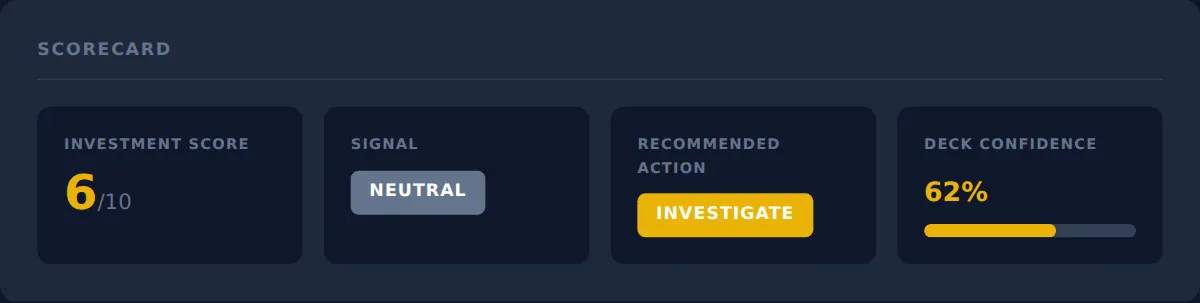
- 📊 Scoring: investment score, signal, recommended action, deck confidence, and (with a fund mandate) deal quality and fund fit
- 📦 Delivery: Markdown and DOCX memo, single-page HTML executive report, one structured dataset item per deal, and a live status page while the run is in progress
What does AI Dealflow Analysis do?
AI Dealflow Analysis ingests a pitch deck (and optionally a financial model, LOI, term sheet, founder notes, or extra URLs) and runs a multi-stage agent pipeline that produces an IC-ready investment memo. The output covers:
- 💰 Unit economics: CAC, LTV, LTV/CAC ratio, payback period, gross margin
- 📈 Revenue quality: MRR/ARR coherence, growth rate validation, net revenue retention
- 🔮 Projections: bear / base / bull scenarios with assumption critique and sector benchmarks
- 🔥 Burn & runway: current burn rate, months of runway, capital efficiency
- 💎 Valuation analysis: revenue multiples, comparable transactions, dilution impact
- 🌍 Market sizing: TAM / SAM / SOM with methodology critique
- 🥊 Competitive landscape: including competitors not mentioned in the deck
- 🛒 Go-to-market: channels, sales cycle, scalability
- 🧲 Product-market fit signals: retention, expansion, customer evidence
- 🔎 Claims verification: each deck claim rated confirmed / exaggerated / false / unverifiable
- 👥 Founder due diligence: LinkedIn verification, background check, career coherence
- 🚩 Red flags: flagged with severity, evidence, and resolution path
How it works
AI Dealflow Analysis runs a seven-agent pipeline. The financial and commercial audits run in parallel. The quality review can send earlier stages back for rework (up to 2 iterations) before finalizing.
Stage 1: Extraction
PDF and PPTX go through Claude Vision (native multimodal). DOCX uses mammoth, XLSX uses xlsx. Text, tables, and figures are preserved as structured input for downstream agents.
Stage 2: Analyst
Extracts named entities (company, founders, investors), financials (MRR, ARR, burn, runway, valuation), traction metrics, and pricing model. Output is a strict JSON schema consumed by every downstream agent.
Stage 3: CFO + CRO (parallel, Promise.allSettled)
The CFO audits unit economics, valuation, projections, and burn. The CRO audits market sizing, competition, GTM, and product-market fit. If one fails on a transient API issue, the successful one is checkpointed so the resume only re-runs the failed agent.
Stage 4: Investigator
Plans the web research: fact-check queries (CFO/CRO red flags), competitor queries (gaps in the deck), founder queries (LinkedIn targets). Output is a structured research plan.
Stage 5: Web research
Executes Google searches (search API with an Apify fallback) and scrapes 30+ URLs (a chain of managed scraping providers with an Apify fallback). LinkedIn profiles are pulled when cookies are provided.
Stage 6: Challenger
Cross-references every claim in the deck against the web evidence. Rates each claim and identifies inconsistencies, suspicious metrics, and omitted competitors.
Stage 7: Writer
Synthesizes everything into an 11-section investment memo (Markdown), with full source citations from a shared SourceRegistry. The Writer is a "Senior Partner" persona.
Stage 8: Director (3 phases)
The Director (Opus 4.7 with extended thinking) reviews the memo, requests rework if needed, polishes the final version, and extracts the structured JSON summary for the dataset.
Partial failures don't block the final output. Successful stages produce a usable artifact, and missing stages are flagged with null fields.
Sample output
Each run produces three artifacts. The structured JSON pushed to the dataset:
The full memo (Markdown + DOCX) is stored separately in the key-value store. See Output below for the exact record keys.
How much will AI Dealflow Analysis cost you?
AI Dealflow Analysis uses a pay-per-event pricing model with two layers of cost. You're charged only on successful events (failed or aborted runs cost $0 on Layer 1).
Layer 1: Agent PPE event
| Event | When charged | Price |
|---|---|---|
analysis-complete | Per successful analysis (memo + dataset + DOCX delivered) | $12.00 |
See the Pricing tab for the full per-tier table by Apify subscription (Free, Starter, Scale, Business).
💡 Cost predictability:
analysis-completecharges only on success. Empty input, validation failure, Anthropic API outage, or any pipeline error bills $0 on Layer 1. You may still incur small Layer 2 costs (see below) if the run reaches the web-research stage before failing.
💡 Spending limit: set
ACTOR_MAX_TOTAL_CHARGE_USDper run in the Apify Console to cap your maximum spend. The Actor exits gracefully if the limit is below $12.
Layer 2: Optional Apify sub-Actor pass-through
When the primary web-research providers fail or are not configured, AI Dealflow Analysis falls back to public Apify Actors that bill directly to your Apify account:
- apify/google-search-scraper: fallback for Google searches. Bills against searches run.
- apify/website-content-crawler: fallback for website scraping. Bills against pages crawled.
- curious_coder/linkedin-profile-scraper: invoked only if you provide
LINKEDIN_COOKIES. Bills per profile scraped.
Layer 2 cost is typically $0 when all the external scraping providers are healthy. Worst case (all of them failing on the same run with 30 URLs): ≈ $0.10–$0.40 in Apify CU.
For programmatic spending caps, see Apify usage limits.
When to use / not to use AI Dealflow Analysis
✅ Good fit when…
- You're a VC partner, analyst, or family-office associate reviewing 5+ decks per week
- You need a defensible written memo (not just a chat output) ready to share with your IC
- You want web-verified claims, not just LLM summarization of what the deck says
- You're triaging early-stage deals (pre-seed, seed, Series A) where standardized analysis saves hours
- You want a Fund Fit Score against your written mandate (Deal Quality + Fund Fit dual scoring)
❌ Not the right tool if…
- You need real-time market data fresher than 5 minutes: the agent uses web search results that may be hours/days stale
- You have fewer than 2 decks per month, because manual analysis is cheaper at very low volume
- The deck is in a highly specialized vertical with limited public web coverage (frontier biotech, hard-tech with classified IP), where claims-verification quality degrades when web evidence is sparse
- You need legal, tax, or regulatory advice on the deal: this is investment-analysis informational only
- You need to keep the analysis fully on-premises (this Actor sends the deck to Anthropic for LLM processing)
For real-time market data, consider pairing with a search-API-based or Crunchbase-based Actor. For on-premises analysis, run the open-source equivalent yourself.
How to use AI Dealflow Analysis
- Open the Actor on the Apify Store and click Try for free (you need an Apify account).
- In the Input tab, upload your pitch deck and any extra files (financial model, data room extract), or paste founder notes in Additional context.
- Optional: add up to 10 company URLs, paste your Fund mandate to unlock Fund Fit scoring, and pick the Memo language.
- Click Start and let the run finish. A full analysis takes 15 to 30 minutes, and you can follow it on the live status page.
- Open the Output tab for the executive report and the memo links, or read the dataset row for the scores and the verdict.
To run it on a schedule or from your own code, see Apify schedules and the API integration section below.
⬇️ Input
| Field | Type | Description |
|---|---|---|
| Files to analyze | File upload | Pitch deck, financial model, data room extract (PDF, PPTX, DOCX, XLSX). Recommended ≤ 50 MB total. |
| Additional context | Text | Founder emails, meeting notes, reference calls, internal notes |
| Additional URLs | URL list | Company website, Crunchbase, press articles (max 10). Web research also runs automatically. |
| Fund mandate | Text | Your fund's investment criteria. Unlocks dual scoring: deal quality + fund fit. |
| Memo language | Select | Output language. Default: English. Input documents can be in any language. |
At least one file or text context is required to start the analysis. See the Input tab for the full schema.
Input example
💡 Input quality matters. A complete pitch deck + financial model produces sharper analysis than a deck alone. Adding the fund mandate unlocks Fund Fit scoring.
⬆️ Output
AI Dealflow Analysis produces four output surfaces.
🧠 Main output: the investment memo
The full memo is delivered as a Markdown artifact in the Apify key-value store, under the record key:
A Word (.docx) version is generated in parallel for IC distribution:
Access via the Apify API:
The memo has 11 sections: Executive Summary, Company Overview, Founding Team, Product, Market, Competition, Go-to-market, Financials & Unit Economics, Valuation, Red Flags & Due Diligence Questions, Managing Partner View.
📊 Executive HTML report
A single-page HTML executive summary is stored as report.html (linked from the Output tab in the Console). Optimized for sharing with internal stakeholders who don't want to read the full memo.
🗂️ Structured dataset
One item per analysis is pushed to the dataset with the structured JSON shown in Sample output. See .actor/dataset_schema.json for the full schema with field types and constraints.
📁 Accessing raw data
Three surfaces let you audit and post-process the analysis:
- Dataset tab: structured scores, signals, risks, strengths (one row per analyzed deal). Filterable and sortable in the Console.
- Key-value store: full memo (Markdown + DOCX), executive HTML report, and a
live-status.htmlfor in-progress runs. - Run log: per-agent timing, token usage (including cached tokens), web research counters, and any rework iterations.
For programmatic post-processing, query the dataset via the Apify API:
Integrate into your workflow
API integration
Call AI Dealflow Analysis programmatically using the Apify API.
Node.js:
Python:
No-code integrations
| Platform | What it does | Setup |
|---|---|---|
| Zapier | Trigger analysis on new deal → send memo to Slack / email | Apify Zapier connector |
| Make | Automate deal pipeline: receive deck → analyze → notify team | Apify Make module |
| n8n | Self-hosted deal flow automation | Apify n8n node |
| Google Sheets | Export deal scores and signals to a spreadsheet | Integrations tab |
Webhooks
- Go to the Actor's Integrations tab in the Apify Console
- Select event: Run succeeded
- Enter your endpoint URL
- Receive the memo URL, investment score, and recommendation automatically
See the Apify docs on webhooks for the payload format.
Use it with AI agents and MCP clients
Every Apify Actor can be called as a tool by AI clients through the Apify MCP server. To expose this one, connect your client (Claude Desktop, ChatGPT, Cursor, or any MCP-compatible agent) to https://mcp.apify.com and add mrbridge/AI-dealflow-analysis to the tools parameter. The agent then passes the deck and the fund mandate as the Actor input and reads the memo link and scores from the result. See the Apify docs on the MCP integration for the client setup.
A full analysis takes 15 to 30 minutes, so start the run and fetch the dataset item once it has finished, rather than waiting on a single tool call.
Two MrBridge MCP servers fit the same workflow. Use the US company filings MCP server to check a US-listed comparable against its SEC filings, and the LEI search MCP server to confirm a legal entity and its parents and subsidiaries.
About this workflow
Built by MrBridge. See the Dealflow Analysis overview or all AI workflows. Once you've shortlisted deals, run them through the Pitch Deck Credibility Analyzer.
More investor tools
- pitch deck credibility analyzer: a credibility score for your pitch deck from six AI reviewers, with red flags and fixes.
- US company filings MCP server: 10-K, 10-Q and 8-K filings and reported figures over time, read from SEC EDGAR data.
- LEI search MCP server: legal entity identifiers by name or register number, parents and subsidiaries, ISIN and BIC lookups.
Frequently asked questions
What LLM does AI Dealflow Analysis use?
AI Dealflow Analysis uses Claude Sonnet 4.6 (claude-sonnet-4-6) for document extraction, structured data analysis, web research planning, and memo writing, and Claude Opus 4.7 (claude-opus-4-7) with adaptive extended thinking for judgment-heavy stages: financial audit (CFO), commercial audit (CRO), claims challenger, and final director review. Effort level is high for CFO/CRO/Challenger and xhigh for the Director Phase 1 review. System prompts are cached across rework iterations via Anthropic's prompt caching (cache_control: ephemeral). All Claude API costs are paid by the Actor maintainer and included in the $12 flat fee.
How accurate is the analysis?
The agent verifies every numerical claim in the deck against public web sources and rates each as confirmed, exaggerated, false, or unverifiable. Unverifiable claims are flagged, not invented. Founder LinkedIn data is cross-checked against the deck's narrative. That said, the analysis is informational, so always review the Top 3 red flags and the Director's verdict manually before any consequential decision.
Can the AI make mistakes?
Yes. LLMs hallucinate occasionally. AI Dealflow Analysis mitigates this with an anti-hallucination policy ("UNVERIFIABLE" / "INSUFFICIENT DATA" outputs are preferred over guessing), a dedicated Challenger agent whose only job is to stress-test claims, and a Director review that can trigger rework. For high-stakes deals, also run a manual due diligence call.
How does this compare to running ChatGPT or Claude on the same deck?
AI Dealflow Analysis differs from a one-shot chat prompt by: (1) orchestrating seven specialized agents with role-specific system prompts, (2) running 90+ web searches and scraping 30+ URLs to verify deck claims (Claude.ai and ChatGPT cannot scrape at scale), (3) producing a publishable Markdown + DOCX memo plus a structured JSON for portfolio screening, (4) running on Apify infrastructure with reproducible outputs, checkpoint recovery on container migration, and a complete audit trail of all sources cited.
What happens to my deck after the analysis?
The deck is processed in an ephemeral Apify container. Apify's default key-value store retention is 7 days (configurable). Document content is never logged, and only file metadata (name, size) appears in the run log. Your fund mandate and deal materials are not used to train any AI model. Anthropic processes the deck content per their data handling policy (no training on API customer data).
Is the analysis deterministic?
No. Claude Sonnet 4.6 and Opus 4.7 use adaptive thinking, so re-running with the same input produces semantically equivalent but lexically different memos. Investment scores typically vary by ±1 point across runs. Web research results also vary because Google's ranking changes over time.
Can I use AI Dealflow Analysis via MCP?
Yes. The Actor can be accessed by AI clients (Claude Desktop, ChatGPT, Cursor) through the Apify MCP server. Connect to mcp.apify.com and add mrbridge/AI-dealflow-analysis to the tools parameter. See Use it with AI agents and MCP clients above.
How do I see my usage and costs?
Apify Console → Billing → Usage by Actor. Filter by mrbridge/AI-dealflow-analysis for per-run Layer 1 charges. Check sub-Actor entries for Layer 2 totals if any fallback Actors were invoked.
Can I customize the agent prompts?
Not currently. Memo language is configurable (11 options). Effort levels, model selection, and agent prompts are fixed. Contact the maintainer for custom variants.
Your feedback
We're always working on improving the performance of our Actors. So if you've got any technical feedback for AI Dealflow Analysis or simply found a bug, please create an issue on the Actor's Issues tab.
An honest review helps other users decide, and you can bookmark this Actor too. For bugs or other problems, use the Issues tab.
Legal & responsible use
AI Dealflow Analysis processes user-provided documents (pitch decks, financial models, data room extracts) using LLMs and verifies claims against public web sources. You are responsible for ensuring your use complies with the source documents' confidentiality terms, your fiduciary obligations, and any applicable data-protection regulation (GDPR in the EU, CCPA in California, similar elsewhere).
Data handling:
- Input retention: documents are processed in an ephemeral Apify container. Key-value store retention follows Apify's default policy (7 days for unnamed storages, configurable in the Console).
- LLM provider: Anthropic processes deck content for model inference. See Anthropic's privacy and data handling policy.
- No training: Your input data is not used to train any AI model.
- No third-party sharing: AI Dealflow Analysis does not share your data with parties beyond the LLM provider and the public web-research providers it relies on (the fallback Actors are listed under "How much will AI Dealflow Analysis cost you?").
- Web research: the Investigator queries public sources (Google search, company websites, LinkedIn public profiles, Crunchbase public pages) using your fund's reputation, not the founder's name in a way that triggers privacy concerns.
The output is informational and should be reviewed by a qualified investment professional before any consequential decision (investment, term sheet issuance, IC vote). LLM outputs can contain factual errors, biased reasoning, or out-of-date market data. The Actor is not a substitute for legal, tax, or regulatory advice.