

Job Posting Requirement Decoder
Pricing
from $180.00 / 1,000 requirement comparison report returneds
Job Posting Requirement Decoder
Compares real job postings for the same role across multiple companies and shows which requirements are genuinely common versus inflated listing fluff, with a plain-language breakdown of what actually matters.


What does Job Posting Requirement Decoder do?
Job Posting Requirement Decoder compares real, currently open job postings for the same role across several companies and separates the requirements that show up everywhere from the ones that only appear once. You give it a role title (for example "Senior Backend Engineer") and a short list of companies; it finds each company's matching postings, reads the full requirement text, and returns a per-company breakdown plus one cross-company comparison: which requirements are probably real (they appear in most or all postings), which are probably inflated listing fluff (a single posting, an unusually high years-of-experience ask), a normalized requirement list, and a plain-language summary of what actually matters for that role.
It is built for job seekers deciding what to actually study or highlight, and for recruiters and hiring managers benchmarking a job description against the real market.
Why use Job Posting Requirement Decoder?
- Signal, not just postings - other tools give you a pile of job ads; this one tells you which lines in them are real requirements and which are filler.
- Evidence per requirement - every requirement lists exactly which companies asked for it.
- Cross-company comparison - one run compares every company at once instead of forcing you to read each posting yourself.
- Clean, structured output - a comparison report with consistent field names, ready for a spreadsheet or a study plan.
- Simple input - a role title and a short company list; the Actor finds and reads the matching postings.
- Automatable - schedule a recurring run over your target companies and watch how the requirement bar shifts.
What makes this different
Job-board scrapers stop at the raw listing. This Actor adds the comparison layer a candidate or hiring manager actually needs: it reads the full requirement text of every matching posting, classifies each distinct requirement as core, common, or fluff based on how many companies actually ask for it, and writes a plain-language "what actually matters" summary grounded only in the postings it read. The comparison uses a no-cost default model, so the per-run cost stays low.
How it works

- Your input - a role title and a list of companies, each with its public job-board identifier.
- The Actor collects it - it finds each company's postings matching the role, reads the full requirement text of each, then compares every matched posting across companies.
- Your output - one comparison report: the matched postings per company, a requirement-frequency breakdown, a normalized "what's real" list, the probable fluff, and a summary. Export to JSON, CSV, or Excel, or read it from the API.
What data can you extract?
| Field | Description |
|---|---|
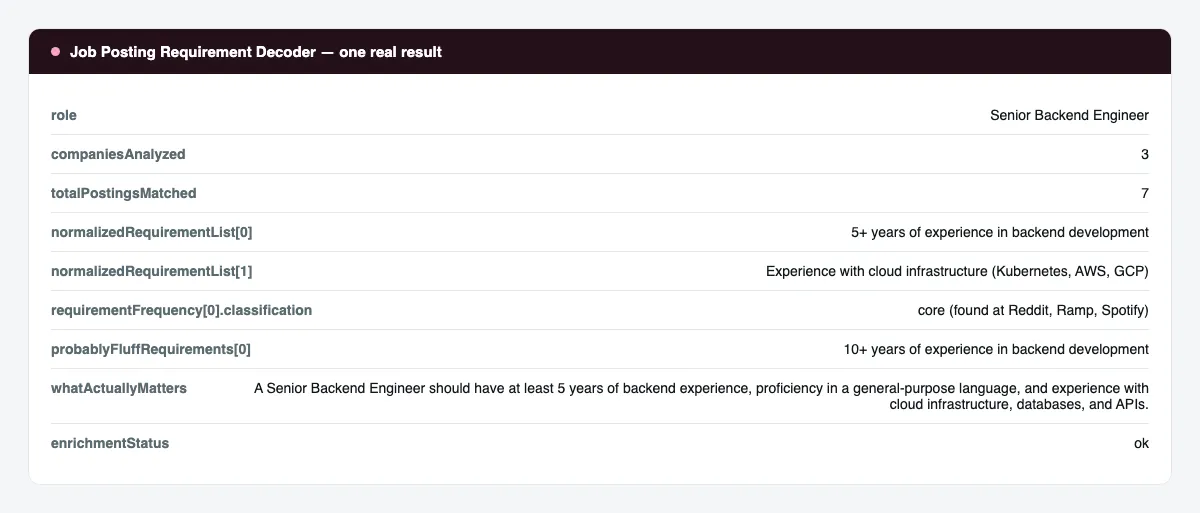
role | The role title that was decoded. |
companiesAnalyzed | Number of companies given as input. |
companiesWithMatches | Number of companies that had at least one posting matching the role. |
totalPostingsMatched | Total matching postings read and compared across every company. |
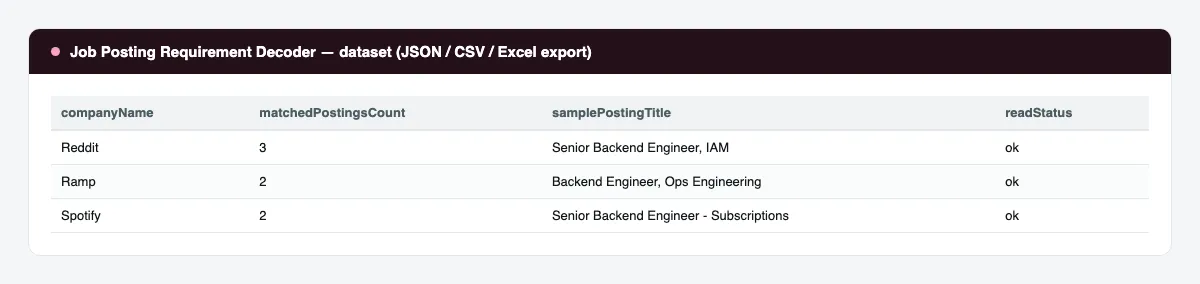
companies | Per-company breakdown: companyName, ats, totalOpenRoles, matchedPostingsCount, and postings (each with title, location, department, url, postedAt, textExcerpt, requirementLines). |
requirementFrequency | Every distinct requirement found, with companiesCount, companies, and a classification of core, common, or fluff. |
normalizedRequirementList | A deduplicated, plain-language list of the requirements that actually matter, most common first. |
probablyRealRequirements | The requirements the comparison judged most likely to be real, load-bearing asks. |
probablyFluffRequirements | The requirements that look like inflated filler - present in only one posting or unusually high. |
whatActuallyMatters | A short plain-language summary of the real bar for this role. |
enrichmentConfidence | The comparison's own confidence: high, medium, or low. |
enrichmentStatus | Whether the comparison was produced, and if not, why. |
scrapedAt | ISO timestamp of the run. |
How to use Job Posting Requirement Decoder
- Open the Actor in the Apify Console.
- In Role to decode, enter the job title to compare, for example "Senior Backend Engineer".
- In Companies, list each company with its name, its public job-board identifier, and its board type.
- Set Max postings per company if you want more or fewer postings read per company.
- Press Start.
- When the run finishes, open the Dataset tab and export to CSV, JSON, or Excel, or connect it to your workflow.
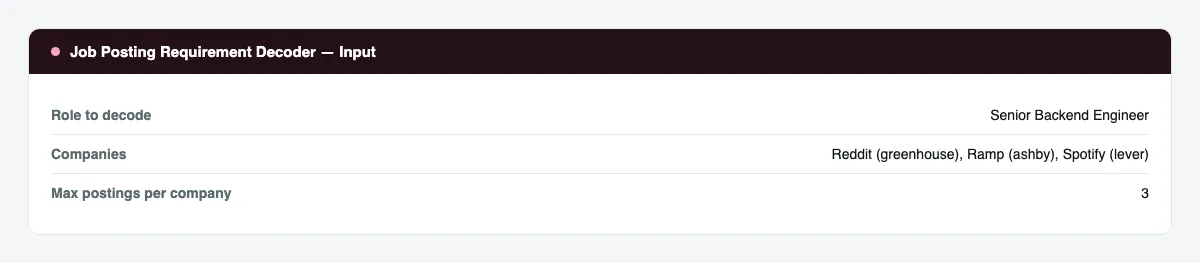
Input Parameters
| Parameter | Type | Required | Default | Description |
|---|---|---|---|---|
role | string | Yes | "Senior Backend Engineer" | The job title to compare across companies. |
companies | array | Yes | 3 example companies | One entry per company: name, atsSlug (its job-board identifier), and ats (greenhouse, lever, or ashby). |
maxPostingsPerCompany | integer | No | 3 | Cap on matching postings read in full per company. Range 1-10. |
useCache | boolean | No | false | Reuse previously collected postings for the same role and company to speed up recurring runs. |
openRouterApiKey | string (secret) | No | - | Optional key for the comparison service. Without it, matched postings are still returned and the comparison fields are empty. |
proxyConfiguration | object | Yes | Apify Proxy | Proxy settings. A proxy is required; the default uses Apify Proxy. |
Output Data
One dataset item per run - the full comparison. Real sample record:
Usage Examples
- Study plan for a job search - decode the role you're targeting across 4-6 real employers, then focus prep on
normalizedRequirementListinstead of every line in one posting. - Sanity-check a draft job description - run your own company alongside 2-3 competitors for the same role and see whether your requirements line up with
probablyRealRequirementsor read likeprobablyFluffRequirements. - Compensation-band research support - use
requirementFrequencyto see which skills are genuinely in demand for a title before setting a leveling bar. - Recurring market check - schedule a monthly run over key employers and track how
whatActuallyMattersshifts as the market moves.
Tips for Best Results
- Compare 3 or more companies - a single posting has nothing to be compared against, so
requirementFrequencyand the fluff/core split need at least two, ideally three or more. - Use the exact working job-board identifier for each company (visible in its careers page URL) - a wrong
atsSlugreturns zero matched postings for that company. - Raise
maxPostingsPerCompanyfor a broad title (e.g. "Software Engineer") so the comparison sees more of that company's postings for the role. - Provide an analysis service API key for the comparison fields; the raw matched postings work without one.
Known Limitations
- Only companies publishing on a supported public job board can be read. Companies using a different or private system are not supported.
- A role title with no matching postings at a company is reported with zero matches for that company, not an error.
- Requirement classification is a judgment call based on the postings given - it is not a guarantee of what a company will actually enforce in an interview.
department,location, andpostedAtare null when the source does not provide them.- The comparison quality reflects the default no-cost model and can be terse when very few postings match.
Integrations
Connect the dataset to Google Sheets, Airtable, Make, Zapier, or n8n; call the Actor from the Apify API; trigger it with webhooks; or schedule recurring runs from the Apify Console.
Export Formats
JSON, CSV, Excel, and XML, from the Dataset tab or the Apify API.
Frequently Asked Questions
Do I need an account or login?
No. The Actor reads only publicly listed job postings and never logs in anywhere.
Which companies can it compare?
Any company that publishes its open roles on a supported public job board. You provide the company's job-board identifier and board type in the input.
How do I find a company's job-board identifier?
It's the segment of the company's careers-page URL after the board's domain - for example the "reddit" in a Reddit careers-board URL.
Why is a company reported with zero matched postings?
Either the company has no open posting whose title matches the role you asked for, or the job-board identifier is wrong. totalOpenRoles shows how many roles were found in total, so you can check the identifier resolved correctly.
What counts as a "fluff" requirement?
A requirement the comparison found in only one company's posting, or one that reads as an outlier (an unusually high years-of-experience ask, an oddly specific tool) relative to the rest of the postings compared.
Am I charged for failed results?
You are charged once per finished comparison report written to the dataset. A run that fails before a report is written is not charged.
How fresh is the data?
Postings are read live at run time, unless caching is enabled, in which case a repeat within the cache window reuses the earlier read. Re-run with caching off, or wait for the cache to expire, to force a fresh read.
Can it export to Google Sheets?
Yes. Connect the dataset to the Google Sheets integration or pull it from the API.
Does it handle duplicate companies?
Yes. Companies are deduplicated by board type and identifier; a duplicate entry is read once.
Support
Questions and bug reports: use the Issues tab on the Actor's Console page. Include the input you ran and the run ID.
Legal / Responsible Use
You are responsible for complying with the target job boards' terms of use, applicable law, and responsible data-use requirements. Job-posting text is generally not personal data, but where a posting includes named contact details you are responsible for meeting any applicable privacy and data-protection obligations (for example GDPR) for personal data you collect and store.


