

China A-Share Main-Force Fund Flow — 主力资金 API
Pricing
from $100.00 / 1,000 stock signals
China A-Share Main-Force Fund Flow — 主力资金 API
Track China A-share main-force capital flow, large net inflow and institutional participation. Clean JSON for analysts, quants and AI agents.
Pricing
from $100.00 / 1,000 stock signals
Rating
0.0
(0)
Developer
NexGenData
Maintained by CommunityActor stats
1
Bookmarked
9
Total users
0
Monthly active users
7 days ago
Last modified
Categories
Share
China A-Share Main-Force Fund Flow
Track China A-share main-force capital flow, large net inflow and institutional participation. Built for analysts, quants, fintech builders and AI agents.
Factual public data — not financial or investment advice.
📊 Sample Output
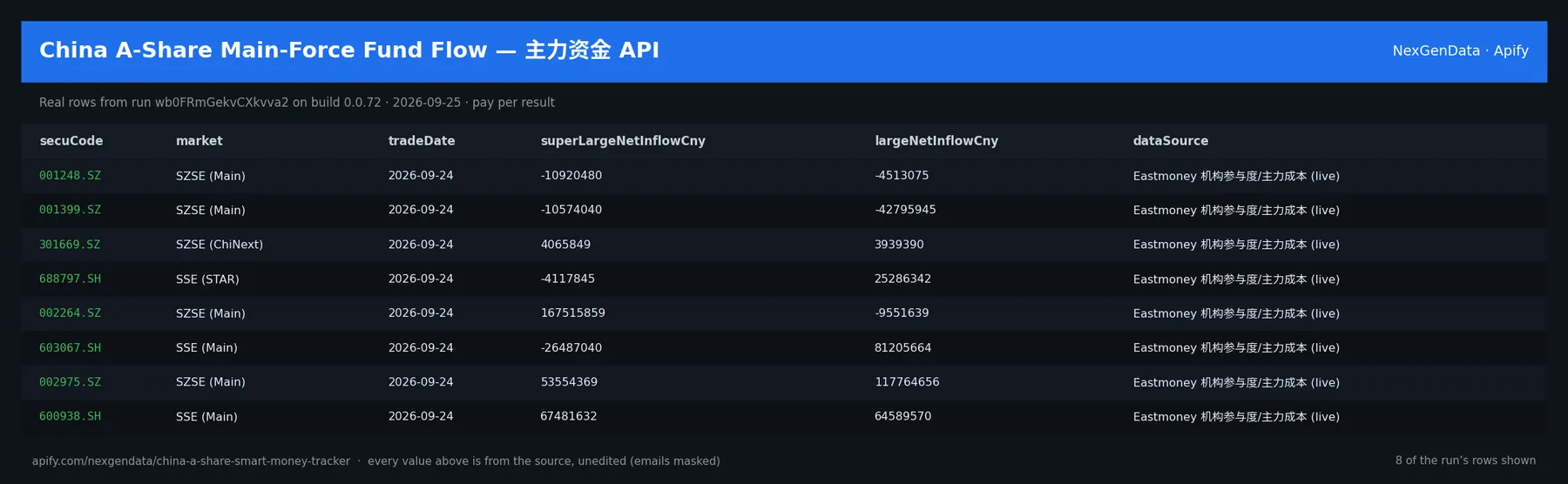
stockCode | secuCode | market | tradeDate | mainForceCost | mainForceCost20d |
|---|---|---|---|---|---|
| 001248 | 001248.SZ | SZSE (Main) | 2026-09-24 | 11.756 | 12.022 |
| 001399 | 001399.SZ | SZSE (Main) | 2026-09-24 | 23.176 | 22.343 |
| 301669 | 301669.SZ | SZSE (ChiNext) | 2026-09-24 | 26.411 | 26.267 |
| 688797 | 688797.SH | SSE (STAR) | 2026-09-24 | 279.396 | 281.615 |
| 002264 | 002264.SZ | SZSE (Main) | 2026-09-24 | 7.718 | 7.375 |
| 603067 | 603067.SH | SSE (Main) | 2026-09-24 | 41.172 | 37.153 |
Real rows from run wb0FRmGekvCXkvva2 on build 0.0.72 (2026-09-25), unedited apart from masked emails/phones and shortened long text; fields the source does not publish are empty.
🔧 Input reference
| Field | Type | Default | What it does |
|---|---|---|---|
sortBy | string (score, participation, attention, change, super_inflow) | "score" | Ranking metric (descending). |
minScore | integer | 0 | Only return stocks with an institutional score at least this high (e.g. 70 for heavy institutional interest). 0 = no filter. |
securityCodes | array | Restrict to specific 6-digit A-share codes (e.g. 600519, 300750). Empty = whole market. | |
includeNEEQ | boolean | false | Include lower-tier 新三板 companies. Off by default — A-shares only. |
maxResults | integer | 100 | Maximum stocks to return. |
🧾 JSON sample record
One real record from run wb0FRmGekvCXkvva2 (emails/phones masked, long text shortened):
💰 Pricing
| Event | Price (USD) | When it is charged |
|---|---|---|
Actor Start (apify-actor-start) | $5e-05 | Charged when the Actor starts running. Number of events charged depends on Actor memory (one event per GB, minimum one event). |
Stock signal (apify-default-dataset-item) | $0.1 | One A-share's institutional signals: score, participation, main-force cost vs price, net inflow. |
Pay-per-event: you pay only for what the run delivers. A run that delivers nothing bills no result events (only the actor-start event, when the actor defines one). Example: a run that delivers 100 results costs 100 × $0.1 = $10.00 plus the start fee.
🔗 Related Actors
More from the NexGenData China markets family:
- Beijing BSE Stock Screener — 北交所 A股 API
- China A-Share Financials — 财务数据 API
- China A-Share Institutional Holdings — 机构持股 API
- China A-Share Unlock Calendar — 限售解禁 API
- China Block Trades — 大宗交易 API
- China Dragon-Tiger List — 龙虎榜 API
18 more in this family on the NexGenData Store page.
📊 What you get
Clean JSON, one record per record (full output has 22 fields):
attentionScore— Attention ScorechangePct— Change Pctclose— CloseinstitutionalParticipationPct— Institutional Participation PctinstitutionalScore— Institutional ScorelargeNetInflowCny— Large Net Inflow CnymainForceCost— Main Force CostmainForceCost20d— Main Force Cost20dmainForceCost60d— Main Force Cost60dmarket— Market
Pricing: $0.10 per record (Pay-Per-Event) — about 10 records per $1.
🤖 Use with AI agents
Structured JSON built for LLM and agent pipelines — point Claude, the OpenAI Agents SDK, an n8n flow or any MCP-aware client at it and pull China A-share main-force capital flow and participation on demand.
Sample agent prompt:
Agentic payments (x402): Supports agentic payment via x402 — agents can call this actor with USDC, no API key required.
⏰ Run on a schedule
This is a monitoring play — schedule a recurring pull:
中文说明
本 Actor 提供中国 A 股主力资金流向数据(大单净流入、主力成本、机构参与度等),输出为整洁的 JSON,适用于分析师、量化研究人员、金融科技开发者和 AI 智能体。按「资金记录」计费(约每美元 10 条)。支持定时运行——可每日或每周自动抓取A 股主力资金流向排名,是一个持续监控型数据源。公开数据,非投资建议。
🔗 Related China actors
China data suite: Listed Company Announcements, Dragon-Tiger List, Stock Connect Flow, A-Share Financials
Cross-market hubs: APAC Disclosure Monitor, APAC IPO Calendar Sweep
*Data from public Chinese market and government sources. Factual public data — not financial or investment advice.
公开数据,非投资建议。*


