

Email DMARC Auditor — SPF/DKIM/DMARC Bulk Check
Pricing
from $50.00 / 1,000 domain audited for spf/dmarc/dkims
Email DMARC Auditor — SPF/DKIM/DMARC Bulk Check
Bulk email authentication audit. Parses SPF, DMARC, and DKIM records, returns deliverability score (0-100), and step-by-step remediation actions per domain.
Pricing
from $50.00 / 1,000 domain audited for spf/dmarc/dkims
Rating
0.0
(0)
Developer

NexGenData
Maintained by CommunityActor stats
0
Bookmarked
3
Total users
1
Monthly active users
8 days ago
Last modified
Categories
Share
📋 Email DMARC Auditor — SPF / DKIM / DMARC Bulk Check
Bulk email-authentication audit over public DNS. For each domain the actor reads
the SPF record, the DMARC record at _dmarc.<domain>, the MX records, and probes
a list of common DKIM selectors, then returns a deliverability score (0–100) and
a prioritised remediation list.
DNS lookups only. This actor does not connect to any mail server, does not send mail, and does not verify mailboxes. Nothing here is an SMTP check or an email-address verification.
📊 Sample Output
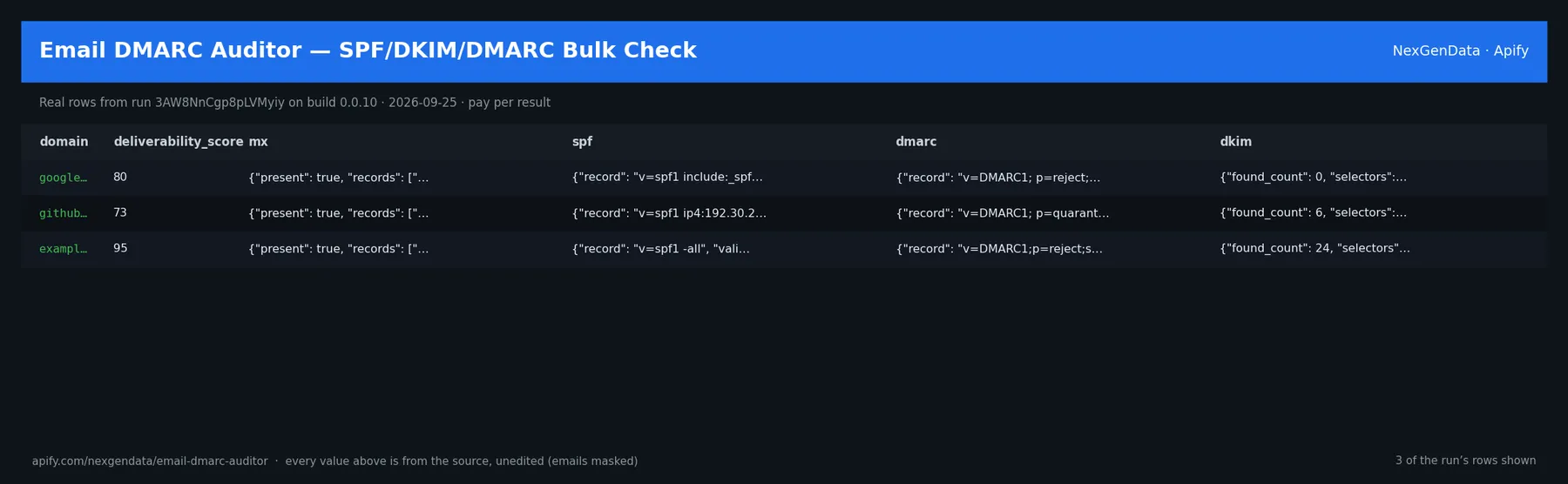
domain | deliverability_score | mx | spf | dmarc | dkim |
|---|---|---|---|---|---|
| google.com | 80 | {'present': True, 'records': ['smtp.google.com.']} | {'record': 'v=spf1 include:_spf.google.com ~all', 'valid': True, 'inc… | {'record': 'v=DMARC1; p=reject; rua=mailto:[email on record]', 'valid… | {'found_count': 0, 'selectors': [], 'selectors_probed': 24} |
| github.com | 73 | {'present': True, 'records': ['github-com.mail.protection.outlook.com… | {'record': 'v=spf1 ip4:192.30.252.0/22 include:spf.protection.outlook… | {'record': 'v=DMARC1; p=quarantine; sp=reject; pct=100; rua=mailto:[e… | {'found_count': 6, 'selectors': [{'selector': 'google', 'record': 'v=… |
| example.com | 95 | {'present': True, 'records': ['.']} | {'record': 'v=spf1 -all', 'valid': True, 'includes': [], 'ip_mechanis… | {'record': 'v=DMARC1;p=reject;sp=reject;adkim=s;aspf=s', 'valid': Tru… | {'found_count': 24, 'selectors': [{'selector': 'default', 'record': '… |
Real rows from run 3AW8NnCgp8pLVMyiy on build 0.0.10 (2026-09-25), unedited apart from masked emails/phones and shortened long text; fields the source does not publish are empty.
⚙️ Sample inputs
This is the Store example input — the same input Apify's automated check runs — so it is proven to return rows on the current build. Paste it into the input form, or send it through the API, CLI or a schedule:
🧾 JSON sample record
One real record from run 3AW8NnCgp8pLVMyiy (emails/phones masked, long text shortened):
🔗 Related Actors
More from the NexGenData Leads, contacts & enrichment family:
- Website Tech Stack Audit — Bulk BuiltWith Alternative API
- Website Contact Scraper — Emails & Phones from a URL List API
- Domain Security Posture Checker — DNS, SPF, DMARC, TLS
- Bulk Email Validator — Verify & Clean Lists API
- Google Maps Reviews Scraper — Local Review Monitoring API
- IP Geolocation — Bulk IP to Location & ISP
30 more in this family on the NexGenData Store page.
Pricing (live, as published on the Apify Store)
| Event | Price |
|---|---|
actor-start | $0.01 per run — startup cost for loading the DKIM selector list and DNS resolvers |
domain-audited | $0.05 per domain fully audited |
That is 20 domains per $1, plus one cent per run. You are charged for a domain only when its audit is actually delivered to your dataset:
- A domain whose DNS never answered (after retrying three resolvers over UDP, TCP and DNS-over-HTTPS) is skipped and not charged, and the status message names it.
- A run with no valid domain in
domainsreturns 0 rows and charges nothing at all, not evenactor-start. - If DNS answered for no domain in the run, the run fails and no
domain-auditedevent is charged. - If the run's maximum charge limit is reached, the run stops before delivering an audit it could not charge for. Rows delivered always equal events charged.
Input
| Field | Type | Required | Notes |
|---|---|---|---|
domains | array of strings | yes | Domains to audit. https:// prefixes, trailing dots and user@ prefixes are stripped; duplicates are removed; entries that are not valid domain names are skipped and counted in the status message. |
dkimSelectors | array of strings | no | Extra DKIM selectors to probe alongside the 24 built-in ones (default, google, selector1, selector2, mailgun, sendgrid, …). |
Output
One row per audited domain:
| Field | Description |
|---|---|
domain | the normalised domain audited |
deliverability_score | 0–100 composite score |
mx | { present, records } — MX presence and hostnames (a null MX "." counts as not present) |
spf | parsed SPF: record, valid, includes, ip_mechanisms, all_mode, mechanism_count, exceeds_10_lookups |
dmarc | parsed DMARC: record, valid, policy, subdomain_policy, pct, rua, ruf, aspf, adkim, fo, enforcing |
dkim | { found_count, selectors, selectors_probed, selectors_unresolved } — each found selector carries its record and an approximate key size in bits |
remediation_actions | ordered list of plain-English fixes |
spfRecord | flat alias for spf.record |
dmarcPolicy | flat alias for dmarc.policy (null when no valid DMARC record) |
issues | flat alias for remediation_actions |
selectors_unresolved is the honest part: if a DKIM probe got no DNS answer, it
is counted there and called out in remediation_actions rather than being
reported as "no such selector".
What the score means
The score is a weighted heuristic, not a guarantee of inbox placement:
- MX present: +10
- Valid SPF: +20, plus +10 for
-allor +5 for~all, minus 15 if the record exceeds the 10-DNS-lookup limit - Valid DMARC: +20, plus +15 for
p=rejector +8 forp=quarantine, plus 5 forpct=100, plus 5 for anruaaddress - Any DKIM selector found: +15, minus 10 if the weakest key is under 1024 bits
Quick start
Use cases
- Pre-sales deliverability audits across a prospect list
- Post-migration verification after moving ESP or mail platform
- Security posture review — spotting
p=nonedomains and missing SPF - Continuous monitoring on a schedule, alerting when a policy weakens
Run behaviour
- Genuine empty result: a domain that publishes no SPF/DMARC/DKIM is a valid audit — it is delivered, charged, and its remediation list tells you what to publish.
- Source failure: DNS timeouts are retried across three public resolvers over UDP, then TCP, then DNS-over-HTTPS. A domain that still gets no answer is never presented as "publishes nothing".
- Time limit: the run derives a deadline from its own timeout and stops cleanly, reporting how many domains were delivered and charged.
Related NexGenData actors
SSL Checker · Domain Security Posture · CVE Monitor · CISA KEV · Dependency Advisories · Chrome Extension Analyzer
A NexGenData utility actor.


