

Domain Security & Email Deliverability — DNS, SPF, DMARC, DKIM
Pricing
from $3.00 / 1,000 dns looked ups
Domain Security & Email Deliverability — DNS, SPF, DMARC, DKIM
Audit a domain portfolio for email spoofing, broken SPF, DMARC enforcement, DNSSEC and shadow-SaaS senders. Returns a posture score, what to fix first, vendor dependencies and drift alerts — not just records. Bulk DNS / SPF / DMARC / DKIM lookup, no API keys.
Pricing
from $3.00 / 1,000 dns looked ups
Rating
0.0
(0)
Developer

Ryan Clinton
Maintained by CommunityActor stats
1
Bookmarked
36
Total users
3
Monthly active users
2 months ago
Last modified
Categories
Share
Domain Security, Deliverability & Governance Intelligence
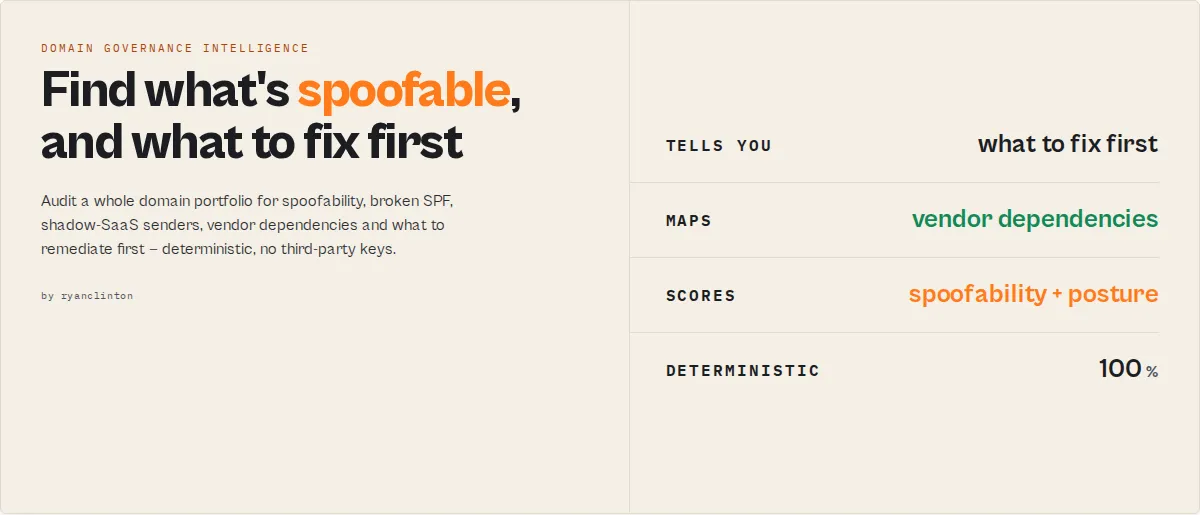
DNS, SPF, DMARC, DKIM & email-auth intelligence for a whole domain portfolio — formerly DNS Record Lookup.
Find in one run:
✓ Spoofable domains ✓ Forgotten SaaS senders ✓ Silent SPF failures ✓ Vendor dependencies ✓ Single points of failure ✓ What to fix first
Find out in 5 seconds
Most DNS tools tell you what records exist. This actor tells you what is broken, what is risky, what changed, and what to fix first — across one domain or a portfolio of thousands. Deterministic, no LLM, no third-party keys.
What nobody realises about their domains
Marketing connected Mailchimp. Sales connected HubSpot. Support connected Zendesk.
Years later, nobody remembers any of it — but the authorisation to send email as your company is still there, sitting in your SPF and DKIM records. This actor finds it.
More broadly, most organisations cannot answer these questions about their own domains:
- Which vendors can send email on our behalf?
- Which SaaS platforms are still authorised that nobody remembers connecting?
- Which of our domains are spoofable right now?
- Which providers are single points of failure?
- What changed in the last 30 days?
This actor answers all five — from records that are already public, that you've simply never correlated.
Questions this actor answers
✓ Is this domain spoofable? ✓ What should we fix first? ✓ Which vendors can send email for us? ✓ What SaaS platforms are still connected? ✓ Which domains are operationally risky? ✓ Which 12 of our 500 domains need attention today? ✓ What changed and why does it matter? ✓ Which providers are we dependent on? ✓ Who owns each domain's setup? ✓ Is this acquisition target a mess?
Outcomes by team
| Team | What they get |
|---|---|
| Security | Find spoofable domains, detect control regressions, surface shadow SaaS senders. |
| MSPs | Prioritise remediation across clients, generate executive reports, monitor portfolios on a schedule. |
| Deliverability | Fix SPF PermErrors, raise DMARC enforcement, discover risky third-party senders. |
| M&A / due diligence | Assess a target's email-security maturity, vendor sprawl and infrastructure risk before the deal closes. |
Used for
Domain portfolio audits · MSP client reporting · security assessments · email-deliverability reviews · M&A due diligence · scheduled DNS / email-auth monitoring · vendor discovery · SaaS rationalisation.
Why this is different
- Most DNS tools show you records.
- Most DMARC tools show you email authentication.
- Most monitoring tools show you changes.
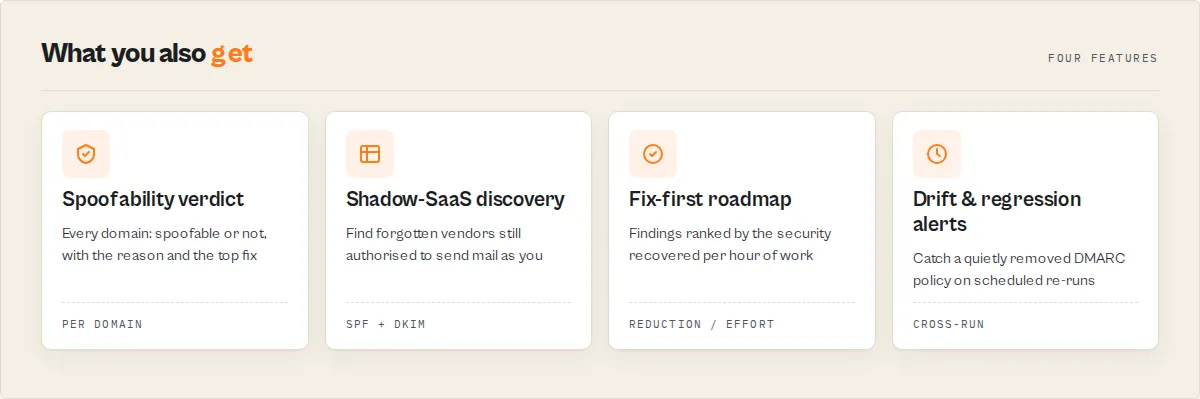
This actor shows you risk, ownership, dependencies, governance, and what to fix first — the decision layer the others leave to you. In detail, where a DNS tool tells you what records exist, this tells you:
- What is risky — spoofability, takeover exposure, operational fragility.
- What is broken — silent SPF PermErrors, dead MX targets, unenforced DMARC.
- What changed — and whether it's a regression worth paging someone over.
- What to fix first — findings ranked by security recovered per hour of work.
- Who you depend on — every vendor authorised to send, and which are single points of failure.
- Whether it's still needed — the forgotten SaaS senders you can probably remove.
- What would break if it failed — per-domain blast radius for email, web and identity.
One example that lands
Point it at a single corporate domain:
Nobody remembered Mailchimp was still authorised to send email as the company. The actor found it in the DKIM records — and flagged it for review — in one call.
Now point it at all 143 of an MSP client's domains in one run — the closing summary record is the prioritised work queue:
143 client domains in, a ranked remediation queue out — drop it straight into the monthly client report.
What you get from one call
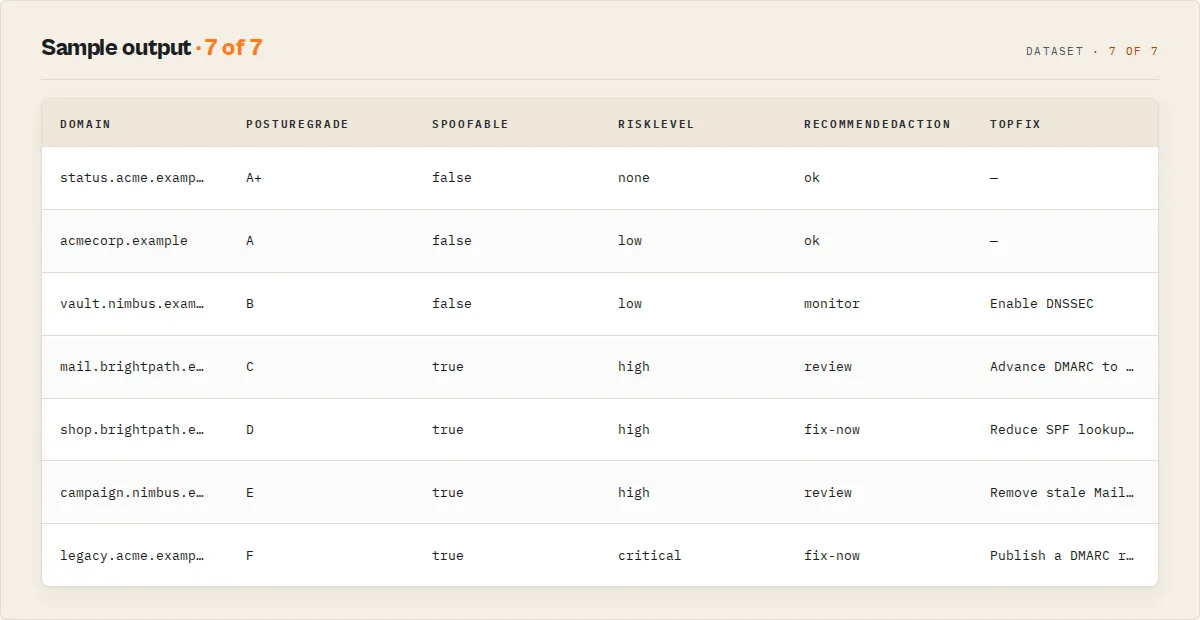
Every domain comes back with the decision fields first — postureScore + grade, spoofable, recommendedAction, topFix — then the supporting intelligence:
- Email authentication — SPF policy + the RFC 7208 10-lookup-limit check (catches the silent
PermErrorthat breaks SPF) + include-tree map; DMARC maturity (0–100, monitoring → enforced); DKIM; MTA-STS / TLS-RPT / BIMI. - DNSSEC — signed / validated / unsigned (via DNS-over-HTTPS).
- DNS resilience & attack surface — redundancy, single-point-of-failure, dangling-CNAME / subdomain-takeover risk, dead-MX targets.
- Vendor & governance — vendor inventory + shadow SaaS, inferred ownership, cleanup candidates, complexity / operational risk / maintainability / blast radius.
- Prioritisation & reporting — security gradecard (5 category grades), remediation roadmap (reduction-per-effort), security debt, account benchmark, and a run-level executive summary, portfolio ranking and vendor dependency graph.
- Compliance — Google / Microsoft bulk-sender mapping (DNS-checkable portion) + a stable findings catalogue (
DNS-NNN). - Monitoring — opt-in cross-run drift with regression alerts, change narratives, baselines and churn.
The full raw record set (A/AAAA/MX/NS/TXT/CNAME/SOA) is still on every record. You get the decision and the data.
(Formerly DNS Record Lookup — it still does every lookup dig does; the lookups are now the data layer underneath the intelligence.)
Problems this finds
- Your domain is spoofable. No enforced DMARC means attackers can impersonate your domain in email today.
- Forgotten SaaS still has the keys. Marketing connected Mailchimp in 2021; it can still send as you, and nobody remembers it. The actor surfaces it as a third-party sender and a cleanup candidate.
- SPF is silently broken. Mail that should authenticate fails because SPF exceeds the RFC 7208 10-lookup limit and returns
PermError— invisible until deliverability drops. - Vendor concentration risk. Dozens of domains depend on one mail gateway; a single outage takes them all down. The dependency graph and
singlePointsOfFailuremake it visible. - A control was quietly removed. DMARC went from
rejecttononeafter two years of stability — the regression alert and change narrative catch it.
Records vs decisions
Most DNS tools return things. This returns work to do.
| A raw DNS lookup gives you | This actor also gives you |
|---|---|
dmarcRecord: "v=DMARC1; p=none" | "DMARC is monitoring-only — your domain is still spoofable. Move to p=reject." |
spfRecord: "v=spf1 include:a include:b … ~all" | "SPF is at 11 DNS lookups — over the limit. Receivers return PermError and SPF fails." |
mxRecords: [...], nsRecords: [...] | "Single self-hosted MX, one nameserver — no redundancy." |
cnameRecords: ["x.s3.amazonaws.com"] | "CNAME points to an unclaimed target — possible subdomain-takeover exposure." |
| 13 fields you still have to interpret | postureScore: 41, riskLevel: "critical", recommendedAction: "fix-now" |
How this compares
DNS and email tools cluster into a few categories. Each is good at its slice; this actor spans the decision + governance layer on top of all of them.
| Capability | DNS diagnostic tools (dig, nslookup, MXToolbox) | DMARC platforms (EasyDMARC, Dmarcian) | Exposure-mapping platforms (Hardenize) | This actor |
|---|---|---|---|---|
| Raw record lookup | ✓ | partial | ✓ | ✓ |
| SPF lookup-limit detection | partial | ✓ | ✓ | ✓ |
| DMARC maturity scoring | ✗ | ✓ | ✓ | ✓ |
| MTA-STS / TLS-RPT / BIMI | partial | partial | ✓ | ✓ |
| DNSSEC | partial | ✗ | ✓ | ✓ |
| Vendor inventory + shadow-SaaS | ✗ | ✗ | partial | ✓ |
| Operational risk + blast radius | ✗ | ✗ | partial | ✓ |
| Remediation roadmap (fix-first) | ✗ | partial | ✗ | ✓ |
| Portfolio ranking + dependency graph | ✗ | partial | partial | ✓ |
| Runs in your own pipeline (Apify API, no SaaS seat) | ✗ | ✗ | ✗ | ✓ |
Comparison reflects the typical focus of each category; specific products evolve their feature sets over time.
Why this exists
Running dig against one domain is easy. Auditing the email security and DNS resilience of 50, 500 or 5,000 domains — and knowing which of them to fix first — is not. Reading a raw SPF string and deciding whether it is safe takes expertise; reading recommendedAction: "fix-now" and whyFlagged takes a second.
This actor does the interpretation for you, deterministically. The same domain always produces the same score — no LLM, no randomness, no external API. It runs on Node's native DNS resolver, so there are no third-party keys, no rate limits, and nothing to manage.
How it works
- Clean + de-duplicate the input domains (protocol, path, port and
www.are stripped; duplicates removed). - Resolve A, AAAA, MX, NS, TXT, CNAME and SOA in parallel, plus SPF / DMARC / DKIM when email-security checks are on.
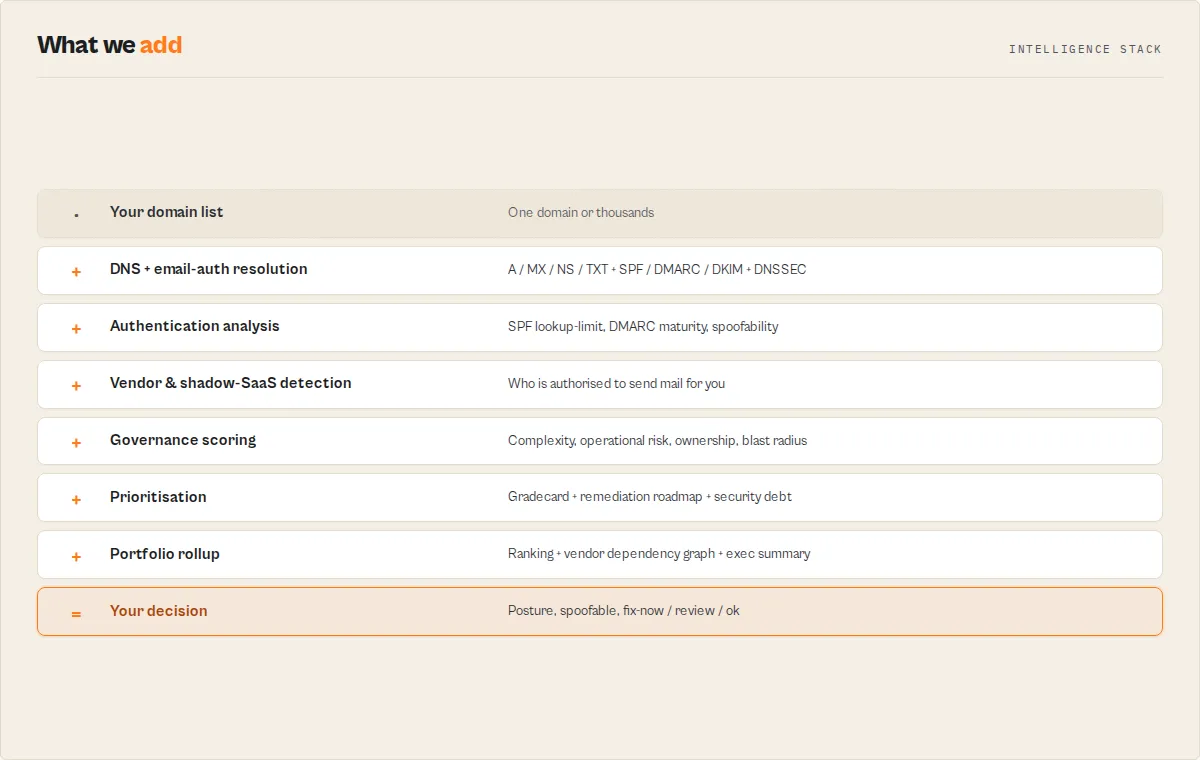
- Analyse the email-authentication posture (SPF policy + lookup limit, DMARC strength, DKIM), the DNS resilience (redundancy, takeover risk), and the providers.
- Score each domain into a posture (0–100) + grade, derive a
riskLevel, stableriskFlags, and arecommendedAction, with a plain-EnglishwhyFlaggedandsummary. - Stream each domain's record as it finishes, then emit a run-level summary (grade distribution, spoofable count, worst domains, prioritised recommendations).
Every domain's record is pushed the moment it is ready, so the first results appear within a second or two even on large runs.
What you learn
Executive view — one domain at a glance
The fields most people act on sit at the top of every record:
Portfolio view — the whole estate in one summary record
Run it against your full list and the closing summary record is the MSP / exec report:
527 domains in, "fix these 9 first and you depend on Proofpoint" out.
Detailed view — the full record
A representative domain record, abridged to the high-signal blocks (a real record carries more):
The closing summary record (shown as the "Portfolio view" above) carries the run-level rollup: executiveSummary, portfolioRanking, grade distribution, the vendor dependency graph, criticalVendors, singlePointsOfFailure and prioritised recommendations. It is also mirrored to the key-value store under SUMMARY.
Headline output fields
| Field | Description |
|---|---|
recordType | domain | summary | error. |
resolved | false when the domain returned no DNS records (likely does not exist / misspelled). Unresolved domains are reported but not billed and excluded from the posture statistics. |
postureScore / postureGrade | 0–100 composite + letter grade (A+ → F). Higher is better. |
riskLevel | critical | high | medium | low | none. |
riskFlags | Stable tokens: NO_DMARC, DMARC_MONITOR_ONLY, DMARC_NOT_ENFORCED, NO_SPF, SPF_PASS_ALL, SPF_NEUTRAL, SPF_LOOKUP_LIMIT_EXCEEDED, SPF_LOOKUP_LIMIT_NEAR, SPOOFABLE, NO_DKIM, DANGLING_CNAME_RISK, SINGLE_POINT_OF_FAILURE. |
recommendedAction | fix-now | review | monitor | ok. |
whyFlagged / summary | Plain-English reason + ≤280-char summary line. |
emailAuth | Full SPF (policy + lookup-limit + include tree + vendor count) / DMARC (+ maturity) / DKIM + spoofable + recommendedActions. |
modernEmailSecurity | MTA-STS (+ mode), TLS-RPT, BIMI (+ VMC), adoptionScore. |
mailArchitecture | Inferred inbound provider, security gateway, outbound senders. |
dnsHealth | Redundancy, single-point-of-failure, IPv6, dangling-CNAME risk, dead-MX. |
dnssec | status: signed-validated / signed / unsigned / unknown. |
providers | DNS provider, mail provider, mail-provider category. |
subdomainProtected | Whether the DMARC policy governs subdomains. |
domainRole | Inferred role: primary / mail-only / web-only / parked-or-inactive. |
findings | Stable misconfiguration catalogue (DNS-NNN id + severity + title). |
compliance | Google / Microsoft bulk-sender mapping (DNS-checkable portion) + CIS controls. |
gradecard | Five executive category letter-grades + overall. |
remediationPlan | Findings ordered by reduction-per-effort (priority, effort, scoreGain). |
securityDebt | Accumulated unfixed-risk score + level. |
benchmark | Posture percentile vs domains scanned on this account. |
topFix | The single highest-priority remediation for this domain. |
vendors | Vendor inventory (vendors[] + thirdPartySenders[] shadow SaaS + count + risk). |
ownership | Inferred owning team (likelyOwner + confidence + evidence) from the vendor mix. |
cleanupCandidates | Vendors authorised in SPF/DKIM only — "can I remove this?" review candidates. |
complexity | Structural complexity score + level + drivers. |
operationalRisk | Operational fragility score + level + drivers. |
maintainability | "Is this manageable to operate?" score + level. |
blastRadius | email / web / identity impact-if-it-breaks. |
monitoring | Cross-run drift (only when watchlistName is set) — changeType, driftSeverity, changeImpactScore, regression, changes, postureScoreDelta, trend. |
Input
| Name | Type | Default | Description |
|---|---|---|---|
domains | string[] | — | Domains to analyse. Protocol / path / port / www. stripped; duplicates removed. |
recordTypes | string[] | all 7 | Which DNS record types to resolve. |
checkEmailSecurity | boolean | true | Resolve SPF, DMARC and DKIM (required for the posture engine). |
timeout | integer | 5000 | Per-query timeout in ms (1,000–30,000). |
analysisMode | select | balanced | Re-weights the posture score: deliverability (SPF/DMARC/DKIM heaviest), security (DNS resilience + takeover risk), monitoring (scheduled re-runs), or balanced. |
outputProfile | select | standard | minimal (decision fields only — for Zapier/Make rules), standard, or full (every diagnostic block). |
expandSpfIncludes | boolean | false | Resolve the full SPF include chain to count real DNS lookups (catches PermErrors) and map sending vendors. Adds extra DNS queries; when off, a static lower-bound count is used. |
checkDnssec | boolean | true | Query DNSSEC state via Cloudflare DNS-over-HTTPS (no key). Adds one lightweight HTTPS request per domain. |
watchlistName | string | — | Name a watchlist to persist this run's fingerprint and diff it next run — flags DMARC/SPF downgrades, DKIM removal, MX / mail-provider changes, and tracks a posture-score trend. |
maxPostureScore | integer | 100 | Surface (and bill for) only domains scoring at or below this — i.e. only the domains that need attention. |
Example — audit a portfolio, deliverability lens, surface only the problems:
Monitoring (scheduled runs)
Set a watchlistName and schedule the actor. On the first run every domain reads changeType: "new". From the second run on, each record carries a monitoring block flagging what drifted since last time:
dmarc-weakened(e.g.reject→none) andspf-weakened(e.g.-all→~all) — regressions: a security control was weakened.monitoring.regression: true.mx-changed/mail-provider-changed— your mail routing moved.dkim-removed,nameservers-changed,a-records-changed.
Each carries a driftSeverity plus a numeric changeImpactScore (so alert routing can branch on WHERE monitoring.regression = true or threshold on the score), and a trend block tracking the posture score across runs (improving / declining / stable). Every record also gets:
baseline—firstSeenanddaysStable(how long the config held before this change). A change after 3 days reads very differently from one after 3 years.driftRisk—{ level, reason }, the business-impact framing of the change (a regression elevates to at leasthigh).changeFrequency—last30Days/last90Dayschange counts + ariskband. Frequently-changing domains are usually unmanaged or mid-migration.changeNarrative— a paste-ready one-liner with animportancetier: "DMARC enforcement removed after 742 days of stability." Drops straight into a SOC ticket, a change-review (CAB) note, or a Slack alert.
This turns a one-off lookup into continuous DNS / email-auth monitoring with regression alerting.
Prioritisation & reporting
The actor does not just flag problems — it tells you what to fix first and packages the run for a report.
- Remediation roadmap — every record carries a
remediationPlan[]ordered by reduction-per-effort: the fix that recovers the most posture for the least work ispriority: 1. Each step haseffort(low/medium/high),scoreGain, and the stablefindingId. Security teams fix queues, not findings. - Security gradecard — five category letter-grades (
emailAuthentication,transportSecurity,dnsResilience,attackSurface,monitoringReadiness) plusoverall. An executive readsA / C / A / C / Bin one glance. - Security debt —
securityDebt.score(0–100) is the accumulated weight of unfixed findings, aged up the longer they stay open (with a watchlist). - Benchmark —
benchmark.percentileanswers "is 72 good?" by comparing against the domains you have scanned on this account (it is honestly account-scoped, never a fabricated global figure, and staysnulluntil the pool has ≥ 10 samples). - Portfolio ranking — the run
summarycarries aportfolioRanking[](worst domains first, withpriority) and anexecutiveSummaryblock (critical / high / spoofable counts + average score) that drops straight into an MSP client report.
Vendor & governance intelligence
Most DNS tools answer "what does this domain look like?". This one also answers "what are we dependent on, and is it manageable?" — entirely from the records already resolved.
- Vendor inventory —
vendorslists every vendor authorised to send or route mail (Microsoft 365, Salesforce, SendGrid, Mailchimp, Zendesk, …), classified bykind(mailbox / gateway / esp / sender) andsources(mx / spf / dkim).thirdPartySenders[]surfaces the shadow SaaS — the senders marketing wired up years ago that nobody remembers. - Ownership —
ownershipinfers which team likely owns the setup (IT / marketing / developers) from the vendor mix, so you know who to talk to before changing anything. Heuristic and labelled "likely" — ownership isn't literally in DNS. - Cleanup candidates —
cleanupCandidates[]flags vendors authorised in SPF (or a lone DKIM selector) with no other evidence they're in use — the "can I safely remove this?" review list. It recommends review, never blind removal. - Vendor dependency graph — the run
summarycarriesvendorDependencies(each vendor → which of your domains depend on it),criticalVendors[](vendors ≥ 40% of the portfolio leans on), andsinglePointsOfFailure[](vendors ≥ 50% depend on, with the affected domain list). "If our mail gateway has an outage, how many domains go dark?" — answered. - Complexity, operational risk & maintainability —
complexityscores how complicated the setup is;operationalRiskscores how fragile it is to run;maintainabilitycollapses both (plus monitoring hooks) into one "is this manageable?" number. Complex, fragile environments fail more. - Blast radius —
blastRadiustells you, per domain, whether a config break takes outemail,web, oridentity.
M&A due-diligence mode
Set analysisMode: "mna" to point this at a target company's domain portfolio. The run summary adds an acquisitionReadiness block — a graded composite of email/DNS posture, operational fragility, infrastructure complexity, and vendor sprawl — that a consultant drops straight into a due-diligence report.
Use in Dify
Drop this actor into Dify workflows via the Apify plugin's Run Actor node. Every domain returns scored, classified and recommended as structured JSON — fix-now / review / monitor / ok plus the riskLevel and spoofable flags your downstream if/else node branches on. A raw DNS tool pointed at the same domain returns record strings you still have to interpret; this returns the decision.
- Actor ID:
ryanclinton/dns-record-lookup - Sample input (deliverability audit, surface only the domains that need work):
- Branching example — a Dify if/else node routes on the decision enum:
recommendedAction == "fix-now"→ open a ticket / page the on-call.emailAuth.spoofable == true→ hold the campaign for that domain.recommendedAction == "ok"→ continue.
- Monitoring mode — add a
watchlistNameand themonitoring.driftSeverityenum lets a scheduled Dify flow alert only oncriticaldrift (a DMARC downgrade) and ignore the rest.
The recommendedActions[] array on emailAuth is usable verbatim — concrete remediation steps ("Advance DMARC from p=none to p=quarantine, then p=reject"), no LLM rewriting needed.
Combine with other Apify actors
Each record carries a nextActions[] array pointing at the right sibling to run next:
| Actor | Why pair it |
|---|---|
| WHOIS Domain Lookup | Registration, registrar, expiry and ownership for the same domains. |
| SSL Certificate Search | Subdomain enumeration and look-alike / typosquat detection via Certificate Transparency. |
| IP Geolocation Lookup | Geolocate and classify the resolved A/AAAA addresses and mail servers. |
| Website Tech Stack Detector | Cross-reference DNS with the technologies a site runs for a full infrastructure profile. |
API
What this does NOT do
- It does not probe live SMTP / STARTTLS. TLS-grade and opportunistic-TLS detection require live SMTP connections to each mail server on port 25 — a different capability from DNS resolution, and one that cloud egress commonly blocks. The DNS-native alternative (DANE / TLSA records) is also out of reach: Node's resolver exposes no TLSA record type. MTA-STS and TLS-RPT cover the DNS-resolvable side of transport security.
- It does not hunt typosquats / look-alike domains. The domains you pass in are the subjects being audited, not candidates to compare against a brand. For typosquat and look-alike discovery, use SSL Certificate Search, which scans Certificate Transparency logs.
- It does not expose TTLs. Node's
dns.promisesAPI does not return TTL values. - Compliance mapping covers the DNS-checkable portion only. The Google / Microsoft bulk-sender pass/fail reflects SPF + DKIM + DMARC presence. It does not verify spam-rate, one-click-unsubscribe, or message formatting, which are not visible in DNS.
- It does not exhaustively enumerate DKIM selectors. It probes common selectors; domains using a custom selector may report
dkim.present: falseeven when DKIM is configured. - DKIM presence ≠ valid signing. It confirms a selector record exists, not that mail is correctly signed end to end.
- Results are resolver-dependent and point-in-time. Resolution reflects the nameservers Apify's infrastructure uses, at the
lookupTimestamprecorded.
FAQ
Is my domain spoofable? The emailAuth.spoofable boolean answers it directly, with spoofableReason explaining why. A domain is spoofable when DMARC is not enforced (p=reject/p=quarantine at 100%) or SPF does not hard/soft-fail unauthorised senders.
Why does the actor say my SPF "exceeds the limit"? RFC 7208 caps SPF at 10 DNS lookups. Over the cap, receivers return a PermError and SPF silently fails — mail that should pass starts failing. Turn on expandSpfIncludes to count the real include-tree depth instead of the static lower bound.
What does recommendedAction mean? It is the single field to branch on: fix-now (critical risk), review (high), monitor (medium), ok (low/none). It is derived deterministically from the risk flags.
Do I need an API key? No. It uses Node's native DNS resolver — no third-party accounts, no external rate limits.
What happens to a domain that does not exist? It comes back with resolved: false and a clear message, is excluded from the posture statistics, and is not billed.
Can I get just the decision fields? Set outputProfile: "minimal" — you get the score, grade, spoofable, recommendedAction and the primary identifiers, ideal for Zapier / Make / n8n rules.
Can I monitor for DNS changes? Yes — set a watchlistName and schedule the run. Each record then carries a monitoring block flagging DMARC downgrades, MX / mail-provider changes, and more, with a driftSeverity for alert routing.


