OFAC SDN Watchlist Scraper avatar

OFAC SDN Watchlist Scraper

Pricing

from $50.00 / 1,000 sanctioned entities

Go to Apify Store
OFAC SDN Watchlist Scraper

OFAC SDN Watchlist Scraper

Scrape the US Treasury OFAC SDN list. Returns normalized JSON with names, aliases, type, program, dates, passport/ID, and addresses for AML/KYC, bank screening, payment compliance, and trade compliance.

Pricing

from $50.00 / 1,000 sanctioned entities

Rating

0.0

(0)

Developer
NexGenData

NexGenData

Maintained by Community

Actor stats

0

Bookmarked

2

Total users

1

Monthly active users

3 days ago

Last modified

Categories

Share

The canonical OFAC SDN scraper for Apify โ€” turn the US Treasury Specially Designated Nationals list into clean, filterable, screening-ready JSON in seconds.

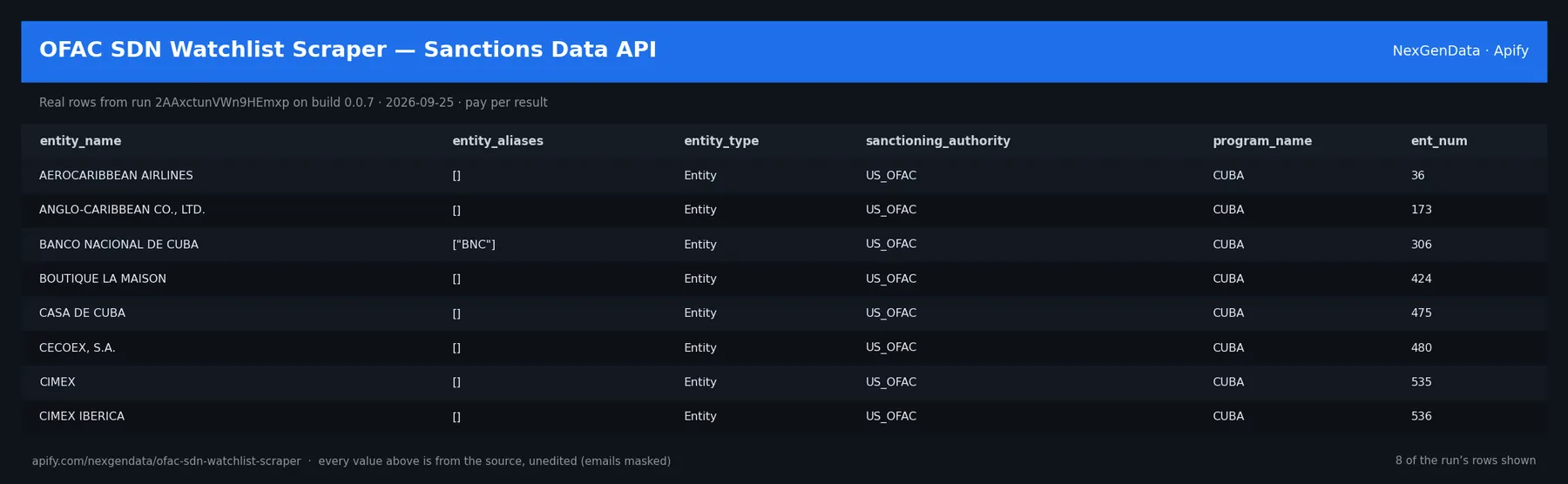
๐Ÿ“Š Sample Output

OFAC SDN Watchlist Scraper sample output โ€” OFAC SDN Watchlist Scraper, premium API, JSON output, NexGenData premium dataset for analysts, hedge funds, compliance, and research teams

Overview

The OFAC Specially Designated Nationals (SDN) list is the single most consulted sanctions list in global financial compliance. Maintained and published by the US Department of the Treasury's Office of Foreign Assets Control (OFAC), it names the individuals, companies, vessels, and aircraft that US persons are legally prohibited from doing business with. Their assets are blocked, and transactions involving them are off-limits to US banks, payment processors, fintechs, crypto exchanges, exporters, and the businesses that work with them.

Sanctions screening is the process of checking a customer, counterparty, vendor, payment, or shipment against these lists before โ€” and during โ€” a business relationship. It is a core pillar of Anti-Money-Laundering (AML) and Know-Your-Customer (KYC) programs. For US-regulated institutions, screening against OFAC's lists is not optional: OFAC enforces a strict-liability regime, meaning a firm can face civil penalties for dealing with a sanctioned party even without intent. That makes accurate, current OFAC data a compliance necessity rather than a nice-to-have.

This actor downloads the OFAC SDN data directly from official US Treasury sanctions-list publications, parses every entry, and returns it as normalized JSON. Instead of wrestling with the multi-megabyte government source files and their idiosyncratic format, you get a schema-stable feed you can filter by name, by sanctions program, or by entity type โ€” ready to drop into a screening pipeline, a spreadsheet, or a research notebook.

Why use this

  • Official US Treasury source. Data comes from OFAC's own sanctions-list publications โ€” the authoritative SDN list itself, not a third-party copy or guess.
  • Built for AML / KYC / sanctions screening. Output is normalized for the exact use most teams need: matching names and aliases against customers, vendors, and counterparties.
  • Aliases included. Sanctioned parties routinely operate under a.k.a. names, transliterations, and front-company names. Every record carries the known aliases OFAC publishes, so your matching isn't limited to a single primary name.
  • Filterable by program and type. Narrow to a single OFAC program code (e.g. a Russia, Iran, or counter-terrorism program) or to a single entity type โ€” individual, entity, vessel, or aircraft โ€” without post-processing.
  • JSON-native and pipeline-ready. No PDF parsing, no fixed-width CSV wrangling, no scraping logic to maintain on your side. Pay per result and pull only what you need.

What you get

Each record is one sanctioned party from the OFAC SDN / consolidated list, returned with the following fields:

FieldDescription
entity_nameThe primary listed name of the sanctioned party.
entity_aliasesArray of known aliases / a.k.a. names, transliterations, and alternate spellings OFAC publishes for the party.
entity_typeThe OFAC classification: individual, entity, vessel, or aircraft.
sanctioning_authorityThe authority that listed the party. For this actor, the OFAC / US Treasury source.
program_nameThe OFAC sanctions program the listing falls under (e.g. a Russia, Iran, counter-terrorism, or non-proliferation program code).
listed_dateThe date the party was added to the sanctions list.
nationalityThe party's nationality, where OFAC publishes it.
country_of_originThe party's country of origin โ€” place of birth for individuals, or registered country for entities โ€” where available.

The entity_aliases array is the field most screening teams care about most: it is what lets you catch a counterparty that appears in your records under a name other than the primary listed one.

Use cases

  1. AML / KYC sanctions screening. Screen new and existing customers against the SDN list as part of onboarding and ongoing monitoring, the foundational control in any AML program.
  2. Vendor and counterparty onboarding. Check suppliers, distributors, partners, and counterparties before signing โ€” so you don't unknowingly contract with a blocked party.
  3. Payments compliance. Screen the originators, beneficiaries, and intermediaries of payments and wire transfers before they settle, the way banks and payment processors are required to.
  4. Trade compliance and export checks. Verify buyers, consignees, vessels, and aircraft against OFAC listings before shipping goods or clearing logistics โ€” sanctions exposure is a real risk in cross-border trade.
  5. Fintech and crypto onboarding. Wallet providers, exchanges, neobanks, and lenders can wire SDN screening straight into automated onboarding and transaction-monitoring flows.
  6. Due diligence and investigations. Enrich M&A, investment, and third-party due diligence with an authoritative check of whether a target or its principals appear on the SDN list.
  7. Journalists and researchers. Investigate sanctions designations, track which programs name a person or company, and build datasets on the structure and timing of US sanctions.
  8. GRC and audit tooling. Feed a governance-risk-compliance platform or internal audit a clean, current snapshot of the SDN list for periodic re-screening and recordkeeping.

Sample output

{
"entity_name": "PUBLIC JOINT STOCK COMPANY ROSNEFT OIL COMPANY",
"entity_aliases": [
"ROSNEFT",
"ROSNEFT OIL COMPANY",
"OJSC ROSNEFT OIL COMPANY",
"NK ROSNEFT PAO",
"PAO NK ROSNEFT"
],
"entity_type": "entity",
"sanctioning_authority": "US_OFAC",
"program_name": "UKRAINE-EO13662",
"listed_date": "2014-07-16",
"nationality": null,
"country_of_origin": "Russia"
}
{
"entity_name": "MAKER, John Doe",
"entity_aliases": [
"DOE, Johnathan",
"DOE, Jon"
],
"entity_type": "individual",
"sanctioning_authority": "US_OFAC",
"program_name": "SDGT",
"listed_date": "2019-03-26",
"nationality": "Lebanon",
"country_of_origin": "Lebanon"
}

Input parameters

Every parameter is optional. With no input, the actor returns the SDN list capped at maxResults.

ParameterTypeDefaultDescription
entity_searchstring""Case-insensitive substring match against the entity name and any aliases. Leave empty to return all entries. Example: rosneft or kalashnikov.
sanctioning_programstring""Case-insensitive substring match against OFAC program codes (e.g. RUSSIA-EO14024, SDGT, IRAN, CUBA, NPWMD). Leave empty for all programs.
entity_typestring (enum)allRestrict to a single type: all, Individual, Entity, Vessel, or Aircraft.
maxResultsinteger100Maximum number of records to return after filters are applied. Range 1-5000.

How to use it

Python (apify-client)

from apify_client import ApifyClient
client = ApifyClient("YOUR_APIFY_TOKEN")
run_input = {
"entity_search": "rosneft",
"sanctioning_program": "RUSSIA-EO14024",
"entity_type": "Entity",
"maxResults": 100,
}
run = client.actor("nexgendata/ofac-sdn-watchlist-scraper").call(run_input=run_input)
for item in client.dataset(run["defaultDatasetId"]).iterate_items():
print(item["entity_name"], "-", item["program_name"])

cURL

curl -X POST "https://api.apify.com/v2/acts/nexgendata~ofac-sdn-watchlist-scraper/run-sync-get-dataset-items?token=YOUR_APIFY_TOKEN" \
-H "Content-Type: application/json" \
-d '{
"entity_search": "rosneft",
"sanctioning_program": "RUSSIA-EO14024",
"entity_type": "Entity",
"maxResults": 100
}'

Replace YOUR_APIFY_TOKEN with the token from your Apify account. The run-sync-get-dataset-items endpoint runs the actor and returns the matching records in one call.

Pricing

This actor is pay-per-result: you are billed for the records the actor returns, with no monthly platform minimum and no enterprise contract. You pay only for what you pull.

Worked example. Suppose your screening job filters the list to a single program and the run returns 250 matching records. At a pay-per-result rate, you pay for those 250 records and nothing else. Run the same job daily for re-screening and your cost scales linearly with results returned, not with seat licenses or annual commitments. A broad pull of several thousand records for a full-list snapshot is similarly priced per record โ€” predictable, and easy to budget against your screening volume.

(See the actor's Apify Store page for the current per-result rate. You only pay for results actually returned after your filters are applied โ€” narrow filters mean fewer results and lower cost.)

How this compares to Dow Jones Risk & Compliance / Refinitiv World-Check / LexisNexis Bridger

These incumbents are well-established enterprise compliance platforms, and this actor is honest about where it fits:

  • Same official OFAC data. The SDN designations themselves originate from the same place โ€” the US Treasury โ€” for everyone. There is no proprietary "better" version of the OFAC SDN list; the list is public.
  • Pay-per-use, not enterprise contract. Dow Jones, Refinitiv World-Check, and LexisNexis Bridger are typically sold via annual enterprise agreements with seat-based or volume licensing and procurement cycles. This actor is pay-per-result with no contract โ€” you can start today.
  • JSON-native and developer-first. You get clean JSON over a simple API, ideal for wiring directly into your own screening pipeline, rather than a vendor portal or a heavyweight integration.
  • Where the incumbents add more. These platforms layer on multi-list coverage (UN, EU, UK HMT and dozens of other national lists), PEP (Politically Exposed Persons) data, adverse-media screening, sophisticated fuzzy-matching and case-management workflows, and ongoing managed-data services. If your program needs consolidated global watchlists, PEP and adverse-media coverage, and vendor-managed match scoring, an enterprise provider does more than a single-list feed. If you need authoritative OFAC SDN data in JSON, fast and pay-as-you-go, this actor is the lean option โ€” and it pairs with our other NexGenData sanctions actors to build multi-list coverage yourself.

FAQ

How fresh is the data, and how often does OFAC update the SDN list? The actor pulls from official OFAC sanctions-list publications at run time, so each run reflects the list as published by Treasury at that moment. OFAC does not update on a fixed schedule โ€” it adds, amends, and removes designations on an ongoing basis, sometimes multiple times a week. Re-run the actor as often as your screening policy requires.

What does "SDN" mean? SDN stands for Specially Designated Nationals and Blocked Persons. It is OFAC's core list of individuals, companies, vessels, and aircraft whose assets are blocked and with whom US persons are generally prohibited from transacting.

Why are aliases important? Sanctioned parties frequently appear under multiple names โ€” alternate spellings, transliterations, business names, and front companies. The entity_aliases array captures the a.k.a. names OFAC publishes, so your screening can match a counterparty even when your records use a name other than the primary listed one.

Can this produce false positives? Yes โ€” name-based screening inherently produces potential matches that turn out to be different people or organizations with similar names (and, conversely, can miss matches where names are spelled very differently). A returned record means a name matched your search, not that you have confirmed a true sanctions hit. Any potential match must be reviewed and adjudicated by your compliance process before you act on it.

Is the output legal or compliance advice? No. This actor provides data only. It does not make a compliance determination, does not tell you whether a transaction is permitted, and is not legal advice. Treat the output as one input to a screening process owned and reviewed by your organization.

Which sanctions programs are covered? The actor returns SDN / consolidated listings across the OFAC programs published in the source data โ€” including Russia/Ukraine-related, Iran, counter-terrorism (SDGT), non-proliferation (NPWMD), Cuba, and many others. Use the sanctioning_program filter to narrow to a specific program code.

The OFAC SDN list is public information published by the US Department of the Treasury. This actor retrieves and normalizes that public data and returns it to you as JSON.

Screening results from this actor are informational. A returned record indicates a name or program match against the data โ€” it is not a compliance determination, not confirmation of a true sanctions hit, and not legal advice. Sanctions compliance is the responsibility of your organization. Before acting on any result, your own compliance process should review and adjudicate potential matches and, where appropriate, consult qualified legal counsel and the authoritative source at OFAC. NexGenData provides the data; you own the decision.

Build broader compliance and entity-resolution coverage by combining this actor with other NexGenData feeds:

  • FINRA BrokerCheck Scraper โ€” broker and firm registration, licensing, and disclosure history for US securities-industry due diligence.
  • GLEIF LEI Lookup โ€” Legal Entity Identifier (LEI) records for resolving and verifying corporate counterparties globally.
  • Company-registry actors โ€” official company-registry lookups for verifying legal entity existence, status, and ownership during onboarding and due diligence.

Browse the full NexGenData actor library for additional sanctions, registry, and compliance data sources.