📈 SEC IPO Prospectus Tracker — 424B & S-1/F-1 avatar

📈 SEC IPO Prospectus Tracker — 424B & S-1/F-1

Pricing

from $20.00 / 1,000 results

Go to Apify Store
📈 SEC IPO Prospectus Tracker — 424B & S-1/F-1

📈 SEC IPO Prospectus Tracker — 424B & S-1/F-1

Track SEC IPO registration and pricing prospectuses (424B4, 424B1, S-1, F-1) with registrant, filing, and date. For IPO analysts, allocation desks, and IR vendors.

Pricing

from $20.00 / 1,000 results

Rating

0.0

(0)

Developer

NexGenData

NexGenData

Maintained by Community

Actor stats

0

Bookmarked

7

Total users

2

Monthly active users

a day ago

Last modified

Categories

Share

Pay-per-result tracking of SEC IPO registration and pricing prospectuses — 424B4, 424B1, S-1, and F-1 filings as structured JSON. $0.10 per filing. No Bloomberg seat, no IPO-database subscription, no EDGAR full-text scraping project.

Every U.S. IPO leaves a paper trail in the SEC's EDGAR system: the S-1 (or F-1 for foreign issuers) when a company first registers to go public, and the 424B prospectus when the deal actually prices. For IPO analysts sizing the new-issue calendar, allocation desks deciding what to bid on, and IR vendors prospecting newly public companies, those filings are the earliest structured signal that a company is coming to market. This actor reads EDGAR's filing index for the IPO prospectus and registration form set and returns each filing as a JSON record carrying the company name, ticker, form type, filed date, and a direct link to the filing document. Set a lookback window or an explicit date range, optionally AND in a keyword, and feed the result straight into an IPO calendar, an allocation workflow, or a sales-prospecting pipeline.

Why use this

EDGAR is free and complete — but it is built for retrieving one filing at a time, not for tracking a form-type stream across a window. To monitor the IPO pipeline you have to query the right form types, paginate the index, parse the filing metadata, map filings back to issuers and tickers, and re-run the whole thing on a schedule, deduping against what you have already seen. That is a standing maintenance burden against a source whose index format and rate limits you do not control — and the commercial alternative, an IPO database inside a Bloomberg terminal, is a $24K/year per-seat product you cannot license a slice of.

This actor turns the EDGAR IPO-form stream into a clean, scheduled JSON feed. You set a daysBack window (or explicit startDate/endDate), optionally narrow with a keyword, and get back the matching prospectus and registration filings as records. It handles the form-type filter, the index pagination, and the SEC's fair-access requirements for you. Pay-per-result means a quiet week with few filings costs you almost nothing, and your cost scales exactly with the size of the new-issue calendar.

What you get

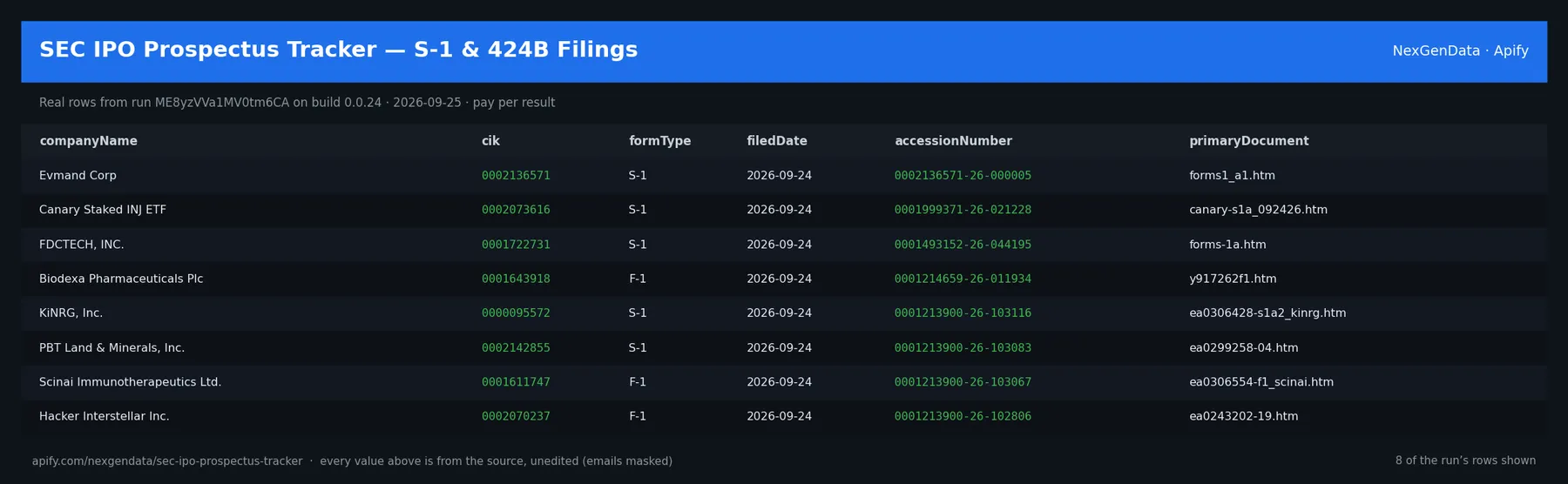
Each record is one IPO-related filing, structured JSON from EDGAR:

  • companyName — the registrant / issuer name
  • ticker — the issuer's ticker symbol where available
  • formType — the specific form (424B4, 424B1, S-1, F-1, etc.)
  • filedDate — the date the filing hit EDGAR
  • documentUrl — a direct link to the filing document for reading and verification

The schema is additive-only and stable, so records load straight into an IPO calendar, a CRM, Snowflake, BigQuery, or Postgres without re-mapping each refresh.

Use cases

  • IPO calendar construction — Track the S-1/F-1 registration stream to build a forward pipeline of companies that have filed to go public, then watch for the 424B pricing prospectus to flip a name from "filed" to "pricing" on your calendar.
  • Allocation-desk deal flow — Surface every 424B4/424B1 as it appears so the desk sees priced deals and can size interest against the new-issue calendar in near-real time.
  • IR-vendor and B2B prospecting — A newly public company is a fresh buyer for IR software, transfer-agent services, ESG-reporting tools, and compliance platforms; track S-1 filings to reach issuers at the moment they enter the public-company lifecycle.
  • Foreign-issuer IPO monitoring — Filter the form set to F-1 to isolate foreign private issuers registering for a U.S. listing — the cross-border IPO pipeline.
  • Sector and theme tracking — AND in a keyword (a sector term, a technology, a geography) to isolate IPOs in a theme you cover for thematic research.
  • Competitive and market intelligence — Watch a peer set's registration activity to anticipate a competitor's IPO and the capital it will raise.
  • Underwriting and league-table research — Build a record of priced deals over a window for new-issue volume and timing analysis.
  • Event-driven research — Feed the priced-deal stream into a model that studies first-day and aftermarket IPO performance.

Sample output

{
"companyName": "Helio Quantum Systems, Inc.",
"ticker": "HLQS",
"formType": "424B4",
"filedDate": "2026-06-22",
"documentUrl": "https://www.sec.gov/Archives/edgar/data/1991234/000119312526198765/d424b4.htm"
}

An earlier registration filing for the same issuer:

{
"companyName": "Helio Quantum Systems, Inc.",
"ticker": null,
"formType": "S-1",
"filedDate": "2026-05-08",
"documentUrl": "https://www.sec.gov/Archives/edgar/data/1991234/000119312526154321/ds1.htm"
}

Input parameters

ParameterLabelDescription
formsForm typesComma-separated SEC IPO forms (default: IPO prospectus + registration set).
queryKeyword (optional)Optional exact-phrase keyword to AND with the form filter.
daysBackDays backLook back this many days (ignored if explicit dates are set).
startDateStart dateOverride the start of the range (YYYY-MM-DD).
endDateEnd dateOverride the end of the range (YYYY-MM-DD).
maxResultsMax resultsMaximum number of filings to return.
userAgentContactSEC User-Agent contactSEC requires a UA with contact info (e.g. Company you@email.com).

How to use

Python (apify-client)

from apify_client import ApifyClient
client = ApifyClient("YOUR_TOKEN")
run = client.actor("nexgendata/sec-ipo-prospectus-tracker").call(run_input={
"forms": "424B4,424B1,S-1,F-1",
"daysBack": 14,
"maxResults": 200,
"userAgentContact": "Acme Research you@acme.com",
})
for item in client.dataset(run["defaultDatasetId"]).iterate_items():
print(item["companyName"], item["ticker"], item["formType"], item["filedDate"])

cURL

curl -X POST "https://api.apify.com/v2/acts/nexgendata~sec-ipo-prospectus-tracker/run-sync-get-dataset-items?token=YOUR_TOKEN" \
-H "Content-Type: application/json" \
-d '{
"forms": "424B4,424B1,S-1,F-1",
"daysBack": 14,
"maxResults": 200,
"userAgentContact": "Acme Research you@acme.com"
}'

Results stream into the Apify dataset, exportable as JSON, JSONL, CSV, or Excel. Schedule via Apify's built-in scheduler for a daily pull and dedupe on documentUrl; wire a webhook to fire a Slack / Zapier / Make alert when a new priced deal appears.

Pricing

This actor runs on Apify's pay-per-event (PPE) model — you pay for results, not run-time:

  • $0.10 per filing record — the primary event, charged once per filing pushed to the dataset
  • Actor start — a negligible one-time per-run event

No subscriptions, no seat licences, no minimums.

Cost worked example

  • A 14-day window returning ~60 IPO filings → ~$6
  • A daily pull of ~8 new filings → ~$0.80/day
  • A full-quarter backfill of ~400 filings → ~$40 one-time

A quiet window with no qualifying filings costs nothing beyond the actor-start event. Apify's free tier covers most experiments. Browse 200+ buyer-intent actors at https://apify.com/nexgendata?fpr=2ayu9b

How this compares to Bloomberg

SourceCostWhat you get
Bloomberg Terminal (IPO monitor)~$24,000 / seat / yearIPO calendar and prospectus access inside a full terminal; seat-locked, not a standalone feed
Commercial IPO databasesSubscription, often $5K+/yearCurated IPO data behind a per-seat or per-API contract
EDGAR (DIY)FreeRaw filing index; you build the form filter, pagination, issuer/ticker mapping, and scheduler
SEC IPO Prospectus Tracker (this actor)$0.10/filing, no subscriptionFiltered, structured JSON — company, ticker, form type, filed date, document URL — over a window you set

If you already run a Bloomberg seat, the IPO monitor is in there. But if you want the IPO registration and pricing stream as a standalone, scheduled, programmatic JSON feed — for a calendar, an allocation workflow, or IR prospecting — without a $24K/year terminal, this actor is the right cost model.

FAQ

Q: Where does the data come from?

A: The SEC's EDGAR system — the official, public repository of U.S. securities filings. Each record links to the filing via documentUrl.

Q: What forms does it track by default?

A: The IPO prospectus and registration set — 424B pricing prospectuses (424B4, 424B1) and the S-1/F-1 registration statements. Override forms to broaden or narrow the set.

Q: What is the difference between S-1 and 424B?

A: An S-1 (or F-1 for foreign issuers) is the registration statement filed when a company first registers to go public. A 424B prospectus is filed when the deal prices. Tracking both lets you follow a name from registration to pricing.

Q: Why do I have to provide a User-Agent contact?

A: The SEC's fair-access policy requires every automated requester to identify itself with a contact (e.g. Company you@email.com) so the SEC can reach the operator. The actor sends your userAgentContact value on each request.

Q: Is the ticker always populated?

A: Tickers are included where EDGAR associates one with the registrant. Early-stage S-1 filings sometimes precede a confirmed ticker, in which case ticker is null until a later filing.

Q: Can I restrict to a date range instead of a lookback?

A: Yes — set startDate and endDate (YYYY-MM-DD) to pull an explicit window, which overrides daysBack. This is how you backfill a specific quarter.

Schema stability & versioning

This actor follows NexGenData's additive-only schema contract. New fields may be added as new keys, defaulting to null for older runs. Existing fields are never renamed or removed without a major-version bump and advance changelog notice. Field semantics — form-type codes, date formats — are never silently changed; a required change adds a new field and keeps the old for at least 90 days. Build a production IPO calendar on this output without a change breaking your ETL.

  • The actor reads the public SEC EDGAR filing index — the same filings any member of the public may access. Securities filings are public records by statute.
  • Every request identifies itself per the SEC's fair-access policy via your userAgentContact, and is paced politely.
  • The actor collects, stores, and transmits no credentials and accesses no paywalled content.
  • Filing data is informational, not investment advice. Verify any filing against the source documentUrl before relying on it.
  • You are responsible for ensuring downstream use complies with SEC terms and your jurisdiction's laws.

Part of NexGenData's SEC & Disclosure intelligence cluster — pair this actor with:

Browse the full 200+ actor catalog at https://apify.com/nexgendata?fpr=2ayu9b.