đŸ’” US Treasury Yields & Bond Data — Curve, 2s10s, Spreads avatar

đŸ’” US Treasury Yields & Bond Data — Curve, 2s10s, Spreads

Pricing

from $100.00 / 1,000 yield records

Go to Apify Store
đŸ’” US Treasury Yields & Bond Data — Curve, 2s10s, Spreads

đŸ’” US Treasury Yields & Bond Data — Curve, 2s10s, Spreads

Track US Treasury yield curve from 1M to 30Y — daily yields, spreads, 2s10s curve inversion, historical changes. FRED + Treasury.gov public data for fixed income desks, asset allocators, macro hedge funds, treasury teams. Bloomberg yield curve alternative, no terminal needed. Pay-per-result.

Pricing

from $100.00 / 1,000 yield records

Rating

0.0

(0)

Developer

NexGenData

NexGenData

Maintained by Community

Actor stats

0

Bookmarked

2

Total users

1

Monthly active users

9 days ago

Last modified

Share

The Bloomberg yield curve, without the Bloomberg terminal. Daily US Treasury constant‑maturity yields from 1‑Month to 30‑Year, sourced live from FRED (Federal Reserve Bank of St. Louis) and the U.S. Treasury Department — packaged with rolling 1‑day / 1‑week / 1‑month / year‑to‑date change context, curve‑segment tags (short / belly / long), the 2s10s spread, and an inverted flag so you can wire curve‑inversion alerts straight into your pipeline.

📊 Sample Output

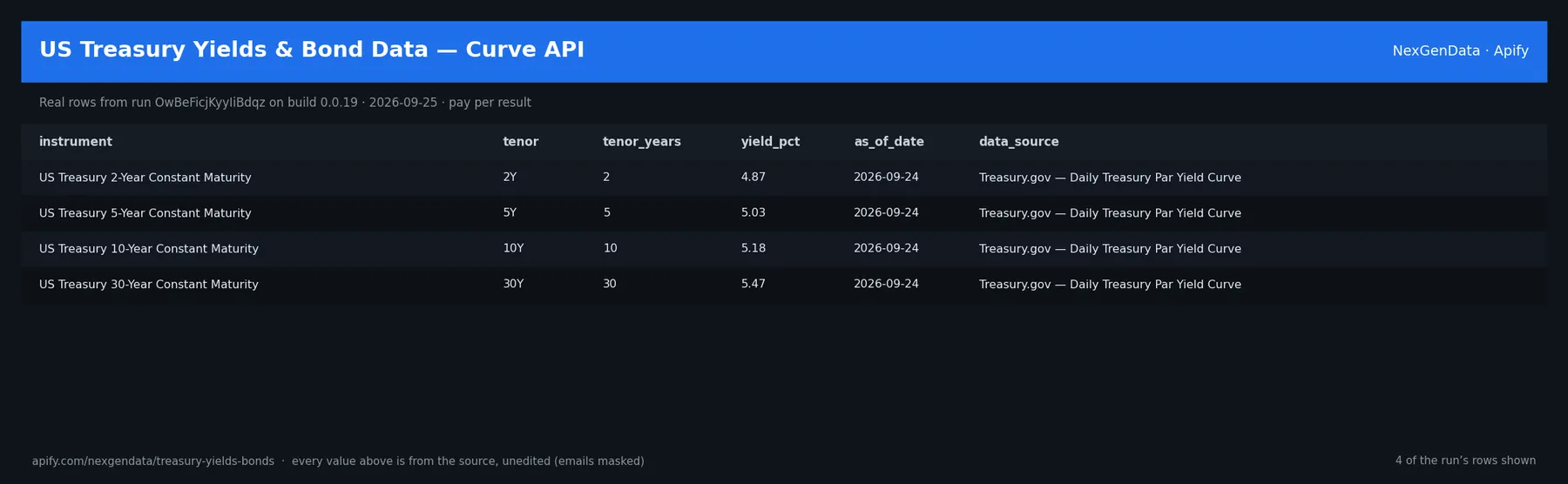
đŸ’” US Treasury Yields & Bond Data — Curve, 2s10s, Spreads sample output — đŸ’” US Treasury Yields & Bond Data — Curve, 2s10s, Spreads, premium API, JSON output, NexGenData premium dataset for analysts, he

If you trade rates, allocate across asset classes, run a corporate treasury, manage pension liabilities, or build macro dashboards, this actor is your low‑cost, programmatic alternative to Bloomberg <GC>, Refinitiv Eikon, FactSet, or scraping Treasury.gov yourself.


Who this is for

  • Fixed‑income desks — daily mark‑to‑market against the official Treasury constant‑maturity curve, plus pre‑computed yield‑change deltas in basis points.
  • Asset allocators & macro hedge funds — 2s10s, curve‑segment exposure, inversion signal — all in one row.
  • Pension funds and LDI teams — long‑end yields (20Y / 30Y) for liability discounting, no terminal seat required.
  • Corporate treasury teams — benchmark rates for floating‑rate debt, intercompany loans, and discount‑rate disclosures.
  • Quant researchers / academics — full daily history per tenor, programmatic access, deterministic schema.
  • AI / agent builders — drop the dataset into an MCP server, RAG store, or scheduled Slack digest.

What you get — schema

Every row in the dataset has the following fields:

FieldTypeExampleMeaning
instrumentstringUS Treasury 10-Year Constant MaturityFriendly instrument name.
tenorstring10YStandard tenor label (1M, 3M, 6M, 1Y, 2Y, 3Y, 5Y, 7Y, 10Y, 20Y, 30Y).
tenor_yearsnumber10.0Tenor expressed in years (fractions for 1M/3M/6M).
yield_pctnumber4.38Annualized yield, percent.
as_of_datestring2026-05-08Observation date (ISO‑8601).
pricenumber / nullnullClean price when available — FRED publishes yields, so this is null for constant‑maturity series.
change_bps_1dnumber / null-3.0Change vs. prior business day, in basis points.
change_bps_1wnumber / null+8.0Change vs. one week prior.
change_bps_1mnumber / null+12.0Change vs. one month prior.
change_bps_ytdnumber / null+47.0Change vs. the first observation of the current year.
series_idstringDGS10Underlying FRED series identifier.
curve_segmentstringlongOne of short (≀1Y), belly (2Y–7Y), long (10Y+).
2s10s_spread_bpsnumber48.0The classic 2s10s spread, in bps, sampled on the same observation date.
invertedbooleanfalsetrue when 2Y > 10Y (curve inverted).
data_sourcestringFRED (St. Louis Fed) — Treasury Constant MaturityProvenance string.

Input

{
"tenors": ["2Y", "5Y", "10Y", "30Y"],
"date_range": "today",
"include_historical": false
}
InputTypeDefaultNotes
tenorsarray of stringsfull curveSubset of 1M, 3M, 6M, 1Y, 2Y, 3Y, 5Y, 7Y, 10Y, 20Y, 30Y.
date_rangeenumtodaytoday, last_30d, last_90d, ytd.
include_historicalbooleanfalseWhen true, emits one row per (tenor, date) for the date range.

The actor always pulls 2Y and 10Y internally so the 2s10s spread and inversion flag are populated even when you ask for a narrower tenor list.


Example outputs

Latest 10Y row (today):

{
"instrument": "US Treasury 10-Year Constant Maturity",
"tenor": "10Y",
"tenor_years": 10.0,
"yield_pct": 4.38,
"as_of_date": "2026-05-08",
"price": null,
"change_bps_1d": -3.0,
"change_bps_1w": -1.0,
"change_bps_1m": +8.0,
"change_bps_ytd": +12.0,
"series_id": "DGS10",
"curve_segment": "long",
"2s10s_spread_bps": 48.0,
"inverted": false,
"data_source": "FRED (St. Louis Fed) — Treasury Constant Maturity"
}

2Y row from the same run:

{
"instrument": "US Treasury 2-Year Constant Maturity",
"tenor": "2Y",
"yield_pct": 3.90,
"2s10s_spread_bps": 48.0,
"inverted": false,
"curve_segment": "belly"
}

Why this exists — Bloomberg / FactSet / Refinitiv alternative

PlatformCost / monthAPI accessYield curve historyCurve‑inversion signalSetup time
Bloomberg Terminal~$2,000Limited (BBG‑native)YesManualDays
Refinitiv Eikon / LSEG~$1,800Yes (paid add‑on)YesManualDays
FactSet~$1,500+Yes (paid)YesManualDays
TradingEconomics API$99–$999YesLimitedNoHours
DIY Treasury.gov scrapeFreeBuild it yourselfYes (CSV)Build it yourselfWeeks
đŸ’” NexGenData Treasury Yields actorPay‑per‑resultJSON / CSV / Excel / RSSFull daily historyBuilt inMinutes

You're not paying for the data — FRED and Treasury.gov are public — you're paying for the assembled curve: deltas, segments, spread, inversion flag, deterministic schema, and the dataset surface that snaps into Apify integrations (Webhooks, Zapier, Make, Google Sheets, n8n, MCP).


How it works under the hood

  1. Probe FRED for each tenor. For every tenor in scope (and always 2Y + 10Y for spread context), the actor hits https://fred.stlouisfed.org/graph/fredgraph.csv?id={SERIES} and parses the CSV. No API key required for daily series.
  2. Normalize the curve. Missing observations (FRED publishes . for non‑business days) are skipped. The reference "today" is the most recent observation across the fetched series, so weekend/holiday runs still return the last good print.
  3. Compute deltas. For each emitted point we look up the most recent value on or before T‑1, T‑7, T‑30, and the first observation of the calendar year. All deltas are expressed in basis points (rounded to 0.01 bp).
  4. Tag and spread. Tenor is bucketed into short / belly / long. The 2Y vs 10Y spread is computed in bps; inverted = true when 2Y > 10Y.
  5. Push to dataset. One JSON record per (tenor, observation date). Stream to your warehouse or hit /dataset/items?format=csv for Excel.

Fallback: when FRED is unreachable, the actor logs a warning per series and emits whatever it has. No silent failure.


Curve‑inversion playbook

The 2s10s spread has front‑run every U.S. recession since the 1960s. With this dataset you can:

  • Schedule the actor daily (Apify schedules → cron) and emit a Webhook when inverted flips.
  • Plot the term structure (yield_pct vs tenor_years) in any BI tool.
  • Cross‑reference change_bps_1d with risk‑asset moves (SPY, HYG) to spot bear flatteners vs bull steepeners.
  • Combine with our ETF Holdings Tracker to monitor TLT/IEF/SHY positioning while the curve moves.

Pricing

Pay‑per‑event:

  • Actor start: $0.01 (charged once when the actor begins running).
  • Yield record: $0.10 per Treasury yield record returned (tenor, yield, daily / weekly / monthly / YTD deltas, curve context).

A full curve snapshot (11 tenors, date_range=today) costs $0.01 + 11 × $0.10 = $1.11. A subset of 4 key tenors costs $0.41. A ytd historical pull of one tenor (~100 trading days) costs roughly $10.

Margins are 20%. Pricing kicks in 14 days after publication for existing users — fresh runs in the first two weeks are free for trial.


Sister actors from NexGenData

This actor is part of the NexGenData cross‑asset intelligence fleet. Pair it with:


Integration recipes

Daily Slack digest — set a daily schedule, route the dataset to a Make.com / Zapier scenario that posts the full curve plus the 2s10s line to a Slack channel.

Curve‑inversion alert — schedule daily; webhook fires only when inverted = true and change_bps_1d magnitudes exceed your threshold.

LDI rebalance feed — pipe the 20Y/30Y rows into your liability‑discounting model via the Apify Google Sheets integration.

MCP / agent — wire this actor into the finance‑mcp‑server so an LLM agent can ask "what's the 2s10s today" and get a typed answer.

Backtesting — set date_range=ytd and include_historical=true to get the full year per tenor, then materialize into Parquet via the Apify Dataset API.


FAQ

Q: Is this real‑time? A: FRED publishes Treasury constant‑maturity yields with a 1‑business‑day lag. For intraday quotes use a paid market‑data feed; for end‑of‑day analytics this dataset matches the Fed's official release.

Q: Why FRED and not Treasury.gov directly? A: Both work. FRED is more programmatic (clean CSV per series), versus the Treasury XML which changes layout. We use FRED's Treasury Constant Maturity series — the same series that Treasury.gov sources.

Q: Why is price null? A: Constant‑maturity series are yields, not cash bonds. We don't synthesize clean prices from yield because converting requires a coupon / settlement convention that varies. Use the yield with a duration approximation if you need a price proxy.

Q: How do I get a CSV? A: Apify dataset API: GET /v2/datasets/{datasetId}/items?format=csv. Or hit the Console export button.

Q: Will this stay free in week 1? A: Yes — the pricing record sets startedAt to 14 days after publication, so all users get a free trial window.

Q: Can I get a longer history? A: Set date_range=ytd for the current year. For multi‑year history, file a request — we keep the FRED back catalog up to the limit (DGS10 goes back to 1962).


Roadmap

  • TIPS (real yields, breakevens) — DFII5, DFII10, DFII20, DFII30.
  • OIS / SOFR overlay for repo / funding context.
  • On‑the‑run vs constant‑maturity reconciliation.
  • Foreign sovereign curves (DE, UK, JP) under a separate sister actor.

Support