πŸ›οΈ US Treasury Auction Results Tracker avatar

πŸ›οΈ US Treasury Auction Results Tracker

Pricing

from $5.00 / 1,000 business records

Go to Apify Store
πŸ›οΈ US Treasury Auction Results Tracker

πŸ›οΈ US Treasury Auction Results Tracker

US Treasury auction results: yields, bid-to-cover ratio, offering & accepted amounts, bidder breakdown by security and date. For rates traders, macro analysts, and fintech.

Pricing

from $5.00 / 1,000 business records

Rating

0.0

(0)

Developer

NexGenData

NexGenData

Maintained by Community

Actor stats

0

Bookmarked

11

Total users

1

Monthly active users

a day ago

Last modified

Categories

Share

Pay-per-result US Treasury auction data β€” $0.10 per auction record. No Bloomberg seat, no Refinitiv contract, no rates-desk data subscription gating a number that the US Treasury already publishes for free.

US Treasury auction results: yields, bid-to-cover ratio, offering and accepted amounts, and bidder breakdown by security and date. Every auction in the marketable-securities calendar β€” Treasury bills (4-week through 52-week), notes (2, 3, 5, 7, 10-year), bonds (20 and 30-year), TIPS (5, 10, 30-year inflation-protected), and FRNs (2-year floating-rate notes) β€” is emitted as a discrete, structured record sourced straight from official TreasuryDirect auction results. Built for rates traders, macro analysts, and fintech teams who need auction outcomes in clean JSON without paying terminal money.

Why use this

The US Treasury runs the largest, most-watched auction calendar on the planet β€” roughly 400+ marketable-securities auctions a year across bills, notes, bonds, TIPS, and FRNs. Each prints a stop-out yield, a bid-to-cover ratio, and a tendered-vs-accepted breakdown that moves the rates complex within seconds of release.

The data is public β€” TreasuryDirect publishes it with no authentication, no paywall, and no per-symbol licensing. Yet the moment you want it programmatically, in a stable schema, on a schedule, the conventional answer is a Bloomberg Terminal at ~$24,000 per seat per year or a Refinitiv Workspace in the same range. That is an absurd price for a number the government gives away.

This actor closes that gap. Pass a date range and an optional security filter; get back one JSON record per auction with the fields that matter β€” auction date, security type and term, high yield, bid-to-cover ratio, offering amount, and CUSIP. You pay $0.10 per record. No seat, no subscription, no minimum, no proxy add-ons.

What you get

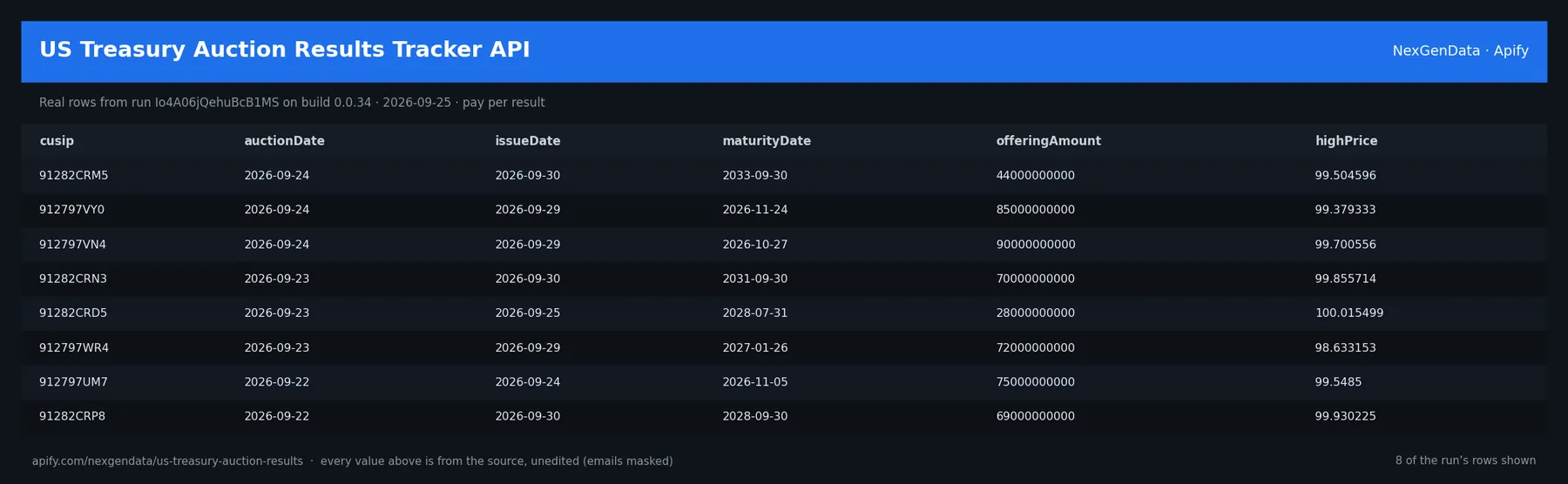
Each emitted record represents one completed Treasury auction. Records carry exactly seven fields, each mapped to a column on the official Treasury auction results release:

  • auctionDate β€” the date the auction was held (ISO YYYY-MM-DD). This is the competitive/non-competitive close date, the moment the results print and the market reacts.
  • securityType β€” the marketable-securities class: Bill, Note, Bond, TIPS, or FRN. This is your top-level filter for separating short-end bill supply from coupon issuance.
  • securityTerm β€” the exact tenor as the Treasury labels it: 4-Week, 13-Week, 26-Week, 52-Week, 2-Year, 3-Year, 5-Year, 7-Year, 10-Year, 20-Year, 30-Year, plus TIPS/FRN equivalents. Use it to isolate one point on the curve.
  • highYield β€” the stop-out / high yield: the highest accepted yield at which the auction cleared. The single most-watched number on the release β€” the gap between the stop-out and the pre-auction when-issued level is the auction "tail" (or "stop-through") that rates traders trade off.
  • bidToCoverRatio β€” total bids tendered divided by amount accepted. The headline demand metric: a 2.6x cover means $2.60 was bid for every $1.00 sold. A cover below the trailing average signals weak demand and often precedes a yield back-up.
  • offeringAmount β€” offering size in raw USD (e.g. 39000000000 = $39 billion). Tracked over time, this is the cleanest read on Treasury issuance and supply.
  • cusip β€” the 9-character CUSIP security identifier β€” the canonical key for joining auction results to secondary-market pricing, settlement, and your own holdings system.

Use cases

  • Rates trading & auction tail analysis β€” compute the stop-out vs when-issued tail from highYield to gauge whether an auction came in strong (stopped through) or weak (tailed), and feed that signal into post-auction rates positioning.
  • Primary-dealer demand monitoring β€” track bidToCoverRatio against its trailing average per tenor to flag deteriorating or improving sponsorship before it shows up in the curve.
  • Macro research on issuance & supply β€” chart offeringAmount over time by securityType and securityTerm to quantify the Treasury's funding mix, duration extension, and the bill-vs-coupon supply rotation that drives front-end dynamics.
  • Fintech auction calendars β€” power a consumer or pro-facing app displaying completed Treasury auctions with results, without a $24k/seat data backend.
  • Fixed-income backtesting β€” build a clean historical series of auction yields and cover ratios per CUSIP/tenor to backtest auction-cycle and supply-pressure strategies.
  • Fixed-income product yield reference β€” use highYield as an authoritative, government-sourced yield reference for pricing, marketing, or benchmarking savings, money-market, and bond products.
  • Issuance-size trend tracking β€” monitor offeringAmount quarter over quarter to anticipate refunding announcements, coupon size changes, and bill supply waves.

Sample output

{
"auctionDate": "2026-06-11",
"securityType": "Note",
"securityTerm": "10-Year",
"highYield": 4.276,
"bidToCoverRatio": 2.58,
"offeringAmount": 39000000000,
"cusip": "91282CME8"
}

Input parameters

ParameterDescriptionExample
securityTypeFilter by security type (Bill / Note / Bond / TIPS / FRN)"Note"
securityTermExact term to filter on"10-Year"
daysBackLook back this many days from today (ignored if explicit dates are set)90
startDateOverride start date (YYYY-MM-DD)"2026-03-01"
endDateOverride end date (YYYY-MM-DD)"2026-06-25"
maxResultsMaximum number of auctions to return150

All parameters are optional. With neither dates nor daysBack, the actor returns the most recent auctions up to maxResults; explicit startDate/endDate take precedence over daysBack.

How to use

Python (apify-client):

from apify_client import ApifyClient
client = ApifyClient("YOUR_APIFY_TOKEN")
run_input = {
"securityType": "Note",
"securityTerm": "10-Year",
"daysBack": 90,
"maxResults": 150
}
run = client.actor("nexgendata/us-treasury-auction-results").call(run_input=run_input)
for item in client.dataset(run["defaultDatasetId"]).iterate_items():
print(item["auctionDate"], item["securityTerm"], item["highYield"], item["bidToCoverRatio"])

cURL (run-sync, results in one call):

curl -X POST "https://api.apify.com/v2/acts/nexgendata~us-treasury-auction-results/run-sync-get-dataset-items?token=YOUR_TOKEN" \
-H "Content-Type: application/json" \
-d '{
"securityType": "Note",
"securityTerm": "10-Year",
"daysBack": 90,
"maxResults": 150
}'

You can also run it from the Apify web console: open the actor page, click Try for free, paste your input JSON, and hit Run. Results export as JSON, JSONL, CSV, Excel, or HTML. The actor pairs cleanly with the built-in Apify Scheduler β€” run it daily after the auction close and dedupe new rows on the stable cusip + auctionDate key.

Pricing

This actor runs on Apify's pay-per-event (PPE) model β€” you pay for results, not run-time:

  • $0.10 per auction record β€” the primary event, charged once per row pushed to the dataset.
  • Actor start β€” a one-time per-run cost (sub-cent at typical memory), charged when the run launches.

No subscriptions, no minimums, no per-CPU-second billing, no proxy add-ons.

Worked example. Pulling 90 days of auctions across the full calendar returns roughly 150 records:

1 actor start β‰ˆ $0.01
150 records Γ— $0.10 = $15.00
-------------------------------------
Total β‰ˆ $15.01

That is a full quarter of every bill, note, bond, TIPS, and FRN auction outcome for about fifteen dollars β€” versus a ~$24,000/seat/year terminal. Apify's $5 free credit covers your first experiments, no credit card. Browse the full NexGenData fleet at https://apify.com/nexgendata?fpr=2ayu9b.

How this compares to Bloomberg

PlatformTreasury auction resultsAnnual costProgrammatic access
Bloomberg Terminal (rates / auction analytics)Yes β€” full auction analytics, when-issued, tails~$24,000 / seat / yearYes (BLPAPI, seat-locked)
Refinitiv / LSEG WorkspaceYes β€” auction results & rates~$22,000 / seat / yearYes (Refinitiv Data Platform)
US Treasury Auction Results Tracker (this actor)Yes β€” date, type, term, high yield, bid-to-cover, offering amount, CUSIPPay-per-record, no subscriptionYes (Apify REST API + webhooks)

A Bloomberg or Refinitiv terminal is the right tool when you need real-time when-issued quotes, the full bidder-allotment breakdown the instant it prints, sub-second alerting, and an integrated rates workspace on top of the raw results. If you are a sell-side trader reacting in the millisecond an auction clears, keep your terminal.

But much auction-results consumption needs none of that. If your workflow is:

  • A daily or post-auction-close pull of yields and cover ratios into a warehouse
  • A macro research notebook charting issuance size and demand over months
  • A fintech app surfacing a Treasury auction calendar to end users
  • A backtest that ingests historical auction outcomes once per run

…then a $24k/seat terminal is dramatic overkill for what is, at bottom, public TreasuryDirect data. Paying $0.10 per record for exactly the seven fields you need is a 90%+ cost saving and a far simpler integration.

FAQ

Q: How fresh is the data, and when is it published? A: Treasury auction results post to TreasuryDirect shortly after each auction closes (typically early afternoon ET on auction day). Run the actor after the close β€” or schedule it daily β€” to pick up that day's results. Each run pulls live.

Q: What exactly is bid-to-cover? A: It is total bids tendered divided by the amount accepted. A 2.6x bid-to-cover means $2.60 was bid for every $1.00 of securities sold. It is the headline demand gauge β€” higher is stronger sponsorship; a cover below the trailing average for that tenor signals soft demand.

Q: Can I filter to just 10-Year notes? A: Yes. Set securityType to "Note" and securityTerm to "10-Year" and the actor returns only 10-year note auctions in your date window. You can also filter by type alone (e.g. all Bill auctions) or term alone.

Q: How do date range and daysBack interact? A: If you pass startDate/endDate, those win and daysBack is ignored. If you pass only daysBack, the actor looks back that many days from today. If you pass neither, it returns the most recent auctions up to maxResults.

Q: How far back does coverage go? A: The actor reads the official TreasuryDirect auction results history, so you can pull recent auctions or reach back across prior years by widening startDate/endDate β€” bounded by maxResults.

Q: What output formats are available? A: JSON, JSONL, CSV, Excel, and HTML via Apify dataset export. The schema is stable and additive-only (see below).

Schema stability & versioning

This actor follows NexGenData's additive-only schema contract:

  • New fields may be added at any time β€” they appear as new keys in the JSON, defaulting to null for older runs.
  • Existing fields are never renamed or removed without a major-version bump and an advance changelog notice.
  • Field semantics (units, timezones, value-sets) are never silently changed β€” if a change is needed, we add a new field with the new name and deprecate (but keep) the old one for at least 90 days.

This means you can build a production ETL job on these seven fields and not worry about a Tuesday change breaking a Friday's pipeline. If you spot an unexpected change, open an issue on the actor's Apify Issues tab and we'll look the same day.

  • The actor reads public, unauthenticated US Treasury (TreasuryDirect) auction results β€” the same data the government publishes for free, the way a logged-out browser would.
  • US Treasury auction results are official government data and carry no authentication or per-symbol licensing wall.
  • You are responsible for ensuring your downstream use complies with applicable terms and your jurisdiction's data-protection and financial-data rules. Auction data used for product yield references, trading, or redistribution should be reviewed against your own regulatory obligations.
  • We do not collect, store, or transmit any credentials for the source.

Part of the NexGenData Finance / Markets suite β€” pair this actor with:

Explore the full fleet of 200+ finance and markets actors at https://apify.com/nexgendata?fpr=2ayu9b.