

Australia International Goods Trade - ABS
Pricing
from $33.50 / 1,000 trade observations
Australia International Goods Trade - ABS
Australia's monthly goods trade from the ABS (credits = exports, debits = imports, balance on goods, by commodity group, A$ million): pick items (e.g. total exports, coal), original/seasonally adjusted/trend, a month range and newest first. CC BY 4.0. $0.05 per record.
Pricing
from $33.50 / 1,000 trade observations
Rating
0.0
(0)
Developer
NexGen Signal
Maintained by CommunityActor stats
0
Bookmarked
2
Total users
1
Monthly active users
20 days ago
Last modified
Categories
Share
Australia's international trade in goods from the Australian Bureau of Statistics (ABS), as clean per-observation records - one trade classification x measure/partner x period, with the observation value.
Who buys this and for what job
- Trade, commodity and logistics analysts following Australia trade data month by month.
- Exporters, importers and consultants sizing markets with Australia exports imports data by commodity and partner.
- Economists watching the goods balance in the official ABS series.
Buyers usually search for this as "australia trade data" or "australia exports imports data".
Choose the series
Question: What are Australia's latest monthly goods exports, imports and trade balance (seasonally adjusted)?
Run on 30 Sep 2026 the selection held 1,983 observations; the newest 10 were returned (10 × $0.05 = $0.50 on Apify's Free plan):
| Month | Item | Adjustment | A$ million |
|---|---|---|---|
| 2026-07 | Balance on goods | Seasonally Adjusted | 1923 |
| 2026-07 | Goods Debit; Total goods | Seasonally Adjusted | -44339 |
| 2026-07 | Goods Credit; Total goods | Seasonally Adjusted | 46261 |
| 2026-06 | Balance on goods | Seasonally Adjusted | 2341 |
| 2026-06 | Goods Debit; Total goods | Seasonally Adjusted | -45496 |
Search options (all optional; a record must match every option you set, and several values in one option match any of them):
- Items (
items) — ABS item codes or words:170Balance on goods,1000total exports (Goods Credit),2000total imports (Goods Debit), or words such asCoal,Metal ores,Machinery. - Adjustment (
adjustment) —original,seasonally adjustedortrend. - From / to month (
fromPeriod,toPeriod) — e.g.2025-07. - Newest first (
newestFirst) — latest month first.
Items and adjustment go into the ABS SDMX query, so ABS returns only the chosen series and months, before the record limit. A period with no data is reported as an empty result, not a failure; an item that matches nothing stops the run before any request, nothing charged. Every record now also carries data_item_label and tsest_label, the ABS names for the codes (added 30 Sep 2026). This dataflow covers Australia's goods trade by commodity group (credits = exports, debits = imports, in A$ million); it has no trading-partner split. With no option set the actor returns the dataflow exactly as before (the older sdmxKey/startPeriod inputs still work through the API).
What one record represents
The source is the ABS Data API at data.api.abs.gov.au, read as keyless SDMX-CSV from the ABS,ITGS,1.2.0 dataflow. Each record is one observation: measure, data item, region, frequency, period and the observation value, plus the SDMX unit and status fields.
Sample output
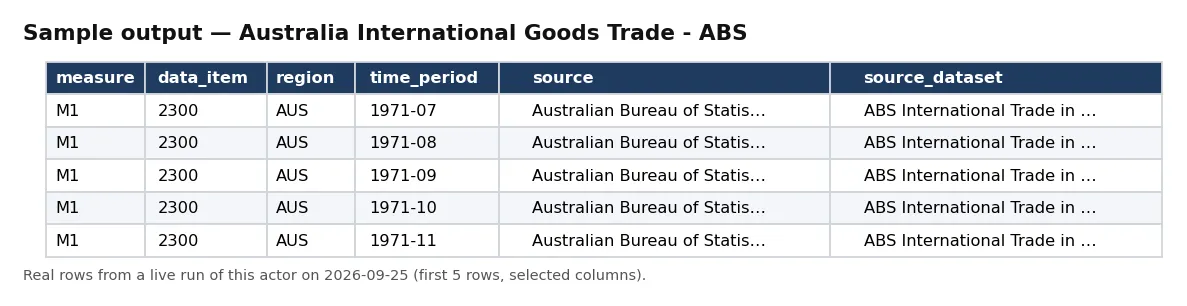
Real rows from a live run of this actor (first 5 rows, selected columns).
One full record from the same run, exactly as delivered:
Coverage and the default run
Default changed on 30 Sep 2026: if you leave maxRecords out, a run now returns up to 10 records (it was 1,000). Set maxRecords yourself to get more — the maximum is unchanged.
The complete dataflow is 97,932 observations. The Actor streams the SDMX-CSV and the default run is capped by Maximum records so a first run is inexpensive; raise the cap to pull the complete set. Only statistical aggregates are emitted - ABS logos, unit-record microdata and identified third-party material are not part of this dataflow.
Licence
Australian Bureau of Statistics (ABS). Creative Commons Attribution 4.0 International (CC BY 4.0): commercial reuse and adaptation permitted with attribution to the ABS. Logos, unit-record microdata and identified third-party material are excluded.
Sibling Actors
The companion ABS building approvals cell shares this door but is a different dataflow. No row overlap.
Fields, scheduling and integration
Every field in the record is either a source-native identifier, a source-native attribute, or one of the six
provenance fields (source, source_dataset, licence, attribution, caveat, observed_at) the fleet attaches to
every record. Nothing is derived or inferred beyond the small, documented transforms noted above, and nothing is
dropped silently - the handling section spells out exactly what is excluded and why. The grain is one record per the
natural unit of the source, which keeps each row independently meaningful, keeps the key stable across runs so
re-running is a cheap upsert rather than a re-import, and lets you aggregate up to whatever unit you need without
unpicking a pre-joined table.
Because the source republishes on its own cadence, a scheduled run keeps a downstream table current: new and changed
records upsert over the old ones on the stable key, and the observed_at stamp tells you when each was last seen live.
Set Maximum records low to sample the shape of the data cheaply, then raise it once the cell fits your use; the
Actor streams or partitions its source, so memory stays flat regardless of how many records you request, and you are
billed only for what is delivered. The output is a flat table of typed records, so it drops straight into whatever you
already use: load the run's dataset over the API or an export, key on the record id, and upsert. Because identifiers
are preserved exactly as the source publishes them, joins across the fleet's cells - and onto your own systems - work
without a mapping layer. There is no subscription and no minimum: the per-record price and the record cap together
mean the spend on any run is known in advance and matched exactly to the data you receive.
Reconciling counts honestly
Where the live count differs from any previously published figure, the live measure is the honest one and is what this listing quotes; sources re-issue and re-version their data over time. The run receipt always states what was actually delivered and charged and confirms the two agree, so every run is auditable against itself regardless of what any external index expected.
Scaling, scheduling and support
A common pattern is a light scheduled run that pulls the newest slice into a staging table, then a merge on the stable key into the table your product reads, so you never re-pay for rows you already hold and your history grows cleanly over time. Because the record shape assumes no particular warehouse, language or tool, the integration work is a load and a merge, not a cleaning project: the same code path handles a 40-row sample and a full pull, and the only thing that changes between them is the record cap. If you only need a slice, the cap and any partition or filter inputs bound the run precisely, so a targeted pull costs cents rather than the price of the whole set, and a broad pull is simply a higher cap left to run. Nothing about the delivery is subscription-gated: each run stands alone, priced at exactly the records it returns, so you can dial spend up or down run by run as your needs change, and a scheduled cadence keeps a downstream table current without any standing commitment. When the source publishes a correction or a new period, the next run picks it up and upserts it over the stale row on the same key, so the table you maintain stays both complete and current with no manual reconciliation.
Provenance and compliance
Every run reads the door host's robots.txt at runtime and records the result (URL, status, byte length and, where
a policy is served, its SHA-256) in the run's RUN_RECEIPT. Where the host serves no applicable policy - a 404, a
403, or a homepage redirect - the gate records that as a flag and proceeds on the licence, which grants re-use; a flag
is never treated as permission in itself. The endpoint is keyless and the Actor reads only the public data door -
never a mirror, and it never bypasses a block.
Data quality and freshness
Numbers arrive as real numbers, booleans as real booleans, and every other value as a string or null, so the dataset
loads without a cleaning pass. Each record is keyed on a stable composite of the source's own identifiers, so it is
safe to diff, deduplicate or upsert. Every run re-reads the live door, so the data is as fresh as the source
publishes, and each record's observed_at stamp dates the snapshot. The receipt records how many rows were delivered
and charged and confirms charge_equals_delivered.
Billing, delivery and joins
Pricing is per record: you are billed only for records the Actor actually delivers, and the charge is raised after each record is pushed (push-then-charge), so a failed or empty run costs nothing. The Maximum records cap bounds every run, so spend is known before you start - sample cheaply, then raise it. Every record is a flat, typed object keyed on a stable id, so it loads without a cleaning pass, diffs cleanly between runs, and upserts into a table you keep over time; re-running keeps that table current without re-paying for rows you already hold, and each receipt reconciles delivered against charged. Because the source's own identifiers are preserved verbatim, the dataset joins onto other sources keyed on the same identifier.
Who buys this, and how they use it
This cell is bought by teams that need the source's published set as a typed, keyed table they can hold and refresh rather than a page they scrape: market- and macro-intelligence teams sizing and tracking a market, data engineers wiring a clean upstream feed into a warehouse, and compliance and research teams building on a stable identifier. The grain and the key are chosen so the output is a building block, not a one-off export - you run it on a schedule, keep the delta, and join it to your other sources on the identifiers it preserves verbatim. The spend on any run is the per-record price times the records delivered, matched exactly to what you receive.


