

Company Email Lookup by Domain — Role & Published Emails, Bulk
Pricing
from $67.00 / 1,000 business email records
Company Email Lookup by Domain — Role & Published Emails, Bulk
Company email lookup by domain, in bulk: the business emails published on the company's own pages plus role addresses as labelled suggestions, MX-checked. One record per email. Keyless, no person data. Part of NexGen Signal — data tools and official-source data products
Pricing
from $67.00 / 1,000 business email records
Rating
0.0
(0)
Developer

NexGen Signal
Maintained by CommunityActor stats
0
Bookmarked
2
Total users
1
Monthly active users
7 days ago
Last modified
Categories
Share
Turn a list of company domains into reachable company emails — without buying a people database. Paste one domain or thousands; for each you get the email addresses the company publishes on its own site, plus the standard role addresses (info@, sales@, contact@) labelled as suggestions, each with a DNS check that the domain can receive mail.
Pay per email. No API key, no login, no person data. Where a "leads finder" sells you named people, this answers the plainer question most outreach lists start with: what address reaches this company? — and tells you for every row whether it was read off the company's pages or is a standard-role suggestion.
Use it when you have domains, not names: a CRM export, a list of exhibitors, a directory crawl. One tidy record per email, keyed by domain, ready for a CSV or an automation step.
What this is, in one paragraph
Every company publishes a way to reach it, but it's spread across a contact page, an about page, a footer. This actor pulls it together: for each domain it reads the homepage and a few likely contact/about pages, extracts the business emails published there (classifying each as a role address like sales@ or a named-person business address), adds the standard role addresses that almost every business runs, and confirms via a DNS lookup whether the domain can receive mail at all. You get one record per email, each tagged as published or inferred, so you know exactly what came off the site and what is a standard-role suggestion. It is a keyless, code-friendly B2B contact-discovery endpoint.
Who buys this and for what job
- Sales and RevOps teams turning a list of target-company domains into a reachable contact per account.
- Lead-generation and agency teams building B2B prospect lists at scale.
- Data teams assembling a company-email table keyed by domain.
- Builders and agents who need a keyless company-email endpoint they can call from code.
The job it does: take a company's domain and return the business emails that reach it — published and standard-role — with a check that the domain receives mail (not that each mailbox exists), without an account or key.
Buyers usually search for this as "email finder" or "find business email by domain".
Sample output
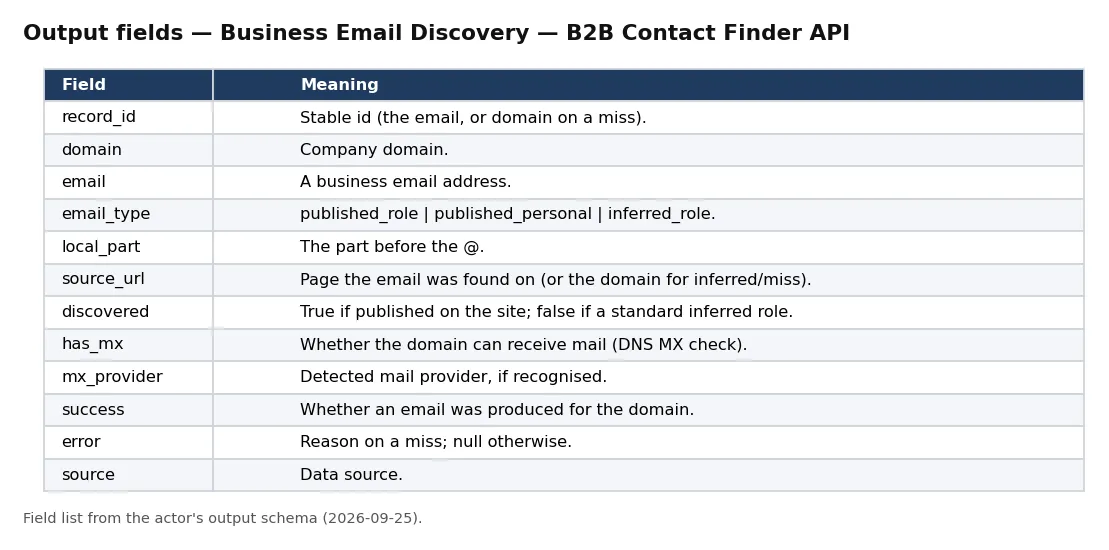
Output fields of this actor.
Pricing
Pay per event. One event: a business email record delivered. Tiered by your Apify plan; the record is delivered before it is charged. No subscription. A domain that yields nothing still returns one record (with success: false) and counts as one processed lookup.
| Event | Free plan | Bronze | Silver | Gold / Platinum / Diamond |
|---|---|---|---|---|
| Business email record | $0.10 | $0.09 | $0.08 | $0.067 |
There is also a negligible per-run start fee. About 10 emails per dollar at the base rate.
Input
| Field | Type | Default | Description |
|---|---|---|---|
domains | array | (required) | One or more company domains (e.g. stripe.com). One record is returned per business email found. |
includeInferredRoles | boolean | true | Also return standard role addresses (info@, contact@, sales@, …) for mail-capable domains, marked as inferred. |
maxPerDomain | integer | 50 | Cap on email records returned per domain. |
proxyConfiguration | object | No proxy (useApifyProxy: false) | Proxy for site requests. Apify proxy with no group chosen uses the automatic datacenter proxy; residential only if you select the RESIDENTIAL group. |
Output
One JSON object per email. Real example:
email_type is one of published_role, published_personal, or inferred_role; discovered is true only for addresses actually published on the site. An unbilled RUN_RECEIPT records how many domains went in, how many email records were delivered, and how many domains yielded at least one.
Field reference
Each record carries record_id (the email), the domain, the email and its local_part, the email_type and discovered flag that tell you whether it was published or a standard-role suggestion, the source_url it came from, and the domain's mail capability (has_mx, mx_provider) from a DNS check. success and error let your pipeline branch on empty domains. Provenance travels on every record: source, licence, attribution, disclaimer, and observed_at.
How a run works
For each domain the actor fetches the homepage and a few likely contact/about pages (directly by default, or through the proxy you set), extracts every email that belongs to that domain, and classifies each. It confirms the domain's mail server via a DNS MX lookup, and — when that check passes and you've left inferred roles on — adds the handful of standard role addresses every business runs, marked inferred_role so they're never confused with published data. Each email becomes one delivered, billed record; a domain with nothing to show still returns a single honest record so every input is accounted for.
Published vs. inferred
The distinction is deliberate and always explicit. A published_role or published_personal address was found in the company's own public pages — that's data. An inferred_role address (info@company.com and friends) is a standard-role suggestion returned only when the domain's DNS says it can receive mail — that's a lead, not a claim that the mailbox is monitored. Filter on discovered to keep only what was published, or keep both for maximum reach; either way you always know which is which, so you never mistake a suggestion for a verified find.
Running at scale
Feed a single domain to test or a list of thousands to build a whole prospect base in one pass. Cost tracks output exactly: the number of email records delivered is the number of events billed, and maxPerDomain caps how many emails any one domain can contribute so a single large site can't blow the budget. Every domain resolves to at least one record — a real email or an honest miss — so nothing silently disappears from a big run, and the unbilled run receipt reconciles domains-in against records-out and how many domains produced a contact. Each site fetch is retried up to three times (on a fresh proxy session when you set a proxy), so an intermittent block on one company doesn't cost you the rest of the batch.
Use with AI agents
Point Claude, an OpenAI Agents SDK tool, an n8n or Make flow, or any MCP-aware client at this actor and hand it a list of company domains. Because the output is flat JSON keyed by domain and email, an agent can build a reachable-contact list per account in one call and prefer published addresses over inferred ones. A typical prompt: find the business contact emails for each of these company domains and flag which were actually published.
Lawful use and limitations
- Business contacts, public sources. Every published address comes from the company's own public pages; inferred addresses are standard business roles gated on a DNS mail check. This is a B2B prospecting dataset for contacting businesses and their published business contacts — not private individuals.
- Use it lawfully. Respect applicable outreach and data-protection law (for example GDPR legitimate-interest and CAN-SPAM requirements) and honour opt-outs and unsubscribe requests.
- MX is a DNS check. It confirms a domain can receive mail; it is never an SMTP mailbox probe and does not confirm a specific address is monitored.
- Coverage varies. Some companies publish no addresses or obfuscate them; those return an honest empty record. No data beyond business email details is collected.
Business email addresses discovered from a company's public web pages plus standard role addresses, DNS-verified at the domain. For B2B outreach to businesses and their published business contacts, not private individuals. Use in line with applicable outreach and data-protection law, and honour opt-outs.


