

Colombia SECOP II Public Contracts
Pricing
from $33.50 / 1,000 secop contract records
Colombia SECOP II Public Contracts
Colombia SECOP II public contracts (datos.gov.co) as clean per-record data by signing year - entity, contract id, status, type, modality, dates, value, awarded organisation. Organisations only (natural-person providers and 18 person/bank fields dropped). CC BY-SA 4.0. $0.05 per record.
Pricing
from $33.50 / 1,000 secop contract records
Rating
0.0
(0)
Developer
NexGen Signal
Maintained by CommunityActor stats
0
Bookmarked
1
Total users
0
Monthly active users
22 days ago
Last modified
Categories
Share
Colombia's public contracts from SECOP II (Sistema Electronico de Contratacion Publica), operated by Colombia Compra Eficiente, as clean, per-contract records - for the signing year you choose, organisations only. Entity, department, contract id, status, type, modality, dates, value, and the awarded organisation.
What one record represents
The source is the SECOP II Contratos Electronicos dataset on the national open-data portal
datos.gov.co (Socrata resource jbjy-vk9h). Each record is one electronic contract: the contracting
entity (name, NIT, department, city, order, sector, branch), the purchase-process id, the contract id and
reference, its status, the main category code, the contract type and contracting modality, the signature and
start/end dates, the awarded provider (organisation name, NIT, whether it is a group or an SME), the contract
value and amount paid, the source of funds, and the public process URL. It is the contract-registry view of
Colombian public spending, at the grain of one signed contract.
Sample output
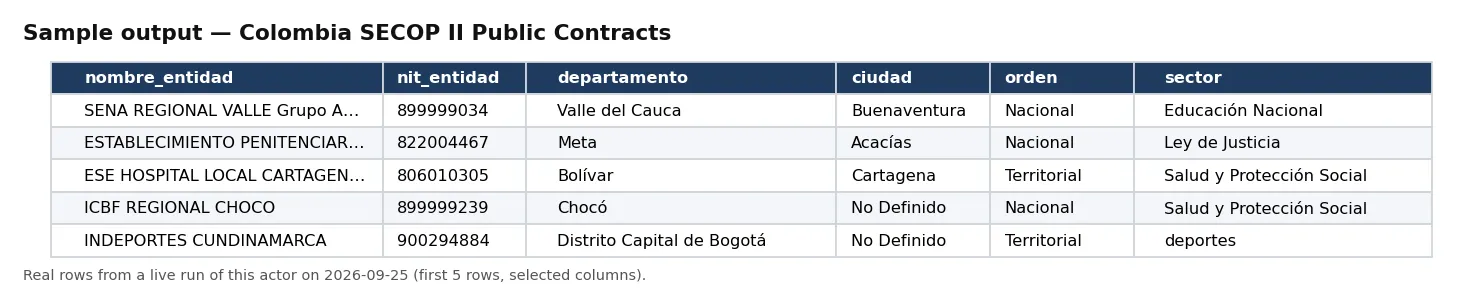
Real rows from a live run of this actor (first 5 rows, selected columns).
One full record from the same run, exactly as delivered:
Coverage, volume and the year partition
Default changed on 30 Sep 2026: if you leave maxRecords out, a run now returns up to 10 records (it was 500). Set maxRecords yourself to get more — the maximum is unchanged.
The SECOP II contract master is very large - a live count(*) over the resource returns about 5.98 million
rows across all years, and organisation-only (NIT provider) contracts number about 896,000. Because a
single run over six million rows would be neither cheap nor useful, the Actor takes a required year input
(the contract-signing year, prefilled to the current year) and scopes each run to that year's organisation
contracts. For the current year that is on the order of tens of thousands of contracts; you raise Maximum
records to pull the whole year, or lower it to sample. Paging is by Socrata's indexed row id, so a run is a
stable, resumable sweep of the selected year.
Person data: a two-layer structural exclusion
Colombian contract data carries a great deal of personal data about the individuals around a contract, and this cell removes all of it, structurally, in two independent layers.
The first layer is a named-field exclusion: eighteen columns that identify natural persons or bank accounts - the legal representative's name, nationality, domicile, identification type, identification number and gender; the ordenador del gasto, supervisor and ordenador de pago name, document type and document number; and the bank name, account type and account number - are never placed in the query and never delivered. The run receipt lists them. A record that somehow carried one would fail a built-in assertion before it could be pushed.
The second layer is a provider-type gate. Every SECOP II contract records the provider's document type
(tipodocproveedor). Where that is anything other than NIT (the organisation tax id) the provider is a
natural person - a Cedula de Ciudadania, Cedula de Extranjeria or passport holder - and the whole row is
dropped. The filter is applied server-side in the query and re-checked on every row before delivery, so a
natural-person provider is never emitted. Only organisation (NIT) contracts reach the dataset. In a typical
recent year this drops the large majority of rows: the delivered set is the clean, organisation-only subset,
and the awarded-provider field is therefore always a company legal name, never a person.
Licence
Creative Commons Attribution-ShareAlike 4.0 International (CC BY-SA 4.0). You are free to share and adapt the material for any purpose, including commercially, provided you give appropriate credit AND distribute any derived material under the same CC BY-SA 4.0 licence. ShareAlike: any redistribution or derived dataset built from these records must itself be licensed under CC BY-SA 4.0. The attribution and the ShareAlike obligation ride on every record and are restated here so any downstream redistribution carries them.
Who buys this, and how they use it
This cell is bought by teams that need the source's full published set as a typed, keyed table they can hold and refresh, rather than a page they scrape. Market-intelligence and lead-generation teams use it to size a market and track who is active in it; analysts and journalists use it to build a longitudinal series that the source's own portal does not expose; data engineers use it as a clean upstream feed into a warehouse, keyed so it upserts without duplication. The common thread is that the record grain and the stable key are chosen so the output is a building block, not a one-off export: you run it on a schedule, keep the delta, and join it to your other sources on the identifiers it preserves verbatim.
Field-by-field, and why the grain is what it is
Every field in the record is either a source-native identifier, a source-native attribute, or one of the six
provenance fields (source, source_dataset, licence, attribution, caveat, observed_at) the fleet
attaches to every record. Nothing is derived or inferred beyond the small, documented transforms noted above,
and nothing is dropped silently: the person-handling section spells out exactly which fields are excluded and
why. The grain - one record per the natural unit of the source - is deliberate: it keeps each row independently
meaningful, keeps the key stable across runs so re-running is a cheap upsert rather than a re-import, and lets
you aggregate up to whatever unit you need without having to unpick a pre-joined table. If you need a different
grain, you compose it downstream from these rows; the cell's job is to deliver the atomic, person-safe,
licence-clean records that everything else is built from.
Reconciling counts honestly
Where the live count differs from any previously published figure, the live measure is the honest one and is what this listing quotes; sources re-issue and consolidate their data over time, so a figure drifts. The run receipt always states what was actually delivered and charged and confirms the two agree, so every run is auditable against itself regardless of what any external index expected.
Sibling Actors
Provenance and compliance
Every run reads the door host's robots.txt at runtime; the gate result (URL, status, byte length and, where a
policy is served, its SHA-256) is written to the run's RUN_RECEIPT. Where the host serves no applicable
robots rule, or redirects its policy to another host, the gate records that (flagged) and proceeds on the
licence, which grants re-use. The endpoint is keyless. The Actor never bypasses a block or fetches through a
mirror, and it reads only the public listing endpoint - never a per-record detail page.
Data quality and freshness
Numeric columns are delivered as real numbers and every other column as a string or null, so the dataset loads
without a cleaning pass. Delivery is keyed on a stable source identifier, so the data is safe to diff,
deduplicate or upsert. Every run re-reads the live door, so the data is as fresh as the source publishes, and
each record's observed_at stamp dates the snapshot. The run's RUN_RECEIPT records the source URL and how
many records were delivered and charged, and confirms charge_equals_delivered.
Billing, delivery and joins
Pricing is per record: you are billed only for records the Actor actually delivers, with the charge raised after each record is pushed (push-then-charge), so a failed or empty run costs nothing. The Maximum records cap bounds every run, so you control spend precisely - sample cheaply, then raise it. Every record is a flat, typed object keyed on a stable id, so the data loads without a cleaning pass, diffs cleanly between runs, and upserts into a table you maintain over time; re-running keeps that table current without re-paying for rows you already hold, and each receipt reconciles delivered against charged. Because the source's own identifiers are preserved verbatim, the dataset joins cleanly onto other sources keyed on the same identifier.
Scaling and scheduling
Set Maximum records low to sample the shape of the data cheaply, then raise it once the cell fits your use.
The Actor delivers incrementally and streams its source, so memory stays flat regardless of how many records you
request, and you are billed only for what is delivered. Because the source republishes on its own cadence, a
scheduled run keeps a downstream table current: new and changed records upsert over the old ones on the stable
key, and the observed_at stamp on every record tells you when each was last seen live. There is no
subscription and no minimum - the per-record price and the record cap together mean the spend on any run is
known in advance and matched exactly to the data you receive.


