

EU Additional Water Resource Records — EEA WISE
Pricing
from $33.50 / 1,000 additional water resource records
EU Additional Water Resource Records — EEA WISE
Keyless pay-per-record EEA WISE SOE additional freshwater resources — spatial unit, parameter, reference period and observed volume in million m3, as filed. Basin/country grain, no person data. Gold $0.0335/record.
Pricing
from $33.50 / 1,000 additional water resource records
Rating
0.0
(0)
Developer
NexGen Signal
Maintained by CommunityActor stats
0
Bookmarked
2
Total users
1
Monthly active users
22 days ago
Last modified
Categories
Share
Keyless. Pay per record. Europe's additional freshwater resources — external inflow, desalination, reuse and more.
This actor turns the European Environment Agency (EEA) WISE State of Environment (SOE) Waterbase into clean, per-record data — the additional freshwater resource components European countries and basins report beyond the renewable resource: external inflow, desalinated water, reused water and other supplementary sources. Each run reads the EEA's keyless DiscoData SQL service and delivers one row per observation, structured for water-resource analysis, reusable with acknowledgement of the EEA, with no personal data of any kind.
What this is, in one paragraph
A territory's water balance is not only rainfall and recharge — it also includes water that arrives from upstream, water made by desalination, and water recovered through reuse. This actor reads the Waterbase additional-water-resources table and delivers one record per observation: the country, the spatial unit (a country or river basin district, with its identifier scheme), the observed PARAMETER, the reference period, and the observed VOLUME in million cubic metres — all carried as filed. It is the supplementary-supply layer of Europe's state-of-environment reporting, the companion to the renewable-resource and water-use cells.
Who buys this and for what job
- Water-resource and drought analysts completing the water balance beyond renewable supply.
- Utilities and desalination/reuse operators benchmarking supplementary sources by basin.
- Climate and sustainability researchers tracking reliance on non-renewable water over time.
- Data engineers who want the WISE SOE additional-water-resources table as clean rows from a keyless source.
EEA licence — reuse with acknowledgement
One licence rider travels on every record. EEA data may be reused, including commercially, provided the source is acknowledged: "Source: European Environment Agency (EEA)." Where third-party content is marked, it keeps its own terms. These are reported values as filed — not a modelled estimate of this actor's making.
Basin / country grain — no person data
The unit of every record is an additional-resource observation for a spatial unit — a basin or country and its reported volume, never a person. WISE SOE Waterbase reporting is at spatial-unit level: there is no contact, operator, or responsible-person field in the source table, and none is selected or emitted — the query keeps only the spatial-unit identity, the parameter, the period, and the volume with its status flags. The free-text remarks and metadata-statements fields are EXCLUDED at field selection. A person-key guard runs on every record as a backstop.
A note on scale, honestly
The source table holds 4,204 rows as verified by an exact COUNT(*) at build time, which matches the planning index for this category exactly. It spans reporting countries, spatial units, parameters, and years. The live count above is authoritative.
Sample output
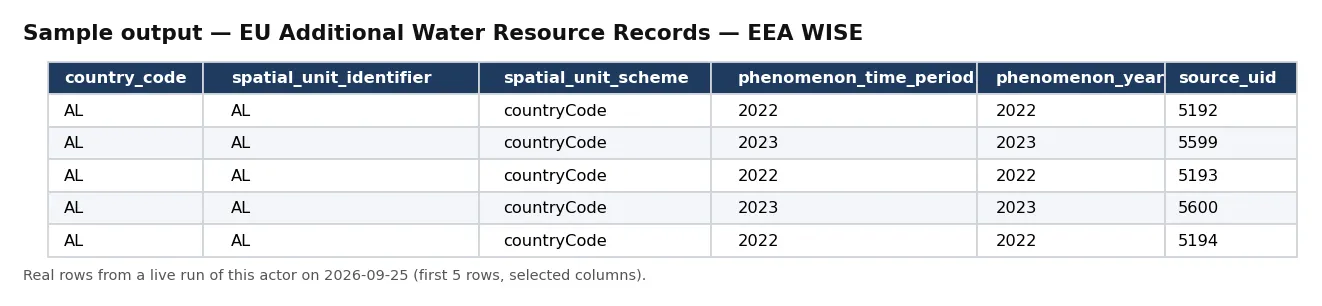
Real rows from a live run of this actor (first 5 rows, selected columns).
One full record from the same run, exactly as delivered:
Pricing
| Event | Free plan | Bronze | Silver | Gold / Platinum / Diamond |
|---|---|---|---|---|
additional_water_resource_record | $0.05 | $0.045 | $0.04 | $0.0335 |
Delivered before charged. Blocked runs and empty results cost nothing.
Input
| Field | Type | Default | Description |
|---|---|---|---|
countryCode | string | — | Optional 2-letter country code (e.g. DE, FR). |
year | integer | — | Optional reference year to filter (e.g. 2016, 2020). |
maxRecords | integer | 10 | Ceiling on records delivered and billed. |
Default changed on 30 Sep 2026: if you leave maxRecords out, a run now returns up to 10 records (it was 500). Set maxRecords yourself to get more — the maximum is unchanged.
Output
One JSON object per observation. Representative example (values as reported):
An unbilled RUN_RECEIPT records the robots check, the filters, rows seen and delivered, and whether charged equals delivered.
Field reference
Each record is one additional-resource observation. Identity: record_id, country_code, spatial_unit_identifier, spatial_unit_scheme, and source_uid. Observation: observed_property (the parameter), phenomenon_time_period, phenomenon_year, phenomenon_month, and result_observed_volume_hm3 (million cubic metres). Status: result_observation_status, observation_status, and status_code. Provenance travels on every record: source, source_url, licence, attribution, disclaimer, and observed_at.
How a run works
A run first re-reads the source host's robots posture from your runtime — the EEA DiscoData host — and stops at the door if that ever changes. It pages the WISE SOE additional-water-resources table (filtered to your optional countryCode and year), ordered by the high-cardinality spatial-unit identifier, and flattens each row to one record — carrying every value verbatim, never anything person-shaped and never the free-text remarks — delivered before it is charged, so a blocked or empty run costs you nothing. The actor stops at your maxRecords ceiling and records charge_equals_delivered in the receipt.
Coverage and scope
The table holds 4,204 rows across reporting countries, spatial units, parameters, and reference years. Because each record carries the country_code, the spatial_unit_identifier, the observed_property, and the phenomenon_year, segmenting by country, basin, parameter, or year is straightforward. Pull one country, one parameter, or the whole table to seed a water-resource warehouse.
Working with the data
The additional resources are a supply-completion layer, and the fields make them actionable. Because every record pairs a spatial unit with an observed_property and a result_observed_volume_hm3 for a period, an analyst can add supplementary sources to the renewable resource for a full water-availability picture, track reliance on desalination or reuse over time, and — joined to the renewable-freshwater and water-use cells on the spatial unit — build a complete basin water balance.
Cost guidance
One additional_water_resource_record per delivered row: cost = rows delivered × your plan's per-record price. Scope with countryCode and year to keep runs bounded. 1,000 rows is $50 (Free) / $33.50 (Gold).
Honest limitations
- As reported. Volumes and parameters are as filed by countries for the SOE reporting; this actor reformats, it does not audit or recompute.
- Experimental status kept verbatim. Some observations are flagged experimental; the status is carried through as reported.
- Parameters vary. The
observed_propertydistinguishes external inflow, desalination, reuse and other components — filter on it for a single source. - Acknowledge the EEA, and note there is no person data of any kind.
Differentiation
It is the SUPPLEMENTARY-supply layer, a distinct source table from the live eu-renewable-freshwater-resource-records (Waterbase T_WISE3 renewable) and eu-water-use-records (T_WISE3 use). Its specific job is the WISE SOE additional freshwater resources.
A note on the water balance
Read alongside the renewable-freshwater and water-use cells on the same spatial_unit_identifier, this cell closes the water balance: renewable resource plus these additional components, minus use, is what a basin actually has to work with. Because all three cells share the spatial-unit key and the same volume unit, the arithmetic is a straightforward join with no reconciliation step.
The NexGen Signal family
Part of the NexGen Signal family of pay-per-record data products:
- EU Renewable Freshwater Resource Records — EEA
- EU Water Use Records — EEA
- EU Water Abstraction Records — EEA
- EU Waterbody Quality Records — EEA
- EU Nitrate Monitoring Records — EEA
Source: European Environment Agency (EEA), WISE State of Environment (SOE) Waterbase (discodata.eea.europa.eu). EEA data may be reused, including commercially, provided the source is acknowledged: "Source: European Environment Agency (EEA)"; marked third-party content keeps its own terms. Basin/country grain; no contact, operator, or responsible-person field is selected or emitted, no natural-person data of any kind. Reported values as filed, not a modelled estimate.


