

EU Air Quality Measure Records — EEA AQ Plans
Pricing
from $33.50 / 1,000 measure records
EU Air Quality Measure Records — EEA AQ Plans
Keyless pay-per-record EEA air-quality plan measures — type, status, cost, timeline, impact. Partition by country; no person data. EEA acknowledge. GOLD $0.05 ladder.
Pricing
from $33.50 / 1,000 measure records
Rating
0.0
(0)
Developer
NexGen Signal
Maintained by CommunityActor stats
0
Bookmarked
2
Total users
1
Monthly active users
12 days ago
Last modified
Categories
Share
Keyless. Pay per record. Every European air-quality remediation measure — type, status, cost, timeline — as one clean catalogue.
This actor turns the European Environment Agency (EEA) Air Quality e-Reporting plan-measures dataset into clean, per-measure records — the remediation measures that member states apply under EU air-quality plans to bring polluted zones back into compliance. Each run reads the EEA's keyless DiscoData SQL service for the country you choose and delivers one row per measure: its code and name, description, classification and type, administration level and time scale, estimated and actual cost, implementation status and dates, expected emission reduction and concentration impact, the source sector and spatial scale, the air pollutant and protection target it addresses, and the zone and attainment it links to. Measure / type / status / cost / timeline grain, structured for engineering use, reusable with acknowledgement of the EEA, with no personal data of any kind.
What this is, in one paragraph
When a European air-quality zone exceeds a limit value, the member state reports an air-quality plan and the concrete measures it will take — a low-emission zone, a variable speed limit, a fuel-switch subsidy, a retrofit programme. The EEA collects those measures across Europe. This actor reads that dataset and flattens each measure into a single analysis-ready record: the measure code and name, its description, classification (traffic, industry, residential, and so on) and type, the administration level and time scale, the estimated and actual cost with currency, the implementation status and planned/actual start and end dates, the expected emission reduction and concentration/exceedance impact, the source sector and spatial scale, the air pollutant and protection target, and the zone and attainment identifiers. A measure is an administrative action — an organisation-level policy, never a person. Values are carried verbatim as published. You are billed only for records actually delivered.
Who buys this and for what job
- Environmental-policy, city, and consultancy teams cataloguing the air-quality measures applied by country, sector, and pollutant.
- Clean-air, transport, and ESG products benchmarking measure types, costs, and expected impacts across Europe.
- Researchers and NGOs studying which remediation measures member states deploy and at what stage.
- Data engineers who want the AQ plan-measures catalogue as clean rows without writing SQL against the EEA service.
EEA licence — reuse with acknowledgement
One licence rider travels on every record. EEA data may be reused, including commercially, provided the source is acknowledged: "Source: European Environment Agency (EEA)." Where third-party content is marked, it keeps its own terms. The data is a catalogue of reported policy measures as published — not a compliance verdict or an assessment of a measure's effectiveness.
Measure grain — no person data
The unit of every record is a policy measure — an administrative action, never a person. The source carries no contact or responsible-person field, and this actor emits none: it selects only the structured measure attributes plus the measure name and description (which describe the action — a speed limit, a subsidy — not a person), and the free-text comment fields are excluded at field selection. A person-key guard runs on every record as a backstop, and the acceptance suite injects a responsible-person and contact field into a source row and asserts neither the key nor the value can ever appear in output.
Sample output
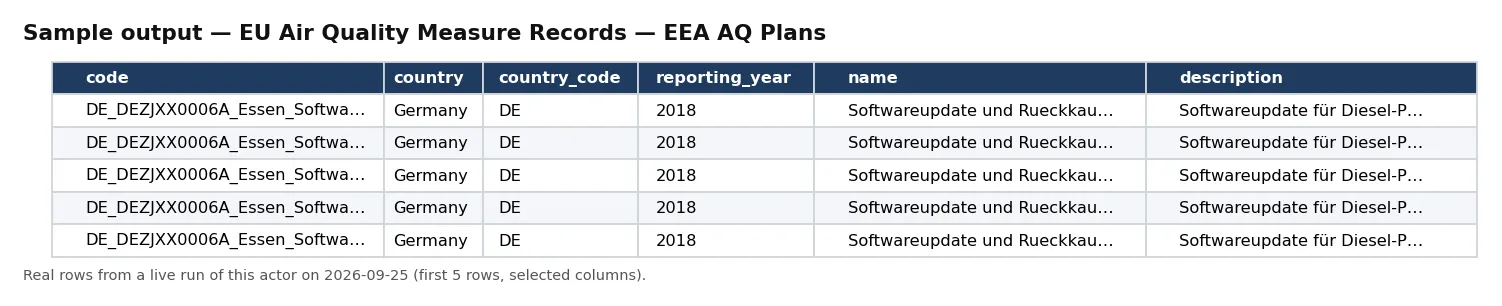
Real rows from a live run of this actor (first 5 rows, selected columns).
One full record from the same run, exactly as delivered:
Pricing
| Event | Free plan | Bronze | Silver | Gold / Platinum / Diamond |
|---|---|---|---|---|
measure_record | $0.05 | $0.045 | $0.04 | $0.0335 |
Delivered before charged. Blocked runs and empty results cost nothing.
A required partition — this is a multi-million-row dataset
The EEA plan-measures dataset holds over 1.38 million rows, so this actor requires a partition: every run must set a countryCode. The country bounds the run; there is no unbounded all-Europe pull. Optional year and pollutant filters narrow further, and maxRecords is the hard ceiling.
Input
| Field | Type | Default | Description |
|---|---|---|---|
countryCode | string | — | Required 2-letter country code (e.g. DE, FR, IT). |
year | integer | — | Optional reporting year to filter. |
pollutant | string | — | Optional air pollutant (e.g. NO2, PM10, PM2.5, O3). |
maxRecords | integer | 10 | Ceiling on records delivered and billed. |
Default changed on 30 Sep 2026: if you leave maxRecords out, a run now returns up to 10 records (it was 500). Set maxRecords yourself to get more — the maximum is unchanged.
Output
One JSON object per measure. Real example (values as published):
An unbilled RUN_RECEIPT records the robots check, the country/year/pollutant filters, rows seen and delivered, and whether charged equals delivered.
Field reference
Each record is one measure. Identity: record_id / measure_id, code, and aq_plan_id. Scope: country, country_code, and reporting_year. Description: name, description, measure_classification, and measure_type. Delivery: administration_level, time_scale, implementation_status, planned_implementation_beg/_end, actual_implementation_beg/_end, and full_effect_date. Cost: estimated_costs, actual_cost, and currency. Expected effect: emission_reduction, impact_conc_delta, impact_exceedance_delta, and implementation_indicators. Target: source_sector, spatial_scale, air_pollutant, protection_target, objective_type, and reporting_metric. Links: zone_id, attainment_id, and source_data_url. Provenance: source, source_url, licence, attribution, disclaimer, and observed_at.
How a run works
A run first re-reads the source host's robots posture from your runtime — the EEA DiscoData host — and stops at the door if that ever changes. It queries the plan-measures table through the DiscoData SQL service filtered to your countryCode (and optional year and pollutant), and flattens each measure to one record — selecting only the structured attributes and the measure name and description, never a contact or responsible-person field — delivered before it is charged, so a blocked or empty run costs you nothing. The actor stops at your maxRecords ceiling and records charge_equals_delivered in the receipt.
Coverage and scope
The dataset spans the reporting countries, with 1.38 million+ measure rows in total. Because each record carries the country_code, measure_type, source_sector, and air_pollutant, segmenting by country, measure type, sector, or pollutant is straightforward. Pull one country, or one pollutant within a country, to seed a measures table.
Working with the catalogue
The catalogue is built to be compared, and the fields carry the structure to do it. The measure_classification and measure_type group measures into families — traffic, industry, residential heating — so an analyst can compare how different countries tackle the same pollutant. The estimated_costs and actual_cost sit alongside the emission_reduction and impact_conc_delta, so a cost-effectiveness view falls out of the same row, and the implementation_status with the planned and actual dates supports a delivery-tracking view across a plan's lifetime. Because the air_pollutant and protection_target travel on every measure, the catalogue joins cleanly to any zone- or attainment-keyed air-quality dataset, and two country pulls can be diffed to see which measures advanced between reporting rounds.
Cost guidance
One measure_record per delivered measure: cost = measures delivered × your plan's per-record price. Scope with countryCode, year, or pollutant. 1,000 measures is $50 (Free) / $33.50 (Gold).
Honest limitations
- A catalogue, not a verdict. These are reported policy measures as published — not a compliance judgment or an effectiveness assessment.
- Partition required. Every run must set a
countryCode. - As published. Costs, dates, and expected impacts are carried verbatim; this actor reformats, it does not audit.
- No person data of any kind.
Differentiation
It is distinct from any monitoring or emissions cell (which carry pollutant readings or facility emissions, not the policy responses), and it is the measures companion to the fleet's air-quality scenario records. Its specific job is the EEA air-quality plan-measures catalogue — the remediation actions, measure by measure.
The NexGen Signal family
Part of the NexGen Signal family of pay-per-record data products:
- EU Air Quality Scenario Records — EEA AQ Plans
- EU Industrial Emissions Records — EEA IED Facilities
- EU GHG Inventory Records — EEA
- EU Bathing Water Quality Records — EEA BWD
- EU Maritime Environmental Measure Records — WISE
Source: European Environment Agency (EEA), Air Quality e-Reporting — plan measures dataset (discodata.eea.europa.eu). EEA data may be reused, including commercially, provided the source is acknowledged: "Source: European Environment Agency (EEA)"; marked third-party content keeps its own terms. Measure / type / status / cost / timeline grain; organisation-level policy actions, no contact or responsible-person field, no person data of any kind. Reported measures as published, not a compliance verdict.


