

EU Groundwater Chemical Failure Reason Records — EEA WISE
Pricing
from $33.50 / 1,000 gw chemical failure reason records
EU Groundwater Chemical Failure Reason Records — EEA WISE
Keyless pay-per-record EEA WISE WFD groundwater chemical-status failure reasons — groundwater body, chemical status, assessment confidence, reason for failure, as filed. No person data. Gold $0.0335/record.
Pricing
from $33.50 / 1,000 gw chemical failure reason records
Rating
0.0
(0)
Developer
NexGen Signal
Maintained by CommunityActor stats
0
Bookmarked
2
Total users
1
Monthly active users
15 days ago
Last modified
Categories
Share
Keyless. Pay per record. The official reasons Europe's groundwater bodies fail chemical status — as filed.
This actor turns the European Environment Agency (EEA) WISE Water Framework Directive (WFD) database into clean, per-record data — the official reasons reported for groundwater chemical-status failure. Each run reads the EEA's keyless DiscoData SQL service and delivers one row per failure-reason record, structured for water-status and catchment analysis, reusable with acknowledgement of the EEA, with no personal data of any kind.
What this is, in one paragraph
Under the Water Framework Directive, where a groundwater body fails chemical status, member states report the reason. This actor reads that chemical-reasons table and delivers one record per groundwater body / reason / year: the country and river basin, the groundwater body, its chemical status value, assessment year, confidence, and expected achievement date, and the reported REASON FOR FAILURE — carried as filed. It is the chemical-failure-reason layer of Europe's groundwater assessment.
Who buys this and for what job
- Groundwater analysts categorising why bodies fail chemical status
- Regulatory and programme-of-measures teams targeting the documented failure reasons
- Researchers studying the drivers of groundwater chemical failure across basins
- Data engineers who want the WISE WFD groundwater chemical failure reason table as clean rows from a keyless source.
EEA licence — reuse with acknowledgement
One licence rider travels on every record. EEA data may be reused, including commercially, provided the source is acknowledged: "Source: European Environment Agency (EEA)." Where third-party content is marked, it keeps its own terms. These are reported values and status labels as filed — not a compliance verdict.
Water-body grain — no person data
The unit of every record is a chemical-failure reason for a groundwater body — a water body and its reported attributes, never a person. WISE reporting is at water-body / river-basin level: there is no contact, operator, or responsible-person field in the source table, and none is selected or emitted — the query reads only the water-body identity, the status/flags, and the chemical status and reason for failure; the free-text 'other' pressure and impact narrative fields are excluded at field selection. A person-key guard runs on every record as a backstop. The file_url points to the official Eionet/CDR reporting file, never a person.
Sample output
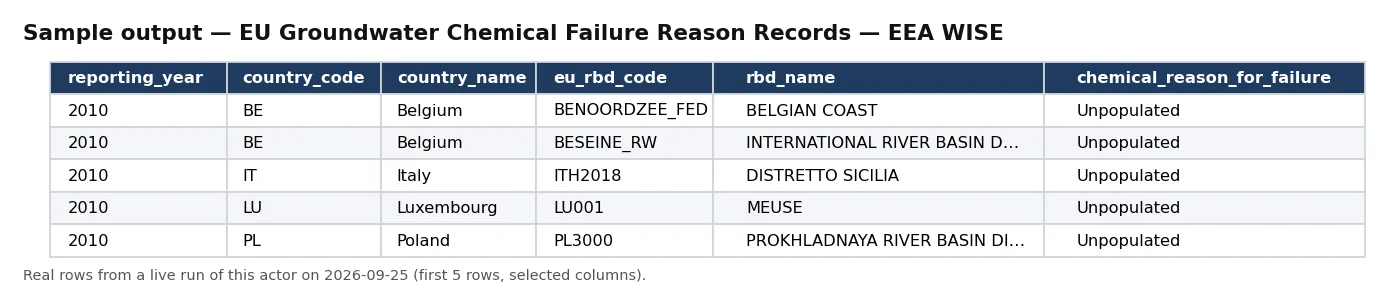
Real rows from a live run of this actor (first 5 rows, selected columns).
One full record from the same run, exactly as delivered:
Pricing
| Event | Free plan | Bronze | Silver | Gold / Platinum / Diamond |
|---|---|---|---|---|
gw_chemical_failure_reason_record | $0.05 | $0.045 | $0.04 | $0.0335 |
Delivered before charged. Blocked runs and empty results cost nothing.
Input
| Field | Type | Default | Description |
|---|---|---|---|
countryCode | string | — | Optional 2-letter country code (e.g. DE, FR). |
year | integer | — | Optional reporting cycle year to filter (e.g. 2016, 2022). |
maxRecords | integer | 10 | Ceiling on records delivered and billed. |
Default changed on 30 Sep 2026: if you leave maxRecords out, a run now returns up to 10 records (it was 500). Set maxRecords yourself to get more — the maximum is unchanged.
Output
One JSON object per failure-reason record. Real example (values as reported):
An unbilled RUN_RECEIPT records the robots check, the filters, rows seen and delivered, and whether charged equals delivered.
Field reference
Each record is one chemical-failure reason. Identity: record_id, country_code, country_name, eu_rbd_code, rbd_name, eu_groundwater_body_code, groundwater_body_name, and reporting_year. Status and reason: chemical_status_value, chemical_assessment_year, chemical_assessment_confidence, chemical_status_expected_achievement_date, and chemical_reason_for_failure. Plus file_url. Provenance travels on every record: source, source_url, licence, attribution, disclaimer, and observed_at.
How a run works
A run first re-reads the source host's robots posture from your runtime — the EEA DiscoData host — and stops at the door if that ever changes. It pages the WISE WFD groundwater chemical failure reason table (filtered to your optional countryCode and optional year), and flattens each row to one record — carrying every status label and value verbatim, never anything person-shaped — delivered before it is charged, so a blocked or empty run costs you nothing. The actor stops at your maxRecords ceiling and records charge_equals_delivered in the receipt.
Coverage and scope
The table holds on the order of 49,328 rows across reporting countries, river basin districts, and the 2016 and 2022 WFD reporting cycles. Because each record carries the country_code, the water-body identity, and the reporting_year, segmenting by country, basin, or cycle is straightforward. Pull one country, or the whole table to seed a water-status warehouse.
A compact, joinable failure taxonomy
Because the reason is reported as a short structured value rather than free prose, this table behaves like a taxonomy: an analyst can group failures into a handful of recurring causes — nitrate, a specific industrial pollutant, saline intrusion — and count them by basin and cycle without any text mining. Paired with the pollutant-assessment cell on the shared groundwater-body code, the reason gives the why behind the which pollutant, turning two tables into a complete account of a body's chemical failure.
Working with the data
The reasons are a categorisation layer, and the fields make them countable. Because every record pairs a chemical_reason_for_failure with the body's chemical_status_value and expected achievement date, an analyst can tally the documented reasons for chemical failure across a basin and see how far off the target date the bodies are. The reporting_year tracks change between cycles.
Identifiers and joins
Every record carries the eu_groundwater_body_code, keying each reason to the fleet's groundwater pollutant-assessment, exemption, and threshold-value cells for the same body, on a shared identifier.
Cost guidance
One gw_chemical_failure_reason_record per delivered row: cost = rows delivered × your plan's per-record price. Scope with countryCode and year to keep runs bounded. 1,000 rows is $50 (Free) / $33.50 (Gold).
Honest limitations
- As reported. Status labels, reasons, and values are as filed by member states for the WFD reporting cycle; this actor reformats, it does not audit or recompute.
- A label, not a verdict. These are reported classifications, assessments, and reasons, not an independent compliance assessment.
- Two cycles merged. The table carries both the 2016 and 2022 reporting cycles; the
reporting_yearfield distinguishes them. - Acknowledge the EEA. The acknowledgement travels on every record.
- No person data of any kind.
Differentiation
It is distinct from eu-groundwater-quantity-failure-reason-records — that cell carries the QUANTITATIVE-status failure reasons (a separate table with a near-identical row count), while this cell carries the CHEMICAL-status failure reasons; two different regimes, two different tables. Its specific job is the WFD groundwater chemical-status failure reasons.
The NexGen Signal family
Part of the NexGen Signal family of pay-per-record data products:
- EU Groundwater Chemical Exemption Records — EEA WISE
- EU Surface Water Chemical Exemption Records — EEA WISE
- EU Pressure Substance Failure Records — EEA WISE
- EU Surface Water Failing Pollutant Records — EEA WISE
- EU Waterbody Quality Records — EEA
Source: European Environment Agency (EEA), WISE Water Framework Directive (WFD) database (discodata.eea.europa.eu). EEA data may be reused, including commercially, provided the source is acknowledged: "Source: European Environment Agency (EEA)"; marked third-party content keeps its own terms. Groundwater-body / reason / year grain; no contact/operator/responsible-person field selected or emitted, free-text 'other' narrative excluded. No natural-person data of any kind. Values and status labels as filed, not a compliance verdict.


