

FDA Device Clearance Records — 510(k) via openFDA
Pricing
from $33.50 / 1,000 clearance records
FDA Device Clearance Records — 510(k) via openFDA
Per-record FDA 510(k) medical-device clearances from the official openFDA API. Applicant, device, product code, decision, dates, class. Keyless, public domain, no personal data.
Pricing
from $33.50 / 1,000 clearance records
Rating
0.0
(0)
Developer
NexGen Signal
Maintained by CommunityActor stats
0
Bookmarked
2
Total users
1
Monthly active users
12 days ago
Last modified
Categories
Share
Official source. No API key. Pay per record.
This actor turns the U.S. FDA's 510(k) premarket notification database into clean, per-clearance records — every medical-device market-entry decision, at the grain an organization tracks when it watches who is clearing what device and when. Each run reads the official openFDA device/510k endpoint and delivers one row per clearance: the 510(k) number, the applicant organization, the device name and product code, the decision and its dates, the device class and regulation, and the medical specialty — device and organization grain, with no applicant contact person, and openFDA's own accuracy disclaimer carried on every record.
What this is, in one paragraph
Before most medical devices reach the U.S. market, their makers file a 510(k) premarket notification and the FDA issues a substantial-equivalence decision. openFDA publishes every one of these through a keyless API. This actor reads that endpoint, paginates within openFDA's published window, and flattens each clearance into a single analysis-ready row: who cleared a device, what it is, how it is classified, and when it was received and decided. Values are verbatim. You are billed only for records actually delivered.
Who buys this and for what job
- Medical-device companies and consultancies tracking competitors' clearances by product code or specialty, and timing their own market entry.
- Regulatory-affairs teams monitoring what the FDA is clearing in their device category and how long decisions take.
- Investors and market analysts watching device market-entry activity across applicants and specialties.
- Data engineers who want a keyless, one-call feed of FDA device clearances already reduced to device/org fields.
openFDA disclaimer (carried verbatim)
openFDA labels its data as unvalidated. This actor carries that disclaimer, exactly as published, on every record and in this listing:
"Do not rely on openFDA to make decisions regarding medical care. While we make every effort to ensure that data is accurate, you should assume all results are unvalidated. We may limit or otherwise restrict your access to the API in line with our Terms of Service."
One more honest note travels on every record: a 510(k) clearance is a substantial-equivalence decision, not an FDA endorsement or approval. These are records for market-entry tracking — not medical, legal, or safety advice.
Device / organization grain — no contact person
This actor works at device and organization grain: the clearance, the device, and the applicant company. The 510(k) record includes an applicant contact — a natural person — which this actor never maps to a field. As a second, structural safeguard, the device name is scrubbed before emit: the contact person's name (matched across whitespace variants, because the FDA data stores it with irregular spacing), and any email or phone-number pattern, are redacted. This is enforced by an acceptance test that feeds a clearance with a contact name, email, and phone embedded in the device name and asserts none survive, plus a live sweep over real clearances (100 clearances, 82 carrying a real contact person in the source → 0 emitted).
Sample output
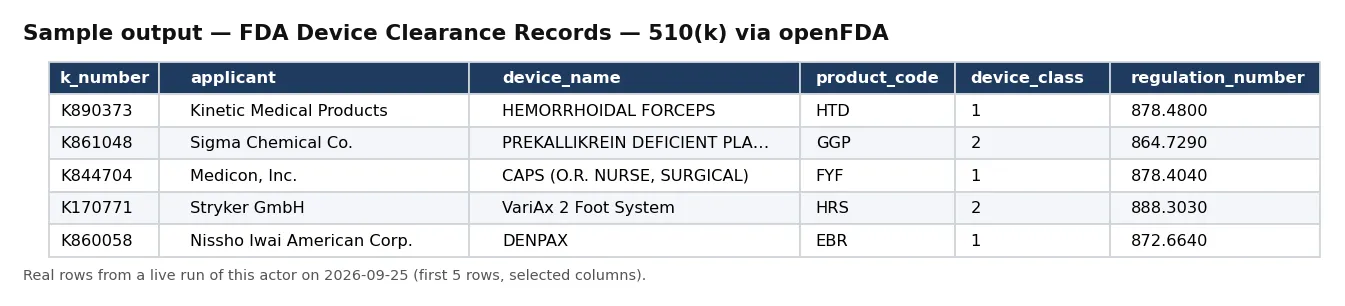
Real rows from a live run of this actor (first 5 rows, selected columns).
One full record from the same run, exactly as delivered:
Pricing
| Event | Free plan | Bronze | Silver | Gold / Platinum / Diamond |
|---|---|---|---|---|
clearance_record | $0.05 | $0.045 | $0.04 | $0.0335 |
Delivered before charged. Blocked runs and empty results cost nothing.
Input
| Field | Type | Default | Description |
|---|---|---|---|
productCode | string | — | Optional 3-character FDA product code (e.g. LPL) to filter clearances. |
decisionSince | string (YYYYMMDD) | — | Optional. Keep only clearances with a decision date on or after this date. |
maxRecords | integer | 10 | Ceiling on records delivered and billed. |
Default changed on 30 Sep 2026: if you leave maxRecords out, a run now returns up to 10 records (it was 500). Set maxRecords yourself to get more — the maximum is unchanged.
The actor paces requests under openFDA's published rate limit.
Output
One JSON object per clearance. Real example (values verbatim):
An unbilled RUN_RECEIPT records the robots check, the filters, the total matched, the disclaimer seen, records delivered, whether charged equals delivered, and whether the paging window was reached.
Field reference
Each record is a flat set of market-entry fields. Identity: record_id / k_number. Who and what: applicant (organisation) and device_name (scrubbed of any contact). Classification: product_code, device_class, regulation_number, medical_specialty, and advisory_committee_description. The decision: clearance_type, decision_code, decision_description, decision_date, and date_received, plus the third_party_flag, expedited_review_flag, and statement_or_summary indicators. Where: applicant_city, applicant_state, and applicant_country — organisation location, never a person. Provenance and caveats: source, source_url, openfda_disclaimer, licence, attribution, disclaimer, and observed_at.
How a run works
A run first re-reads the source's robots posture from your runtime (the openFDA host serves no robots file, a no-policy posture) and stops at the door if that ever changes. It then builds a single filtered query from your product-code and decision-date inputs and reads the first page, recording openFDA's own total match count into the run receipt. Each clearance is flattened to one record — the applicant contact person dropped, the device name scrubbed — and delivered before it is charged, so a run that is blocked or finds nothing costs you nothing (an openFDA 404 is treated as a genuine-empty result, not an error). The actor pages through openFDA's bounded window, pacing between requests to stay within the published rate limit, and stops as soon as your maxRecords ceiling, the total match count, or the paging-window limit is reached — flagging that last case in the receipt so a truncated deep pull is never mistaken for full coverage. The charge_equals_delivered flag confirms you were billed for exactly what you received.
Cost guidance
One clearance_record per delivered clearance: cost = clearances delivered × your plan's per-record price. The full 510(k) corpus is about 175,814 records. openFDA serves a bounded paging window per query, so for deep historical pulls narrow with productCode or decisionSince — a single product code or a recent date range is typically a few hundred to a few thousand clearances. 1,000 clearances is $50 (Free) / $33.50 (Gold).
Honest limitations
- Unvalidated by the source. openFDA states results are unvalidated; treat as informational and verify against the FDA 510(k) database.
- Clearance ≠ approval. A 510(k) is a substantial-equivalence decision, not FDA approval or endorsement.
- Predicate device chains are not in the structured feed. The 510(k) API does not expose predicate references (those live in the summary PDFs); this actor delivers the structured clearance record, not the predicate graph.
- Bounded paging window. Very deep pulls require a
productCodeordecisionSincefilter; the run receipt flags when the window is reached. - No applicant contact-person data is emitted, by design.
Differentiation
Distinct from the sibling fda-recall-risk-records: recalls are devices (and foods/drugs) being pulled off the market — the opposite of clearances, which are devices entering it. Both are named so buyers pick the right one.
The NexGen Signal family
Part of the NexGen Signal family of official-source, pay-per-record products:
- FDA Recall Risk Records — openFDA
- Federal Rulemaking Records — US Federal Register
- Grant Opportunity Records — US Grants.gov
- World Bank Project Records — Development Pipeline
- Organization Sanctions & LEI Risk
Source: U.S. FDA via openFDA (device/510k). Public-domain U.S. Government data (https://open.fda.gov/license/). A 510(k) clearance is a substantial-equivalence decision, not an FDA approval or endorsement. Reformatted to device/organisation records; values verbatim; openFDA's "results are unvalidated" disclaimer carried on every record; no applicant contact-person data emitted.


