

EU Vehicle CO2 Records — EEA New-Car Monitoring
Pricing
from $33.50 / 1,000 vehicle records
EU Vehicle CO2 Records — EEA New-Car Monitoring
Keyless, pay-per-record EEA new-passenger-car CO2 monitoring. One row per vehicle type — manufacturer, make, commercial name, fuel, WLTP/NEDC CO2, mass, engine. Partition required (year); vehicle grain, no person or VIN data; acknowledge EEA.
Pricing
from $33.50 / 1,000 vehicle records
Rating
0.0
(0)
Developer
NexGen Signal
Maintained by CommunityActor stats
0
Bookmarked
2
Total users
1
Monthly active users
12 days ago
Last modified
Categories
Share
Keyless. Pay per record. Every new car registered in the EU, with its official CO2 and technical figures.
This actor turns the European Environment Agency (EEA) new-passenger-car CO2 monitoring dataset into clean, per-vehicle records — the official register of new cars registered across the EU under the CO2 monitoring regulation. Each run reads the EEA's keyless DiscoData SQL service for one monitoring year and delivers one row per vehicle-type registration: the manufacturer and make, the commercial name and category, the fuel, the WLTP and NEDC CO2 figures, the mass, and the engine and electric-consumption metrics. Vehicle/manufacturer technical grain, structured for engineering use, reusable with acknowledgement of the EEA, with no registration-holder, owner, personal-name, or VIN field of any kind.
What this is, in one paragraph
Under EU Regulation (EU) 2019/631, member states report every new passenger car registered, and the EEA aggregates and publishes the monitoring data. This actor reads that dataset and flattens each vehicle-type record into a single analysis-ready row: the harmonised manufacturer and make, the commercial name, the vehicle and registration categories, the fuel type and mode, the specific CO2 emissions under both the WLTP and NEDC test cycles, the mass in running order, the engine capacity and power, the electric energy consumption, and the type-approval identifiers. It is the technical monitoring layer of Europe's vehicle fleet — not a vehicle-registration or owner database. Values are exactly as monitored and published. You are billed only for records actually delivered.
Who buys this and for what job
- Automotive-analytics and fleet-intelligence teams studying CO2 performance, fuel-mix, and technical specifications across makes, models, and countries.
- ESG, transport-policy, and decarbonization researchers measuring the emissions profile of new registrations by year and member state.
- OEM and supplier strategy teams benchmarking their models' registered CO2 and powertrain metrics against competitors.
- Data engineers who want the EEA monitoring dataset as clean rows without writing SQL against the service or paging a hundred-million-row table.
EEA licence — reuse with acknowledgement
One licence rider travels on every record. EEA data may be reused, including commercially, provided the source is acknowledged: "Source: European Environment Agency (EEA)." Where third-party content is marked, it keeps its own terms. This rider is carried in this README and on every single record. The data is monitoring data as reported by member states — not a compliance verdict, a recall notice, or a real-world emissions measurement.
Vehicle/manufacturer grain — no person or VIN data
This actor works at vehicle-type/manufacturer grain: one record per monitored vehicle registration line. The monitoring dataset carries no registration-holder, owner, personal-name, or VIN field — it describes vehicle types and their manufacturers, not the people who own them — and this actor emits none. Only manufacturer, make, technical, and emissions columns are selected; a person/VIN-key guard runs on every record as a structural backstop against any future schema drift, and the acceptance suite feeds a deliberately person-and-VIN-shaped row and asserts none of it can ever appear in output.
A required partition — this is a 100-million-row dataset
The full multi-year monitoring table runs to over 100 million rows, so this actor requires a partition: every run is bounded to a single reportingYear (defaulting to the most recent final monitoring year), and an unbounded pull of the whole table is structurally impossible in code — the year always bounds the query. Optional countryCode, make, and fuelType filters narrow it further, and maxRecords is the hard ceiling on delivery. A single country-year is still on the order of a few million rows, so scope and cap deliberately.
Sample output
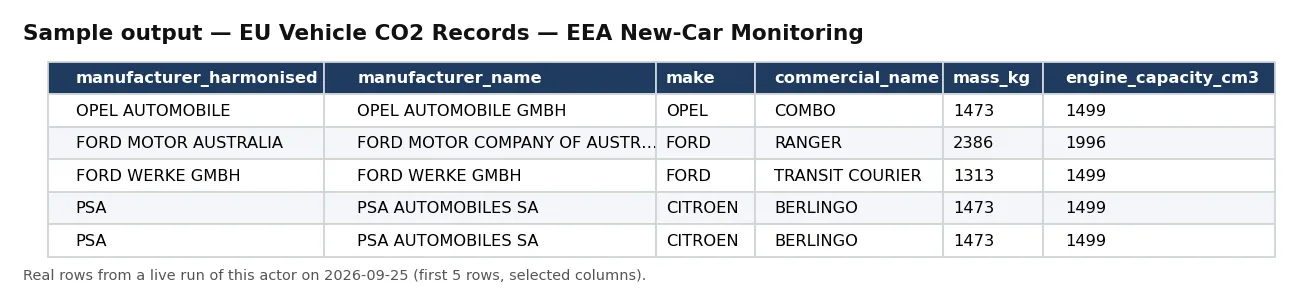
Real rows from a live run of this actor (first 5 rows, selected columns).
One full record from the same run, exactly as delivered:
Pricing
| Event | Free plan | Bronze | Silver | Gold / Platinum / Diamond |
|---|---|---|---|---|
vehicle_record | $0.05 | $0.045 | $0.04 | $0.0335 |
Delivered before charged. Blocked runs and empty results cost nothing.
Input
| Field | Type | Default | Description |
|---|---|---|---|
reportingYear | integer | 2022 | Monitoring year to pull (required partition; the full multi-year table cannot be pulled unbounded). |
countryCode | string | — | Optional 2-letter member-state code (e.g. DE, FR, IT). |
make | string | — | Optional. Keep only vehicles of this make (e.g. BMW, VOLKSWAGEN). |
fuelType | string | — | Optional. Keep only vehicles of this fuel type (e.g. PETROL, DIESEL, ELECTRIC). |
maxRecords | integer | 10 | Ceiling on records delivered and billed. |
Default changed on 30 Sep 2026: if you leave maxRecords out, a run now returns up to 10 records (it was 500). Set maxRecords yourself to get more — the maximum is unchanged.
Output
One JSON object per vehicle-type record. Real example (values as published by the EEA):
An unbilled RUN_RECEIPT records the robots check, the year and filters, rows seen and delivered, and whether charged equals delivered.
Field reference
Each record is one vehicle-type monitoring row. Identity: record_id, monitoring_year, and country_code. Manufacturer: manufacturer_harmonised, manufacturer_name, and make. Vehicle: commercial_name, vehicle_category, and registration_category. Powertrain: fuel_type, fuel_mode, engine_capacity_cm3, engine_power_kw, and electric_consumption_wh_km. Emissions and mass: co2_wltp_g_km, co2_nedc_g_km, co2_reduction_innovative_g_km, innovative_technology, and mass_kg. Type approval: type_approval_number, type, variant, and version. Provenance: source, source_url, licence, attribution, disclaimer, and observed_at.
How a run works
A run first re-reads the source host's robots posture from your runtime — the EEA DiscoData host — and stops at the door if that ever changes. It then queries the CO2 monitoring table through the DiscoData SQL service, bounding the query to your reportingYear and pushing your optional country, make, and fuel filters into the WHERE clause so the dataset is bounded server-side, and pages through the results. Each row is flattened to one vehicle record — reading only manufacturer, technical, and emissions fields, never a person or VIN — delivered before it is charged, so a blocked or empty run costs you nothing. The actor stops at your maxRecords ceiling and records charge_equals_delivered in the receipt.
Coverage and scope
The monitoring dataset holds over 100 million vehicle-type registration records across member states and monitoring years — one of the largest official vehicle datasets in Europe. A single year is on the order of ten million rows and a single country-year a few million, so always bound with reportingYear (required) and narrow with countryCode, make, or fuelType. Because each record carries the make, commercial name, fuel, and CO2 figures, the data joins cleanly to model catalogues and supports fleet-level CO2 and powertrain analysis.
Cost guidance
One vehicle_record per delivered row: cost = rows delivered × your plan's per-record price. Always scope with reportingYear plus countryCode, make, or fuelType, and rely on maxRecords as the ceiling. 1,000 vehicles is $50 (Free) / $33.50 (Gold). Pulling a whole country-year (millions of rows) is possible but rarely what you want; scope and cap first.
Honest limitations
- Monitoring data, not a verdict. These are CO2 monitoring records as reported by member states — not a compliance judgment, a recall, or a real-world emissions figure.
- Very large dataset. Bound it with
reportingYearand further filters; unbounded pulls are structurally prevented, and even a country-year is millions of rows. - As published. Values are exactly as the EEA distributes them; this actor reformats, it does not recompute.
- Acknowledge the EEA. Reuse requires acknowledging the EEA as the source; the acknowledgement travels on every record.
- No person or VIN data — the dataset carries none and this actor emits none.
Differentiation
It is distinct from the fleet's facility- and sector-level emissions cells (which carry industrial installations or industry gas accounts, not vehicles) and from any vehicle-recall or VIN cell: this actor is the EEA new-passenger-car CO2 monitoring register — make by make, model by model, with the official CO2 and powertrain figures — not a recall feed and not an owner database.
The NexGen Signal family
Part of the NexGen Signal family of pay-per-record data products:
- EU Industrial Emissions Records — EEA IED Facilities
- EU Regulatory Change Records — CELLAR
- Air Quality Monitor Records — US EPA AQS
- EPA Facility Compliance Records — Envirofacts
- Organization Sanctions & LEI Risk
Source: European Environment Agency (EEA), CO2 emissions from new passenger cars dataset (discodata.eea.europa.eu). EEA data may be reused, including commercially, provided the source is acknowledged: "Source: European Environment Agency (EEA)"; marked third-party content keeps its own terms. Vehicle/manufacturer monitoring data, not a compliance verdict. Vehicle-type/manufacturer grain; no registration-holder, owner, personal-name, or VIN field is emitted.


