

National Macro Indicator Records — World Bank
Pricing
from $33.50 / 1,000 indicator records
National Macro Indicator Records — World Bank
Per-record World Bank development indicators (country x indicator x year) from the official keyless API. GDP, inflation, trade, and thousands more, with data vintage. CC BY 4.0, no personal data.
Pricing
from $33.50 / 1,000 indicator records
Rating
0.0
(0)
Developer
NexGen Signal
Maintained by CommunityActor stats
0
Bookmarked
2
Total users
1
Monthly active users
12 days ago
Last modified
Categories
Share
Official source. No API key. Pay per record.
This actor turns the World Bank's development-indicators database into clean, per-observation records — one row for every country × indicator × year data point. Each run reads the keyless World Bank Indicators API and delivers GDP, inflation, trade, unemployment, population, and any of thousands of other series, with the country, the year, the value, the unit, and the data vintage on every record. Country and organization grain, licensed CC BY 4.0, no person fields.
What this is, in one paragraph
The World Bank publishes global development data — the World Development Indicators and many other series — as a keyless API keyed by country and indicator code. This actor reads that API for the indicators you choose, paginates every observation, and flattens each into a single analysis-ready row: which country, which indicator, which year, the value, and the source vintage (the lastupdated date so you know exactly which data release you got). Missing observations are excluded and counted, so you are billed only for real data points. Values are verbatim.
Who buys this and for what job
- Economists, analysts, and researchers pulling standardized cross-country macro series without stitching together CSV downloads.
- Fintech, risk, and sovereign-analysis teams feeding GDP, inflation, and trade series into models with a known vintage.
- Dashboards and data products ingesting a clean, per-observation macro feed keyed by ISO country code and indicator.
- Data engineers who want a keyless, one-call global indicators feed already reduced to one row per data point.
Licence — CC BY 4.0, commercial use permitted
World Bank development indicators are World Bank-produced datasets and carry the World Bank's default dataset licence: Creative Commons Attribution 4.0 (CC BY 4.0). The World Bank states this licence lets you "copy, modify and distribute data in any format for any purpose, including commercial use", with attribution. Every record carries: "The World Bank: World Development Indicators: data.worldbank.org (CC BY 4.0)." These are observation records for analysis — not investment or economic advice; values are periodically revised, so the vintage travels on every record.
Country / organization grain — no person data
This actor works at country and indicator grain — national aggregates and World Bank regional/income groupings. There are no natural-person fields in this data, and this actor emits none, with a person-key guard on every record as a backstop.
Sample output
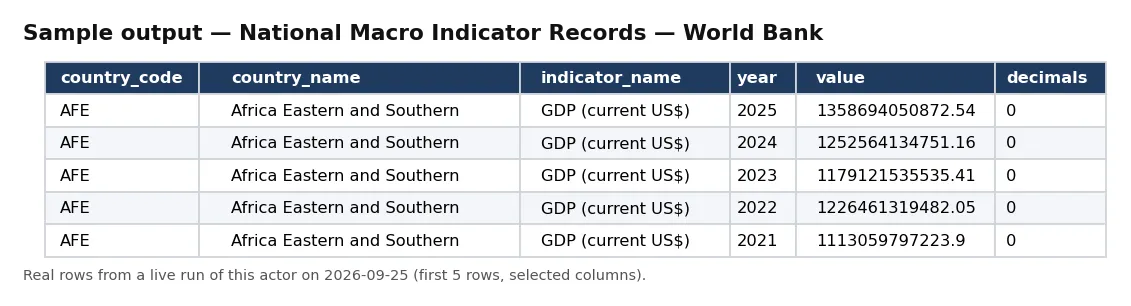
Real rows from a live run of this actor (first 5 rows, selected columns).
One full record from the same run, exactly as delivered:
Pricing
| Event | Free plan | Bronze | Silver | Gold / Platinum / Diamond |
|---|---|---|---|---|
indicator_record | $0.05 | $0.045 | $0.04 | $0.0335 |
Delivered before charged. Blocked runs and empty results (and missing observations) cost nothing.
Input
| Field | Type | Default | Description |
|---|---|---|---|
indicators | string list | core macro set | World Bank indicator codes (e.g. NY.GDP.MKTP.CD, FP.CPI.TOTL.ZG). |
country | string | all | all for every country/aggregate, or ISO codes (semicolon-separated, e.g. USA;CHN;DEU). |
dateRange | string | — | Optional. A single year (2024) or range (2010:2024). |
maxRecords | integer | 10 | Ceiling on records delivered and billed. |
Default changed on 30 Sep 2026: if you leave maxRecords out, a run now returns up to 10 records (it was 500). Set maxRecords yourself to get more — the maximum is unchanged.
The default indicator set covers GDP (current US$ and growth), inflation, unemployment, trade (% of GDP), and total population.
Output
One JSON object per observation. Real example (values verbatim):
An unbilled RUN_RECEIPT records the robots check, the indicators and filters, observations seen, missing observations skipped, records delivered, and whether charged equals delivered.
Field reference
Each record is one observation. Identity: record_id (the country:indicator:year composite). Where and what: country_code (ISO3), country_name, indicator_id, and indicator_name. The data point: year, value, unit, obs_status, and decimals. Provenance and vintage: source_vintage (the World Bank lastupdated date for this data release), source_id, source, source_url (a direct data.worldbank.org link), licence, attribution, disclaimer, and observed_at.
How a run works
A run first re-reads the source's robots posture from your runtime — the API host serves no robots file, a no-policy posture — and stops at the door if that ever changes. For each indicator you requested, it reads observations page by page (up to 1,000 at a time) for the countries and date range you set, recording the World Bank's own lastupdated vintage into every record. Each non-missing observation is flattened to one record and delivered before it is charged, so a blocked or empty run costs you nothing. Observations with no value are excluded and tallied in the receipt as missing_skipped, so you never pay for an empty cell. The actor paces between pages and stops at your maxRecords ceiling; charge_equals_delivered in the receipt confirms you were billed for exactly what you received.
Cost guidance
One indicator_record per delivered observation: cost = observations delivered × your plan's per-record price. A single indicator across all countries and years is on the order of 17,000 observations; scope with dateRange (one year is a few hundred observations) or country (a single country is a handful per indicator per year) to keep runs bounded. 1,000 observations is $50 (Free) / $33.50 (Gold).
Indicator coverage
The World Bank exposes thousands of indicator codes across dozens of source databases — national accounts, prices, labour, trade, debt, health, education, environment, and governance — and this actor can pull any of them: pass the codes you want in indicators. The default set is a compact macro dashboard (GDP level and growth, inflation, unemployment, trade openness, and population) chosen to be useful out of the box, but a fintech team might swap in debt and reserves series, a development analyst might pull health and education series, and a climate desk might pull emissions and energy series — all through the same one row per country × indicator × year shape. Because every record carries the indicator code and name alongside the value, a mixed pull across many indicators stays self-describing and easy to pivot.
Honest limitations
- Observation grain. One row per country × indicator × year — not a pre-built time series object.
- Values are revised. The World Bank restates figures; the
source_vintageon every record tells you which release you pulled, so diff by vintage to catch revisions. - Missing observations are skipped (excluded and counted in the receipt) — you are billed only for real data points.
- Indicator codes are the World Bank's — an unknown code returns no data (a genuine-empty result, which costs nothing).
- No person data is emitted.
Differentiation
Same publisher as world-bank-project-records, deliberately different record class: that actor delivers development projects (the lending pipeline), this one delivers macro indicators (country statistics) — both named so buyers pick the right grain.
The NexGen Signal family
Part of the NexGen Signal family of official-source, pay-per-record products:
- World Bank Project Records — Development Pipeline
- EU Regulatory Change Records — EUR-Lex
- Federal Rulemaking Records — US Federal Register
- EMA Medicine Status Records — EU Medicines
- Organization Sanctions & LEI Risk
Source: World Bank Indicators API (v2), data.worldbank.org. Licensed CC BY 4.0 (the World Bank's default dataset licence — commercial use permitted with attribution). Reformatted to observation records; values verbatim; missing observations excluded and counted; no person data emitted.


