

PR Newswire Scraper — Company & Topic Search
Pricing
from $33.50 / 1,000 press releases
PR Newswire Scraper — Company & Topic Search
PR Newswire press releases by topic (M&A, earnings, executive appointments, funding and 60+ more), by a watchlist of companies or by keyword: headline, issuer, tickers, dateline and text as JSON. Watch mode returns only new releases. No API key. Pay per release.
Pricing
from $33.50 / 1,000 press releases
Rating
0.0
(0)
Developer
NexGen Signal
Maintained by CommunityActor stats
0
Bookmarked
2
Total users
1
Monthly active users
18 days ago
Last modified
Categories
Share
Follow PR Newswire press releases three ways: by topic (every M&A deal, earnings release, executive appointment, funding round and more), by a watchlist of companies, or by keyword. One clean record per release: headline, issuing company, stock tickers, dateline, publish time and opening paragraph, with full text optional. No API key. Pay per release.
PR Newswire files every release under its own topic lists. This actor reads those lists directly, so "every acquisition announced this week" or "every new executive appointment" is one run, not a guessing game with keywords. Add a watchlist of up to 50 companies and you get each company's own releases in one feed. Search by keyword when you want everything that mentions a name. Turn on watch mode, schedule it, and each run delivers only releases you have not had before.
Ready-made searches
Open one, press Start, and change the inputs to your own:
- New Executive Appointments — PR Newswire Feed
- Track Press Releases From a List of Companies
- Bankruptcy & Chapter 11 Press Release Alerts
- Contract Awards & Business Agreements — PR Newswire
Guide: search press releases by company or topic
A step-by-step guide with a real result: three companies' own releases from 1 October 2026 back to August (an executive transition, an acquisition completed, quarterly results), the exact watchlist and topic inputs, the same call with curl, and a Python script that saves the releases to a CSV, with costs and limits.
Read the guide · Python script, CSV output · The real output (CSV)
Who buys this and for what job
- Sales and business-development teams: trigger events at target accounts — acquisitions, new executives, funding rounds, expansions, contracts won.
- Investors and analysts: earnings, guidance, dividends, stock offerings, M&A and FDA approvals from listed companies, with tickers already pulled out.
- PR and communications teams: their own company and competitors, and every release in their industry.
- Journalists and newsletter writers: a daily feed for their beat.
- Builders and AI agents: a keyless tool that answers "what did these companies announce this week?"
Three ways to use it
Topics. Pick from 67 of PR Newswire's topic lists. Event types: mergers & acquisitions, earnings, earnings guidance, earnings-call notices, dividends, stock offerings, private placements, venture capital, financing agreements, joint ventures, contracts, bankruptcy, restructuring, shareholder activism, executive appointments, new products, expansions, licensing, awards, product recalls, FDA approvals, clinical trials, legal, patents, real-estate transactions and more. Industries: AI, biotech, pharma, medical equipment, fintech, banking, insurance, crypto, software, semiconductors, cybersecurity, telecom, automotive, aerospace & defense, energy, mining, retail, food, travel, education and more. Several topics merge into one newest-first feed; a release filed under more than one topic arrives once and lists each.
Company watchlist. Paste up to 50 company names. The actor searches for each and keeps only releases the company issued itself, not ones that merely mention it. Results are merged newest first and tagged with the watched name. maxReleasesPerCompany stops one busy company from filling the run.
Keyword. On its own, a keyword uses PR Newswire's news search, which matches anywhere in a release. Each record says whether the keyword company is the issuer or just mentioned, and issuerOnly keeps only its own releases. Combined with topics or a watchlist, the keyword narrows them to releases whose headline or opening lines contain it — for example, venture-capital releases mentioning "AI".
Sample output
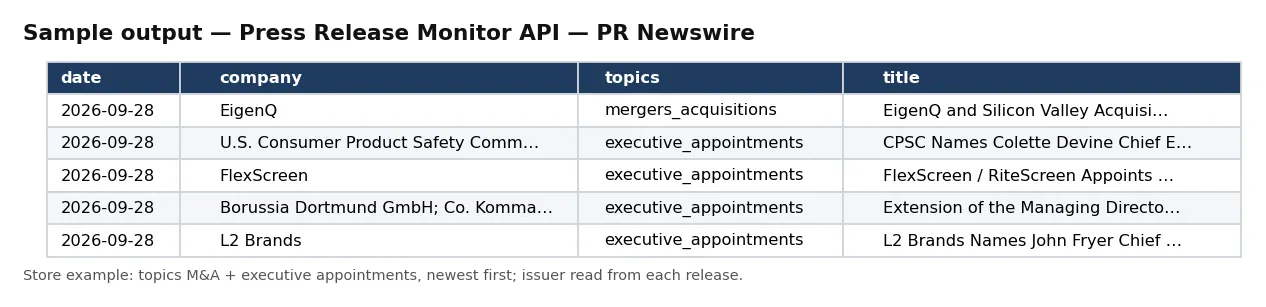
Real rows from the Store example (topics: mergers & acquisitions + executive appointments, 10 releases), run on 28 September 2026.
One record from the same run, as delivered (provenance fields shortened here):
Pricing
| Event | Free plan | Bronze | Silver | Gold / Platinum / Diamond |
|---|---|---|---|---|
apify-actor-start | $0.00005 | $0.00005 | $0.00005 | $0.00005 |
apify-default-dataset-item (one release) | $0.05 | $0.045 | $0.04 | $0.0335 |
You pay only for releases delivered; the ten-release Store example is about $0.50 on the Free plan. Nothing found, nothing charged. If PR Newswire cannot be reached the run says so and charges nothing. With a maximum cost per run set, the actor stops at it and says "CAPPED"; every release delivered is charged and nothing beyond your limit is sent.
Input
| Field | Default | What it does |
|---|---|---|
topics | none | PR Newswire topic lists to follow (pick in the form; 67 available). Not combined with companies. |
companies | none | Up to 50 company names; each company's own releases. |
keyword | empty | Alone: full-text search. With topics or companies: headline/opening-lines filter. |
issuerOnly | false | Keyword search only: keep releases the keyword company issued. |
dateFrom, dateTo | none | Publication window, YYYY-MM-DD. |
includeFullBody | false | Add the full text; tables kept as rows (`cell |
englishOnly | true | Skip French, Spanish, German and other-language releases (about 1 in 5 on some topic lists). |
maxReleases | 25 | Most releases in one run, across all topics or companies together (1–1,000). |
maxReleasesPerCompany | 10 | Watchlist only; the overall maximum still applies. |
newSinceLastRun | false | Watch mode: skip releases delivered before under the same label. |
watchLabel | automatic | Name of the watch memory; defaults to your topics, companies or keyword. |
proxyConfiguration | Apify Proxy | Standard pool first; residential only if PR Newswire refuses a page. |
Output fields
record_id (stable PR Newswire id, prn: prefix — use it to de-duplicate), title, company (the issuer: the SOURCE line of the release), tickers (with exchange, e.g. NYSE: GTES; empty when none are tagged), location (dateline), date and published_at (exact time with UTC offset), language, summary (opening paragraph, up to 600 characters), body (full text when asked), match (keyword search: issuer or mention), topics (requested topics the release is filed under), watched_company (the watchlist name it was found for), url, image_url, is_new (watch runs), and provenance on every record: source, source_url, licence, attribution, disclaimer, observed_at.
Each run also saves a RUN_RECEIPT (not charged): pages read, how many releases each topic or company delivered, why others were skipped (outside your dates, seen before, not English, keyword not in headline, not issued by the watched company, company limit, duplicate posting, PR Newswire test message), which proxy pool was used, and whether the run stopped at your cost limit.
How a run works
The actor checks PR Newswire's robots.txt for every page it will read and stops, uncharged, if any is disallowed. It then reads each topic list or search newest first, 100 releases a page, and merges them newest first. Search results name each release's issuer, so a watchlist skips mere mentions without opening them. It opens each remaining release, five at a time, for the headline, issuer, tickers, dateline, time and text, removes contact details, and delivers until your maximum or cost limit is reached.
Tested live on 28 September 2026: two topics merged (6 deals, 4 appointments) in 6–9 seconds; a five-company watchlist delivered 12 releases, each company's own, in 29 seconds after skipping 32 mentions; two funding topics filtered to "AI" delivered 5 after skipping 38 that did not mention it; a second watch run skipped everything the first delivered; a $0.15 cap stopped cleanly at 3. All 67 topic lists were loaded and parsed.
Honest limitations
- PR Newswire only, not Business Wire, GlobeNewswire or other wires.
- Topics are PR Newswire's own tags, set when a release is sent. Most are accurate; a few releases are filed loosely (an employee stock-grant notice can sit under M&A).
- Watchlist matching is by name. The issuer name must contain your company name; a brand that differs from the legal issuer ("Google" vs "Alphabet") needs its own entry. Without
dateFrom, each company's search is read 300 results deep; setdateFromfor a longer look-back. - Tickers appear only when the release tags them.
- Publicity, not verified fact: releases are written by the issuers.
- Contact details removed: e-mail addresses, phone numbers and media-contact blocks. Names quoted in a release stay as published.
- A monitor, not an archive: one topic or search is read at most 4,000 releases deep per run.
- Not affiliated with PR Newswire or Cision. The actor reads their public pages; if a page layout changes, the run says it could not read it.
Use with AI agents and schedules
Records are flat JSON with a stable id, so an agent can call the actor as a tool: "any acquisitions or new executives at my accounts this week?" is one watchlist run with a dateFrom. Scheduled with watch mode, a topic feed or watchlist becomes a standing alert that only returns new releases, so a daily run costs as much as that day's news and no more.
Source: PR Newswire (prnewswire.com). Each release remains the property of its issuer; records link to the original. E-mail addresses, phone numbers and media-contact blocks are removed.


