

US Airline On-Time Flight Records - BTS
Pricing
from $33.50 / 1,000 on-time flight records
US Airline On-Time Flight Records - BTS
Every operated US domestic flight (BTS On-Time Performance) as clean per-flight records - scheduled and actual times, delay minutes and causes, taxi/air time, cancellation and diversion flags. Year+month partition; ~600k/month, default run capped. Public domain (BTS). $0.05 per record.
Pricing
from $33.50 / 1,000 on-time flight records
Rating
0.0
(0)
Developer
NexGen Signal
Maintained by CommunityActor stats
0
Bookmarked
2
Total users
1
Monthly active users
20 days ago
Last modified
Categories
Share
Every operated U.S. domestic flight from the Bureau of Transportation Statistics On-Time Performance data, as clean per-flight records - scheduled and actual departure/arrival times, delay minutes and causes, taxi and air time, and cancellation and diversion flags. Choose a year and month.
Who buys this and for what job
- Airline, airport and travel analysts studying flight delay data by carrier and airport.
- Travel-tech and insurance products modelling delay risk from BTS on-time performance records.
- Researchers who need the official BTS series as clean records.
Buyers usually search for this as "flight delay data" or "on-time performance bts".
What one record represents
The source is the U.S. DOT / BTS Reporting Carrier On-Time Performance dataset, downloaded from the stable
transtats.bts.gov/PREZIP static ZIP for the selected month (a keyless GET of a fixed-name file - a machine door, not
a page scrape). Each record is one operated flight: date, reporting airline (code and DOT id), flight number and
aircraft tail number, origin and destination airport / city / state, the scheduled and actual departure and arrival
times, departure and arrival delay minutes and 15-minute-late flags, taxi-out / wheels-off / wheels-on / taxi-in, CRS
and actual elapsed time, air time, distance, cancellation flag and code, diversion flag, and the five delay-cause
minute fields (carrier, weather, NAS, security, late-aircraft).
Sample output
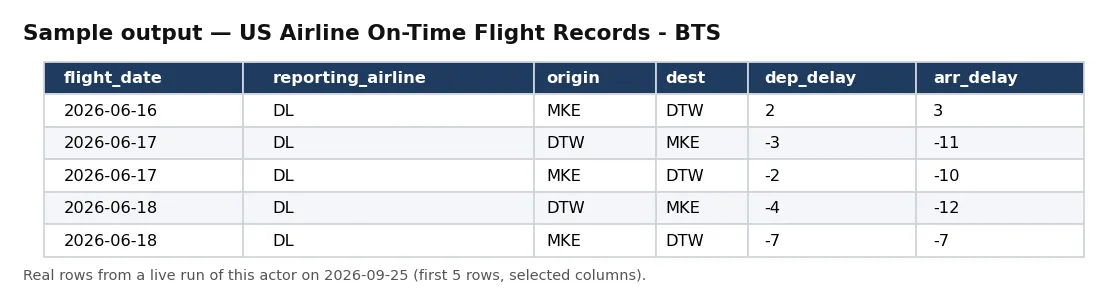
Real rows from a live run of this actor (first 5 rows, selected columns).
One full record from the same run, exactly as delivered:
Coverage, volume and the default run
Default changed on 30 Sep 2026: if you leave maxRecords out, a run now returns up to 10 records (it was 1,000). Set maxRecords yourself to get more — the maximum is unchanged.
The full catalogue is 234 million flights from 1987 to the present, across 110 source fields. A single month is about 600,000 flights - the live June 2026 partition holds 607,577. Because a full month at the per-record price is a large charge, the Maximum records cap defaults to 10 so a first run is inexpensive (about US$0.50 at the standard rate); raise it to pull a whole month, and set the year and month to the partition you want. Tail numbers are aircraft registrations, not people - the dataset carries no personal data.
Licence
U.S. Department of Transportation, Bureau of Transportation Statistics. A U.S. Government work in the public domain under 17 U.S.C. 105 - no copyright; cite BTS as the source.
Fields, scheduling and joins
Every field in the record is either a source-native identifier, a source-native attribute, or one of the six
provenance fields (source, source_dataset, licence, attribution, caveat, observed_at) the fleet attaches to
every record. Nothing is derived or inferred beyond the small, documented transforms noted above, and nothing is
dropped silently - the person-handling section spells out exactly which fields are excluded and why. The grain is one
record per the natural unit of the source, which keeps each row independently meaningful, keeps the key stable across
runs so re-running is a cheap upsert rather than a re-import, and lets you aggregate up to whatever unit you need
without unpicking a pre-joined table.
Because the source republishes on its own cadence, a scheduled run keeps a downstream table current: new and changed
records upsert over the old ones on the stable key, and the observed_at stamp on every record tells you when each was
last seen live. Set Maximum records low to sample the shape of the data cheaply, then raise it once the cell fits
your use; the Actor streams its source, so memory stays flat regardless of how many records you request, and you are
billed only for what is delivered. There is no subscription and no minimum - the per-record price and the record cap
together mean the spend on any run is known in advance and matched exactly to the data you receive.
Reconciling counts honestly
Where the live count differs from any previously published figure, the live measure is the honest one and is what this listing quotes; sources re-issue and re-version their files over time, and a workbook's declared row dimension can include trailing empty rows. The run receipt always states what was actually delivered and charged and confirms the two agree, so every run is auditable against itself regardless of what any external index expected.
Integration notes
The output is a flat table of typed records, so it drops straight into whatever you already use: load the run's dataset over the API or an export, key on the record id, and upsert. A common pattern is a light scheduled run that pulls the newest slice into a staging table, then a merge on the stable key into the table your product reads, so you never re-pay for rows you already hold and your history grows cleanly over time. Because identifiers are preserved exactly as the source publishes them, joins across the fleet's cells - and onto your own systems - work without a mapping layer: the same organisation, product, option or facility id lines up on both sides. If you only need a slice, the record cap and any partition inputs bound the run precisely, so a targeted pull costs cents rather than the price of the whole set. Nothing about the record shape assumes a particular warehouse, language or tool; it is deliberately plain so the integration work is a load and a merge, not a cleaning project.
Sibling Actors
The fleet's other BTS aviation cells cover different datasets - carrier traffic, origin-airport traffic, airport-pair fares and airline financials - and the METAR cell and aviation MCP cover live weather and positions. This cell is the distinct flight-level operations grain: one operated flight with its timing and disruption fields. There is no row overlap with those summary datasets.
Provenance and compliance
Every run reads the door host's robots.txt at runtime and records the result (URL, status, byte length and, where
a policy is served, its SHA-256) in the run's RUN_RECEIPT. Where the host serves no robots policy (HTTP 404), the
gate records that as a flag and proceeds on the licence, which grants re-use. The endpoint is keyless and the Actor
reads only the public data door - never a per-record detail page, never a mirror, and it never bypasses a block.
Data quality and freshness
Numbers arrive as real numbers, booleans as real booleans, and every other value as a string or null, so the dataset
loads without a cleaning pass. Each record is keyed on a stable source identifier, so it is safe to diff, deduplicate
or upsert. Every run re-reads the live door, so the data is as fresh as the source publishes, and each record's
observed_at stamp dates the snapshot. The receipt records how many rows were delivered and charged and confirms
charge_equals_delivered.
Billing, delivery and joins
Pricing is per record: you are billed only for records the Actor actually delivers, and the charge is raised after each record is pushed (push-then-charge), so a failed or empty run costs nothing. The Maximum records cap bounds every run, so spend is known before you start - sample cheaply, then raise it. Every record is a flat, typed object keyed on a stable id, so it loads without a cleaning pass, diffs cleanly between runs, and upserts into a table you keep over time; re-running keeps that table current without re-paying for rows you already hold, and each receipt reconciles delivered against charged. Because the source's own identifiers are preserved verbatim, the dataset joins onto other sources keyed on the same identifier.
Who buys this, and how they use it
This cell is bought by teams that need the source's published set as a typed, keyed table they can hold and refresh rather than a page they scrape: market-intelligence and analytics teams sizing and tracking a market, data engineers wiring a clean upstream feed into a warehouse, and product teams building on a stable identifier. The grain and the key are chosen so the output is a building block, not a one-off export - you run it on a schedule, keep the delta, and join it to your other sources on the identifiers it preserves verbatim. The spend on any run is the per-record price times the records delivered, matched exactly to what you receive.


