
Climate-Tech Funding Leads
Pricing
from $33.50 / 1,000 qualified funding leads
Climate-Tech Funding Leads
Climate & clean-energy funding leads from SEC Form D: one row per new Form D filed by an Energy Conservation, Environmental Services, Electric Utilities or Other Energy issuer — issuer, CIK, location, offering size, amount sold, EDGAR link.
Pricing
from $33.50 / 1,000 qualified funding leads
Rating
0.0
(0)
Developer
NexGen Watch
Maintained by CommunityActor stats
0
Bookmarked
1
Total users
1
Monthly active users
a day ago
Last modified
Categories
Share
💸 Climate-Tech Funding Leads
Climate & Clean Energy funding leads straight from SEC Form D, the notice a company files with the SEC within 15 days of the first sale in a Regulation D private placement. One qualified_funding_lead row per Form D filing that matches this cut, with the issuer's legal name, CIK, city and state, industry group, total offering, amount sold, first-sale date, exemptions and the EDGAR link — the facts a fund, banker, vendor or recruiter needs to act the same week.
How this cut is defined. Form D industry group is Energy Conservation, Environmental Services, Electric Utilities or Other Energy as declared by the issuer; Coal Mining and Oil and Gas are excluded. Measured on 2026-10-03 with the Store example (last 30 days, maxRecords 10): 10 leads in 17 seconds from 31 search matches. This is a thin cut: a single filing date often has 0–2.
Why Form D and not news. The previous version of this actor read startup-news feeds and resolved company domains; those feeds are bot-walled or carry no sector tags, so it returned 0–1 leads per run. Form D is the primary source: the issuer files it, the SEC publishes it, and the actor reads each filing's XML directly from www.sec.gov. Pooled investment funds (VC/PE/hedge vehicles raising their own capital) are never delivered as leads.
Output is one qualified_funding_lead row per result; billing is pay-per-event, the value event being one qualified funding lead (a $0.02 start fee per run, then $0.05 per qualified funding lead). Source: www.sec.gov.
No login, no API key and no CAPTCHA solving are involved: the source is read logged-out.
Who buys this
Buyers usually search for climate tech funding or SEC Form D funding.
- Sales, SDR and vendor teams building outbound lists from climate tech funding.
- VC associates, bankers and analysts scanning SEC Form D funding by sector and geography.
- Recruiters and service providers who sell to companies right after they raise.
📊 Sample Output
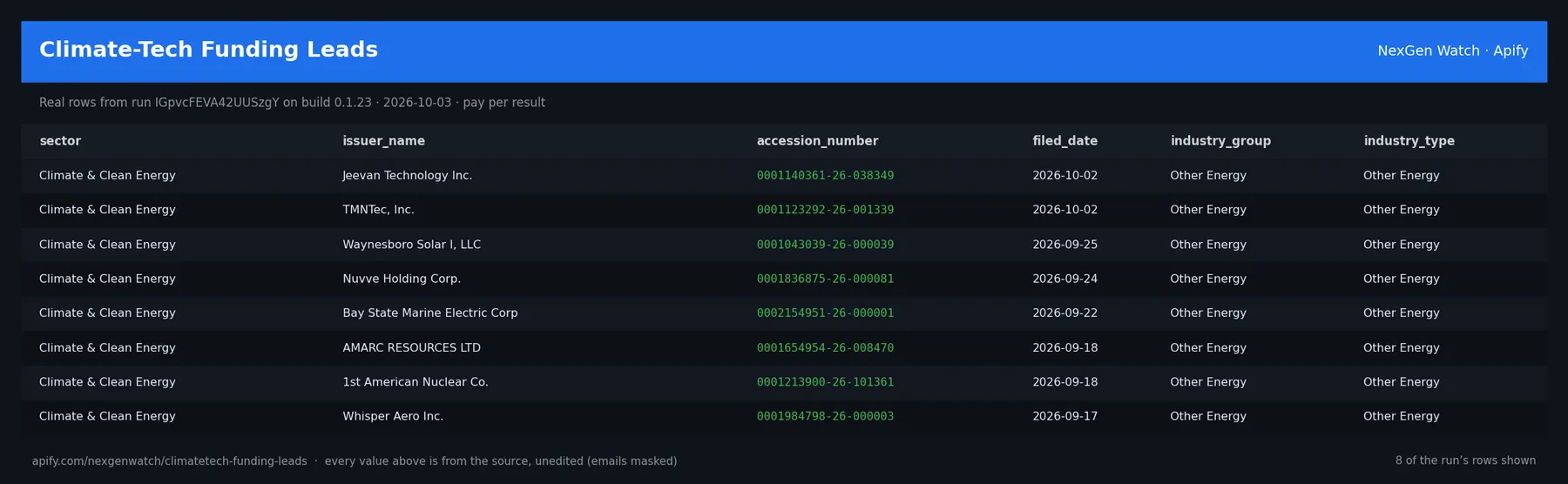
Real rows from run IGpvcFEVA42UUSzgY on build 0.1.23 (2026-10-03), the same input as the Quick start below — every value is as the source published it (emails masked, long text shortened):
| sector | issuer_name | accession_number | filed_date | industry_group | industry_type |
|---|---|---|---|---|---|
| Climate & Clean Energy | Jeevan Technology Inc. | 0001140361-26-038349 | 2026-10-02 | Other Energy | Other Energy |
| Climate & Clean Energy | TMNTec, Inc. | 0001123292-26-001339 | 2026-10-02 | Other Energy | Other Energy |
| Climate & Clean Energy | Waynesboro Solar I, LLC | 0001043039-26-000039 | 2026-09-25 | Other Energy | Other Energy |
| Climate & Clean Energy | Nuvve Holding Corp. | 0001836875-26-000081 | 2026-09-24 | Other Energy | Other Energy |
| Climate & Clean Energy | Bay State Marine Electric Corp | 0002154951-26-000001 | 2026-09-22 | Other Energy | Other Energy |
| Climate & Clean Energy | AMARC RESOURCES LTD | 0001654954-26-008470 | 2026-09-18 | Other Energy | Other Energy |
| Climate & Clean Energy | 1st American Nuclear Co. | 0001213900-26-101361 | 2026-09-18 | Other Energy | Other Energy |
| Climate & Clean Energy | Whisper Aero Inc. | 0001984798-26-000003 | 2026-09-17 | Other Energy | Other Energy |
The run finished with the status message: CAPPED: 10 Climate & Clean Energy leads from 10 Form D filings checked (31 search matches, the last 30 days; 0 dropped by the industry-group, fund, amount, first-sale or state rules); more may qualify in the window — rai
✅ What you get
One qualified_funding_lead per SEC Form D filing that matches the sector rule; every field is as filed on EDGAR.
Each row is flat JSON with these fields (from the dataset schema and the sample run; a field the source does not publish for a given row is null):
record_type(string) — e.g.qualified_funding_leadsector(string/null) — e.g.Climate & Clean Energysector_rule(string/null) — e.g.Form D industry group is Energy Conservation, Environmental Services, Electric Uissuer_name(string/null) — e.g.Jeevan Technology Inc.cik(string/null) — e.g.2092046accession_number(string/null) — e.g.0001140361-26-038349form_type(string/null) — e.g.Dfiled_date(string/null) — e.g.2026-10-02industry_group(string/null) — e.g.Other Energyindustry_type(string/null) — e.g.Other Energyentity_type(string/null) — e.g.Corporationjurisdiction_of_incorporation(string/null) — e.g.DELAWAREyear_of_incorporation(integer/string/null) — e.g.2022issuer_city(string/null) — e.g.Allentownissuer_state_or_country(string/null) — e.g.PAissuer_postal_code(string/null) — e.g.18109issuer_phone(string/null) — e.g.314.369.6867revenue_range(string/null) — e.g.Decline to Disclosefederal_exemptions(array/null) — e.g.["06b"]security_types(array/null) — e.g.["Equity", "Security to be Acquired Upon Exercise"]total_offering_amount(integer/number/null) — e.g.4700000total_amount_sold(integer/number/null) — e.g.700002total_remaining(integer/number/null) — e.g.4700000investor_count(integer/null) — e.g.7minimum_investment(integer/number/null) — e.g.0date_of_first_sale(string/null) — e.g.2026-09-18yet_to_sell(boolean/null) — e.g.Trueis_amendment(boolean/null) — e.g.Falserelated_persons(array/null) — null in every sample rowfiling_index_url(string/null) — e.g.https://www.sec.gov/Archives/edgar/data/2092046/000114036126038349/index.jsonsource_url(string/null) — e.g.https://www.sec.gov/Archives/edgar/data/2092046/000114036126038349/primary_doc.xobserved_at(string/null) — e.g.2026-10-03T21:32:54Z
Every run also writes a RUN_RECEIPT record to its key-value store with the source checks it made and the counts it charged — diagnostics never land in the paid dataset.
⚙️ Sample inputs
1. Quick start — the Store example (this is what the sample above came from)
The sample run charged exactly: 1 × $0.02 apify-actor-start + 10 × $0.05 qualified_funding_lead = $0.52 on the Free tier — every delivered row was billed.
2. A smaller, narrowed run
Caps the run at 5 rows — about $0.27 on the Free tier ($0.02 start + 5 × $0.05).
3. A full-size run
Up to 40 rows (the schema default for maxRecords) — about $2.02 on the Free tier ($0.02 start + 40 × $0.05) if the source has that many.
🧾 JSON sample record
One real record from run IGpvcFEVA42UUSzgY, exactly as it lands in the dataset (emails masked, long text shortened):
🔧 How it works
Source. The actor reads www.sec.gov. Public pages and feeds only; nothing behind a login.
Transport. Plain HTTPS from the Apify platform, no proxy.
Terminal states. A run ends NORMAL, CAPPED (your cap was reached), PARTIAL (something was withheld and the message says what), GENUINE_EMPTY (the source was read and truly had nothing in scope) or BLOCKED (the source refused or changed shape — the run FAILS loud and bills nothing). A zero-row run is never reported as a silent success.
Charging. Each qualified funding lead is charged at the moment it is pushed (qualified_funding_lead); a row that fails to charge is not delivered, so the dataset count always equals the charged count.
Finding candidates. EDGAR's own full-text search (efts.sec.gov) indexes the Form D document itself, so the industry group the issuer declared is searchable. The actor runs one search per group this cut keeps (Energy Conservation, Environmental Services, Electric Utilities, Other Energy) over the window, merges the hits newest first and fetches only those filings — one request each, straight to the Form D XML named in the search hit (the filing directory is read only when a hit carries no document name). Each filing is then checked by the same engine as our Form D watch: the declared industry group must be one of the groups above (a search phrase can also appear elsewhere in a filing, so the declared group is what qualifies), first sale within 90 days or yet to occur, and issuerStates, minTotalOfferingAmount, maxTotalOfferingAmount when set. Pooled investment funds are always dropped. The run stops at maxRecords.
Window. lookbackDays (1–365) searches the last N days ending today; the Store example uses 30. Leave it empty and the run keeps the original contract: filingDates complete EDGAR filing dates (1–5, default 1 = the latest), or the first ones on/after startDate, read from the EDGAR daily index. On 2026-10-02 the search path returned exactly the same filings as reading every Form D filed that day, for all four sector cuts.
Fair access. The search host is paced at about one request per 1.2 seconds with retries and backoff (it answers an occasional 500); filing fetches on www.sec.gov at most 2 per second with the SEC-required contact User-Agent (overridable with secUserAgent). A typical run takes 15–30 seconds.
No repeats on a schedule. Every row carries the SEC accession number. A daily schedule with lookbackDays empty and filingDates: 1 delivers each filing once; a weekly schedule with lookbackDays: 7 does the same week to week. A 30-day window re-reads filings you may already hold — de-duplicate on accession_number. If EDGAR's search or daily index does not answer, or every fetched filing fails, the run FAILS with BLOCKED_WITH_ZERO and charges nothing; a window with no matching filings ends GENUINE_EMPTY, also unbilled.
What is not done. No login, no cookie or CAPTCHA bypass, no private or personal-account data, no browser automation.
⏰ Optional: run it on a schedule
A single run returns the current records. If you also want to be told what changed over time, open the actor in Apify Console → Schedules → Create new, add this actor with the input you want, and pick a cadence:
- Daily —
0 7 * * *(07:00 UTC): catch changes within a day. - Weekly —
0 7 * * 1: a Monday digest.
Each run is independent; keep the same input on the schedule so the results stay comparable. Schedules can also POST results to a webhook (Console → Integrations).
💰 Pricing example
| Event | Free | Bronze | Silver | Gold |
|---|---|---|---|---|
Actor Start (apify-actor-start) | $0.02 | $0.02 | $0.02 | $0.02 |
Qualified Funding Lead (qualified_funding_lead) | $0.05 | $0.045 | $0.04 | $0.0335 |
Worked at the live Free-tier price:
- 8 qualified funding leads: $0.02 start + 8 × $0.05 = $0.42
- 25 qualified funding leads: $0.02 start + 25 × $0.05 = $1.27
- 40 qualified funding leads: $0.02 start + 40 × $0.05 = $2.02
A run that delivers zero rows charges the $0.02 start fee only. A BLOCKED run (source refused) fails loud and charges no value event. The start fee is charged once per GB of run memory; the default run memory is 1024 MB.
Yield on the sample run: CAPPED: 10 Climate & Clean Energy leads from 10 Form D filings checked (31 search matches, the last 30 days; 0 dropped by the industry-group, fund, amount, first-sale or state rules); more may qualify. maxRecords is a hard ceiling on what is delivered and billed, never a target.
⚖️ Legal & ToS
This actor reads public, logged-out pages and feeds published by www.sec.gov. It collects only what the source publishes to any visitor, identifies itself, and does not access accounts, private data or anything behind authentication. Use the output in line with the source's terms and your local law; the intended use is B2B research and monitoring.
❓ FAQ
Q: Do I need an API key or a login?
A: No. The source (www.sec.gov) is read logged-out; the input schema has no key field and the actor carries no secrets.
Q: Why did my run return 0 rows?
A: Read the run's status message. GENUINE_EMPTY means the source was read and had nothing in scope for your input; BLOCKED means the source refused and the run failed without billing a value event — retry later or narrow the input. A zero-row run bills the start fee only.
Q: How many rows can one run return?
A: Up to maxRecords (default 40). Raise the cap for a bigger run; you pay per delivered row.
Q: How fresh is the data?
A: Every run reads the source live at run time; nothing is cached between runs. Put it on a schedule for a continuous feed.
Q: What formats can I export?
A: The dataset downloads as JSON, CSV, Excel, XML or RSS from the run's Dataset tab or the Apify API, and any run can push to a webhook or integration.
Q: How is this different from the other startup funding leads actors?
A: Same output shape and billing model; this one covers www.sec.gov. The siblings under Related Actors cover the other sources or slices — run several on one schedule for a combined feed.
Q: Are there rate limits?
A: The actor paces itself against the source; there is no per-buyer limit beyond your Apify plan's concurrency.
🆘 Troubleshooting
- Run FAILED with BLOCKED → the source refused the request or changed its page shape → nothing was billed beyond the start fee; retry after a while, and if it persists open an Issue with the run id.
- Status says CAPPED → your cap (
maxRecords) was reached → raise it for a bigger run. - Input validation error on start → a field is outside the schema's allowed values → start from the Quick start block and change one field at a time.
- Run TIMED-OUT → a very wide request on a slow day → raise the run timeout in Run options or narrow the input; what was delivered before the timeout is still in the dataset.
🔗 Related Actors
- Africa Startup Funding Rounds Scraper — Scrape African startup funding rounds from TechCabal's public funding feed: company, amount, stage, investors and date. One record per result. Pay pe…
- AI Funding Leads — AI funding leads straight from SEC Form D, the notice a company files with the SEC within 15 days of the first sale in a Regulation D private placeme…
- Biotech Funding Leads — Biotech & health funding leads from SEC Form D: one row per new Form D filed by a Health Care-group issuer (Biotechnology, Pharmaceuticals, Other Hea…
- Cybersecurity Funding Leads — Cybersecurity funding leads straight from SEC Form D, the notice a company files with the SEC within 15 days of the first sale in a Regulation D priv…
- European Startup Funding Rounds Scraper — Scrape European startup funding rounds from EU-Startups' public feed: company, amount, stage, investors and date. One record per result. Pay per resu…
- Fintech Funding Leads — Fintech & financial-services funding leads from SEC Form D: one row per new Form D filed by a Commercial Banking, Insurance, Investment Banking or Ot…
- 🏢 About NexGen Watch — NexGen Watch is a catalog of more than 300 public data actors built on official sources, pay-per-result. Browse the catalog at apify.com/nexgenwatch.
⭐ Found this useful?
If this actor saved you a manual check, a quick review on the Apify Store helps other teams find it. Feature request or a source that changed? Open it from the Issues tab — every one is read.


