

Funding Leads Report — Scored SEC Form D Raises
Pricing
from $10,050.00 / 1,000 scored funding-leads reports
Funding Leads Report — Scored SEC Form D Raises
One report call surfaces the newly-funded companies in your sector and geography from SEC Form D filings — a dated, sourced funding-leads book.
Pricing
from $10,050.00 / 1,000 scored funding-leads reports
Rating
0.0
(0)
Developer
NexGen Watch
Maintained by CommunityActor stats
0
Bookmarked
2
Total users
1
Monthly active users
3 days ago
Last modified
Categories
Share
💸 Funding Leads Report — Scored SEC Form D Raises
One report call surfaces the newly-funded companies in your sector, geography and deal-size window — scored and ranked — for less than the price of a coffee. A VC associate or SDR building a prospecting list of freshly-raised companies otherwise reads the raw EDGAR Form D feed by hand, or pays $100–500+/month for a funding-intelligence subscription. This actor delivers the same weekly answer as a single, self-contained report: $15.00 per report (FREE tier) — run it once a week and a whole sector desk is covered for ~$60/month.
It reads the official SEC EDGAR daily indexes, parses public D / D/A Form D XML as filed, filters to your window, and returns a deterministically scored and ranked lead list plus one rendered markdown brief you can paste straight into a prospecting doc.
Output is one funding_lead row per result; billing is pay-per-event, the value event being one scored funding-leads report (a $0.05 start fee per run, then $15.00 per scored funding-leads report).
No login, no API key and no CAPTCHA solving are involved: the source is read logged-out.
📊 Sample Output
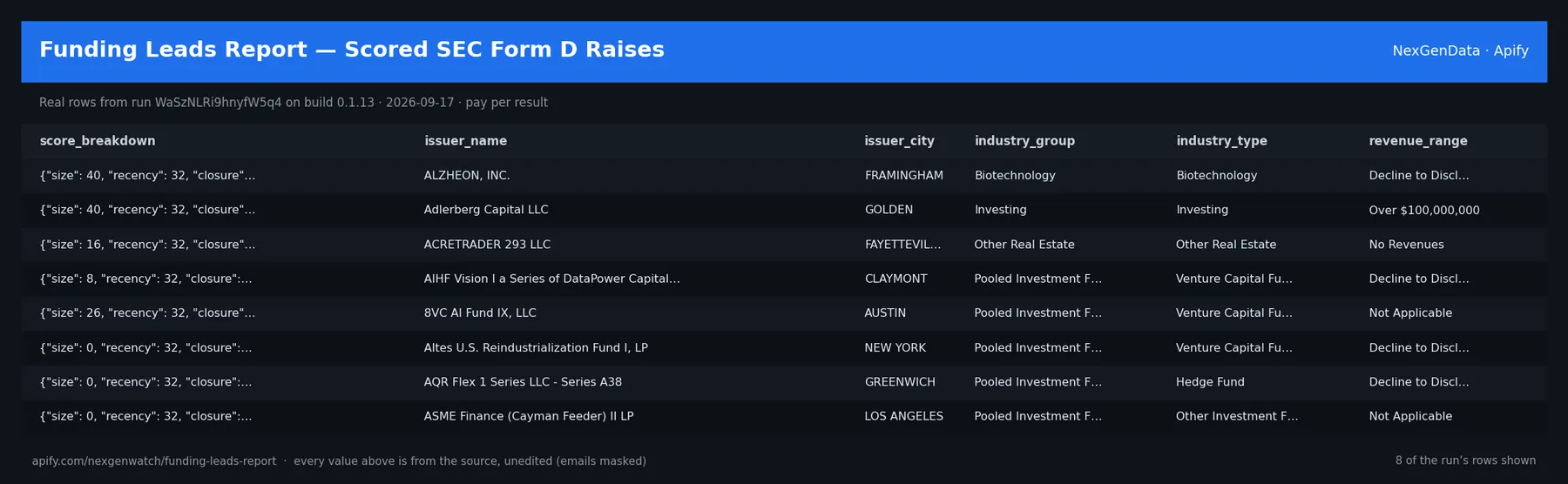
Real rows from run WaSzNLRi9hnyfW5q4 on build 0.1.13 (2026-09-17), the same input as the Quick start below — every value is as the source published it (emails masked, long text shortened):
| score_breakdown | issuer_name | issuer_city | industry_group | industry_type | revenue_range |
|---|---|---|---|---|---|
| {"size": 40, "recency": 32, "closure": 17} | ALZHEON, INC. | FRAMINGHAM | Biotechnology | Biotechnology | Decline to Disclose |
| {"size": 40, "recency": 32, "closure": 8} | Adlerberg Capital LLC | GOLDEN | Investing | Investing | Over $100,000,000 |
| {"size": 16, "recency": 32, "closure": 25} | ACRETRADER 293 LLC | FAYETTEVILLE | Other Real Estate | Other Real Estate | No Revenues |
| {"size": 8, "recency": 32, "closure": 25} | AIHF Vision I a Series of DataPower Capital Partners LLC | CLAYMONT | Pooled Investment Fund | Venture Capital Fund | Decline to Disclose |
| {"size": 26, "recency": 32, "closure": 3} | 8VC AI Fund IX, LLC | AUSTIN | Pooled Investment Fund | Venture Capital Fund | Not Applicable |
| {"size": 0, "recency": 32, "closure": 8} | Altes U.S. Reindustrialization Fund I, LP | NEW YORK | Pooled Investment Fund | Venture Capital Fund | Decline to Disclose |
| {"size": 0, "recency": 32, "closure": 8} | AQR Flex 1 Series LLC - Series A38 | GREENWICH | Pooled Investment Fund | Hedge Fund | Decline to Disclose |
| {"size": 0, "recency": 32, "closure": 3} | ASME Finance (Cayman Feeder) II LP | LOS ANGELES | Pooled Investment Fund | Other Investment Fund | Not Applicable |
The run finished with the status message: CAPPED: cap_reached(maxFilings 10 reached; capped_dates=2026-09-10,2026-09-11,2026-09-14,2026-09-15,2026-09-16); emitted=10; rows_seen=1466; dates_complete=1/6 | leads=10 grades={'HOT': 3, 'WARM': 2, 'COOL': 5} | leads_r
✅ What you get
One of three record types, discriminated by record_type: funding_lead (a scored lead), leads_report (the single rendered digest), or source_receipt (a per-filing-date run receipt). Every item carries source_url and observed_at.
Each row is flat JSON with these fields (from the dataset schema and the sample run; a field the source does not publish for a given row is null):
record_type(string) — Discriminator.lead_score(number/null) — Deterministic 0-100 lead score (ngd-fundscore-v1).lead_grade(string/null) — Score band.score_breakdown(object/null) — size / recency / closure subscores.days_since_filed(number/null) — Days between the filing date and the run.sold_ratio(number/null) — total_amount_sold / total_offering_amount when both known.issuer_name(string/null) — Primary issuer name.cik(string/null) — Issuer CIK (no leading zeros).issuer_state(string/null) — Issuer state or country code.issuer_city(string/null) — Issuer city.industry_group(string/null) — Issuer-reported industry group.industry_type(string/null) — Issuer-reported industry/fund type.revenue_range— e.g.Decline to Disclosetotal_offering_amount(number/null) — Total offering amount USD; null when indeterminate.total_amount_sold(number/null) — Total amount sold USD; null when omitted.total_remaining— e.g.421202815date_of_first_sale(string/null) — Date of first sale, or null when yet-to-sell/omitted.yet_to_sell(boolean/null) — True when the offering reports no first sale yet.investor_count— e.g.3filed_date(string/null) — SEC filing date.form_type(string/null) — Form D filing type.is_amendment— e.g.Falseaccession_number(string/null) — SEC accession number (filing composite key).federal_exemptions(array/null) — Filed exemption/exclusion codes (preserved).security_types(array/null) — Security types offered.related_persons— e.g.[{"first_name": "Martin", "middle_name": null, "last_name": "Tolar, M.D., Ph.D."parse_warnings(array/null) — Non-fatal parse warnings (e.g. indeterminate amounts).score_method— e.g.weighted rubric over offering size + filing recency + closure signals; determiniscore_model— e.g.ngd-fundscore-v1filing_index_url— e.g.https://www.sec.gov/Archives/edgar/data/1582636/000158263626000002/index.jsonsource_url(string/null) — Exact public EDGAR request URL supporting this item.observed_at(string/null) — RFC3339 UTC time after shape validation.lead_rank(number/null) — 1-based rank within the report (funding_lead).report_id(string/null) — Deterministic report id (leads_report).generated_at(string/null) — Report generation timestamp.window(object/null) — Lookback window (start/end/dates scanned).filters(object/null) — Applied filter window.lead_count(number/null) — Number of qualifying leads in the report.filings_scanned(number/null) — Form D rows scanned in the window.grade_counts(object/null) — HOT/WARM/COOL counts.score_max(number/null) — Highest lead score in the report.score_median(number/null) — Median lead score.top_leads(array/null) — Compact top-25 lead list.report_markdown(string/null) — Rendered markdown brief.report_kv_key(string/null) — Key-value store key holding the markdown brief.source_terminal(string/null) — Source terminal state.method(string/null) — Scoring method description.model(string/null) — Scoring model id (ngd-fundscore-v1).partial(boolean/null) — True if the run hit a budget/source cap.terminal_state(string/null) — source_receipt only.canary_passed(boolean/null) — Whether the source-shape canary passed.reason_code(string/null) — Stable terminal reason code.
What you get
funding_leadrecords — one per qualifying raise, each with a 0–100lead_score, aHOT/WARM/COOLgrade, the score breakdown, and the buyer-relevant filing fields (issuer, state, sector, offering amount, amount sold, first-sale date, exemptions, source URL).- One
leads_reportrecord — the ranked digest: window, filters, lead and grade counts, score summary, the top leads, and a full rendered markdown brief (also written to the key-value store underreport_kv_key). source_receiptrecords — a per-filing-date run receipt (terminal state, canary, request counters). Always emitted, never billed.
Every run also writes a RUN_RECEIPT record to its key-value store with the source checks it made and the counts it charged — diagnostics never land in the paid dataset.
⚙️ Sample inputs
1. Quick start — the Store example (this is what the sample above came from)
The sample run charged exactly: 1 × $0.05 apify-actor-start + 1 × $15.00 leads_report = $15.05 on the Free tier — every delivered row was billed.
2. A smaller, narrowed run
A bounded run for checking the field shape before scheduling.
3. A full-size run
The same input run on a schedule; each run is billed only for what it delivers.
🧾 JSON sample record
One real record from run WaSzNLRi9hnyfW5q4, exactly as it lands in the dataset (emails masked, long text shortened):
🔧 How it works
Transport. Plain HTTPS from the Apify platform, no proxy.
Terminal states. A run ends NORMAL, CAPPED (your cap was reached), PARTIAL (something was withheld and the message says what), GENUINE_EMPTY (the source was read and truly had nothing in scope) or BLOCKED (the source refused or changed shape — the run FAILS loud and bills nothing). A zero-row run is never reported as a silent success.
Charging. Each scored funding-leads report is charged at the moment it is pushed (leads_report); a row that fails to charge is not delivered, so the dataset count always equals the charged count.
How leads are scored (transparent, no AI)
Scoring is a fixed, deterministic rubric — ngd-fundscore-v1. Identical inputs
always produce identical scores. No LLM, no external model, no "AI-powered"
anything.
- Size (0–40) — banded by total offering amount (bigger raise, bigger account).
- Recency (0–35) — linear decay over a 90-day horizon from the filing date.
- Closure (0–25) — traction signals: capital already sold, the sold-vs-offering ratio, and a very recent first sale (money just started moving) or a brand-new open raise.
Leads are ranked by score, with deterministic tie-breaks (larger offering, then fresher filing, then accession number).
Billing
Pay-per-event, listed price = charged price:
apify-actor-start— reserved system event, auto-charged by the platform.leads_report— charged exactly once, only after the report is successfully built and pushed. An empty window over a valid search is a delivered report and is charged. A source failure (EDGAR blocked, shape drift, missing User-Agent) fails loud and charges nothing.
Honest limits
A Form D is an issuer-filed notice of an exempt offering — not proof the
raise closed, of company quality, or of investor intent. Issuers sometimes omit
amounts (Indefinite amounts become null and score 0 on size). The score is a
prospecting heuristic, not investment advice. Public, logged-out EDGAR only; the
actor self-throttles below SEC's rate ceiling and fails loud on EDGAR outages or
fair-access controls — never a silent empty success.
What is not done. No login, no cookie or CAPTCHA bypass, no private or personal-account data, no browser automation.
💰 Pricing example
| Event | Free | Bronze | Silver | Gold |
|---|---|---|---|---|
Actor Start (apify-actor-start) | $0.05 | $0.05 | $0.05 | $0.05 |
Scored funding-leads report (leads_report) | $15.00 | $13.50 | $12.00 | $10.05 |
Worked at the live Free-tier price:
- 8 scored funding-leads reports: $0.05 start + 8 × $15.00 = $120.05
- 25 scored funding-leads reports: $0.05 start + 25 × $15.00 = $375.05
- 100 scored funding-leads reports: $0.05 start + 100 × $15.00 = $1,500.05
A run that delivers zero rows charges the $0.05 start fee only. A BLOCKED run (source refused) fails loud and charges no value event. The start fee is charged once per GB of run memory; the default run memory is 512 MB.
Yield on the sample run: CAPPED: cap_reached(maxFilings 10 reached; capped_dates=2026-09-10,2026-09-11,2026-09-14,2026-09-15,2026-09-16); emitted=10; rows_seen=1466; dates_complete=1/6 | leads=10 grades={'HOT': 3, 'WARM': 2, .
⚖️ Legal & ToS
This actor reads public data only. It collects only what the source publishes to any visitor, identifies itself, and does not access accounts, private data or anything behind authentication. Use the output in line with the source's terms and your local law; the intended use is B2B research and monitoring.
❓ FAQ
Q: Do I need an API key or a login?
A: No. the input schema has no key field and the actor carries no secrets.
Q: Why did my run return 0 rows?
A: Read the run's status message. GENUINE_EMPTY means the source was read and had nothing in scope for your input; BLOCKED means the source refused and the run failed without billing a value event — retry later or narrow the input. A zero-row run bills the start fee only.
Q: How fresh is the data?
A: Every run reads the source live at run time; nothing is cached between runs. Put it on a schedule for a continuous feed.
Q: What formats can I export?
A: The dataset downloads as JSON, CSV, Excel, XML or RSS from the run's Dataset tab or the Apify API, and any run can push to a webhook or integration.
Q: How is this different from the other startup funding leads actors?
A: Same output shape and billing model; this one covers Funding Leads Report — Scored SEC Form D Raises. The siblings under Related Actors cover the other sources or slices — run several on one schedule for a combined feed.
Q: Are there rate limits?
A: The actor paces itself against the source; there is no per-buyer limit beyond your Apify plan's concurrency.
🆘 Troubleshooting
- Run FAILED with BLOCKED → the source refused the request or changed its page shape → nothing was billed beyond the start fee; retry after a while, and if it persists open an Issue with the run id.
- Fewer rows than expected → the source had fewer items in scope → widen the input.
- Input validation error on start → a field is outside the schema's allowed values → start from the Quick start block and change one field at a time.
- Run TIMED-OUT → a very wide request on a slow day → raise the run timeout in Run options or narrow the input; what was delivered before the timeout is still in the dataset.
🔗 Related Actors
- European Startup Funding Tracker — Clean, structured European startup funding rounds from EU-Startups' public feed — one record per deal, extracted from feed fields only. The article p…
- Fintech Funding Leads — Fintech & financial-services funding leads from SEC Form D: one row per new Form D filed by a Commercial Banking, Insurance, Investment Banking or Ot…
- 💵 SEC Form D Funding Leads — New Raises Watch — SEC EDGAR Form D watch — new private placements and funding leads (issuer, amount, dates) with deltas on new and changed filings
- LatAm Startup Funding Tracker — Latin American startup funding rounds — company, amount, currency, location, date, source. Ready for CRM and market mapping
- Seed & Pre-Seed Funding Leads — Seed and pre-seed funding leads from SEC Form D: one row per new operating-company Form D with a total offering of $3M or less — issuer, CIK, city/st…
- Startup Funding Leads from SEC Form D Filings — Fresh company-round funding leads pulled from official SEC Form D filings — company, round, amount, date, provenance. Ready for CRM and outreach
- 🏢 About NexGenData — NexGen Watch is NexGenData's fleet of 256 public monitoring and lookup actors built on official sources, pay-per-result. Browse the catalog at apify.com/nexgenwatch.
⭐ Found this useful?
If this actor saved you a manual check, a quick review on the Apify Store helps other teams find it. Feature request or a source that changed? Open it from the Issues tab — every one is read.


