

EDGAR Diligence Report — Per-Issuer SEC Filing Brief
Pricing
from $16,750.00 / 1,000 diligence reports
EDGAR Diligence Report — Per-Issuer SEC Filing Brief
Per-issuer SEC/EDGAR diligence in one run — material 8-K events, filing history, and risk factors as structured findings plus a rendered markdown brief.
Pricing
from $16,750.00 / 1,000 diligence reports
Rating
0.0
(0)
Developer
NexGen Watch
Maintained by CommunityActor stats
0
Bookmarked
2
Total users
1
Monthly active users
5 days ago
Last modified
Share
📑 EDGAR Diligence Report — Per-Issuer SEC Filing Brief
SEC filings are public but scattered across EDGAR. Investors, corporate-development, and compliance teams pay for the brief: one issuer, one run, the material events and filing history assembled into a diligence report they can read in minutes.
Output is one diligence_finding row per result; billing is pay-per-event, the value event being one diligence report (a $0.05 start fee per run, then $25.00 per diligence report). Source: www.sec.gov.
No login, no API key and no CAPTCHA solving are involved: the source is read logged-out.
Use cases by team
- Investors / analysts: Get a fast, sourced read on an issuer's recent filings before a call or memo.
- Corporate development / M&A: Pull a target's material events and filing history into one diligence brief.
- Compliance / legal: Track an issuer's periodic and 8-K filings with accession IDs preserved for the record.
- Data teams: Feed structured, deterministic findings into a pipeline without scraping EDGAR yourself.
📊 Sample Output
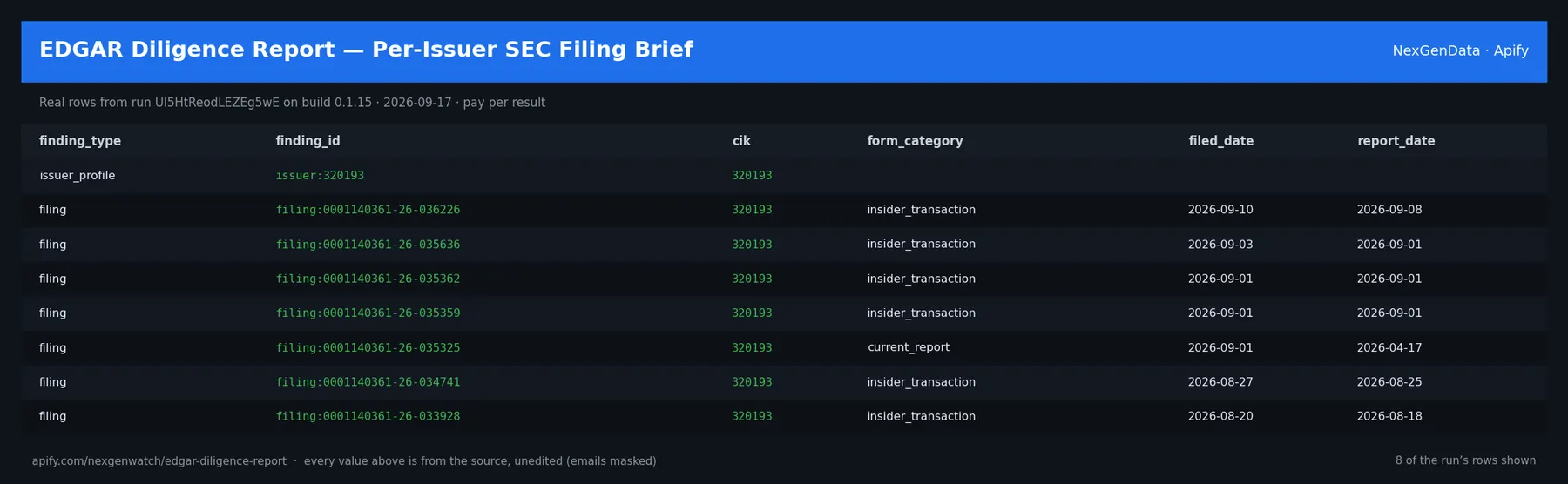
Real rows from run UI5HtReodLEZEg5wE on build 0.1.15 (2026-09-17), the same input as the Quick start below — every value is as the source published it (emails masked, long text shortened):
| finding_type | finding_id | cik | form_category | filed_date | report_date |
|---|---|---|---|---|---|
| issuer_profile | issuer:320193 | 320193 | |||
| filing | filing:0001140361-26-036226 | 320193 | insider_transaction | 2026-09-10 | 2026-09-08 |
| filing | filing:0001140361-26-035636 | 320193 | insider_transaction | 2026-09-03 | 2026-09-01 |
| filing | filing:0001140361-26-035362 | 320193 | insider_transaction | 2026-09-01 | 2026-09-01 |
| filing | filing:0001140361-26-035359 | 320193 | insider_transaction | 2026-09-01 | 2026-09-01 |
| filing | filing:0001140361-26-035325 | 320193 | current_report | 2026-09-01 | 2026-04-17 |
| filing | filing:0001140361-26-034741 | 320193 | insider_transaction | 2026-08-27 | 2026-08-25 |
| filing | filing:0001140361-26-033928 | 320193 | insider_transaction | 2026-08-20 | 2026-08-18 |
The run finished with the status message: NORMAL: emitted=7; sources_ok=2/2 | issuer=Apple Inc. findings=9 events=1 | diligence_report charged=1
✅ What you get
One of two record families discriminated by record_type: diligence_finding (a structured finding — finding_type one of issuer_profile / filing / material_event / risk_factor_summary), diligence_report (the single rendered per-issuer digest), or source_receipt (a per-source run receipt). Every item carries source_url and observed_at.
Each row is flat JSON with these fields (from the dataset schema and the sample run; a field the source does not publish for a given row is null):
record_type(string) — Discriminator.finding_type(string/null) — diligence_finding subtype.finding_id(string/null) — Deterministic source-native composite id for the finding.cik(string/null) — Issuer CIK (no leading zeros).issuer_name(string/null) — Primary issuer name.tickers(array/null) — Issuer tickers.exchanges(array/null) — Listing exchanges.sic(string/null) — SIC code.sic_description(string/null) — SIC description.entity_type(string/null) — SEC entity type.ein(string/null) — Employer identification number.state_of_incorporation(string/null) — State/country of incorporation.fiscal_year_end(string/null) — Fiscal year end (MMDD).category(string/null) — SEC filer category.former_names(array/null) — Prior issuer names.business_address(object/null) — Business address block.phone(string/null) — Issuer phone.website(string/null) — Issuer website.investor_website(string/null) — Investor relations website.source_url(string/null) — Exact public EDGAR request URL supporting this item.observed_at(string/null) — RFC3339 UTC time after shape validation.form_type(string/null) — SEC form type (filing / material_event).form_category(string/null) — Diligence lens category for the form.filed_date(string/null) — SEC filing date.report_date(string/null) — Period-of-report date.days_since_filed(number/null) — Days between the filing date and the run.accession_number(string/null) — SEC accession number (filing composite key).primary_doc_description(string/null) — Filer-supplied primary document description.eight_k_items(array/null) — Labeled 8-K item codes on a current report.document_url(string/null) — Archive URL of the filing's primary document.item_code(string/null) — 8-K item code (material_event).event(string/null) — Canonical 8-K item meaning (material_event).high_signal(boolean/null) — Whether the 8-K item is diligence high-signal.based_on_accession(string/null) — 10-K accession the risk-factor excerpt was drawn from.section_chars(number/null) — Character length of the located risk-factor section.excerpt(string/null) — Bounded Item 1A risk-factor excerpt.report_id(string/null) — Deterministic report id (diligence_report).generated_at(string/null) — Report generation timestamp.window(object/null) — Lookback window summary.filings_scanned(number/null) — Filings in the window.finding_count(number/null) — Findings delivered in the report.form_counts(object/null) — Filing counts by form type.latest_10k(object/null) — Latest in-window 10-K pointer.latest_10q(object/null) — Latest in-window 10-Q pointer.latest_8k(object/null) — Latest in-window 8-K pointer.material_event_count(number/null) — Total 8-K material events found.high_signal_event_count(number/null) — High-signal 8-K events found.high_signal_events(array/null) — Compact high-signal event list.offering_forms(array/null) — Offering/registration forms present.risk_factors(object/null) — Risk-factor excerpt summary block (diligence_report).report_markdown(string/null) — Rendered markdown brief.report_kv_key(string/null) — Key-value store key holding the markdown brief.source_terminal(string/null) — Run terminal state.method(string/null) — Assembly method description.model(string/null) — Assembly model id (ngd-diligence-v1).partial(boolean/null) — True if the run hit a budget/optional-source cap.source(string/null) — source_receipt: which source (TICKER_MAP / SEC_EDGAR_SUBMISSIONS / RISK_FACTORS).terminal_state(string/null) — source_receipt only.required(boolean/null) — source_receipt: whether the source is required for delivery.canary_passed(boolean/null) — Whether the source-shape canary passed.reason_code(string/null) — Stable terminal reason code.
What you get
- A per-issuer diligence report record with a rendered markdown brief (also written to the key-value store)
- Structured findings: an issuer profile, every in-window filing, material 8-K events by item code, and an optional risk-factor summary
- Every finding carries the SEC accession number and document URL, so each claim links back to its primary EDGAR source
- Report highlights: form counts, the latest 10-K / 10-Q / 8-K, and the high-signal 8-K events (results, leadership changes, and more)
- Deterministic assembly (ngd-diligence-v1): the same issuer and window produce the same brief every run
Every run also writes a RUN_RECEIPT record to its key-value store with the source checks it made and the counts it charged — diagnostics never land in the paid dataset.
⚙️ Sample inputs
1. Quick start — the Store example (this is what the sample above came from)
The sample run charged exactly: 1 × $0.05 apify-actor-start + 1 × $25.00 diligence_report = $25.05 on the Free tier — every delivered row was billed.
2. A smaller, narrowed run
A bounded run for checking the field shape before scheduling. company narrows what the source is asked for.
3. A full-size run
The same input run on a schedule; each run is billed only for what it delivers.
🧾 JSON sample record
One real record from run UI5HtReodLEZEg5wE, exactly as it lands in the dataset (emails masked, long text shortened):
🔧 How it works
Source. The actor reads www.sec.gov — endpoints: https://www.sec.gov/files/company_tickers.json. Public pages and feeds only; nothing behind a login.
Transport. Plain HTTPS from the Apify platform, no proxy.
Terminal states. A run ends NORMAL, CAPPED (your cap was reached), PARTIAL (something was withheld and the message says what), GENUINE_EMPTY (the source was read and truly had nothing in scope) or BLOCKED (the source refused or changed shape — the run FAILS loud and bills nothing). A zero-row run is never reported as a silent success.
Charging. Each diligence report is charged at the moment it is pushed (diligence_report); a row that fails to charge is not delivered, so the dataset count always equals the charged count.
How it works
Give it an issuer by ticker, name, or CIK. It resolves the CIK against SEC's official company_tickers map, pulls the submission history from data.sec.gov, and scans the filings in your window from the EDGAR archives. It classifies each filing, extracts material 8-K events by item code, optionally summarizes the latest risk factors, and assembles everything into one diligence report — structured records plus a rendered markdown brief. Assembly is deterministic (ngd-diligence-v1), not an LLM: the same issuer and window produce the same brief every run.
Compliance & honest limits
- Public, logged-out SEC EDGAR only (data.sec.gov, www.sec.gov). No login, no paywall, no private data.
- Records-and-filings framing only. This is a diligence brief, not investment advice, and it never infers undisclosed transactions.
- Bounded windows: lookbackDays, maxFilings, and maxFindings cap every run so it stays fast and predictable.
- An issuer with zero filings in your window still returns a valid, delivered report (GENUINE_EMPTY) and is charged — the answer 'nothing filed' is the product.
- SEC fair-access requires a descriptive User-Agent with a real contact; the actor supplies a default and you can override it with secUserAgent.
- Accession numbers and document URLs are preserved on every finding so each claim links to the primary EDGAR source.
About
EDGAR Diligence Report turns SEC's public filing record into a per-issuer diligence brief you can read in minutes, with every finding linked to its primary EDGAR source. Built by NexGenData. Questions or need a custom feed? Open an issue on the Actor page.
What is not done. No login, no cookie or CAPTCHA bypass, no private or personal-account data, no browser automation.
💰 Pricing example
| Event | Free | Bronze | Silver | Gold |
|---|---|---|---|---|
Actor Start (apify-actor-start) | $0.05 | $0.05 | $0.05 | $0.05 |
Diligence report (diligence_report) | $25.00 | $22.50 | $20.00 | $16.75 |
Worked at the live Free-tier price:
- 8 diligence reports: $0.05 start + 8 × $25.00 = $200.05
- 25 diligence reports: $0.05 start + 25 × $25.00 = $625.05
- 100 diligence reports: $0.05 start + 100 × $25.00 = $2,500.05
A run that delivers zero rows charges the $0.05 start fee only. A BLOCKED run (source refused) fails loud and charges no value event. The start fee is charged once per GB of run memory; the default run memory is 512 MB.
Yield on the sample run: NORMAL: emitted=7; sources_ok=2/2 | issuer=Apple Inc. findings=9 events=1 | diligence_report charged=1.
⚖️ Legal & ToS
This actor reads public, logged-out pages and feeds published by www.sec.gov. It collects only what the source publishes to any visitor, identifies itself, and does not access accounts, private data or anything behind authentication. Use the output in line with the source's terms and your local law; the intended use is B2B research and monitoring.
❓ FAQ
Q: Do I need an API key or a login?
A: No. The source (www.sec.gov) is read logged-out; the input schema has no key field and the actor carries no secrets.
Q: Why did my run return 0 rows?
A: Read the run's status message. GENUINE_EMPTY means the source was read and had nothing in scope for your input; BLOCKED means the source refused and the run failed without billing a value event — retry later or narrow the input. A zero-row run bills the start fee only.
Q: How fresh is the data?
A: Every run reads the source live at run time; nothing is cached between runs. Put it on a schedule for a continuous feed.
Q: What formats can I export?
A: The dataset downloads as JSON, CSV, Excel, XML or RSS from the run's Dataset tab or the Apify API, and any run can push to a webhook or integration.
Q: How is this different from the other premium report actors actors?
A: Same output shape and billing model; this one covers www.sec.gov. The siblings under Related Actors cover the other sources or slices — run several on one schedule for a combined feed.
Q: Are there rate limits?
A: The actor paces itself against the source; there is no per-buyer limit beyond your Apify plan's concurrency.
🆘 Troubleshooting
- Run FAILED with BLOCKED → the source refused the request or changed its page shape → nothing was billed beyond the start fee; retry after a while, and if it persists open an Issue with the run id.
- Fewer rows than expected → the source had fewer items in scope → widen the input.
- Input validation error on start → a field is outside the schema's allowed values → start from the Quick start block and change one field at a time.
- Run TIMED-OUT → a very wide request on a slow day → raise the run timeout in Run options or narrow the input; what was delivered before the timeout is still in the dataset.
🔗 Related Actors
- App Review Competitive Report — Head-to-Head Comparison — Stop paying $50–100+/month for a review-intelligence subscription to compare your app against the competition
- App Review Deep Report — Sentiment, Themes & Complaints — Stop paying $50–100+/month for a review-intelligence subscription you use a few times
- ASO Audit Report — App Store Listing Health & Keyword Coverage — Mobile growth / ASO agencies auditing a client app's store listing before a keyword or creative push, and PMs benchmarking their listing against cate…
- Grant Funding Report — NIH Awards & Grants.gov Window — Research-development offices and grant consultancies sizing a funder's activity in a topic area, and life-science BD teams tracking award concentrati…
- Tender Pipeline Report — UK & EU Procurement Window Analysis — Bid teams and procurement-intelligence vendors sizing a pipeline for a buyer or CPV category over a dated window, and consultancies producing client…
- Trademark Gazette Issue Digest — USPTO TMOG & CIPO Journal — Trademark attorneys and brand teams reviewing what published in a class or keyword window before a filing decision, and IP watch vendors needing a da…
- 🏢 About NexGenData — NexGen Watch is NexGenData's fleet of 256 public monitoring and lookup actors built on official sources, pay-per-result. Browse the catalog at apify.com/nexgenwatch.
⭐ Found this useful?
If this actor saved you a manual check, a quick review on the Apify Store helps other teams find it. Feature request or a source that changed? Open it from the Issues tab — every one is read.


