

SBIR/STTR Award Intelligence
Pricing
from $33.50 / 1,000 funding intelligences
SBIR/STTR Award Intelligence
One structured fundingintelligence per record from the robots-permitted sbir.gov HTML award search (cross-agency, all participating agencies). Public, logged-out, robots-honoured.
Pricing
from $33.50 / 1,000 funding intelligences
Rating
0.0
(0)
Developer
NexGen Watch
Maintained by CommunityActor stats
0
Bookmarked
2
Total users
1
Monthly active users
3 days ago
Last modified
Categories
Share
🎓 SBIR/STTR Award Intelligence
One structured funding_intelligence per record from the robots-permitted sbir.gov HTML award search (cross-agency, all participating agencies). Public, logged-out, robots-honoured.
Difference: one sbir_award_record per award in a fiscal-year cohort: award title, awarding firm (SBC), topic code, award year, and the award page URL, from the public sbir.gov award search. Distinct from an NSF-only award watch: this is a cross-agency fiscal-year cohort.
Output is one sbir_award_record row per result; billing is pay-per-event, the value event being one funding intelligence (a $0.02 start fee per run, then $0.05 per funding intelligence). Source: www.sbir.gov.
No login, no API key and no CAPTCHA solving are involved: the source is read logged-out with an identified contact User-Agent.
📊 Sample Output
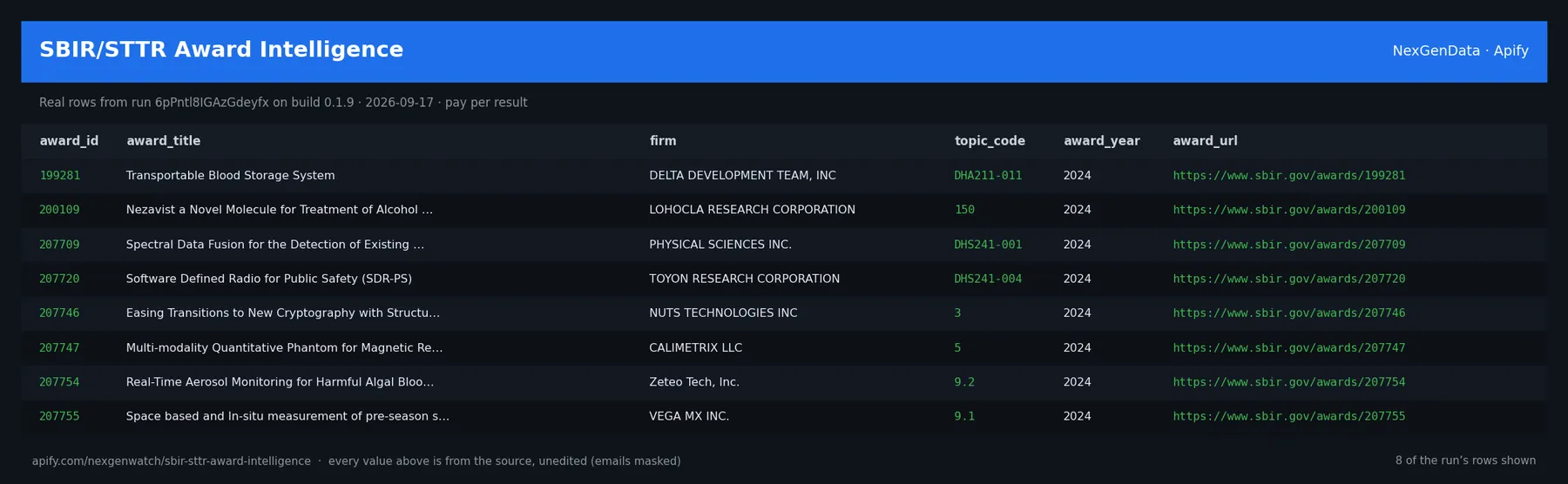
Real rows from run 6pPntl8IGAzGdeyfx on build 0.1.9 (2026-09-17), the same input as the Quick start below — every value is as the source published it (emails masked, long text shortened):
| award_id | award_title | firm | topic_code | award_year | award_url |
|---|---|---|---|---|---|
| 199281 | Transportable Blood Storage System | DELTA DEVELOPMENT TEAM, INC | DHA211-011 | 2024 | https://www.sbir.gov/awards/199281 |
| 200109 | Nezavist a Novel Molecule for Treatment of Alcohol Use Disorder | LOHOCLA RESEARCH CORPORATION | 150 | 2024 | https://www.sbir.gov/awards/200109 |
| 207709 | Spectral Data Fusion for the Detection of Existing and Emerging Synthe | PHYSICAL SCIENCES INC. | DHS241-001 | 2024 | https://www.sbir.gov/awards/207709 |
| 207720 | Software Defined Radio for Public Safety (SDR-PS) | TOYON RESEARCH CORPORATION | DHS241-004 | 2024 | https://www.sbir.gov/awards/207720 |
| 207746 | Easing Transitions to New Cryptography with Structured Data Folding wi | NUTS TECHNOLOGIES INC | 3 | 2024 | https://www.sbir.gov/awards/207746 |
| 207747 | Multi-modality Quantitative Phantom for Magnetic Resonance Imaging and | CALIMETRIX LLC | 5 | 2024 | https://www.sbir.gov/awards/207747 |
| 207754 | Real-Time Aerosol Monitoring for Harmful Algal Blooms and Toxins via M | Zeteo Tech, Inc. | 9.2 | 2024 | https://www.sbir.gov/awards/207754 |
| 207755 | Space based and In-situ measurement of pre-season soil moisture and la | VEGA MX INC. | 9.1 | 2024 | https://www.sbir.gov/awards/207755 |
The run finished with the status message: CAPPED: delivered 10 of 6412 available source rows (maxRecords=10) — a buyer bound, not an outage. billable=10 [requested_cap=10, delivered=10]
✅ What you get
Each row is flat JSON with these fields (from the dataset schema and the sample run; a field the source does not publish for a given row is null):
record_type(string) — e.g.sbir_award_recordaward_id(string/null) — e.g.199281award_title(string/null) — e.g.Transportable Blood Storage Systemfirm(string/null) — e.g.DELTA DEVELOPMENT TEAM, INCtopic_code(string/null) — e.g.DHA211-011award_year(string/null) — e.g.2024award_url(string/null) — e.g.https://www.sbir.gov/awards/199281source(string/null) — e.g.sbir-sttr-award-intelligencerelease_date(string/null) — null in every sample rowsource_url(string/null) — e.g.https://www.sbir.gov/awardsobserved_at(string/null) — e.g.2026-09-17T17:49:28Zterminal(string/integer/null) — null in every sample rowreported_total(string/integer/null) — null in every sample rowraw_seen(string/integer/null) — null in every sample rowduplicates(string/integer/null) — null in every sample rowunique_found(string/integer/null) — null in every sample rowdelivered(string/integer/null) — null in every sample rowscope(string/integer/null) — null in every sample rownote(string/integer/null) — null in every sample row
What you get
One funding_intelligence per entity, deduplicated on the source-native id. Fields the source does not publish for a row are honest null. A run_receipt row carries the source URL, any reported total, and the delivered/duplicate counts.
Every run also writes a RUN_RECEIPT record to its key-value store with the source checks it made and the counts it charged — diagnostics never land in the paid dataset.
⚙️ Sample inputs
1. Quick start — the Store example (this is what the sample above came from)
The sample run charged exactly: 1 × $0.02 apify-actor-start + 10 × $0.05 funding_intelligence = $0.52 on the Free tier — every delivered row was billed.
2. A smaller, narrowed run
Caps the run at 5 rows — about $0.27 on the Free tier ($0.02 start + 5 × $0.05). scope narrows what the source is asked for.
3. A full-size run
Up to 300 rows (the schema default for maxRecords) — about $15.02 on the Free tier ($0.02 start + 300 × $0.05) if the source has that many.
🧾 JSON sample record
One real record from run 6pPntl8IGAzGdeyfx, exactly as it lands in the dataset (emails masked, long text shortened):
🔧 How it works
Source. The actor reads www.sbir.gov — endpoints: https://www.sbir.gov/awards. Public pages and feeds only; nothing behind a login.
Transport. Plain HTTPS from the Apify platform, no proxy. robots.txt is read first and a disallowed path is never fetched. Every request carries an identified contact User-Agent. Pacing: CRAWL_DELAY=1.0.
Charging. Each funding intelligence is charged at the moment it is pushed (funding_intelligence); a row that fails to charge is not delivered, so the dataset count always equals the charged count.
How it behaves
Scope is a fiscal-year cohort (the scope input, e.g. 2024), fetched via the public award search with a year facet; an empty or blocked cohort fails loudly (blocked-with-zero). The token-gated JSON API is not used. maxRecords caps the count. Duplicates, outages, and schema drift charge nothing.
What is not done. No login, no cookie or CAPTCHA bypass, no private or personal-account data, no browser automation.
💰 Pricing example
| Event | Free | Bronze | Silver | Gold |
|---|---|---|---|---|
Actor Start (apify-actor-start) | $0.02 | $0.02 | $0.02 | $0.02 |
Funding Intelligence (funding_intelligence) | $0.05 | $0.04 | $0.04 | $0.03 |
Worked at the live Free-tier price:
- 8 funding intelligences: $0.02 start + 8 × $0.05 = $0.42
- 25 funding intelligences: $0.02 start + 25 × $0.05 = $1.27
- 300 funding intelligences: $0.02 start + 300 × $0.05 = $15.02
A run that delivers zero rows charges the $0.02 start fee only. A BLOCKED run (source refused) fails loud and charges no value event. The start fee is charged once per GB of run memory; the default run memory is 1024 MB.
Yield on the sample run: CAPPED: delivered 10 of 6412 available source rows (maxRecords=10) — a buyer bound, not an outage. billable=10 [requested_cap=10, delivered=10]. maxRecords is a hard ceiling on what is delivered and billed, never a target.
⚖️ Legal & ToS
This actor reads public, logged-out pages and feeds published by www.sbir.gov. It collects only what the source publishes to any visitor, keeps to the source's robots rules (checked on every run), identifies itself with a contact User-Agent, and does not access accounts, private data or anything behind authentication. Use the output in line with the source's terms and your local law; the intended use is B2B research and monitoring.
❓ FAQ
Q: Do I need an API key or a login?
A: No. The source (www.sbir.gov) is read logged-out; the input schema has no key field and the actor carries no secrets.
Q: Why did my run return 0 rows?
A: Read the run's status message. GENUINE_EMPTY means the source was read and had nothing in scope for your input; BLOCKED means the source refused and the run failed without billing a value event — retry later or narrow the input. A zero-row run bills the start fee only.
Q: How many rows can one run return?
A: Up to maxRecords (default 300). Raise the cap for a bigger run; you pay per delivered row.
Q: How fresh is the data?
A: Every run reads the source live at run time; nothing is cached between runs. Put it on a schedule for a continuous feed.
Q: What formats can I export?
A: The dataset downloads as JSON, CSV, Excel, XML or RSS from the run's Dataset tab or the Apify API, and any run can push to a webhook or integration.
Q: How is this different from the other grant and research-funding watches actors?
A: Same output shape and billing model; this one covers www.sbir.gov. The siblings under Related Actors cover the other sources or slices — run several on one schedule for a combined feed.
Q: Are there rate limits?
A: The actor paces itself against the source (CRAWL_DELAY=1.0) and honours its robots rules; there is no per-buyer limit beyond your Apify plan's concurrency.
🆘 Troubleshooting
- Run FAILED with BLOCKED → the source refused the request or changed its page shape → nothing was billed beyond the start fee; retry after a while, and if it persists open an Issue with the run id.
- Status says CAPPED → your cap (
maxRecords) was reached → raise it for a bigger run. - Input validation error on start → a field is outside the schema's allowed values → start from the Quick start block and change one field at a time.
- Run TIMED-OUT → a very wide request on a slow day → raise the run timeout in Run options or narrow the input; what was delivered before the timeout is still in the dataset.
🔗 Related Actors
- EU Horizon / CORDIS Grant Awards Change Watch — Receive seed-zero, structured records for newly signed and changed EU research grant awards — the funded projects published on the European Commissio…
- NIH RePORTER Grant Award Delta — NIH awards as they are noticed: new awards and changes to award amount, keyed on the source-native project number
- US NSF Research Award Change & Funding Momentum Watch — Auditable change deltas on US NSF research awards — new, amended, and funding-momentum shifts, keyed to the award id. Facts-only, seed-zero, one rece…
- UK 360Giving Dataset Publication Watch — UK grantmakers publishing and republishing their grants data to the 360Giving Standard: who published, what changed, the licence, and a direct link t…
- UK 360Giving Funder Grant Watch — New grants from ONE named UK grantmaker, read from that funder's own published 360Giving file - the grant identifier, recipient, amount, award date a…
- UK Find a Grant: New & Changed Grant Watch — Turn the UK government's 'Find a government grant' service into a seed-zero, deterministic delta feed
- 🏢 About NexGenData — NexGen Watch is NexGenData's fleet of 256 public monitoring and lookup actors built on official sources, pay-per-result. Browse the catalog at apify.com/nexgenwatch.
⭐ Found this useful?
If this actor saved you a manual check, a quick review on the Apify Store helps other teams find it. Feature request or a source that changed? Open it from the Issues tab — every one is read.


