
US Grants.gov Eligibility Changes Scraper
Pricing
from $335.00 / 1,000 grant opportunity deltas
US Grants.gov Eligibility Changes Scraper
Scrape US Grants.gov applicant eligibility changes: opportunity, agency and eligibility before and after. Every run returns the current records as a dataset. Optional watch mode returns only what changed since your last run. Pay per result.
Pricing
from $335.00 / 1,000 grant opportunity deltas
Rating
0.0
(0)
Developer
NexGen Watch
Maintained by CommunityActor stats
0
Bookmarked
2
Total users
1
Monthly active users
16 days ago
Last modified
Categories
Share
🎓 US Grants.gov Eligibility Changes Scraper
Scrape US Grants.gov applicant eligibility changes: opportunity, agency and eligibility before and after. Run it once and you get the current records as a dataset — that is the default. Turn on watch mode and a scheduled run returns only what changed since the last run (see Optional: run it on a schedule).
Changes to who may apply for a posted federal funding opportunity.
Output is one grant_opportunity_record row per result; billing is pay-per-event, the value event being one grant opportunity delta (a $0.02 start fee per run, then $0.50 per grant opportunity delta plus one $0.10 source check per run that reads the source). Source: api.grants.gov.
Who buys this
Buyers usually search for grants.gov eligibility or federal grant eligibility.
- Grant consultants and research-development offices tracking grants.gov eligibility.
- Universities, nonprofits and companies watching federal grant eligibility relevant to their field.
- Analysts and journalists following where public funding goes.
📊 Sample Output
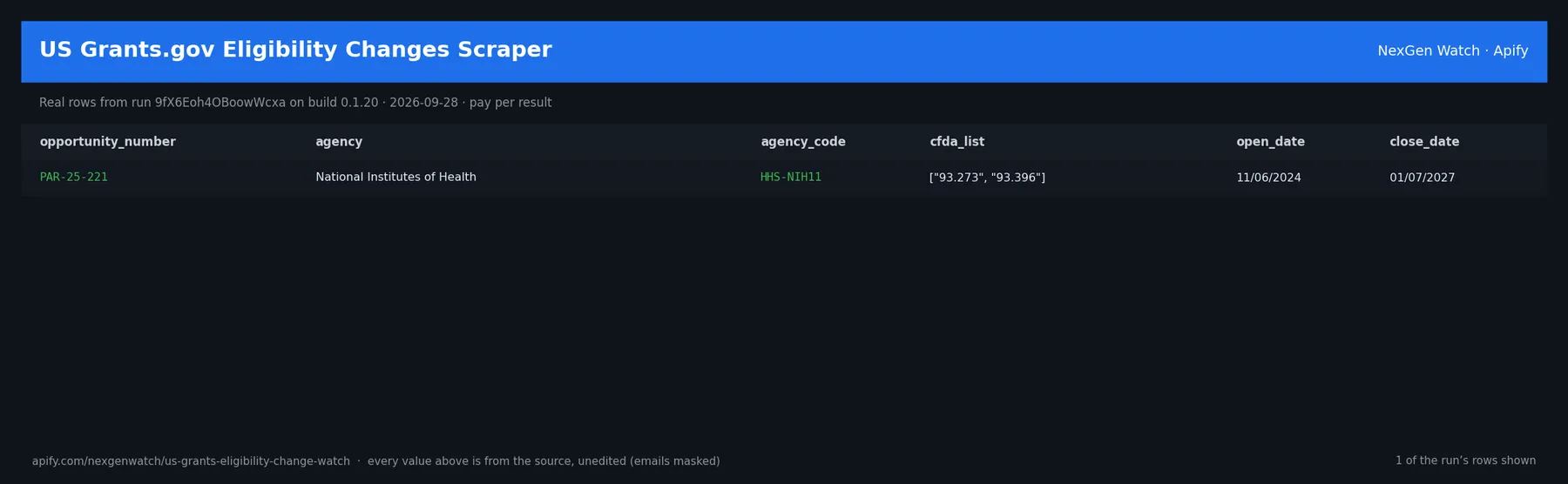
Real rows from run 9fX6Eoh4OBoowWcxa on build 0.1.20 (2026-09-28), the same input as the Quick start below — every value is as the source published it (emails masked, long text shortened):
| opportunity_number | agency | agency_code | cfda_list | open_date | close_date |
|---|---|---|---|---|---|
| PAR-25-221 | National Institutes of Health | HHS-NIH11 | ["93.273", "93.396"] | 11/06/2024 | 01/07/2027 |
The run finished with the status message: NORMAL: emitted 1 item(s)
✅ What you get
Each row is flat JSON with these fields (from the dataset schema and the sample run; a field the source does not publish for a given row is null):
record_key(string/null) — e.g.grants:357021opportunity_id— e.g.357021opportunity_number— e.g.PAR-25-221title— e.g.Population Approaches to Reducing Alcohol-related Cancer Risk (R01 Clinical Triaagency— e.g.National Institutes of Healthagency_code— e.g.HHS-NIH11cfda_list— e.g.["93.273", "93.396"]open_date— e.g.11/06/2024close_date— e.g.01/07/2027opp_status— e.g.posteddoc_type— e.g.synopsisdetail_read— e.g.Trueopportunity_url— e.g.https://www.grants.gov/search-results-detail/357021award_ceiling— e.g.noneaward_floor— e.g.noneestimated_funding— null in every sample rownumber_of_awards— null in every sample rowcost_sharing— e.g.Falseapplicant_types— e.g.["00", "01", "02", "04", "05", "06", "07", "08", "11", "12", "13", "20", "22", "response_date— e.g.2027-01-07-00-00-00posting_date— e.g.2024-11-06-00-00-00attachment_count— e.g.1document_urls— null in every sample rowsynopsis_version— e.g.2modified_fields— e.g.["agencyContactDesc", "applicantEligibilityDesc", "createTimeStamp", "revision",opportunity_category— e.g.Discretionaryrecord_type(string) — e.g.grant_opportunity_recorddelta_type(string/null) — null in every sample rowdelta_kinds(array/null) — null in every sample row
✅ What you get
✅ What you get
⚙️ Sample inputs
1. Quick start — the Store example (this is what the sample above came from)
The sample run charged exactly: 1 × $0.02 apify-actor-start + 1 × $0.10 source-check + 0 × $0.50 grant-opportunity-delta = $0.12 on the Free tier — snapshot preview rows are delivered unbilled; only the source check and the start fee were charged.
2. A smaller, narrowed run
Caps the run at 5 rows; same billing shape as the sample run above. opp_statuses narrows what the source is asked for.
3. Optional watch mode (changes only, for a schedule)
The first run seeds a private baseline and emits zero deltas; every later run emits one row per change, billed at $0.50 each plus the $0.10 source check; billed deltas are capped at 500 per run.
🧾 JSON sample record
One real record from run 9fX6Eoh4OBoowWcxa, exactly as it lands in the dataset (emails masked, long text shortened):
🔧 How it works
Source. The actor reads api.grants.gov — endpoints: https://api.grants.gov/v1/api/fetchOpportunity, https://api.grants.gov/v1/api/search2. Public pages and feeds only; nothing behind a login.
Transport. Plain HTTPS from the Apify platform, no proxy. robots.txt is read first and a disallowed path is never fetched. Every request carries an identified contact User-Agent.
Watch semantics. Snapshot mode (watch_mode: false) returns a preview capped at 25 records. Watch mode keys every record on a source-native id, stores a private baseline in a named key-value store, and on each later run emits one delta row per change (new / changed / removed). A blocked fetch is never diffed, so a source outage cannot show up as a mass removal.
Terminal states. A run ends NORMAL, CAPPED (your cap was reached), PARTIAL (something was withheld and the message says what), GENUINE_EMPTY (the source was read and truly had nothing in scope) or BLOCKED (the source refused or changed shape — the run FAILS loud and bills nothing). A zero-row run is never reported as a silent success.
Charging. Each grant opportunity delta is charged at the moment it is pushed (grant-opportunity-delta); a row that fails to charge is not delivered, so the dataset count always equals the charged count. One source-check is charged per run that actually read the source.
🔧 How it works
🔧 How it works
You name what this Actor watches
This Actor reads fields that only exist on the per-opportunity detail record, so it must issue one request per opportunity. It will not do that across the whole live set — instead it watches exactly what you name:
opportunity_numbers— e.g.PAR-25-221. One bounded lookup each, exact-number match.agency_codes— e.g.DOI-NPS. Every live opportunity for that agency.
At least one is required. A run with neither fails immediately and says why, rather than quietly watching an arbitrary slice of the corpus and looking healthy.
Both bounds were proven to actually filter, control-vs-test on 2026-07-27 — oppNum takes
1,224 live opportunities to 1, agencies=DOI-NPS takes it to 16. A named opportunity that
resolves to nothing is reported as NOT FOUND, never dropped in silence.
Why this matters for what you pay. Pool-wide, this field family changes on the order of a dozen times a year across all 1,224 live opportunities. Watching 40 opportunities you actually care about turns that into a signal; watching 150 arbitrary ones turns it into nothing.
One delta type per Actor
This Actor watches eligibility-change and nothing else. The other delta types in this family are separate Actors, each with its own price and its own baseline — so you pay for the feed you want and no other.
What "eligibility" means here, precisely
This Actor watches the structured applicant-type list — the coded set of who may apply,
applicantTypes in the Grants.gov synopsis. It does not watch
applicantEligibilityDesc, the free-text eligibility narrative.
That is deliberate, and it makes this Actor much quieter than the word "eligibility" suggests. Measured on 2026-07-27 across 375 revisions of 200 live posted opportunities: agencies modified the structured list 2 times and the free-text description 24 times — the wording moves about 12× more often than the rule it describes.
Agencies routinely reword the narrative — contact details, clarifications, formatting — without changing who is actually allowed to apply. Signing that text would bill you for copy-editing. So a delta from this Actor means the set of eligible applicant types changed, and if you need to know when the eligibility wording changed, this is not the Actor for it.
Run it WEEKLY, not daily
Schedule this Actor once a week. That is a recommendation about your bill, not about coverage — a weekly run reads the same opportunities and misses nothing.
This is a bounded, low-frequency feed by construction. Measured on 2026-07-27 across 200 of the 1,234 live posted opportunities, through this Actor's own classifier: 1.00 of this Actor's events per 100 watched opportunities per year. At the maximum bound this Actor accepts — 300 opportunities — that is about 3 deltas a year, or 0.06 a week.
A daily schedule pays seven source-check events a week to re-read a set that changes a few
times a year: the check would be roughly 90% of your bill and buy no extra signal. On a weekly
schedule the per-delta event carries about 19% of the bill and you see exactly the same
changes. Override the cadence if you have a reason to.
What is not done. No login, no cookie or CAPTCHA bypass, no private or personal-account data, no browser automation.
⏰ Optional: run it on a schedule
A single run returns the current records. If you also want to be told what changed over time, open the actor in Apify Console → Schedules → Create new, add this actor with the watch-mode input above (watch_mode: true) so each run returns only the changes, and pick a cadence:
- Daily —
0 7 * * *(07:00 UTC): catch changes within a day. - Weekly —
0 7 * * 1: a Monday digest.
The baseline persists in a named key-value store between runs, so every scheduled run compares against the last one; use a different baseline_id for independent watches. Schedules can also POST results to a webhook (Console → Integrations).
💰 Pricing example
| Event | Free | Bronze | Silver | Gold |
|---|---|---|---|---|
Actor Start (apify-actor-start) | $0.02 | $0.02 | $0.02 | $0.02 |
Source check (source-check) | $0.10 | $0.09 | $0.08 | $0.067 |
Grant Opportunity Delta (grant-opportunity-delta) | $0.50 | $0.45 | $0.40 | $0.335 |
Worked at the live Free-tier price (watch mode, one delta per change):
- 1 grant opportunity deltas: $0.02 start + $0.10 source check + 1 × $0.50 = $0.62
- 25 grant opportunity deltas: $0.02 start + $0.10 source check + 25 × $0.50 = $12.62
- 1000 grant opportunity deltas: $0.02 start + $0.10 source check + 1000 × $0.50 = $500.12
A run that delivers zero rows charges the $0.02 start fee plus the $0.10 source check (the source was read and reported empty). A BLOCKED run (source refused) fails loud and charges no value event. The start fee is charged once per GB of run memory; the default run memory is 1024 MB.
Yield on the sample run: NORMAL: emitted 1 item(s). max_items is a hard ceiling on what is delivered and billed, never a target. Snapshot output is capped at 25 records regardless of the cap you set; watch mode is the full feed.
⚖️ Legal & ToS
This actor reads public, logged-out pages and feeds published by api.grants.gov. It collects only what the source publishes to any visitor, keeps to the source's robots rules (checked on every run), identifies itself with a contact User-Agent, and does not access accounts, private data or anything behind authentication. Use the output in line with the source's terms and your local law; the intended use is B2B research and monitoring.
❓ FAQ
Q: Do I need an API key or a login?
A: No. The source (api.grants.gov) is read logged-out; the input schema has no key field and the actor carries no secrets.
Q: Why did my run return 0 rows?
A: Read the run's status message. GENUINE_EMPTY means the source was read and had nothing in scope for your input (in watch mode the first run always seeds the baseline and returns zero deltas); BLOCKED means the source refused and the run failed without billing a value event — retry later or narrow the input. A zero-row run bills the start fee plus one source check.
Q: How many rows can one run return?
A: Up to max_items (default 1000); snapshot previews stop at 25. Raise the cap for a bigger run; you pay per delivered row.
Q: What does watch mode remember between runs?
A: A private baseline of source-native record ids in a named key-value store (baseline_id names it, so several independent watches can coexist). Each later run diffs the live source against it and emits only changes.
Q: How fresh is the data?
A: Every run reads the source live at run time; nothing is cached between runs except the watch baseline. Put it on a schedule for a continuous feed.
Q: What formats can I export?
A: The dataset downloads as JSON, CSV, Excel, XML or RSS from the run's Dataset tab or the Apify API, and any run can push to a webhook or integration.
Q: How is this different from the other grant and research-funding scrapers actors?
A: Same output shape and billing model; this one covers api.grants.gov. The siblings under Related Actors cover the other sources or slices — run several on one schedule for a combined feed.
🆘 Troubleshooting
- Run FAILED with BLOCKED → the source refused the request or changed its page shape → nothing was billed beyond the start fee; retry after a while, and if it persists open an Issue with the run id.
- Status says CAPPED → your cap (
max_items) was reached → raise it for a bigger run. - Input validation error on start → a field is outside the schema's allowed values → start from the Quick start block and change one field at a time.
- Run TIMED-OUT → a very wide request on a slow day → raise the run timeout in Run options or narrow the input; what was delivered before the timeout is still in the dataset.
- First watch run shows no deltas → expected: it seeds the baseline; changes appear from the second run.
🔗 Related Actors
- California Grant Deadlines Scraper — Scrape California state grant deadlines from the Grants Portal: program, agency, closing date and deadline changes. Every run returns the current rec…
- California Grant Opportunities Scraper — Scrape California state grant opportunities from the Grants Portal: program, agency, amount and closing date. Every run returns the current records a…
- US Grants.gov Deadline Amendments Scraper — Scrape US Grants.gov application deadline amendments: opportunity, agency, old and new close date. Every run returns the current records as a dataset…
- US Grants.gov Forecast to Posted Scraper — Scrape US Grants.gov opportunities that moved from forecast to posted: opportunity, agency, amount and dates. Every run returns the current records a…
- US Grants.gov Award Amount Changes Scraper — Scrape US Grants.gov award funding range changes: opportunity, agency, old and new award floor and ceiling. Every run returns the current records as…
- US Grants.gov New Funding Opportunities Scraper — Scrape new US Grants.gov funding opportunities: agency, title, category, award ceiling and close date. Every run returns the current records as a dat…
- 🏢 About NexGen Watch — NexGen Watch is a catalog of more than 300 public data actors built on official sources, pay-per-result. Browse the catalog at apify.com/nexgenwatch.
⭐ Found this useful?
If this actor saved you a manual check, a quick review on the Apify Store helps other teams find it. Feature request or a source that changed? Open it from the Issues tab — every one is read.


