PubMed Scraper: Articles, Abstracts & Evidence Table to Excel
Pricing
Pay per event
PubMed Scraper: Articles, Abstracts & Evidence Table to Excel
Turn PubMed searches into a screening-ready Excel evidence table. One row per article with PMID, journal, study design, sample size and retraction status, plus PRISMA counts; filter by date and study design.
Pricing
Pay per event
Rating
0.0
(0)
Developer

Panda Federation
Maintained by CommunityActor stats
0
Bookmarked
2
Total users
1
Monthly active users
a day ago
Last modified
Categories
Features
Share
PubMed scraper on Apify: search PubMed and export articles and abstracts to a screening-ready Excel evidence table, with study-design tags, retraction screening, PRISMA counts and Rayyan/Covidence import files. Apify's free plan includes $5 of monthly platform credit, enough for roughly 1,250 articles at $0.004 each (pricing below).
Run your PubMed searches and get a screening-ready Excel evidence table. Each article comes with its study design, a sample size quoted from the abstract, its retraction and correction status, and PMID, DOI and PMC links. You also get PRISMA-style counts and import files for Rayyan, Covidence, EndNote and Zotero.
Most PubMed exports are raw dumps that someone then spends hours tidying in Excel. PubMed Evidence Table does the mechanical part and leaves the judgement to you. It queries PubMed through NCBI's official E-utilities API, tags study designs from NLM's own indexing, screens every article against PubMed and Crossref retraction notices (including Retraction Watch data), and records how many records each filter removed.
- 🔎 Your exact PubMed syntax, with one or more search strings. Overlaps are de-duplicated and counted
- 🧪 Study design from NLM indexing: RCT (with trial phase), meta-analysis, systematic review, cohort, case-control, cross-sectional, case report, guideline, review. If PubMed hasn't indexed a record yet, the field stays blank rather than guessed
- 👥 Population tags from MeSH (age groups, sex, humans or animals) and a sample size quoted from the abstract with a confidence level and the exact sentence it came from, left blank when the abstract is ambiguous
- 🚦 Retraction screen: OK, CHECK (expression of concern, preprint, or a notice record) or FIX (retracted). Errata are noted
- 📊 PRISMA-style counts: records identified, removed by each filter, duplicates removed, records over your limit, retracted records excluded, and records left for screening. The numbers always add up
- 📥 Import files: RIS (Rayyan, Covidence, EndNote, Zotero), Rayyan CSV, and the original PubMed-format text straight from NCBI
- 🧾 Search log: each query as written, the final search string, PubMed's own translation of it, and the date, ready for your methods section
- 💸 $0.004 per returned article. 200 articles cost $0.80. Searches with no results cost nothing
Who it's for
- Medical writers and med-affairs teams: evidence tables for literature reviews, publication plans and value dossiers
- Clinicians, pharmacists and guideline groups: a fast, structured first pass over the evidence on a question
- HEOR, market-access and consulting analysts: reproducible PubMed searches with counts you can report
- Systematic-review teams: run the searches, then screen in Rayyan or Covidence with the counts already logged
Not for coursework or ghostwriting. This tool searches, organizes and screens records. It doesn't write reviews, judge study quality or extract outcomes, and it isn't meant for completing assignments or academic work on someone else's behalf. Every included study still needs a human to read it.
How to use the PubMed scraper
- Click Try for free and paste one or more PubMed search strings, written exactly as you would in PubMed (
[tiab],[mh],[pt], AND / OR / NOT). - Optional: add filters, such as publication dates, study designs, languages, animal-only exclusion, abstract required or free full text. Each filter's effect is counted.
- Set Maximum articles. You pay per returned article, so this also caps the cost.
- Click Start. 200 articles usually take under a minute without an NCBI key.
- Download EVIDENCE_TABLE_XLSX from Storage → Key-value store. Import REVIEW_IMPORT_RIS or REVIEW_IMPORT_RAYYAN_CSV into your screening tool.
Input example
Output example
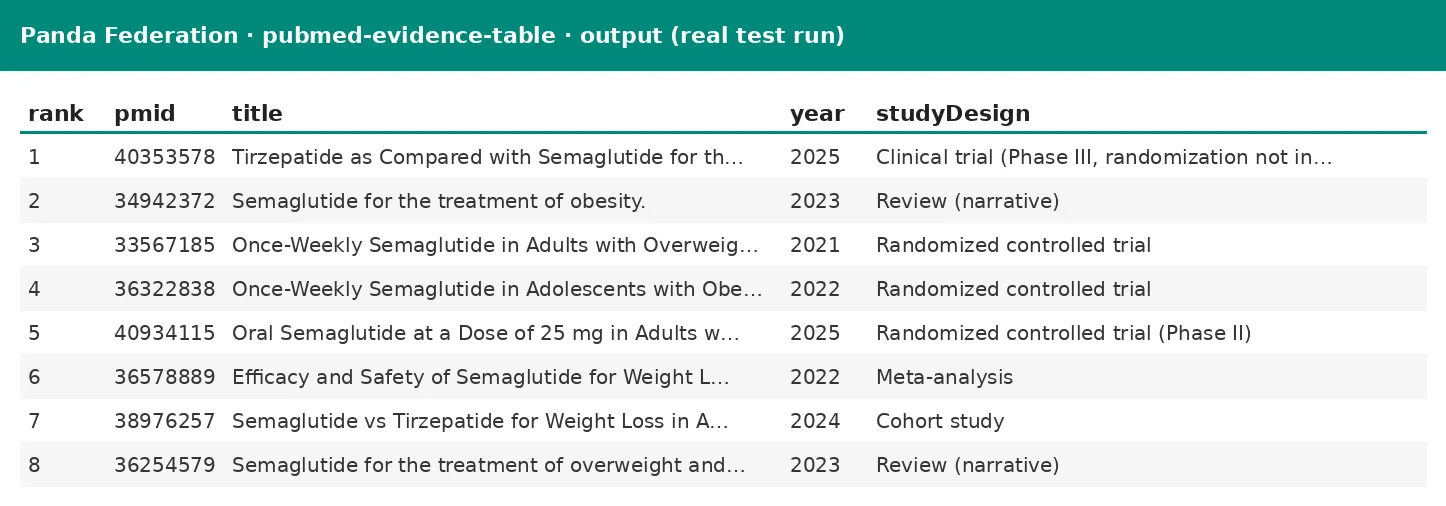
Real output from a platform run of the input above:
PRISMA-style counts (PRISMA_COUNTS / Excel sheet)
| Stage | Records |
|---|---|
| Records identified (PubMed, 2 queries) | 5,419 |
| Removed by filter: publication date 2020–2025 | 2,001 |
| Removed by filter: study design (RCT, meta-analysis, systematic review) | 2,911 |
| Removed by filter: language English | 4 |
| Duplicates removed (found by both queries) | 198 |
| Not included (maximum articles reached) | 245 |
| Records for screening | 60 |
Evidence table rows (shortened)
| Status | Citation (Vancouver, shortened here) | Study design | Sample size (confidence) | Quote |
|---|---|---|---|---|
| OK | Wilding JPH, Batterham RL, Calanna S, et al. Once-Weekly Semaglutide in Adults with Overweight or Obesity. N Engl J Med. 2021;384(11):989–1002. | Randomized controlled trial | 1,961 adults (high) | "…we enrolled 1961 adults with a body-mass index…" |
| OK | Lincoff AM, Brown-Frandsen K, Colhoun HM, et al. Semaglutide and Cardiovascular Outcomes in Obesity without Diabetes. N Engl J Med. 2023;389(24):2221–32. | Randomized controlled trial | 17,604 patients (high) | "…A total of 17,604 patients were enrolled…" |
| OK | Tan HC, Dampil OA, Marquez MM. Efficacy and Safety of Semaglutide for Weight Loss in Obesity Without Diabetes: A Systematic Review and Meta-Analysis. J ASEAN Fed Endocr Soc. 2022;37(2):65–72. | Meta-analysis | 4 studies (medium); note: pooled participants 3,613 | "…The study included 4 randomized controlled trials having a total of 3,613 individuals…" |
| OK | PMID 35441470 (its abstract reports two different group sizes) | Randomized controlled trial | blank (unclear: 327 and 1,961) | n/a: extract by hand |
A retracted trial, as the screen reports it:
The Excel evidence table
| Column group | What's in it |
|---|---|
| Citation, year, journal | Formatted in your chosen style (Vancouver by default) with citeproc-js and the official CSL style |
| Study design + source | From PubMed publication types or MeSH, with the source named. Blank when PubMed hasn't indexed it |
| Population tags | MeSH age, sex and species check tags (e.g. Humans, Adult, Aged, Female) |
| Sample size, unit, confidence, quote | Copied from the abstract only when it is stated clearly. high = an explicit total or enrolment statement; medium = one clear statement; low = only an "n =" mention; blank = unclear or not stated |
| Outcomes, Include/Exclude, Reason, Notes | Left empty for the reviewer (shaded) |
| Retraction / correction status, flags | Retracted, expression of concern, corrected (erratum), notice record, or none found |
| PMID, PubMed, DOI and PMC links | Clickable |
| Publication types, major MeSH, title, authors, abstract | For screening and filtering in Excel |
Other sheets: PRISMA counts, Search strategy (queries, final strings, PubMed translations, per-filter counts) and Read me (column definitions and caveats).
What OK, CHECK and FIX mean
| Status | Meaning |
|---|---|
| 🟢 OK | No retraction or expression of concern found in PubMed or Crossref. Errata are noted but don't change the status |
| 🟡 CHECK | Partial retraction, expression of concern, preprint, or a record that is itself a retraction, erratum or concern notice |
| 🔴 FIX | Retracted (PubMed "Retracted Publication" / RetractionIn, or a Crossref / Retraction Watch notice). Left out of the citations file |
"OK" means no notice was found. It isn't a quality rating. To check a finished manuscript's reference list, use our Reference Checker.
Files you get
| Key-value store key | What it is |
|---|---|
EVIDENCE_TABLE_XLSX | Excel evidence table plus PRISMA, search strategy and read-me sheets |
EVIDENCE_TABLE_CSV | The evidence table as CSV |
PRISMA_COUNTS | Identification-stage counts as JSON (with an arithmetic check) |
REVIEW_IMPORT_RIS | RIS for Rayyan, Covidence, EndNote, Zotero, Mendeley (abstract, MeSH keywords, PMID, DOI). The recommended import file |
REVIEW_IMPORT_RAYYAN_CSV | CSV in Rayyan's column layout (key, title, authors, abstract, doi, pubmed_id, pmc_id…) |
PUBMED_MEDLINE_TXT | The records in PubMed (MEDLINE) text format, straight from NCBI. It's the same format as PubMed's Save → Format: PubMed, so save it as a .txt file for Covidence or Rayyan |
CITATIONS | Bibliography in your chosen style (retracted articles left out) |
SUMMARY | Search log, PRISMA counts, design breakdown and API stats |
Task examples
Copy any of these into the Actor's JSON input (or pass them from an agent or the API).
- RCTs and meta-analyses since 2020:
{"queries": ["semaglutide[tiab] AND obesity[tiab]"], "studyDesigns": ["rct", "meta-analysis"], "dateFrom": "2020"} - Human studies with free full text:
{"queries": ["vitamin D AND depression"], "excludeAnimalOnly": true, "freeFullTextOnly": true} - Newest systematic reviews, retractions excluded:
{"queries": ["long covid treatment"], "studyDesigns": ["systematic-review"], "retractedArticles": "exclude", "sortBy": "newest"} - Evidence table in APA style:
{"queries": ["mindfulness anxiety"], "maxResults": 30, "citationStyle": "apa"}
For AI agents
Use this Actor to search PubMed and get a screening-ready evidence table with PRISMA counts. Call it with Apify's MCP server (https://mcp.apify.com, tool call-actor, Actor pandadad0214/pubmed-evidence-table) or the API (POST https://api.apify.com/v2/acts/pandadad0214~pubmed-evidence-table/run-sync-get-dataset-items).
Minimal input:
Each dataset item includes:
summary: one line, e.g.OK: PMID 36216945, Title (2022); Journal; Randomized Controlled Trial; n=304status:OK,CHECKorFIX(retracted)pmid,title,year,journal: article detailsstudyDesign: from PubMed publication typessampleSize,sampleSizeConfidence: only when it can be quoted from the abstractretractionStatus,retracted: retraction screeningcitation: formatted reference
The run's key-value store has a SUMMARY record with counts (returned, prisma counts, counts.OK/CHECK/FIX, studyDesigns) and file names (EVIDENCE_TABLE_XLSX, REVIEW_IMPORT_RIS, ...), a one-line takeaway, and nextStep (the suggested follow-on tool). Every input field has a description with formats, units and limits.
PubMed scraper pricing and free results
Apify paid-plan discounts: Bronze members pay 10% less, Silver 20% less and Gold 30% less per result. Free-plan prices are shown below; the discount applies automatically.
$0.004 per article returned (pay-per-event). Design tags, sample-size quotes, the retraction screen, citations and all export files are included.
| Articles | Cost |
|---|---|
| 50 | $0.20 |
| 200 | $0.80 |
| 1,000 | $4.00 |
Searches with no results cost nothing. If you choose Exclude for retracted articles, they are removed before you're charged. The Actor also never fetches more articles than your maximum charge per run allows.
Limits, honestly
- Study design depends on NLM indexing. Very recent articles are often not indexed yet, so their design is blank and flagged. We never infer a design from the abstract.
- Sample size is a quote, not an extraction. We copy a number only when the abstract states it unambiguously, show you the sentence, and leave it blank otherwise. Always confirm against the full text.
- Outcomes, risk of bias and inclusion decisions are yours. Those columns stay empty.
- PRISMA counts cover identification only. Screening and eligibility happen in your review tool.
- PubMed returns at most 9,999 records per search string. Anything beyond that is counted, and the fix is to split the search by date.
- One database. This searches PubMed/MEDLINE only. A systematic review usually needs more (Embase, CENTRAL, trial registries).
FAQ
Is there a free way to try this PubMed scraper? Yes. Apify's free plan includes $5 of monthly platform credit, enough for roughly 1,250 articles at $0.004 each.
Does it work without an NCBI API key? Yes. It identifies itself to NCBI as required and stays under NCBI's limit of 3 requests per second. Adding your own free NCBI key makes large searches faster.
Will my search give the same results as the PubMed website? The same search string gives the same records. The Search strategy sheet shows PubMed's own translation of each query, so you can reproduce it. Counts change over time as PubMed adds records, which is why the date is logged.
Can AI agents use it? Yes, through the Apify API, the Python or JavaScript clients, or Apify's MCP server. Each run returns structured JSON with designs, links and retraction flags.
Data sources and credits
- PubMed / MEDLINE, U.S. National Library of Medicine, through NCBI E-utilities. Not affiliated with or endorsed by NLM/NCBI
- Crossref for retraction, correction and expression-of-concern notices, including Retraction Watch data
- citeproc-js and the CSL project styles (CC BY-SA 3.0) for citations
More Panda Federation tools
- Reference Checker
- Citation Generator
- Google Scholar Scraper Alternative
- Grants.gov Scraper
- Academic Research MCP Server
All Panda Federation Actors on Apify
Questions or a custom data feed? Open an issue on this Actor's Issues tab.
Changelog
- 2026-10-30 (agent update): Built for AI agents: a one-line
summaryon every result,takeawayandnextStepin the SUMMARY record, and input fields with formats, limits and examples. - 2026-10-30: New search-friendly title and page, FAQ, safe demo run on empty input, Bronze/Silver/Gold discounts, output screenshot, and a next-step hint in the log and
NEXT_STEPrecord pointing to Reference Checker. - 2026-10-29: First public release with pay-per-event pricing.
Listed on: