

Hosco Jobs Search Scraper
Pricing
from $1.50 / 1,000 results
Hosco Jobs Search Scraper
Efficiently scrape job listings from Hosco.com, the world's leading hospitality career platform. Extract comprehensive data including hotel jobs, restaurant positions, salary ranges, and company details. Perfect for recruitment agencies, hospitality market research, and career analytics.
Pricing
from $1.50 / 1,000 results
Rating
0.0
(0)
Developer

Stealth mode
Maintained by CommunityActor stats
0
Bookmarked
5
Total users
0
Monthly active users
2 months ago
Last modified
Categories
Share
Hosco.com Jobs Search Scraper: Extract Hospitality Industry Career Data
Understanding Hosco.com and Its Value in Hospitality Recruitment
Hosco.com stands as the world's premier professional network dedicated exclusively to the hospitality industry. Unlike generic job boards, Hosco connects hotels, restaurants, cruise lines, and hospitality businesses with talented professionals seeking careers in this dynamic sector. The platform serves over 5 million hospitality professionals globally, making it an essential data source for understanding hiring trends in hotels, restaurants, culinary arts, and hospitality management.
The platform's specialization means it captures unique industry-specific information that general job boards miss: seasonal positions, international placements, culinary specializations, hotel departments, and hospitality-specific benefits. For recruitment agencies specializing in hospitality, market researchers analyzing tourism employment, or hospitality businesses benchmarking compensation, this data provides unmatched insights into one of the world's largest employment sectors.
Manually collecting job data across multiple searches, locations, and specializations would require countless hours of clicking through pages and copying information. The Hosco.com Jobs Search Scraper automates this entire process, transforming search results into structured datasets ready for analysis, integration, or competitive intelligence.
What This Scraper Extracts and Who Should Use It
The Hosco.com Jobs Search Scraper extracts job listings from search result pages on Hosco. Unlike detail page scrapers that require individual job URLs, this tool processes entire search pages, capturing multiple job listings efficiently. This approach is ideal when you need to collect broad datasets across different searches, locations, or job categories.
The scraper captures essential job information including position titles, company names, locations, salary ranges, job types (full-time, part-time, seasonal), and posting dates. It also extracts company branding elements like avatars and cover images, along with unique identifiers and URLs for deeper analysis.
This tool serves multiple professional audiences. Hospitality recruitment agencies can build comprehensive job databases across different specializations (culinary, front office, management, housekeeping). Market researchers gain insights into hiring patterns, salary trends, and geographic demand for hospitality talent. Hospitality businesses can monitor competitor hiring activities, benchmark salaries, and identify talent shortages in specific markets. Career counselors in hospitality education can provide students with real-time market data about job availability and requirements.
Input Configuration: Search URLs and Parameters Explained
The scraper processes Hosco search result page URLs, not individual job detail pages. These are the pages you see after performing a search on Hosco.com, displaying multiple job listings with filters applied. Understanding how to construct these URLs is crucial for targeting the right data.
Example Input Configuration:
Example Screenshot:
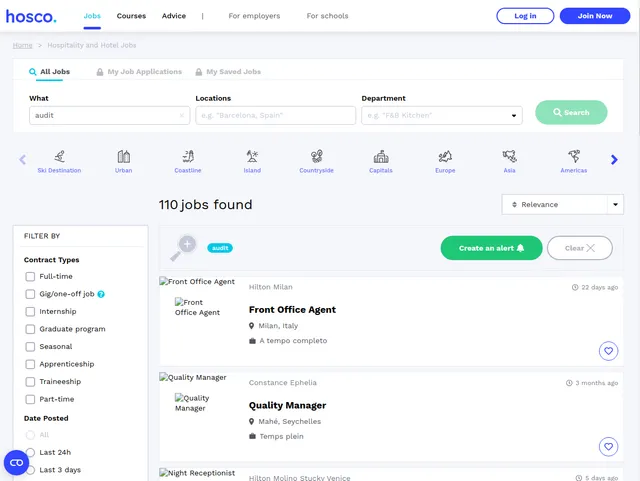
Understanding Each Parameter:
proxy configuration: Essential for reliable scraping. Residential proxies mimic real user behavior, reducing detection risk. While you can choose any proxy country, selecting one that matches your target market (e.g., "FR" for French hospitality jobs) may improve results and respect regional content delivery.
max_items_per_url: Controls how many job listings to extract per search page. Setting this to 20 means the scraper will collect up to 20 job listings from each URL provided. Hosco typically displays 20-30 jobs per page, so this parameter lets you collect complete pages or limit extraction for testing. Higher values (50-100) work if pages contain more results.
ignore_url_failures: When set to true, the scraper continues processing remaining URLs even if some fail. This is crucial when scraping multiple search pages—one broken URL won't stop your entire job. Set to false if you need to ensure every URL succeeds.
urls array: Contains the search result page URLs to scrape. You can include multiple search URLs to collect different job categories, locations, or keywords in a single run.
Pro tip: When building your URL list, perform searches manually on Hosco first to verify your filters return relevant results. Then copy those URLs into your configuration. For large datasets spanning multiple pages, systematically increment the page parameter.
Complete Output Structure and Field Definitions
The scraper returns JSON data with each job listing as an object containing multiple fields. Understanding what each field represents ensures you can effectively analyze and utilize this data.
Owner: Identifies the company or organization posting the job. This field contains the employer's name as it appears on Hosco, essential for tracking which companies are actively hiring and building employer databases.
Types: An array indicating job classification. Common values include "full-time", "part-time", "internship", "seasonal", or "temporary". Hospitality relies heavily on varied employment types, making this field critical for matching candidates to appropriate opportunities and analyzing market composition.
Pay Range: Contains salary information when available, typically as an object with minimum and maximum values plus currency. Format varies but generally appears as {"min": 30000, "max": 40000, "currency": "EUR"}. This data enables salary benchmarking and compensation analysis across roles and markets.
Cover Public Path: URL to the company's cover image on Hosco. Many hospitality businesses use appealing imagery to attract candidates, showcasing properties, kitchens, or work environments. Useful for displaying job listings or analyzing employer branding strategies.
Displayed Location: The job's geographic location as shown in the listing. May be a city ("Paris"), city and country ("London, UK"), or region. Critical for geographic analysis, filtering remote vs. on-site positions, and understanding where hospitality hiring is concentrated.
Avatar: URL to the company's logo or avatar image. Provides branding assets for displaying job listings and helps identify employers visually when building databases or applications.
Title: The job position name exactly as posted. Examples include "Executive Chef", "Front Office Manager", "Sommelier", "Revenue Manager". Essential for categorization, search functionality, and understanding what roles are in demand.
Company: The hiring organization's name, which may differ slightly from the Owner field in formatting. Used for linking jobs to employer profiles and tracking which companies are actively recruiting.
ID: Unique identifier assigned by Hosco to each job posting. Critical for building relational databases, tracking specific postings over time, and avoiding duplicates when merging datasets from multiple scrapes.
Excerpt: Brief job description or summary, typically the first few sentences of the full description. While not the complete text, it provides enough context to understand the role's basic nature and can be used for keyword analysis or initial filtering.
Slug: URL-friendly version of the job title, used in the job's web address. Format like "executive-chef-luxury-hotel-paris-123456". Useful for constructing direct links to job pages and as an alternative identifier.
Posted Date: Timestamp showing when the job was published on Hosco. Enables tracking how recently positions were posted, identifying stale listings, and analyzing hiring velocity. Format typically follows ISO 8601 (e.g., "2024-12-01T10:30:00Z").
Start Date: When the position is expected to begin. Particularly important in hospitality where seasonal positions, hotel openings, and event-based hiring are common. May be a specific date or general timeframe ("immediate", "January 2025").
URL: Direct link to the full job posting on Hosco.com. Allows accessing complete details, sharing opportunities with candidates, or verification of scraped data.
Sample Output:
Step-by-Step Usage Guide
1. Identify Your Target Data: Decide what hospitality jobs you need. Consider job types (chef, management, front office), locations (specific cities or countries), employment types (seasonal, full-time), or companies. Perform test searches on Hosco.com to ensure results match your needs.
2. Build Your Search URLs: Copy URLs from your test searches. For broad datasets, create multiple URLs with different keywords or locations. For deep extraction, include pagination by adding URLs like ...&page=1, ...&page=2, etc.
3. Configure Your Input: Set up your JSON with collected URLs. Adjust max_items_per_url based on needs (20 for standard pages, higher for comprehensive extraction). Enable ignore_url_failures when scraping many URLs to ensure robustness.
4. Start the Scraper: Launch through Apify console. Monitor progress in real-time. A typical run processing 5-10 search pages with 20 items each completes in 3-5 minutes, though this varies with proxy performance and platform load.
5. Review and Export Data: Preview results in the dataset tab. Check data quality—verify that job titles, companies, and locations look correct. Export in your preferred format: JSON for databases, CSV for spreadsheet analysis, or Excel for business reporting.
6. Handle Pagination for Large Datasets: If you need hundreds of jobs across many pages, either include multiple page URLs in one run or set max_items_per_url higher than the page display limit (e.g., 100) to let the scraper automatically handle pagination.
Error Handling Tips: If URLs consistently fail, verify they're search result pages, not job detail pages or profile pages. Check that filters in URLs are valid (Hosco may change parameter names). The activity log provides detailed error information for troubleshooting.
Strategic Applications for Hospitality Industry Data
Recruitment Intelligence: Build continuously updated job databases filtered by specialization. Track which hotels and restaurant groups are expanding, identify high-demand positions, and discover emerging culinary trends. Analyze posting frequency to gauge company growth or seasonal hiring patterns.
Compensation Benchmarking: The pay range data provides market salary insights rare in hospitality. Compare compensation across cities, hotel tiers (budget vs. luxury), and position levels. Identify markets with salary premiums or shortages that drive higher pay.
Market Entry Analysis: Companies planning to enter new markets can assess competitive hiring landscapes. See what positions competitors prioritize, typical salaries offered, and which skills are in demand. This informs staffing budgets and recruitment strategies.
Talent Availability Research: Geographic analysis reveals where hospitality talent is concentrated. Posting volume by location indicates competitive markets versus underserved areas. Start date patterns show seasonal fluctuations critical for resort or event-based businesses.
Skill Demand Tracking: Analyze job titles and excerpts to identify trending specializations. Growth in "sustainability coordinator" or "digital marketing manager" roles in hospitality signals industry evolution. Language requirements in descriptions indicate international opportunities.
Employer Brand Monitoring: Track how competitors present themselves through cover images and job excerpts. Identify messaging strategies that attract candidates. Monitor which companies consistently hire for similar roles, indicating turnover or expansion.
Maximizing Data Value and Best Practices
Schedule Regular Scraping: The hospitality job market changes rapidly, especially for seasonal positions. Weekly or bi-weekly scraping captures new postings and tracks market dynamics over time. Store historical data to analyze trends.
Segment Your Searches: Rather than one broad search, create targeted URLs by job category, location, or company size. This produces cleaner datasets easier to analyze. Example segments: "luxury hotels London", "resort managers Mediterranean", "culinary positions NYC".
Enrich With Additional Data: Combine Hosco data with LinkedIn company pages, hotel review sites, or tourism statistics. Cross-reference salary data with cost-of-living indices to understand real compensation value across markets.
Quality Assurance: Implement checks for missing critical fields (title, company, location). Flag unusual pay ranges or suspicious patterns. Validate URLs still work before sharing with stakeholders.
Respect Rate Limits: While the scraper handles technical aspects, avoid overwhelming Hosco with excessive concurrent requests. Space out large scraping runs. Sustainable practices ensure continued access to this valuable resource.
Data Storage Strategy: Organize scraped data with timestamps and source URLs. Track when jobs were first seen, when they disappeared (indicating filled positions), and how long they remained active. This temporal analysis reveals hiring urgency and market competitiveness.
Conclusion
The Hosco.com Jobs Search Scraper transforms the world's leading hospitality career platform into actionable intelligence. Whether you're building recruitment pipelines, conducting market research, or analyzing competitive landscapes in hotels, restaurants, or culinary industries, this tool delivers the comprehensive data you need. Start extracting hospitality career insights today and gain competitive advantage in this dynamic global industry.


