

Ambitionbox Jobs Search Scraper
Pricing
from $3.00 / 1,000 results
Ambitionbox Jobs Search Scraper
Efficiently scrape job listings from AmbitionBox.com, India's leading career platform. Extract comprehensive data including job titles, company profiles, salary ranges, experience requirements, and skills. Perfect for recruitment agencies, salary benchmarking, and Indian job market research.
Pricing
from $3.00 / 1,000 results
Rating
0.0
(0)
Developer

Stealth mode
Maintained by CommunityActor stats
0
Bookmarked
25
Total users
4
Monthly active users
2 months ago
Last modified
Categories
Share
AmbitionBox.com Jobs Search Scraper: Extract Indian Job Market Data
Understanding AmbitionBox.com and Its Value for Indian Job Market Intelligence
AmbitionBox.com is India's premier workplace transparency platform, combining company reviews, salary data, and job listings. Unlike generic job boards, AmbitionBox provides verified company ratings, employee reviews, and detailed compensation information—making it an essential resource for understanding India's employment landscape across IT, finance, manufacturing, and service sectors.
The platform serves millions of Indian job seekers and contains unique data: company-specific salary ranges, employee satisfaction ratings, department-level insights, and skill requirements tied to compensation. For recruitment agencies targeting Indian talent, HR consultants benchmarking compensation, or businesses analyzing competitive hiring, this data provides unmatched market intelligence.
Manually collecting job data across multiple searches, locations, and experience levels requires hours of navigation and copy-pasting. The AmbitionBox Jobs Search Scraper automates this process, transforming search result pages into structured datasets ready for analysis and integration.
What This Scraper Extracts and Who Should Use It
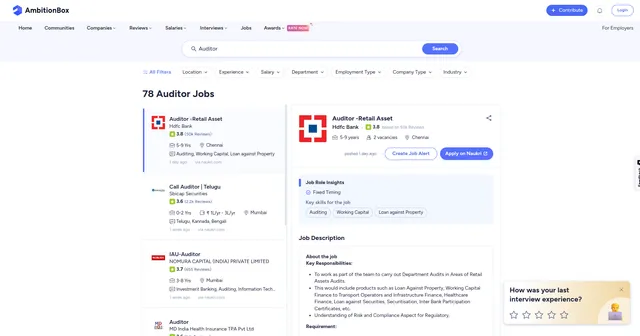
The scraper processes AmbitionBox job search result pages—not individual job detail pages. It captures multiple listings per page, making it efficient for building large datasets across different searches, locations, or job categories.
Key Data Extracted:
- Job identifiers: Title, job ID, profile IDs, role/category/department IDs for classification
- Company information: Name, logo, company ID, URL name, ratings, and review counts for employer profiling
- Compensation: Min/max CTC (Cost to Company), hide CTC flag, and formatted salary strings for benchmarking
- Requirements: Min/max experience, required skills, locations for candidate matching
- Metadata: Posted date, portal source, JDP URL, short name for tracking and verification
Target Users:
Recruitment agencies targeting Indian markets build candidate-job databases with salary and skill requirements. HR consultants benchmark compensation across industries, experience levels, and locations. Market researchers analyze hiring trends, skill demands, and salary patterns in India's job market. Job aggregators integrate AmbitionBox data into their platforms. Career counselors provide students with real market data about salaries and requirements.
Input Configuration: Search URLs and Parameters
The scraper processes job search result pages from AmbitionBox. It supports two scraping modes — use only one at a time:
- Scrape by URLs — scrape data directly from a list of AmbitionBox job search result URLs.
- Scrape by search filters — scrape data using a keyword and additional filters (location, job type, experience, salary, employment type, industry, etc.) instead of providing URLs.
There is also a General settings group (page, item limits, proxy) that applies to both modes.
Example Screenshot:
1. Scrape by URLs
Use this mode when you already have specific AmbitionBox search result URLs. When this mode is used, all options in the "Scrape by search filters" section will be disabled.
| Field | Type | Default | Description |
|---|---|---|---|
urls | array | (required) | One or more AmbitionBox job search result URLs to scrape. You can paste URLs one by one, or use the Bulk edit section to add a prepared list. Build these by performing searches on AmbitionBox with your desired filters (job title, location, experience), then copying the resulting URLs. Include page parameters (?page=2, ?page=3) for pagination. |
ignore_url_failures | boolean | true | If true, the scraper continues processing remaining URLs even if some fail to be scraped — essential for multi-page scraping runs. |
Pro tip: Test your search filters manually on AmbitionBox first to make sure the results are relevant, then copy those URLs into your configuration.
2. Scrape by search filters
Use this mode when you want to search using a keyword and additional filter attributes instead of scraping by URLs. If you use this mode, leave the urls field above empty.
| Field | Type | Default | Description |
|---|---|---|---|
keyword | string | — | The keyword to search for. |
location | string (select) | "" (Any) | Filter listings by city — e.g. mumbai, bengaluru, new-delhi, pune, chennai, hyderabad, gurgaon (Gurugram), noida, and many more Indian cities. |
sort_by | string ("", latest) | — | Sort results by Relevance (empty) or Published date (latest). |
job_type | string ("", work-from-home, work-from-office, hybrid) | — | Filter by work arrangement: All, Work from home, Work from office, or Hybrid. |
experience | string ("", 0–11) | — | Filter by years of experience, from 0 (Fresher) up to 10 (10 Years); 11 covers Above 10 Years. |
salary | string ("", 0-3, 3-6, 6-10, 10-15, 15-25, 25-50, 50-75) | — | Filter by annual salary range, in Lakhs (e.g. 0-3 = 0–3 Lakhs, 50-75 = 50–75 Lakhs). |
employment_type | string ("", permanent, contractual, freelance, part_time) | — | Filter by employment type: All, Full-time, Contractual, Freelance, Part-time. |
industry | string (select) | — | Filter by industry — e.g. it-services-and-consulting, internet, marketing-and-advertising, financial-services, healthcare, fmcg, automobile, banking-or-insurance-or-accounting, and many more. |
page | integer | — | The page number to start scraping from. |
3. General settings
Applies to both scraping modes above.
| Field | Type | Default | Description |
|---|---|---|---|
max_items_per_url | integer | 20 | The maximum number of job listings to extract per search page (typically 20–30 jobs per page). Increase for more comprehensive extraction. |
proxy | object | { "useApifyProxy": true, "apifyProxyGroups": ["RESIDENTIAL"], "apifyProxyCountry": "IN" } | Proxy configuration for the scraper. Set useApifyProxy: false for direct access, or true with a proxy group/country if you run into access issues. AmbitionBox generally allows scraping without a proxy for reasonable request volumes; residential proxies from India (IN) are recommended for higher-volume or filter-based runs. |
Complete Output Structure: Field Definitions
Title: Job position name as posted (e.g., "Senior Auditor," "Software Engineer"). Use: Primary classification, search/filter field, trend analysis.
Company: Employer name. Use: Employer profiling, tracking which companies are hiring.
Company URL Name: URL-friendly company identifier slug. Use: Constructing company profile links, cross-referencing with other data sources.
Company ID: Unique numeric identifier for the company. Use: Primary key for company databases, avoiding duplicates.
Company Logo: URL to company logo image. Use: Visual assets for displaying job listings.
Company Rating: Average employee rating score. Use: Employer brand assessment, filtering quality employers.
Company Reviews Live: Number of published employee reviews. Use: Company reputation indicator, data reliability metric.
Job Profile URL Name: URL slug for job profile. Use: Constructing direct job links.
Job Profile: Standardized job role name. Use: Role categorization across different company naming conventions.
Job Profile ID: Unique identifier for job profile type. Use: Standardizing roles for analysis.
Gen AI One/Two Designation IDs: AI-generated designation classification IDs. Use: Advanced role categorization using AmbitionBox's ML models.
Job Profile IDs List: Array of related profile identifiers. Use: Linking similar job types, broad categorization.
Role ID / Role Category ID / Department ID: Hierarchical classification identifiers. Use: Multi-level job taxonomy, filtering by organizational structure.
Locations: Array of job locations. Use: Geographic filtering, regional demand analysis.
Min/Max Experience: Required experience range in years. Use: Candidate filtering, seniority analysis, career progression research.
Min/Max CTC: Salary range (Cost to Company in Indian Rupees per annum). Use: Compensation benchmarking, market rate analysis.
Hide CTC: Boolean indicating if salary is hidden. Use: Identifying transparent vs. opaque salary postings.
Skills: Array of required skills. Use: Skill demand analysis, matching candidates, trending technology tracking.
Portal: Source platform (AmbitionBox or external). Use: Data source tracking.
Posted On: Posting timestamp. Use: Freshness filtering, hiring velocity analysis.
Job ID: Unique job posting identifier. Use: Primary key, deduplication, tracking.
Short Name: Abbreviated job identifier. Use: Compact reference, URL construction.
Location IDs: Numeric location identifiers. Use: Standardized geographic filtering.
JDP URL: Direct link to job detail page. Use: Accessing full job descriptions, verification.
Salary: Formatted salary string (e.g., "₹6-8 Lakhs"). Use: Display purposes, human-readable compensation.
Sample Output:
Step-by-Step Usage Guide
1. Build Search URLs: Perform test searches on AmbitionBox with desired filters (job type, location, experience). Copy resulting URLs. For comprehensive data, include multiple page URLs (?page=1, ?page=2, etc.).
2. Configure Input: Create JSON with URL list. Set max_items_per_url based on needs (20 for standard extraction). Enable ignore_url_failures for multi-page runs.
3. Execute Scraper: Launch via Apify console. A typical run processing 5-10 search pages completes in 2-4 minutes.
4. Review Data: Check dataset preview for completeness. Verify critical fields (title, company, CTC) are populated correctly.
5. Export Results: Export as JSON (database integration), CSV (spreadsheet analysis), or Excel (reporting).
6. Handle Pagination: For large datasets, either include multiple page URLs in one run or set higher max_items_per_url values.
Error Handling: Ensure URLs are search result pages, not job detail or company profile pages. Verify filters in URLs are valid.
Strategic Applications for Indian Job Market Data
Salary Benchmarking: Build comprehensive compensation databases across industries, experience levels, and locations. Analyze CTC ranges to identify competitive markets and salary premiums for specific skills.
Skill Demand Analysis: Track which skills appear most frequently in job requirements. Identify emerging technologies (AI/ML skills, cloud platforms) versus traditional requirements. Cross-reference skills with salary data to identify high-value competencies.
Recruitment Intelligence: Monitor which companies are actively hiring, position types they prioritize, and experience levels they target. Company ratings provide employer brand insights—high-rated companies may require higher salaries to compete.
Market Entry Research: Companies expanding to India can assess competitive landscapes—typical salaries, required experience levels, and in-demand skills by location and industry.
Geographic Analysis: Compare job density, salary ranges, and skill requirements across Indian cities. Identify high-demand markets (Bangalore, Mumbai, Pune) versus emerging hubs (Ahmedabad, Chandigarh).
Experience-Salary Correlation: Analyze how compensation scales with experience across different roles and industries. Identify career progression patterns and salary jumps at experience milestones.
Company Reputation Tracking: Correlate company ratings and review counts with hiring activity. Monitor whether highly-rated companies offer premium salaries or attract talent through reputation alone.
Maximizing Data Value and Best Practices
Schedule Regular Scraping: Indian job market changes rapidly, especially in IT and startup sectors. Weekly scraping captures new postings and evolving salary trends.
Segment Your Searches: Create targeted URLs by industry, location, or experience level rather than broad searches. Examples: "IT jobs Bangalore 5-8 years," "finance jobs Mumbai entry-level."
Enrich With External Data: Combine AmbitionBox data with LinkedIn profiles, company financial data, or cost-of-living indices. Cross-reference salaries with inflation data for real compensation trends.
Quality Checks: Flag unusual patterns—extreme salary ranges, missing skills for specialized roles, very old posted dates. Validate company ratings against review counts (low reviews = unreliable ratings).
CTC Analysis: Remember "hide_ctc" flag indicates withheld salaries. Track percentage of transparent vs. hidden salary postings by industry—sectors with more transparency may be more candidate-friendly.
Historical Tracking: Store data with timestamps to analyze salary inflation, skill demand shifts, and hiring velocity changes over time.
Multi-City Comparison: Normalize salaries by cost-of-living to compare real compensation across Indian cities. A ₹10L salary in Pune may equal ₹15L in Mumbai in purchasing power.
Conclusion
The AmbitionBox.com Jobs Search Scraper transforms India's leading career platform into actionable intelligence for recruitment, compensation research, and market analysis. From salary benchmarking across industries to skill demand forecasting, this tool delivers comprehensive data for navigating India's dynamic job market. Start extracting Indian employment insights today.


