

Jumia Product Search Scraper
Pricing
from $1.00 / 1,000 results
Jumia Product Search Scraper
Automate extraction of product data from Jumia Nigeria's marketplace. Capture SKUs, pricing, ratings, seller information, categories, and images from search results. Perfect for price monitoring, competitor analysis, market research, and inventory intelligence across Nigeria's leading e-commerce.
Pricing
from $1.00 / 1,000 results
Rating
0.0
(0)
Developer

Stealth mode
Maintained by CommunityActor stats
0
Bookmarked
33
Total users
0
Monthly active users
a month ago
Last modified
Categories
Share
Jumia.com.ng Product Search Scraper: Extract Nigerian E-commerce Data at Scale
Understanding Jumia.com.ng and Its Market Significance
Jumia.com.ng stands as Nigeria's largest and most trusted online marketplace, connecting millions of buyers with sellers across electronics, fashion, home goods, beauty products, and more. As Africa's leading e-commerce platform, Jumia aggregates products from thousands of vendors, creating a comprehensive database of consumer goods with detailed specifications, competitive pricing, and verified seller information.
For e-commerce businesses monitoring competition, retailers analyzing pricing trends, market researchers studying Nigerian consumer markets, or dropshippers sourcing products, Jumia data provides invaluable insights into one of Africa's fastest-growing digital marketplaces. Manual collection across product categories, price ranges, and seller types requires endless scrolling through search pages and copying fragmented information. The Jumia.com.ng Product Search Scraper automates this entire process, transforming search result pages into structured datasets ready for competitive intelligence, pricing analysis, or inventory planning.
What This Scraper Extracts
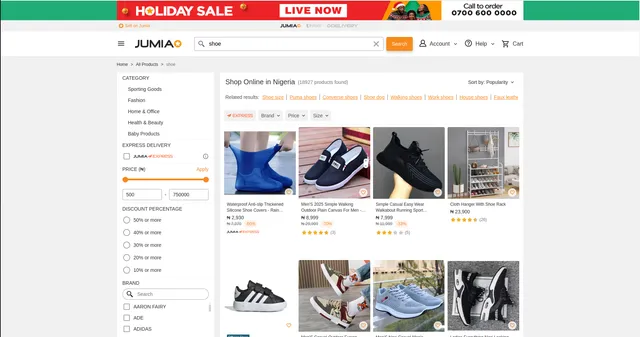
The Jumia.com.ng Product Search Scraper processes search result pages—the product listings displayed after applying filters for keywords, categories, price ranges, or brands on Jumia. Unlike detail page scrapers requiring individual product URLs, this tool efficiently captures multiple products from search pages, ideal for building comprehensive datasets across different searches, categories, or seller segments.
Key Data Extracted:
Product Identification: SKU (Stock Keeping Unit), name, display name, and URL enable unique product tracking, database integration, and direct product access.
Brand & Seller Information: Brand name and seller ID identify product manufacturers and marketplace vendors for competitive analysis and seller performance tracking.
Pricing Intelligence: Prices object (including original price, discounts, sale prices) provides comprehensive pricing data for market analysis and price monitoring strategies.
Product Classification: Categories array enables product taxonomy understanding, market segmentation, and category-level analysis.
Quality Indicators: Rating scores and review metrics assess product popularity, customer satisfaction, and purchase likelihood.
Visual Assets: Image URLs and alt text provide product visuals for display, image analysis, or machine learning applications.
Marketplace Features: Is Shop Express flag, shop express details, and buyability status indicate Jumia's fulfillment services and immediate purchase availability.
Product Variations: Simples, selected variation, and variation selection data capture product options (colors, sizes, models) enabling complete product catalog understanding.
Marketing Data: Tags, is sponsored flag, and tracking information reveal promotional strategies and advertising investments.
Customer Engagement: Wishlist status indicates product popularity and consumer interest trends.
Target Users:
E-commerce Businesses monitor competitor products, pricing strategies, and market positioning across Nigerian online retail. Retailers & Dropshippers identify trending products, analyze pricing gaps, and discover sourcing opportunities for inventory decisions. Market Researchers study product trends, category performance, pricing dynamics, and consumer preferences in Nigerian e-commerce. Brand Managers track brand presence, authorized sellers, pricing compliance, and competitive positioning. Price Intelligence Platforms aggregate Jumia data for real-time price tracking, automated repricing, and market benchmarking tools.
Input Configuration: Targeting Product Searches
The scraper supports two scraping modes — use only one at a time:
- Scrape by URLs — scrape data directly from a list of Jumia search result page URLs (the pages displaying multiple product listings after applying search filters).
- Scrape by search filters — scrape data using a keyword and additional filter attributes (brand, category, price range, size, discount, etc.) instead of providing URLs.
There is also a General settings group that applies to both modes, plus a top-level proxy configuration.
Example Screenshot:
Proxy Configuration
Set to false by default for basic usage. Enable Apify proxy (useApifyProxy: true) with residential proxies for large-scale or frequent scraping to avoid bot detection. Jumia implements anti-scraping measures, so proxy rotation becomes essential for daily monitoring or extracting hundreds of products. Occasional small runs (20–50 products) may work without proxies, while systematic price tracking across categories benefits from proxy usage.
1. Scrape by URLs
Use this mode when you already have specific Jumia search result URLs. When this mode is used, all options in the "Scrape by search filters" section will be disabled.
| Field | Type | Default | Description |
|---|---|---|---|
urls | array | (required) | One or more Jumia product search list URLs to scrape. You can paste URLs one by one, or use the Bulk edit section to add a prepared list. Each URL represents a specific product search with filters applied (keywords, categories, price ranges, brands, ratings). Add multiple URLs to collect different product segments — e.g. multiple result pages, different categories, or various brand filters — in a single run. |
ignore_url_failures | boolean | true | If true, the scraper continues processing remaining URLs even if some fail due to expired searches, connection timeouts, or page errors. Critical for batch processing multiple search URLs — one broken URL won't halt your entire scraping job. Set false only when every URL must succeed and you need to troubleshoot specific failures. |
Understanding URL Structure: Jumia URLs contain query parameters:
q=shoe— search keyword or query termpage=11— pagination index; modify this to scrape multiple result pages#catalog-listing/— anchor for the product listing section- Additional parameters can filter by category, price range (
shipped_from), brand, seller type, or ratings
Pro Tip: Perform manual searches on Jumia first to verify filters return relevant products matching your research needs, then copy those URLs into your configuration. For comprehensive datasets spanning multiple pages, systematically include URLs with different page numbers: page=1, page=2, etc. Check the total result count displayed on Jumia to calculate how many pages you need to scrape for complete coverage.
2. Scrape by search filters
Use this mode when you want to search using a keyword and additional filter attributes instead of scraping by URLs. If you use this mode, leave the urls field above empty.
| Field | Type | Default | Description |
|---|---|---|---|
keyword | string | — | The keyword to search for. |
brand | string | "" (All) | Filter results by brand (e.g. apple, samsung, xiaomi, huawei). Select from the available brand list, or leave empty to include all brands. |
category | string | "" (All) | Filter results by product category, such as Computing, Electronics, Phones & Tablets, Fashion, Home & Office, Health & Beauty, and more. Leave empty to search across all categories. |
sort_by | string (newest, lowest-price, highest-price, rating) | "" (Relevance) | Sort results by Relevance (default), Newest, Lowest Price, Highest Price, or Rating. |
price_range | string | — | Filter by price range, formatted as min-max (e.g. 1000-2000). |
size | string | "" (All) | Filter by product size (e.g. s, m, l, xl, shoe sizes, or age-based sizes for baby/kids items). Leave empty to include all sizes. |
discount | string (50-100, 40-100, 30-100, 20-100, 10-100) | "" (Any) | Filter for products with a discount of at least the selected percentage (e.g. 20-100 returns items discounted 20% or more). |
page | integer | — | The page number to start scraping from. |
3. General settings
Applies to both scraping modes above.
| Field | Type | Default | Description |
|---|---|---|---|
max_items_per_url | integer | 20 | Controls product extraction quantity per search URL. Jumia typically displays 20–40 products per page depending on category and device. Use lower values for a quick sample or testing, and higher values (40–50) to ensure capturing all visible products even as page sizes vary across categories. |
Complete Output Structure: Understanding Every Data Field
The scraper returns JSON data with each product listing as an object. Understanding field meanings enables effective analysis and utilization.
SKU (Stock Keeping Unit): Unique identifier assigned by Jumia or the seller to each product variant. Purpose: Primary key for database storage, tracking specific products over time, matching products across different scrapes, avoiding duplicates when merging datasets. Essential for inventory management systems and price tracking applications.
Name: Official product name as listed by the seller or manufacturer. Purpose: Product identification, search functionality, displaying products to end users, text analysis for categorization or feature extraction.
Display Name: Marketing-optimized product name shown prominently on Jumia, may differ from technical name. Purpose: Understanding marketing strategies, capturing consumer-facing product descriptions, analyzing naming conventions that drive clicks.
Brand: Manufacturer or brand name associated with the product. Purpose: Brand-level analysis, filtering products by manufacturer, tracking brand presence across categories, identifying authorized vs. unauthorized sellers, competitive brand intelligence.
Seller ID: Unique identifier for the marketplace vendor selling this product. Purpose: Seller performance analysis, identifying top sellers by category, tracking seller inventory, monitoring seller pricing strategies, verifying authorized dealers.
Is Shop Express: Boolean flag indicating whether product is fulfilled by Jumia's express delivery service (Jumia's logistics). Purpose: Filtering by fulfillment method, analyzing premium service offerings, identifying fast-shipping products preferred by customers, understanding Jumia's inventory vs. third-party fulfillment.
Categories: Array of category classifications (hierarchical path from broad to specific categories). Purpose: Product taxonomy understanding, category-level market analysis, filtering products by vertical (electronics, fashion, home), identifying market gaps in specific categories.
Prices: Object containing comprehensive pricing information including regular price, discount price, sale price, percentage discounts, currency. Purpose: Core metric for price monitoring, competitive pricing analysis, discount strategy evaluation, calculating price trends, identifying pricing anomalies, measuring price positioning within categories.
Tags: Array of product tags or labels (e.g., "Best Seller," "New Arrival," "Limited Stock," "Flash Sale"). Purpose: Identifying promoted products, understanding merchandising strategies, tracking product lifecycle stage, prioritizing high-potential products, analyzing marketing tactics.
Rating: Product rating score (typically 1-5 stars scale) and review count. Purpose: Quality assessment, customer satisfaction measurement, filtering high-rated products, analyzing correlation between ratings and sales, identifying products with strong customer approval.
Image: Primary product image URL or image object with multiple sizes. Purpose: Visual product representation, displaying products in applications, image analysis for visual search, quality assessment through imagery, creating product catalogs.
Image Alt: Alternative text description for the product image (accessibility and SEO). Purpose: Text-based product identification when images unavailable, SEO analysis, accessibility compliance, extracting product features from alt text descriptions.
Is Sponsored: Boolean indicating whether the product listing is a paid advertisement. Purpose: Identifying promoted products, analyzing advertising strategies, understanding which products sellers invest in promoting, filtering organic vs. paid results.
Tracking: Object containing tracking parameters, analytics tags, or campaign identifiers. Purpose: Understanding marketing attribution, analyzing traffic sources, technical implementation of tracking pixels, data lineage verification.
URL: Direct link to the full product detail page on Jumia. Purpose: Accessing complete product information, deep-linking to products, verification of scraped data, sharing products with customers, building product databases with reference links.
Is Buyable: Boolean indicating whether product is currently available for purchase (in stock and not restricted). Purpose: Inventory availability tracking, filtering purchasable products, monitoring stock-out patterns, identifying supply chain issues, analyzing inventory turnover.
Shop Express: Detailed object about Jumia's express fulfillment service for this product. Purpose: Understanding fulfillment options, delivery speed analysis, logistics cost implications, premium service availability.
Simples: Array of simple product variants or child products (for configurable products with multiple options). Purpose: Complete variant inventory, understanding product option structure, tracking stock levels across sizes/colors, pricing variation analysis.
Selected Variation: Currently selected or default product variation shown in search results. Purpose: Identifying default options, understanding presentation strategy, analyzing which variants are promoted.
Variation Selection: Object describing available variation attributes (size options, color choices, model variations). Purpose: Complete product catalog understanding, analyzing option breadth, inventory depth assessment, variant pricing strategies.
Wishlist: Boolean or count indicating wishlist status or popularity. Purpose: Measuring consumer interest and demand signals, identifying trending products before they sell out, analyzing wishlist-to-purchase conversion patterns.
Sample Output Structure:
Step-by-Step Implementation Guide
1. Define Your Research Scope: Identify target products—specific categories, brands, price ranges, or search keywords. Perform test searches on Jumia.com.ng to ensure filters return relevant products matching your competitive intelligence or market research needs.
2. Build Search URLs: Copy URLs from manual Jumia searches. For comprehensive datasets, create multiple URLs with different filters: various categories (electronics, fashion, home), price brackets, brands, or seller types. For deep extraction spanning many result pages, include pagination URLs by incrementing the page= parameter (page=1, page=2, page=3, etc.).
3. Configure Your Input: Set up JSON configuration with collected URLs. Adjust max_items_per_url based on requirements (20 for standard pages, 40-50 for thorough extraction ensuring all visible products are captured). Enable ignore_url_failures: true when scraping multiple URLs to ensure resilience—if one search fails, others continue processing. Consider enabling Apify proxy for large-scale or daily scraping operations.
4. Launch Scraping Run: Start the scraper through Apify console and monitor real-time progress. Typical processing time: 3-5 search pages with 20 items each complete in 2-5 minutes, varying with Jumia's server response times, network conditions, and proxy usage.
5. Review Data Quality: Preview results in the dataset tab. Verify critical fields (SKU, prices, brand, categories, is_buyable) are populated correctly. Check that product types and categories match your target criteria. Validate that pricing data is complete and logical.
6. Export and Analyze: Export in preferred format—JSON for database integration and API usage, CSV for spreadsheet analysis in Excel/Google Sheets, or Excel for business reporting with formatted tables. Clean data by removing duplicates (matching SKUs) or filtering by specific criteria (price range, rating threshold, shop express only, specific brands).
7. Handle Pagination Systematically: For large datasets (hundreds or thousands of products), include multiple page URLs in your configuration. Jumia typically shows 20-40 products per page, so calculate required pages based on total search result counts displayed on the website. For example, if a search shows 500 results and displays 25 per page, you need 20 pages to capture everything.
Error Prevention Best Practices: Ensure URLs are search result pages, not individual product detail pages, category landing pages, or the homepage. Verify URLs load properly in your browser before adding to scraper configuration. Test with small page counts first (2-3 pages) before scaling to dozens of pages. Check that category filters in URLs produce expected product types.
Scaling Best Practices: For datasets exceeding 500 products, split into multiple scraping runs (200-300 products each) to improve reliability and avoid timeouts. Use scheduled scraping (daily or weekly runs) to track market changes over time rather than one-time massive extractions. Store historical data to analyze trends—price changes, new product introductions, category growth patterns.
Strategic Applications for E-commerce Intelligence
Competitive Price Monitoring: Aggregate pricing data across products, brands, and categories. Calculate average prices, identify pricing trends, detect price changes (increases or decreases), and discover underpriced or overpriced products. Compare your prices against market averages to optimize competitive positioning. Track discount patterns to understand promotional cycles.
Market Trend Analysis: Analyze product concentrations by category, identify trending products through ratings and wishlist counts, understand seasonal patterns, and detect emerging product categories. Track new product introductions (via tags like "New Arrival") to stay ahead of market shifts.
Brand Intelligence: Monitor brand presence across categories, track authorized sellers versus unauthorized resellers, analyze brand pricing consistency, identify gray market activity, and assess competitive brand positioning. Calculate brand market share by product count and category dominance.
Seller Performance Tracking: Aggregate data by seller_id to identify top performers, analyze seller specializations by category, track seller inventory breadth, monitor seller pricing strategies, and evaluate Shop Express adoption rates among sellers.
Inventory Opportunity Identification: Filter by is_buyable to understand stock availability patterns. Identify frequently out-of-stock products indicating high demand. Find products with low competition (few sellers) but high interest (ratings, wishlists). Discover product gaps where demand exceeds supply.
Pricing Strategy Optimization: Analyze discount percentages across categories and price points. Understand which discount levels drive sales (correlated with ratings/wishlists). Identify optimal price positioning within category ranges. Test pricing hypotheses using competitor data.
Product Sourcing Intelligence: Dropshippers and retailers can identify high-rated, high-demand products with good margins (comparing prices to wholesale costs). Filter by Shop Express to understand fulfillment requirements. Analyze variation options to assess inventory complexity.
Category Performance Analysis: Compare product counts, average prices, rating distributions, and Shop Express penetration across categories. Identify high-growth categories with increasing product counts. Find underserved categories with few products but consumer interest.
Promotional Strategy Insights: Analyze tags, is_sponsored flags, and tracking data to understand marketing tactics. Identify which products receive promotional investment. Track promotional cycles and seasonal campaigns. Benchmark your marketing against competitors.
Maximizing Data Value: Advanced Techniques
Time-Series Price Tracking: Scrape identical searches daily or weekly, storing data with timestamps. Track individual product price changes over time by matching SKUs. Build price history databases showing trends, seasonal fluctuations, and promotional patterns. Identify products with price reductions indicating clearance or increased competition. Detect price increases signaling supply constraints or rising demand.
Rating-Price Correlation Analysis: Statistically analyze relationships between product ratings and pricing. Determine if higher-priced products achieve better ratings (quality perception) or if value-priced products earn higher satisfaction. Guide pricing decisions with data showing optimal price-quality positioning.
Brand Portfolio Analysis: For brands selling on Jumia, comprehensively map your product catalog. Identify missing SKUs suggesting stockouts. Compare your prices against competing brands. Analyze your rating performance versus competitors. Track unauthorized sellers listing your products.
Variation Complexity Assessment: Analyze simples and variation_selection data to understand product complexity. Calculate how many options products offer (sizes, colors, models). Assess if more variations correlate with higher sales (wishlists) or create decision paralysis. Guide your own product variant strategies.
Visual Merchandising Analysis: Download product images using image URLs. Perform image analysis to assess photography quality, identify visual trends (white backgrounds, lifestyle shots, model usage), and understand presentation standards. Benchmark your product photography against competitors.
Shop Express Competitive Advantage: Filter and compare Shop Express products versus standard fulfillment. Analyze if Shop Express designation correlates with higher ratings, prices, or sales indicators. Calculate Shop Express adoption rates by category and seller type. Decide if investing in Jumia fulfillment provides competitive advantages.
Seller Concentration Analysis: Calculate how many sellers offer each product (by matching product names/brands). Identify monopolistic products (single seller) versus competitive products (many sellers). Find opportunities in low-competition, high-demand spaces.
Cross-Category Insights: For diversified businesses, analyze performance across multiple categories. Identify which categories offer better margins, less competition, higher ratings, or faster growth. Optimize category focus based on data-driven insights.
Seasonal Pattern Detection: Historical scraping data reveals seasonal trends—which products peak during holidays, rainy seasons, back-to-school periods, or festive seasons. Forecast demand patterns and adjust inventory planning accordingly.
Data Governance and Best Practices
Scraping Frequency Guidelines: Nigerian e-commerce market updates frequently with price changes, new products, and stock fluctuations. Daily scraping suits price monitoring for high-competition categories (electronics, fashion) where prices change rapidly. Weekly scraping balances data freshness with efficiency for most use cases—tracking trends without excessive resource consumption. Monthly scraping works for broader market research analyzing long-term patterns rather than daily fluctuations.
Data Freshness Validation: Jumia listings constantly update. Implement timestamp tracking on your scrapes to know data age. Flag potentially stale data (scraped more than 7 days ago for price-sensitive applications). Re-scrape critical products or categories more frequently than bulk datasets.
Privacy and Compliance Considerations: Product data is generally public information on e-commerce platforms. However, seller IDs and contact information should be handled appropriately. Comply with Nigeria's data protection regulations when storing or sharing seller information. Use scraped data for legitimate business intelligence, competitive analysis, or research purposes—avoid activities that could harm Jumia's platform or sellers.
Duplicate Management Strategies: Products may appear across multiple searches (category overlap, different keyword matches). Use SKU as the primary key for deduplication. When merging datasets from different scrapes, keep the most recent record for each SKU to ensure pricing and availability accuracy. Consider keeping duplicate records initially for analysis completeness, then consolidate in final databases.
Currency and Pricing Validation: All prices are in Nigerian Naira (NGN). When storing data long-term or comparing across time periods, note scrape dates for inflation adjustment and exchange rate context. Validate extreme prices (too high or too low) that might indicate data errors, currency mistakes, or decimal point issues.
Availability Status Tracking: The is_buyable flag indicates current stock status but changes frequently. For inventory opportunity identification, track how often products are unavailable. Calculate restock frequencies. Identify chronic stock-out products indicating supply-demand imbalances.
Image Rights Consideration: Image URLs link to Jumia-hosted photos. If displaying these images in external applications, ensure compliance with Jumia's terms of service. Consider downloading and hosting images separately if building long-term product databases, but respect intellectual property rights.
Quality Assurance Checks: Implement validation rules to ensure data integrity—SKUs should be alphanumeric strings, prices must be positive numbers, ratings should fall within 0-5 range, categories should contain valid text. Flag anomalies for manual review before analysis. Monitor scraping success rates and investigate patterns of missing data in specific fields.
Rate Limiting and Platform Health: Avoid overwhelming Jumia's servers with excessive concurrent requests. Space out scraping runs rather than hitting the platform continuously. Use reasonable delays between page requests. Implement exponential backoff if encountering errors. Responsible scraping maintains platform health and reduces likelihood of access restrictions.
Conclusion
The Jumia.com.ng Product Search Scraper transforms Nigeria's leading e-commerce marketplace into actionable business intelligence. From pricing dynamics enabling competitive positioning to product trends revealing market opportunities, this tool delivers comprehensive insights into West Africa's fastest-growing online retail landscape. Whether you're building pricing databases, conducting market research, monitoring competition, sourcing products, or analyzing consumer trends, structured Jumia data provides the foundation for data-driven e-commerce decisions in Nigeria's dynamic digital marketplace. Start extracting Nigerian e-commerce insights today and gain competitive advantages in Africa's retail revolution.


