

Liverpool Product Search Scraper
Pricing
from $2.80 / 1,000 results
Liverpool Product Search Scraper
Scrape comprehensive product data from Liverpool.com.mx, Mexico's leading department store chain. Extract product details, pricing, variants, availability, ratings, and category information from search results. Ideal for price monitoring, market research, competitor analysis in Mexican retail market
Pricing
from $2.80 / 1,000 results
Rating
0.0
(0)
Developer

Stealth mode
Maintained by CommunityActor stats
0
Bookmarked
15
Total users
2
Monthly active users
11 days ago
Last modified
Categories
Features
Share
Liverpool.com.mx Product Search Scraper: Extract Mexican E-commerce Product Data
Understanding Liverpool.com.mx and Its E-commerce Ecosystem
Liverpool is one of Mexico's most prestigious department store chains, operating both physical locations and a robust e-commerce platform at liverpool.com.mx. The platform offers extensive product catalogs spanning fashion, electronics, home goods, beauty, and more, serving millions of Mexican consumers.
The site provides rich product data including multi-variant listings (sizes, colors), dynamic pricing with promotional campaigns, inventory availability across geographic stores, customer ratings, and detailed categorization. For businesses operating in Mexican retail—whether competitors, suppliers, or market analysts—this data offers crucial insights into pricing strategies, product trends, and consumer preferences.
Manual collection of product data across categories, brands, and locations requires navigating countless search pages and product listings. The Liverpool.com.mx Product Search Scraper automates this process, transforming search result pages into structured datasets ready for analysis, price monitoring, or competitive intelligence.
What This Scraper Extracts and Who Benefits
The Liverpool.com.mx Product Search Scraper processes search result pages and category listing URLs from Liverpool's website. Unlike single product scrapers, this tool efficiently captures multiple products from search pages, making it ideal for broad market surveys and category analysis.
Key Data Categories:
Product Identification: Name, title, product ID, primary product ID, and URI provide unique identifiers for tracking products across time and linking to detailed pages.
Variants & Options: Complete variant information including swatch colors and gallery images per variant enable analysis of product offerings and inventory depth.
Pricing Intelligence: Minimum/maximum list prices and promotional prices reveal pricing strategies, discount patterns, and competitive positioning across product ranges.
Availability & Distribution: Geo store IDs show which physical locations stock products, while availability status indicates inventory levels—critical for supply chain and distribution analysis.
Classification: Categories, ancestors (parent categories), department, and category breadcrumbs provide hierarchical product organization for market segmentation.
Brand & Quality Indicators: Brand names and rating info enable brand performance analysis and quality perception tracking.
Product Attributes: Material group, product type, group type, and descriptive fields reveal product characteristics for trend identification.
Special Flags: Is marketplace, is importation product, is collection product, ITR eligibility, and HEM service indicators show product sourcing and special program participation.
Visual Assets: Product images and gallery images variants provide visual content for displaying products or visual trend analysis.
Target Users:
E-commerce Competitors monitor Liverpool's pricing, product assortment, and promotional strategies to stay competitive in Mexican retail. Price Intelligence Companies build automated monitoring systems tracking price changes across thousands of products. Brand Managers track their product performance, pricing compliance, and competitive positioning on major retail platforms. Market Researchers analyze product trends, category growth, and consumer preferences in Mexican e-commerce. Suppliers & Manufacturers understand retailer merchandising strategies, inventory patterns, and optimal product characteristics. Business Intelligence Teams integrate retail data into dashboards for strategic decision-making.
Input Configuration: Targeting Search and Category Pages
The scraper processes search result URLs and category page URLs from Liverpool.com.mx—pages displaying multiple products with filters and sorting applied.
Example Input Configuration:
Example Screenshot:
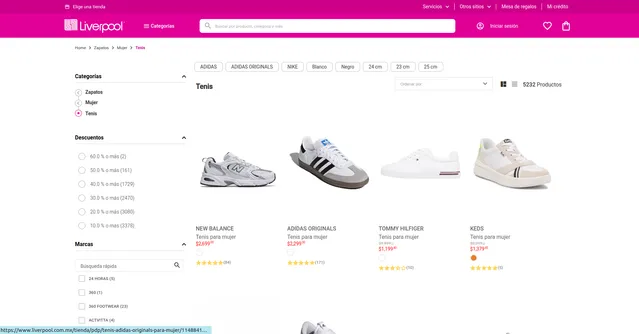
Parameter Details:
proxy configuration: Set to false if not using proxies. For large-scale scraping or to avoid detection, enable Apify proxies with residential IPs. Liverpool may implement rate limiting or bot detection for high-volume requests.
max_items_per_url: Limits products extracted per URL. Set to 20 for quick sampling, higher (50-100) for comprehensive category extraction. Liverpool typically displays 24-48 products per page.
ignore_url_failures: When true, continues processing remaining URLs if some fail. Essential for bulk scraping where some category URLs might be temporarily unavailable or changed.
urls array: Contains search result or category page URLs. Format typically: https://www.liverpool.com.mx/tienda/[category-name]/[category-id] or search URLs with query parameters.
Building URL Lists: Navigate Liverpool.com.mx manually to find relevant categories (electronics, fashion, home goods). Copy category URLs from the address bar. For search-based extraction, perform searches and copy resulting URLs. Include pagination by noting page parameters in URLs if scraping beyond first page.
Pro Tip: Test URLs in browser before scraping to ensure they return product results. Category structure may change, so verify URLs are current.
Complete Output Structure and Field Definitions
The scraper returns JSON data with each product as an object containing detailed fields. Understanding field purposes enables effective analysis and application.
Product Identification
Product ID: Unique identifier of the product on Liverpool Mexico. Purpose: Database indexing, tracking specific products over time, avoiding duplicates, linking to detail pages.
SKU Repository ID: Identifier of the product in Liverpool's SKU repository. Purpose: Cross-referencing with catalog data and inventory systems.
Title: Product name shown on the listing. Purpose: Quick preview, keyword analysis, product matching.
Brand: Brand of the product. Purpose: Brand-level analysis, assortment and market share comparison.
Product Type: Product line classification (e.g., Soft Line for apparel and footwear). Purpose: Separating product families such as fashion, electronics and home goods.
Seller Information
Sellers: List of sellers offering the product. Purpose: Seller tracking, competitor analysis, identifying third-party vendors.
Is Marketplace: Whether the product is sold by a third-party marketplace seller rather than Liverpool directly. Purpose: Separating first-party and marketplace offers.
Is Sponsored: Whether the listing appears as a sponsored result. Purpose: Analyzing advertising investment and result visibility.
Is Collection: Whether the item is a collection or bundle rather than a single product. Purpose: Filtering out grouped listings for clean product-level analysis.
Is Cross Border: Whether the product ships from abroad. Purpose: Estimating delivery time, import costs and sourcing origin.
Pricing
Price: Current selling price. Purpose: Price comparison, market monitoring, budget filtering.
List Price: Original price before discount. Purpose: Measuring discount depth and reference pricing.
Promo Price: Promotional price currently applied. Purpose: Tracking promotions and campaign pricing.
Discount Amount: Difference between list price and selling price. Purpose: Quantifying savings offered to buyers.
Discount Percent: Discount as a percentage of the list price. Purpose: Comparing promotional intensity across brands and categories.
Currency: Currency of all prices (MXN). Purpose: Correct financial interpretation when merging datasets from multiple markets.
Ratings
Rating Average: Average customer rating of the product. Purpose: Quality assessment and product ranking.
Rating Count: Number of customer ratings. Purpose: Judging how reliable the average rating is and measuring popularity.
Categories
Main Category: Top-level category of the product. Purpose: High-level market segmentation.
Category Paths: List of full category trails under which the product is classified. Purpose: Taxonomy analysis and multi-category filtering.
Category Breadcrumb: Ordered list of category objects (id and label) from broad to specific. Purpose: Navigating the category hierarchy and building category-based queries.
Variants and Media
Variant Count: Number of color variants available. Purpose: Measuring assortment breadth.
Variants: List of color variants, each with SKU ID, color name, color hex code and a gallery of media items (type and URL). Purpose: Analyzing color options, per-variant SKU tracking and accessing variant-specific media.
Image Count: Total number of unique product images across all variants. Purpose: Evaluating listing quality and completeness.
Image URLs: Flat list of unique image links in original order. Purpose: Downloading images, visual inspection, computer vision analysis.
Additional Attributes
Labels: List of label and value pairs for extra product badges or attributes (empty if none). Purpose: Capturing flexible promotional or descriptive tags without schema changes.
Available Store IDs: List of stores or channels where the product is available (e.g., online). Purpose: Availability analysis by channel or location.
Raw Data
Raw Data: Complete original JSON object of the product as scraped, without modification. Purpose: Auditing, debugging, accessing fields not included in the cleaned output, and reprocessing without re-scraping.
Sample Output:
Step-by-Step Implementation Guide
1. Identify Target Categories: Browse Liverpool.com.mx to determine relevant product categories—electronics, fashion, home goods, or specific brands. Note category URLs from address bar.
2. Build URL Collection: Create list of category/search URLs. For comprehensive extraction, include multiple categories. For deep category extraction, add pagination URLs if needed.
3. Configure Input: Prepare JSON with URL list. Set max_items_per_url based on needs—20 for sampling, 50+ for complete categories. Enable ignore_url_failures for robust large-scale scraping.
4. Execute Scraping: Launch via Apify console. Monitor real-time progress. Processing 10 category pages with 20 items each typically completes in 3-5 minutes depending on site performance.
5. Data Quality Check: Review dataset preview. Verify pricing fields are populated, variants are captured correctly, and availability status is present. Check for systematic missing data.
6. Export Data: Export in preferred format—JSON for databases, CSV for Excel analysis. Consider exporting variants as separate rows for easier analysis in spreadsheet tools.
7. Handle Errors: Review activity log for failed URLs. Common issues include changed category structures, temporary site unavailability, or invalid URLs. Re-run failed URLs after verification.
Pagination Handling: Liverpool uses dynamic loading. If max_items_per_url exceeds visible products, scraper may automatically handle pagination. Alternatively, manually increment page parameters in URLs for deep extraction.
Strategic Applications for Mexican Retail Intelligence
Dynamic Price Monitoring: Track minimum/maximum promo prices daily to identify promotional cycles, discount patterns, and competitive pricing moves. Alert on significant price drops by competitors or your own products.
Inventory Intelligence: Monitor availability status and geo store IDs to understand stock distribution, identify supply constraints, and optimize omnichannel inventory allocation.
Competitive Assortment Analysis: Compare product offerings across categories. Identify gaps in your catalog vs. Liverpool's assortment, trending products, and emerging categories.
Brand Performance Tracking: Aggregate rating info and availability by brand to assess brand health, identify quality issues, and track brand market share within categories.
Promotional Strategy Analysis: Track promotional gift messages and promo pricing to understand Liverpool's promotional calendar, typical discount depths, and campaign timing.
Market Entry Research: Analyze product types, material groups, and pricing ranges in target categories before launching new products. Understand market positioning and price sensitivity.
Import Dependency Analysis: Use is_importation_product flag to assess reliance on imports across categories. Identify opportunities for domestic sourcing or understand supply chain risks.
Geographic Expansion Planning: Analyze geo_store_ids to see which products are available in which regions. Identify underserved markets or successful regional strategies.
Maximizing Data Value and Best Practices
Schedule Regular Scraping: Mexican e-commerce is dynamic. Weekly scraping captures new products and price changes. Daily scraping during promotional periods (Buen Fin, Hot Sale) tracks aggressive pricing.
Segment by Category: Rather than one massive scrape, create category-specific runs. This produces cleaner datasets and enables category-level analysis without massive data processing.
Track Historical Trends: Store scraped data with timestamps. Compare week-over-week pricing, availability, and new product introductions to identify market dynamics.
Enrich with External Data: Combine Liverpool data with social media trends, Google Trends, or competitor data from other retailers (Amazon.com.mx, Mercado Libre) for comprehensive market view.
Price Elasticity Analysis: Correlate rating info with pricing tiers to understand quality-price perception. Identify sweet spots where ratings remain high despite higher prices.
Variant Complexity Assessment: Analyze variant counts and swatch colors to understand product complexity. High variant counts may indicate operational challenges or customer preference for customization.
Marketplace Identification: Filter by is_market_place to separate Liverpool direct inventory from third-party sellers. Analyze pricing and availability differences between channels.
Quality Monitoring: Implement automated alerts for missing critical fields (price, availability, brand). Flag unusual values (negative prices, impossibly high ratings) for verification.
Data Governance and Compliance
Scraping Frequency: Respect Liverpool's servers by spacing scraping runs. Avoid aggressive concurrent requests. Use delays between URL processing for sustainable data collection.
Data Storage: Organize data with clear timestamps and source URLs. Maintain data lineage for troubleshooting discrepancies and understanding data freshness.
Privacy Compliance: Product data is generally public, but ensure compliance with Mexican data protection regulations (LFPDPPP) especially if combining with personal consumer data.
Competitive Intelligence Ethics: Use scraped data for legitimate business purposes—market research, competitive analysis, pricing strategy. Avoid automated purchasing or fraudulent activities.
Data Validation: Implement checks for data integrity. Prices should be positive, availability should be valid enum values, IDs should be numeric. Flag anomalies for review.
Currency Handling: All prices are in Mexican Pesos (MXN). When comparing international markets, convert currencies using appropriate exchange rates and dates.
Conclusion
The Liverpool.com.mx Product Search Scraper provides comprehensive intelligence into Mexico's leading department store e-commerce platform. From pricing strategies to inventory distribution, variant offerings to promotional tactics, this tool transforms public product data into actionable retail intelligence. Whether monitoring competitor pricing, analyzing market trends, or optimizing your own product strategy in Mexican retail, structured Liverpool data drives informed decisions. Start extracting Mexican e-commerce insights today.


