

Marriott Hotels Search Scraper
Pricing
from $1.50 / 1,000 results
Marriott Hotels Search Scraper
Scrape comprehensive hotel search results from Marriott.com, the world's largest hotel chain. Extract property details, room rates, location data, brand information, and guest reviews across 8,000+ hotels worldwide. Perfect for travel agencies, price comparison platforms, hospitality market research
Pricing
from $1.50 / 1,000 results
Rating
0.0
(0)
Developer

Stealth mode
Maintained by CommunityActor stats
0
Bookmarked
35
Total users
0
Monthly active users
5 days ago
Last modified
Categories
Share
Marriott.com Hotels Search Scraper: Extract Global Hotel Property Data
Understanding Marriott.com and Its Value in Hospitality Intelligence
Marriott International operates over 8,000 properties across 139 countries, representing 30+ hotel brands from budget-friendly Fairfield Inn to ultra-luxury St. Regis. As the world's largest hotel company, Marriott.com provides unparalleled insights into global hospitality pricing, availability, and property positioning across multiple market segments.
The platform's search functionality reveals real-time pricing data, property amenities, guest satisfaction scores, and geographic distribution of hotels—intelligence that drives strategic decisions in travel, tourism, and hospitality industries. Unlike booking aggregators that show limited data, Marriott's direct platform displays complete brand hierarchy, renovation status, exclusive member rates, and property-specific features that define competitive positioning.
Manually collecting hotel data across multiple destinations, date ranges, and property types requires exhaustive searching, page-by-page navigation, and tedious data recording. The Marriott.com Hotels Search Scraper automates this entire process, transforming search result pages into structured datasets ready for price analysis, market research, or competitive benchmarking.
What This Scraper Extracts and Who Should Use It
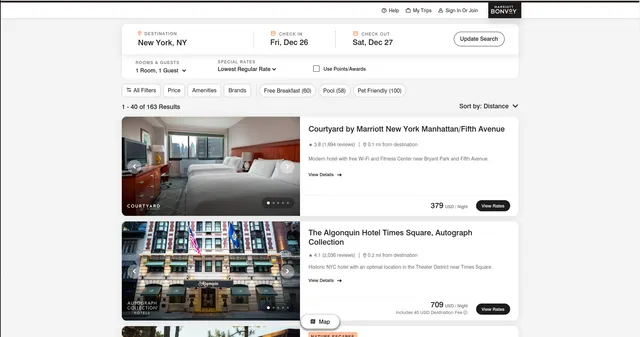
The Marriott.com Hotels Search Scraper processes hotel search result pages—the listings displayed after specifying location, dates, and guest parameters. Unlike property detail scrapers requiring individual hotel URLs, this tool efficiently captures multiple properties from search pages in single runs.
Core Data Categories:
Distance Metrics: Physical distance from search center point enables proximity analysis, identifying hotel density in specific areas, analyzing market saturation, and understanding geographic distribution patterns.
Property Information: Comprehensive hotel profiles including unique property ID (e.g., "NYCES"), SEO-friendly nickname, official name, brand affiliation (Courtyard, Ritz-Carlton, etc.), geographic coordinates (latitude/longitude), opening dates, and property classifications (resort, adults-only, newly renovated).
Brand Intelligence: Complete brand hierarchy with brand codes, names, type (Marriott vs. third-party), and brand-specific imagery. This data reveals Marriott's multi-brand strategy and helps identify which brands dominate specific markets.
Visual Assets: Primary property images with multiple renditions (square, horizontal, wide), brand photos, and alternate descriptions provide visual inventory for travel platforms and marketing analysis.
Rate Data: Detailed pricing structure including base rates, mandatory fees, taxes, total costs, currency information, rate categories (standard, promotional), member-only pricing flags, and availability status. This enables comprehensive price comparison and revenue management analysis.
Guest Reviews: Aggregated review counts and star ratings (typically 1-5 scale) provide social proof metrics and quality indicators essential for competitive positioning analysis.
Property Descriptions: Marketing captions highlighting key amenities and unique selling propositions (e.g., "Modern hotel with free Wi-Fi near Bryant Park").
Property Attributes: Boolean flags indicating renovation status (fully renovated, recently renovated, has renovated rooms), unique property features (adults-only, all-inclusive, resort classification), and special designations (new property, MAX properties).
Target Audiences:
Travel Technology Companies integrate Marriott inventory into booking platforms, metasearch engines, and travel planning applications. Revenue Management Consultants analyze pricing patterns, rate optimization strategies, and competitive positioning across hotel brands. Hospitality Market Researchers study property distribution, brand penetration, renovation cycles, and guest satisfaction trends. Real Estate Developers assess hotel density, brand presence, and market gaps for development opportunities. Corporate Travel Managers benchmark rates, identify property options for employee travel programs, and negotiate corporate agreements. Tourism Boards analyze accommodation capacity, brand diversity, and competitive landscape in their regions.
Input Configuration: Constructing Search Queries
The scraper processes Marriott.com search result page URLs containing encoded search parameters. Understanding URL structure ensures precise data targeting.
Example Input Configuration:
Example Screenshot:
Parameter Analysis:
proxy configuration: While useApifyProxy: false works for basic scraping, enabling residential proxies (useApifyProxy: true with RESIDENTIAL group) significantly improves reliability for large-scale extraction. Marriott implements bot detection; proxies reduce blocking risk.
max_items_per_url: Controls extraction limit per search URL. Marriott displays 20 properties per page by default. Setting this to 20 captures one full page. Increase to 40-60 to automatically handle pagination and collect multiple pages in one run.
ignore_url_failures: Essential when processing multiple search URLs. Setting true ensures one failed URL (expired search, invalid parameters) doesn't halt your entire data collection. Recommended for production workflows.
urls array: Contains search result URLs. Key URL parameters include:
- fromDate/toDate: Check-in and check-out dates determining availability and pricing. Format: MM/DD/YYYY
- lengthOfStay: Number of nights, affects pricing calculations
- destinationAddress.city/stateProvince/country: Geographic target defining search scope
- searchRadius: Distance in miles/kilometers from center point (e.g., 50 miles from city center)
- roomCount: Number of rooms requested, affects availability
- numAdultsPerRoom: Occupancy per room, influences rate calculations
- currentOffset: Pagination parameter (0=page 1, 20=page 2, 40=page 3). Increment by 20 for sequential pages
- view: Display format ("list" for standard results, "map" for geographic view)
Building Search URLs:
- Navigate to Marriott.com and perform your desired search (location, dates, guests)
- Copy the resulting URL from your browser
- Clean URL by removing tracking parameters (optional: keeps URL concise)
- Modify
currentOffsetparameter to collect additional pages (20, 40, 60...) - Create multiple URLs for different cities, date ranges, or search radii
Pro Tip: For comprehensive market analysis, create systematic URL sets varying one parameter at a time (e.g., same location with different dates to track seasonal pricing, or multiple cities with same dates for geographic comparison).
Complete Output Structure: Field-by-Field Analysis
The scraper returns JSON arrays with each property as an object containing three main sections: distance, property, and rates.
Distance Field
distance: Numeric value representing miles/kilometers from search center point (e.g., 162.05388 miles). Purpose: Geographic proximity analysis, identifying hotel clusters, mapping competitive sets, filtering properties by distance thresholds. Essential for "near me" searches and radius-based market analysis.
Property Section
property.__typename: GraphQL type identifier ("Hotel"). Purpose: Schema validation, API integration consistency.
property.id: Unique property identifier code (e.g., "NYCES"). Purpose: Primary key for databases, tracking specific properties over time, linking to booking systems, avoiding duplicates across searches.
property.seo_nickname: URL-friendly property identifier (e.g., "nyces-courtyard-new-york-manhattan-fifth-avenue"). Purpose: Constructing direct property URLs, SEO analysis, human-readable property references.
Basic Information Subsection
basic_information.bookable: Boolean indicating current booking availability. Purpose: Filtering sellable inventory, identifying temporarily closed properties, availability status tracking.
basic_information.brand: Nested object containing brand details:
- id: Brand code (e.g., "CY" for Courtyard). Purpose: Brand segmentation, multi-brand analysis
- name: Full brand name (e.g., "Courtyard"). Purpose: Display purposes, brand recognition
- type: Brand ownership ("Marriott" vs. franchised). Purpose: Distinguishing corporate vs. franchise properties
- photos: Array of brand-level imagery with multiple renditions. Purpose: Brand-consistent visual assets, marketing materials
basic_information.currency: Three-letter currency code (e.g., "USD"). Purpose: Financial calculations, multi-currency price normalization, international market analysis.
basic_information.descriptions: Array of property descriptions:
- text: Marketing caption summarizing key features. Purpose: Amenity identification, competitive positioning analysis, content for travel platforms
- type.code: Description category (e.g., "HOTEL MARKETING CAPTION"). Purpose: Distinguishing marketing text from operational descriptions
basic_information.has_renovated_rooms: Boolean indicating partial renovation. Purpose: Identifying mixed-quality inventory, renovation tracking over time.
basic_information.has_unique_property_logo: Boolean for custom branding. Purpose: Identifying flagship or signature properties with distinct visual identity.
basic_information.is_adults_only: Boolean restricting guest demographics. Purpose: Filtering family-friendly vs. adult-exclusive properties, niche market identification.
basic_information.is_fully_renovated / is_recently_renovated: Renovation status flags. Purpose: Quality assessment, competitive benchmarking, identifying modernization investments.
basic_information.is_max: Boolean for Marriott's "MAX" technology properties. Purpose: Identifying tech-forward properties with enhanced digital features.
basic_information.latitude / longitude: Geographic coordinates (e.g., 40.752132, -73.981665). Purpose: Precise mapping, proximity calculations, geographic clustering analysis, GIS integration.
basic_information.name / name_in_default_language: Property names. Purpose: Display, search functionality, multi-language support analysis.
basic_information.new_property / new_lobby: Newness indicators. Purpose: Tracking market expansions, identifying recently opened properties, lobby renovation monitoring.
basic_information.opening_date: Property launch date (format: YYYY-MM-DD). Purpose: Age analysis, market entry timing, historical property development tracking.
basic_information.resort: Boolean classification. Purpose: Segmenting resort vs. transient properties, amenity expectation setting, pricing tier analysis.
Media Content Subsection
media.primary_image.edges: Array structure containing primary property image:
- node.alternate_description: Image caption (e.g., "Queen Guest room"). Purpose: Accessibility, content categorization
- node.image_urls: Multiple image renditions:
- classic_horizontal: Standard landscape format. Purpose: Traditional displays
- square: 1:1 ratio. Purpose: Social media, mobile interfaces
- wide_horizontal: Panoramic format. Purpose: Hero images, immersive displays
- node.title: Image filename/identifier. Purpose: Asset management, unique image identification
Purpose of Media Section: Visual asset inventory for travel platforms, analyzing property presentation strategies, quality assessment through imagery.
Other Property Information Subsection
other_property_information.is_all_inclusive: Nullable boolean indicating meal plan inclusion. Purpose: Identifying all-inclusive resorts vs. à la carte properties, pricing model analysis, resort segment classification.
Reviews Subsection
reviews.number_of_reviews.count: Integer count of guest reviews (e.g., 1694). Purpose: Social proof strength indicator, popularity metric, statistical significance assessment for ratings.
reviews.stars.count: Average rating (typically 0-5 scale, e.g., 3.8). Purpose: Quality benchmark, competitive comparison, guest satisfaction analysis, filtering high-rated properties.
Purpose of Reviews Section: Guest satisfaction tracking, identifying service quality leaders, competitive positioning analysis, trend monitoring over time.
Rates Section
rates: Array of available rate objects (typically one per rate category):
length_of_stay: Integer indicating booking duration (e.g., 1 night). Purpose: Multi-night pricing validation, minimum stay analysis.
members_only: Boolean flag for exclusive member rates. Purpose: Identifying loyalty program benefits, differentiating public vs. member pricing.
rate_category.code / value: Rate classification (e.g., "StandardRates", promotional codes). Purpose: Distinguishing rate types (BAR, corporate, government, promotional), competitive rate analysis.
rate_modes.lowest_average_rate: Nested pricing object:
- amount.amount: Base rate in minor currency units (e.g., 37900 = $379.00). Purpose: Primary pricing metric, historical price tracking
- amount.currency: Currency code. Purpose: Multi-currency handling
- amount.decimal_point: Decimal places (e.g., 2 for cents). Purpose: Accurate currency conversion
- amount_plus_mandatory_fees: Base rate + required fees. Purpose: True room cost before taxes
- fees.amount: Optional fees in minor units. Purpose: Resort fees, amenity charges analysis
- mandatory_fees.amount: Required fees (resort fees, facility charges). Purpose: Transparent total cost calculation, fee comparison across properties
- taxes.amount: Tax amount (e.g., 5941 = $59.41). Purpose: Tax burden analysis, net vs. gross pricing
- total_amount.amount: Complete cost including all charges (e.g., 43841 = $438.41). Purpose: Final price comparison, true cost-per-night analysis
source_of_rate: Rate system identifier (e.g., "MARSHA" for Marriott's rate engine). Purpose: Understanding rate source, distinguishing direct vs. third-party rates.
status.code: Availability status (e.g., "AvailableForSale"). Purpose: Filtering bookable rates, tracking sellout patterns, demand indicators.
from_url: Original search URL generating this result. Purpose: Traceability, re-running searches, validation of search parameters, linking data to source queries.
Sample Output Structure:
Step-by-Step Implementation Guide
1. Define Research Objectives: Determine your data needs—price comparison for specific dates, property inventory in target markets, brand distribution analysis, or seasonal pricing patterns. Clear objectives guide URL creation.
2. Build Search URL Library: Perform test searches on Marriott.com for each target scenario (city, date range, occupancy). Copy resulting URLs. For multi-page extraction, create URL variants with increasing currentOffset values (0, 20, 40, 60...).
3. Configure Input Parameters: Construct JSON input with URL array. Set max_items_per_url to 20 for single-page extraction or 40-60 for multi-page automatic pagination. Enable ignore_url_failures: true for robustness in large-scale scraping.
4. Validate Sample Run: Test with 2-3 URLs before full deployment. Verify data completeness—check that property names, rates, and coordinates populate correctly. Confirm currency and decimal point handling for accurate price calculations.
5. Execute Production Scraping: Launch via Apify console. Monitor progress through activity log. Processing 10 search URLs with 20 properties each (200 total hotels) typically completes in 3-5 minutes, though timing varies with proxy configuration and platform load.
6. Quality Assurance Review: Examine exported data for anomalies. Verify rate amounts convert correctly (divide by 10^decimal_point). Check coordinate ranges (latitude: -90 to 90, longitude: -180 to 180). Flag properties with missing critical fields (name, rates, location).
7. Data Post-Processing: Convert minor currency units to standard format (37900 → $379.00). Calculate derived metrics like rate-per-star-rating, distance-adjusted pricing, or tax percentages. Normalize data for cross-market comparison.
8. Handle Pagination Strategically: For comprehensive city-level datasets, create systematic offset sequences. Example: New York search might require offsets 0, 20, 40, 60, 80 to capture 100 properties. Monitor when results stop populating (indicates end of available properties).
Error Troubleshooting: Invalid URLs typically result from expired search sessions or incorrect parameter encoding. Re-generate URLs from fresh Marriott searches. Properties showing "bookable": false may indicate seasonal closures or maintenance—filter these for availability analysis.
Scaling Best Practices: For enterprise-level extraction (1000+ properties across multiple markets), batch URLs into groups of 50-100 per run. Schedule recurring scrapes (weekly/monthly) to build time-series pricing databases. Use consistent search parameters (same dates, occupancy) for valid comparative analysis.
Strategic Applications Transforming Hospitality Intelligence
Dynamic Pricing Intelligence: Track rate fluctuations across booking windows (1-day advance vs. 30-day advance vs. 90-day advance). Identify pricing strategies by brand—luxury brands may show less variance while select-service brands adjust aggressively. Build predictive models forecasting optimal booking times.
Competitive Set Analysis: Define geographic competitive sets by proximity (properties within 2-mile radius). Compare rates, review scores, and amenity offerings within competitive sets. Identify underperforming properties with high rates but low ratings, signaling repositioning opportunities.
Brand Penetration Mapping: Visualize brand distribution across markets using coordinate data. Identify over-saturated markets (multiple brands competing) vs. underserved areas (single brand dominance or gaps). Inform development strategy for new property placement.
Renovation Impact Assessment: Track properties transitioning from "not renovated" to "recently renovated" flags. Measure rate increases and review score improvements post-renovation. Calculate renovation ROI by comparing rate premiums against competitor properties.
Seasonal Demand Forecasting: Run identical searches with different date parameters throughout the year. Build seasonal rate curves showing peak vs. shoulder vs. off-peak pricing. Identify markets with consistent demand (urban business) vs. high seasonality (resort destinations).
Member Pricing Analysis: Compare members_only: true rates against standard rates to quantify loyalty program benefits. Analyze which markets offer deepest member discounts, informing membership acquisition strategies.
Tax and Fee Benchmarking: Calculate effective tax rates by market (taxes ÷ base rate). Identify high-fee markets (mandatory resort fees) affecting total cost transparency. Benchmark fee structures across competitive properties.
Review Score Correlation: Analyze relationship between review counts, star ratings, and pricing. Identify properties with pricing premiums justified by superior ratings vs. overpriced properties with mediocre scores. Spot undervalued high-rated properties.
Geographic Expansion Due Diligence: Assess market capacity in target expansion cities. Count existing Marriott properties, dominant brands, average rates, and review distributions. Identify gaps in brand representation (e.g., luxury market underserved despite strong economy presence).
Corporate Travel Program Optimization: Extract properties in frequently visited cities by employees. Compare rates across brands for similar quality (Courtyard vs. Fairfield). Build preferred property lists balancing cost and convenience (distance from business centers).
Maximizing Data Value: Advanced Techniques
Time-Series Rate Databases: Scrape identical search parameters weekly. Track each property's rate evolution approaching travel dates. Identify booking curves—how far in advance rates increase as occupancy fills. Build historical datasets enabling year-over-year comparisons.
Multi-Market Comparative Analysis: Execute parallel searches across cities with similar characteristics (comparable business centers, tourist destinations, airport markets). Normalize data by local economic indicators (GDP per capita, tourism volume) to identify over/underpriced markets.
Brand-Level Performance Aggregation: Group properties by brand ID, calculate average rates, median review scores, and geographic distribution per brand. Identify brand positioning—which consistently commands premiums, which targets value segments, which shows highest guest satisfaction.
Distance-Adjusted Pricing Models: Calculate price-per-mile-from-center metrics. Identify properties with unfavorable distance-to-price ratios (far from center but expensive) vs. favorable positioning (central location, competitive pricing). Inform property acquisition decisions.
Amenity-Rate Correlation: Combine scraped data with detailed property pages (requires detail scraper) extracting amenity lists. Correlate specific amenities (pools, restaurants, meeting space) with rate premiums. Quantify amenity value-add for development planning.
Review Velocity Tracking: Monitor review count changes over time. Calculate reviews-per-month as activity indicator. Sudden review velocity spikes may indicate quality issues or viral attention. Declining velocity suggests reduced occupancy or guest engagement.
Mandatory Fee Transparency Analysis: Calculate fee-to-base-rate ratios across properties. Identify markets/brands with aggressive fee structures vs. all-inclusive rates. Inform pricing strategy and regulatory compliance considerations for transparent pricing.
NEW Property Monitoring: Filter for "new_property": true flags. Track new market entrants, brand expansion patterns, and competitive responses to new openings. Build early databases of properties in pre-opening phase for competitive intelligence.
Seasonal Rate Elasticity: Compare rate ranges (min to max) throughout the year for same properties. Calculate elasticity metrics showing pricing flexibility. Highly elastic markets indicate strong demand fluctuations; inelastic markets suggest stable business models.
Cross-Currency Market Arbitrage: For international properties, compare USD-equivalent rates across markets with different local currencies. Identify pricing inconsistencies exploitable for cost savings or indicating local market conditions.
Data Governance and Best Practices
Scraping Frequency Optimization: Balance data freshness needs against resource consumption. Daily scraping suits dynamic pricing analysis and booking platform feeds. Weekly scraping suffices for market research and trend analysis. Monthly scraping tracks long-term positioning changes.
Rate Calculation Standardization: Always use total_amount field for complete cost comparison including taxes and fees. Document decimal point handling in your system (divide by 10^decimal_point). Store both minor units (API format) and decimal format (human-readable) for flexibility.
Geographic Data Validation: Implement coordinate sanity checks (valid latitude/longitude ranges). Cross-reference coordinates against address information when available. Flag properties with suspicious coordinates (0,0 or ocean locations) for manual review.
Historical Data Archiving: Maintain separate current vs. historical databases. Archive scraped data with immutable timestamps. Never overwrite historical records—append new data enabling trend analysis. Implement data retention policies balancing storage costs against analytical value.
Competitive Intelligence Ethics: Use scraped data for lawful competitive analysis, market research, and consumer applications. Avoid republishing Marriott's proprietary content (descriptions, images) without proper licensing. Focus on factual data points (rates, locations, availability).
API Schema Evolution Handling: Marriott's GraphQL schema may evolve (new fields, deprecated fields). Implement flexible parsing handling missing fields gracefully. Version your scraper to adapt to schema changes. Monitor for __typename changes indicating structural modifications.
Multi-Currency Data Management: Store all financial data with explicit currency codes. Implement conversion functions using current exchange rates for normalized comparison. Document conversion timestamps since rates fluctuate. Consider maintaining both original currency and USD-equivalent fields.
Privacy and PII Considerations: This scraper collects publicly available property data without personal information. However, combined with other data sources (review text, booking patterns), ensure compliance with data protection regulations. Avoid creating datasets enabling individual traveler identification.
Data Freshness Indicators: Always store from_url and scrape timestamp. Calculate data age before using for time-sensitive decisions (pricing, availability). Implement alerts when data exceeds acceptable age thresholds for your use case.
Quality Metrics Dashboard: Track extraction success rates (properties extracted vs. expected), data completeness (percentage with all critical fields), and anomaly rates (suspicious pricing, invalid coordinates). Establish acceptable quality thresholds triggering investigation when breached.
Conclusion
The Marriott.com Hotels Search Scraper transforms the world's largest hotel chain's search platform into actionable intelligence for travel technology, hospitality research, and competitive strategy. From granular pricing data enabling dynamic rate optimization to geographic coordinates powering market penetration analysis, this tool delivers comprehensive property intelligence across 8,000+ hotels and 30+ brands. Whether building travel comparison platforms, conducting market entry research, or optimizing revenue management strategies, Marriott's search data provides unmatched insights into global hospitality markets. Start extracting strategic hotel intelligence today and gain competitive advantage in the $600 billion global hotel industry.


