

Marriott Reviews Scraper
Pricing
from $3.00 / 1,000 results
Marriott Reviews Scraper
Scrape comprehensive guest reviews from Marriott.com hotels worldwide. Extract ratings, detailed feedback, reviewer profiles, photos, response data, and sentiment metrics. Essential for hotel reputation management, competitive analysis, and hospitality market intelligence across Marriott's.
Pricing
from $3.00 / 1,000 results
Rating
0.0
(0)
Developer

Stealth mode
Maintained by CommunityActor stats
0
Bookmarked
3
Total users
0
Monthly active users
a month ago
Last modified
Categories
Share
Marriott.com Reviews Scraper: Extract Guest Feedback & Hotel Ratings Data
Understanding Marriott Reviews and Their Strategic Value
Marriott International operates 8,000+ properties across 139 countries, making it the world's largest hotel chain. Guest reviews on Marriott.com represent authentic feedback from millions of travelers, providing unfiltered insights into service quality, property conditions, and guest satisfaction across brands from budget (Fairfield Inn) to luxury (Ritz-Carlton, St. Regis).
Unlike aggregator platforms (TripAdvisor, Booking.com) that mix properties and brands, Marriott's native reviews offer brand-specific intelligence. Reviews include detailed ratings across multiple dimensions (cleanliness, service, amenities), traveler context (business vs. leisure), and property responses—data critical for operational benchmarking and competitive positioning.
Manually collecting review data across hundreds of properties requires endless scrolling, copying text, and organizing fragmented information. This scraper automates complete review extraction, transforming guest feedback into structured datasets ready for sentiment analysis, reputation monitoring, or competitive intelligence.
What This Scraper Extracts and Target Users
The Marriott.com Reviews Scraper processes hotel review pages, extracting complete guest feedback data from individual property URLs. Unlike search scrapers, this tool focuses on deep review intelligence from specific hotels.
Core Data Captured:
Review Content: Full review text, titles, pros/cons sections, and ratings across multiple dimensions (overall rating plus secondary ratings for cleanliness, service, location, amenities).
Reviewer Profile: User nickname, location, whether review is recommended, badges (verified guest, frequent traveler), and traveler type context.
Engagement Metrics: Total feedback counts (positive, negative, inappropriate), helpfulness scores, comment counts, and client response presence.
Temporal Data: Submission time, last modification time, moderation timestamps—tracking review freshness and property responsiveness.
Rich Media: Photos and videos uploaded by guests, providing visual evidence of property conditions and amenities.
Management Response: Client responses from property staff, analyzing responsiveness and engagement quality.
Syndication & Moderation: Syndication status (cross-posted reviews), moderation status, campaign IDs, and featured review flags.
Target Users:
Hotel Revenue Managers monitor competitor properties, benchmark service quality, and identify reputation threats. Property Managers track guest satisfaction trends, prioritize operational improvements, and measure response effectiveness. Market Researchers analyze sentiment across markets, brands, and property types. Investment Firms conduct due diligence on hospitality assets using guest satisfaction data. Reputation Management Agencies provide automated monitoring and crisis detection for hotel clients. Travel Tech Companies integrate authentic reviews into booking platforms and recommendation engines.
Input Configuration: Targeting Review Pages
The scraper processes hotel review page URLs from Marriott.com. Each property has a dedicated reviews page accessible via the hotel's main page.
Example Input:
Example Screenshot:
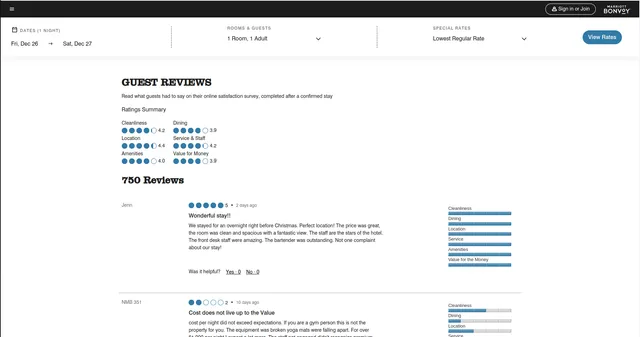
Parameter Details:
proxy configuration: Set useApifyProxy: false for basic scraping. Enable proxies if scraping many properties simultaneously to distribute requests and reduce detection risk.
offset: Starting position for pagination. Set to 0 to begin from newest reviews. Increase by max_items_per_url value to access older reviews (offset: 20 gets reviews 21-40).
max_items_per_url: Number of reviews to extract per URL. Default 20 matches typical page display. Increase to 50-100 for comprehensive extraction, decrease to 5-10 for testing.
ignore_url_failures: Set true when scraping multiple properties—individual failures won't halt entire run. Essential for batch processing.
urls array: Hotel review page URLs. Format: https://www.marriott.com/en-US/hotels/[PROPERTY-CODE]-[property-name]/reviews/. Find property codes on Marriott.com or from booking URLs.
URL Collection: Browse Marriott.com, search for target hotels, navigate to property page, click "Reviews" tab, copy URL. For batch scraping, compile property codes from Marriott's directory or competitor analysis lists.
Complete Output Structure: Every Field Explained
ID: Unique review identifier in Marriott's system. Purpose: Primary key for databases, tracking specific reviews over time, deduplication when merging datasets.
CID / Source Client: Client identifier and source system. Purpose: Tracking review origin, multi-platform data integration.
Last Moderated Time / Last Modification Time: Timestamps for moderation review and content updates. Purpose: Identifying edited reviews, tracking moderation delays, measuring review lifecycle.
Product ID / Original Product Name: Hotel identifier and name as stored in review system. Purpose: Linking reviews to properties, handling name changes, maintaining referential integrity.
Author ID: Unique reviewer identifier. Purpose: Tracking prolific reviewers, identifying review patterns, analyzing reviewer credibility.
Content Locale: Language of review content. Purpose: Multi-language sentiment analysis, market segmentation, translation prioritization.
Is Featured: Boolean indicating highlighted reviews. Purpose: Identifying property-selected exemplary feedback, analyzing curation strategies.
Feedback Counts (Inappropriate/Client Response/Comment/Total/Negative/Positive): Engagement metrics quantifying community interaction. Purpose: Measuring review controversy, property responsiveness, community engagement quality.
Rating: Overall numeric score (typically 1-5 scale). Purpose: Primary satisfaction metric, aggregation for property-level scores, trend analysis.
Secondary Ratings / Secondary Ratings Order: Dimensional ratings (cleanliness, service, location, amenities) with display order. Purpose: Granular satisfaction analysis, identifying specific operational strengths/weaknesses.
Is Ratings Only: Boolean indicating review without text. Purpose: Filtering substantive reviews, analyzing silent satisfaction patterns.
Moderation Status: Review approval state (approved, pending, rejected). Purpose: Quality filtering, understanding moderation criteria, identifying suppressed feedback.
Submission ID / Submission Time: Submission identifier and timestamp. Purpose: Tracking review flow, seasonality analysis, measuring post-stay review timing.
Review Text / Title: Complete review content and headline. Purpose: Sentiment analysis, keyword extraction, issue identification, training NLP models.
User Nickname / User Location: Reviewer display name and geographic origin. Purpose: Market analysis (where guests come from), reviewer authenticity assessment.
Context Data Values: Traveler type (business, leisure, family), room type, stay dates. Purpose: Segmenting feedback by guest profile, analyzing business vs. leisure satisfaction divergence.
Inappropriate Feedback List: Flags for problematic content. Purpose: Quality control, identifying spam or abusive reviews.
Client Responses: Property management replies to reviews. Purpose: Measuring responsiveness, analyzing engagement quality, reputation management assessment.
Videos / Photos: URLs to uploaded media. Purpose: Visual evidence of conditions, enhanced sentiment analysis, identifying maintenance issues.
Pros / Cons: Structured positive/negative aspects. Purpose: Quick sentiment classification, identifying recurring themes without full text analysis.
Is Syndicated: Indicates cross-platform posting. Purpose: Tracking review authenticity, multi-platform reputation analysis.
Rating Range: Min-max scale for context. Purpose: Normalizing scores across different rating systems.
Helpfulness: Community votes on review usefulness. Purpose: Identifying most valuable feedback, prioritizing actionable reviews.
Badges / Badges Order: Reviewer credentials (verified guest, elite member) with display sequence. Purpose: Assessing reviewer credibility, weighting reviews by authority.
Product Recommendation IDs: Related products mentioned. Purpose: Cross-selling insights, analyzing guest discovery patterns.
Additional Fields / Tag Dimensions: Custom attributes and categorization tags. Purpose: Enhanced filtering, property-specific tracking, campaign analysis.
Is Recommended: Boolean indicating recommendation status. Purpose: Binary satisfaction metric, conversion prediction.
Campaign ID: Marketing campaign association. Purpose: Measuring campaign-driven review generation, incentivized feedback tracking.
Comment IDs: References to review comments. Purpose: Threading conversations, community engagement analysis.
Sample Output:
Step-by-Step Implementation
1. Identify Target Properties: Determine which Marriott properties to monitor. Consider competitive sets (3-4 similar properties in same market), brand comparisons (luxury vs. midscale), or portfolio-wide tracking for property managers.
2. Collect Review URLs: Navigate to each property on Marriott.com, access reviews section, copy URLs. For systematic collection, use Marriott's property search to compile codes, then construct URLs following standard format.
3. Configure Scraper Input: Build JSON with URL list. For comprehensive extraction, set max_items_per_url to 100+ to capture historical reviews. Use offset parameter to paginate through large review sets.
4. Execute Scraping: Launch via Apify console. Monitor progress—50 reviews typically process in 1-2 minutes. Large runs (500+ reviews) may take 10-15 minutes.
5. Quality Check: Verify rating distributions look reasonable, review text is complete, timestamps are logical. Flag anomalies—all 5-star ratings may indicate filtering issues.
6. Export and Analyze: Export JSON for analysis tools, CSV for spreadsheets. Immediately calculate aggregate scores, sentiment trends, and response rate metrics.
Error Handling: Invalid URLs return no results. Verify URLs follow correct format and property codes are accurate. Pagination errors occur if offset exceeds total reviews—implement checks for total review count.
Strategic Applications for Hospitality Intelligence
Competitive Benchmarking: Track competitor satisfaction scores across dimensions. Identify where competitors excel (higher service ratings) or struggle (lower cleanliness scores). Monitor review volume as expansion indicator.
Operational Prioritization: Secondary ratings reveal specific weaknesses—low cleanliness ratings trigger maintenance audits, poor service scores prompt staff training. Quantify ROI of improvements through rating changes.
Reputation Crisis Detection: Sudden spikes in negative reviews signal issues. Automated alerts on rating drops or negative keyword frequency (bedbugs, rudeness, dirty) enable rapid response.
Response Effectiveness Analysis: Measure impact of client responses—do responded reviews receive more positive feedback? Track response time trends, correlate with subsequent ratings.
Market Intelligence: Analyze reviewer locations to understand guest origin markets. Business vs. leisure traveler satisfaction differences inform targeted marketing. Seasonal review patterns guide pricing strategies.
Sentiment Trend Analysis: Natural language processing on review text identifies emerging themes—increasing mentions of "outdated décor" signal renovation needs, "great breakfast" mentions validate F&B investments.
Investment Due Diligence: Aggregate historical ratings, calculate satisfaction trends, assess management responsiveness for properties under acquisition consideration. Review volume correlates with occupancy.
Brand Performance Comparison: Compare satisfaction across Marriott's brand tiers. Verify luxury brands (Ritz-Carlton, St. Regis) maintain rating premiums over midscale brands (Fairfield, Courtyard).
Maximizing Data Value
Temporal Analysis: Scrape same properties monthly, tracking rating evolution. Identify improvement/decline trends. Correlate with known events—renovations should boost scores, management changes may cause disruptions.
Photo Analysis: Computer vision on guest photos identifies visual themes—pool crowding, room conditions, amenities usage. Automated image classification scales visual feedback analysis.
Response Quality Scoring: NLP analysis of client responses—measure personalization (name usage), specificity (addressing mentioned issues), tone (apologetic vs. defensive). Benchmark response quality across properties.
Reviewer Segmentation: Cluster reviews by traveler type, origin market, elite status. Business travelers prioritize different amenities than leisure guests—segment analysis informs targeted improvements.
Prediction Modeling: Historical ratings predict occupancy, pricing power, renovation ROI. Machine learning models trained on review features forecast future performance.
Cross-Platform Integration: Combine Marriott reviews with TripAdvisor, Google, Booking.com data. Identify platform-specific sentiment differences, aggregate for holistic reputation view.
Alert Systems: Automated notifications when ratings drop below thresholds, specific keywords appear (health, safety, discrimination), or response rates decline. Proactive reputation management.
Best Practices and Compliance
Scraping Frequency: Weekly scraping captures new reviews while respecting server resources. Daily scraping justified only for crisis monitoring or major properties with high review volume.
Data Retention: Store historical reviews even after property removal from active tracking. Longitudinal data reveals multi-year trends, renovation impacts, market evolution.
Privacy Considerations: Reviewer nicknames and locations are public data, but aggregate and anonymize when publishing analysis. Avoid republishing complete reviews—respect Marriott's content ownership.
Rate Limiting: Space requests when scraping many properties. Batch scraping 100+ properties should occur over hours, not minutes. Sustainable practices ensure continued access.
Data Validation: Check for duplicates (same review ID appearing multiple times), validate rating ranges (1-5 scale), ensure timestamps are chronological. Automated quality checks maintain dataset integrity.
Enrichment Opportunities: Geocode user locations for mapping, translate non-English reviews for unified analysis, categorize review topics (cleanliness, service, amenities) through NLP.
Conclusion
The Marriott.com Reviews Scraper transforms guest feedback into actionable intelligence for the world's largest hotel portfolio. From operational improvements driven by dimensional ratings to competitive positioning informed by sentiment analysis, structured review data powers data-driven hospitality management. Extract authentic guest insights today to elevate service quality, optimize reputation, and gain competitive advantage in global hospitality markets.


