Wayfair Product Search Scraper
Pricing
from $1.00 / 1,000 results
Wayfair Product Search Scraper
Efficiently scrape product listings from Wayfair.com search results. Extract comprehensive furniture and home decor data including prices, reviews, variants, shipping details, and inventory status. Perfect for e-commerce competitors, price monitoring, market research, and product catalog building.
Pricing
from $1.00 / 1,000 results
Rating
0.0
(0)
Developer

Stealth mode
Maintained by CommunityActor stats
0
Bookmarked
22
Total users
2
Monthly active users
20 days ago
Last modified
Categories
Share
Wayfair.com Product Search Scraper: Extract Furniture and Home Decor Data
Understanding Wayfair.com and Its E-Commerce Value
Wayfair.com stands as one of the world's largest online retailers for home furnishings, offering over 14 million products across furniture, decor, home improvement, and housewares categories. Unlike general marketplaces, Wayfair specializes exclusively in the home goods sector, making it a critical data source for understanding furniture market trends, pricing strategies, and consumer preferences.
The platform aggregates thousands of suppliers and brands, creating a comprehensive view of the home furnishings market. For furniture retailers analyzing competitive pricing, manufacturers monitoring brand presence, or market researchers tracking home decor trends, Wayfair's search results provide unmatched insights into product availability, pricing dynamics, and customer sentiment across the $200+ billion home furnishings industry.
Manually collecting product data across multiple searches, categories, and price ranges would require endless hours of scrolling, clicking through pages, and copying information. The Wayfair.com Product Search Scraper automates this entire workflow, transforming search result pages into structured datasets ready for competitive analysis, price monitoring, or catalog integration.
What This Scraper Extracts and Who Should Use It
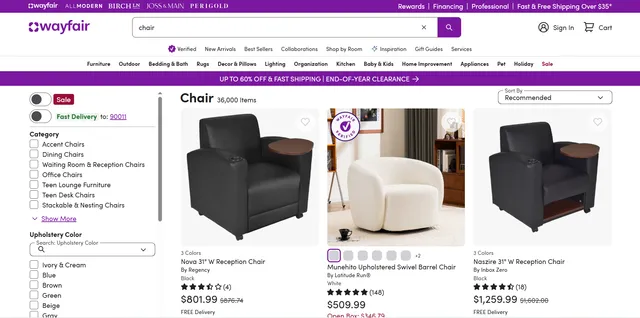
The Wayfair.com Product Search Scraper processes search result pages—the listings you see after searching for products like "dining chairs," "area rugs," or "office desks." Unlike detail page scrapers requiring individual product URLs, this tool efficiently captures multiple products from search pages, ideal for building broad datasets across categories or monitoring market segments.
The scraper extracts essential product information including names, brands, pricing, customer reviews, available variants (colors, sizes, materials), shipping options, inventory status, and promotional badges. It also captures multiple product images and unique identifiers for tracking and database integration.
Target Users:
E-commerce Competitors monitor Wayfair's pricing strategies, product assortment, and promotional tactics to stay competitive. Furniture Manufacturers track how their products and competitors' offerings are positioned, priced, and reviewed. Market Research Firms analyze category trends, price distributions, brand performance, and consumer preferences. Price Monitoring Services track pricing changes across thousands of products for dynamic pricing strategies. Interior Designers research product availability, styles, and price points for client projects. Affiliate Marketers build product databases for content creation and commission optimization.
Input Configuration: Search URLs and Parameters Explained
The Actor supports two scraping modes — use only one at a time:
- Scrape by URLs — scrape data directly from a list of Wayfair search result or category page URLs.
- Scrape by search filters — scrape data using a keyword and additional filters (price range, rating, availability, etc.) instead of providing URLs.
There is also a General settings group (max items per URL, proxy) that applies to both modes.
Example Screenshot:
1. Scrape by URLs
Use this mode when you already have specific search result or category page URLs. When this mode is used, all options in the "Scrape by search filters" section will be disabled.
| Field | Type | Default | Description |
|---|---|---|---|
urls | array | (required) | One or more Wayfair product search or category page URLs to scrape. You can paste URLs one by one, or use the Bulk edit section to add a prepared list. Include multiple URLs to collect different categories, price ranges, or brands in one run. |
ignore_url_failures | boolean | true | If true, the scraper continues processing remaining URLs even if some fail. Critical when scraping multiple search pages — one broken URL won't stop your entire job. Set to false only if you need to ensure every URL succeeds. |
URL formats: https://www.wayfair.com/keyword.php?keyword=[search-term]&curpage=[page-number] for keyword searches, or category pages like https://www.wayfair.com/furniture/cat/chairs-c45333.html.
Building effective URLs: Perform searches manually on Wayfair to apply filters (price range, style, brand, room type), then copy the resulting URL. For pagination, increment the curpage parameter (curpage=1, curpage=2, etc.) — Wayfair's URL structure preserves your filters, ensuring consistent data collection. Test URLs in a browser before scraping to confirm they return the expected products, since Wayfair may change URL parameters over time.
2. Scrape by search filters
Use this mode when you want to search using a keyword and additional filter attributes instead of scraping by URLs. If you use this mode, leave the urls field above empty.
| Field | Type | Default | Description |
|---|---|---|---|
keyword | string | — | The keyword to search for. |
sort_by | string ("", 7, 2, 3) | — | Sort results by Recommended (empty), Customer rating (7), Price: low to high (2), or Price: high to low (3). |
min_price | string | — | Minimum price to filter results by. |
max_price | string | — | Maximum price to filter results by. |
rating | string ("", 5, 4, 3) | — | Minimum customer rating: All (empty), 5 stars, 4 stars and up, 3 stars and up. |
availability | string ("", true) | — | Filter by availability: All (empty) or In stock only (true). |
special_offers | string ("", 9, 12, 13) | — | Filter by offer type: All (empty), New Arrivals (9), Closeout (12), Open Box (13). |
page | integer | — | The page number to start scraping from. |
3. General settings
Applies to both scraping modes above.
| Field | Type | Default | Description |
|---|---|---|---|
max_items_per_url | integer | 20 | The maximum number of products to extract per URL/search. Wayfair typically displays 24–48 products per page, so 20 captures most results efficiently — increase to 50–100 for more comprehensive extraction. |
proxy | object | {"useApifyProxy": true, "apifyProxyGroups": ["RESIDENTIAL"], "apifyProxyCountry": "NL"} | Proxy configuration used by the scraper. Residential proxies mimic real user behavior, reducing detection risk. apifyProxyCountry determines which region's pricing, inventory, and availability you see, since Wayfair shows different data by region — set it to your target market (e.g. US) if you need country-specific data. |
Pro tip: If your target market isn't reflected in your results, double-check apifyProxyCountry — it defaults to NL, so switch it to match the region you actually want to scrape (e.g. US).
Complete Output Structure and Field Definitions
The scraper returns JSON data with each product as an object containing multiple fields. Understanding each field enables effective analysis and application.
ID: Unique product identifier assigned by Wayfair (e.g., "WNST1234"). Purpose: Primary key for databases, tracking specific products over time, avoiding duplicates, linking to detail page scrapers for deeper data. Essential for price monitoring—track same product across multiple scrapes.
Name: Complete product name as displayed on Wayfair (e.g., "Modern Velvet Upholstered Dining Chair"). Purpose: Product identification, search functionality, categorization, SEO analysis. Extract keywords from names to understand product attributes and marketing language.
Brand: Manufacturer or brand name (e.g., "Wade Logan," "Mercury Row," "Wayfair Custom Upholstery"). Purpose: Brand performance analysis, filtering by manufacturer, competitive brand tracking, identifying private label vs. name brands. Critical for manufacturers monitoring their product placement.
URL: Direct link to the product detail page on Wayfair. Purpose: Accessing complete product information, sharing products, verification of scraped data, feeding into detail page scrapers for comprehensive extraction.
Description: Brief product description or tagline (when available in search results). Purpose: Quick product understanding, keyword extraction, content analysis. Note that search pages show abbreviated descriptions—use detail page scrapers for full descriptions.
Image Count: Number of product images available. Purpose: Indicating product presentation quality—higher image counts suggest better merchandising, useful for competitive analysis of product photography strategies.
Image URLs: Array of direct links to product images. Purpose: Displaying products in your applications, visual analysis, building product catalogs, monitoring image quality across competitors. Typically includes main product image and alternative views.
Price: Current product price, may include sale price and original price if discounted (e.g., {"sale": 189.99, "original": 249.99, "currency": "USD"}). Purpose: Competitive pricing analysis, price monitoring over time, identifying discounts and promotions, calculating average prices by category. Core metric for dynamic pricing strategies.
Reviews: Review metrics including count and average rating (e.g., {"count": 342, "rating": 4.5}). Purpose: Quality indicators, popularity metrics, competitive analysis of customer satisfaction. High review counts indicate bestsellers; low ratings signal potential quality issues or poor market fit.
Variants: Available product options like colors, sizes, or materials (e.g., ["Gray", "Navy", "Beige"] or ["Set of 2", "Set of 4"]). Purpose: Understanding product range, inventory depth analysis, identifying popular variants, catalog building. Some products have dozens of variants affecting price and availability.
Shipping: Shipping information including cost, delivery timeframes, and free shipping eligibility (e.g., {"cost": 0, "method": "Free Shipping", "delivery": "2-5 days"}). Purpose: Competitive shipping analysis, calculating total cost of ownership, identifying fast-ship products, logistics strategy insights.
Inventory: Stock status (e.g., "In Stock," "Low Stock," "Out of Stock," "Made to Order"). Purpose: Availability tracking, identifying demand patterns (frequent stockouts = high demand), supply chain analysis, opportunity identification (competitors' out-of-stock items).
Flags & Badges: Promotional indicators like "Best Seller," "Sale," "New Arrival," "Top Rated," "Fast Shipping." Purpose: Identifying promoted products, understanding Wayfair's merchandising strategy, tracking promotional intensity, competitive intelligence on which products get promotional support.
Metadata: Additional data like category, subcategory, product type, room type. Purpose: Product categorization, filtering, trend analysis by category, understanding product taxonomy. Enables hierarchical analysis (e.g., "Furniture > Living Room > Chairs > Accent Chairs").
Sample Output:
Step-by-Step Usage Guide
1. Define Your Data Needs: Identify target products—specific categories (dining chairs, rugs, lighting), brands (searching "brand:wayfair" in Wayfair), price ranges, or style types (modern, farmhouse, industrial). Clear objectives ensure efficient scraping.
2. Build Search URLs: Perform test searches on Wayfair with desired filters applied. Copy resulting URLs including all parameters. For comprehensive data, create multiple URLs covering different categories, price points, or styles. For deep extraction across pages, include pagination URLs (curpage=1, curpage=2, etc.).
3. Configure Your Input: Create JSON configuration with collected URLs. Set max_items_per_url based on needs—20 for standard extraction, 50-100 for comprehensive category coverage. Enable ignore_url_failures for robustness when scraping many URLs.
4. Launch the Scraper: Start through Apify console. Monitor real-time progress in the dashboard. Typical run processing 5-10 search pages with 20 items each completes in 2-4 minutes, varying with proxy performance and Wayfair's response time.
5. Review and Validate Data: Preview results in dataset tab. Check critical fields (name, price, brand) for completeness. Verify products match your search intent. Identify any anomalies like missing prices or incorrect categories.
6. Export and Analyze: Export in preferred format—JSON for databases and APIs, CSV for spreadsheet analysis, Excel for business reporting. Clean data by removing duplicates or out-of-stock items if needed.
7. Handle Pagination for Large Datasets: For hundreds of products across multiple pages, either include all page URLs in one run or set max_items_per_url higher than page display limit to let scraper handle pagination automatically.
Error Handling: If URLs consistently fail, verify they're search result pages, not product detail pages or static content. Check Wayfair hasn't changed URL structure. Activity log provides detailed error diagnostics for troubleshooting.
Strategic Applications for Furniture and Home Decor Intelligence
Competitive Price Monitoring: Track pricing across competitors' products and Wayfair's private labels. Identify pricing patterns—weekend sales, seasonal discounts, clearance timing. Set up automated alerts when competitor prices change. Calculate price elasticity by correlating price changes with review velocity.
Product Assortment Analysis: Compare your catalog against Wayfair's offerings by category. Identify gaps in your product range or oversaturated segments. Track which styles, colors, and sizes competitors prioritize. Discover emerging trends through "New Arrival" badge frequency.
Brand Performance Tracking: Monitor how your brand (or competitors') products perform on Wayfair. Track review counts and ratings over time, pricing relative to category averages, inventory status indicating demand. Identify top-performing products to inform manufacturing priorities.
Market Trend Identification: Analyze product names, descriptions, and metadata to identify trending styles. Track frequency of keywords like "mid-century modern," "farmhouse," "sustainable," "smart home." Emerging terms signal market shifts requiring product development attention.
Inventory Intelligence: Monitor inventory status across categories. Frequent stockouts indicate high-demand products or supply chain issues. "Made to Order" products reveal custom capabilities. Compare your inventory depth against market to identify competitive advantages or vulnerabilities.
Shipping Strategy Benchmarking: Analyze shipping costs, delivery timeframes, and free shipping thresholds across price points. Understand when Wayfair absorbs shipping costs to remain competitive. Optimize your own shipping strategy based on market standards.
Review Velocity Analysis: Track review count changes over time to identify bestsellers gaining momentum or declining products losing favor. High ratings with low review counts suggest new products with potential; low ratings with high counts indicate widespread dissatisfaction.
Promotional Effectiveness: Correlate flags like "Sale," "Best Seller," "Top Rated" with pricing, reviews, and inventory status. Identify which promotional tactics correlate with success. Understand Wayfair's merchandising priorities.
Maximizing Data Value and Best Practices
Schedule Regular Scraping: Wayfair's dynamic pricing and inventory change frequently. Daily scraping captures price fluctuations, weekly scraping tracks inventory trends, monthly scraping reveals seasonal patterns. Store historical data for time-series analysis.
Segment Your Searches: Create targeted URLs by category, price range, brand, or room type rather than broad searches. Cleaner datasets simplify analysis. Examples: "living room chairs under $200," "best-selling area rugs," "Wade Logan brand products."
Enrich With Additional Data: Combine Wayfair data with Amazon Furniture, Overstock, or manufacturer websites. Cross-reference prices across platforms to understand Wayfair's market positioning. Merge with Google Trends data to correlate product popularity with search interest.
Implement Quality Checks: Flag missing critical fields (price, name, brand). Validate price formats (avoid scraped HTML tags). Check image URLs are accessible. Identify outliers (suspiciously low prices may indicate scraping errors).
Respect Rate Limits: While the scraper handles technical throttling, avoid overwhelming Wayfair with excessive concurrent requests. Space out large runs over hours. Sustainable practices ensure continued platform access.
Build Comparison Databases: Track same products over time using ID field. Calculate price change percentages, review growth rates, inventory availability patterns. This temporal analysis reveals competitive dynamics and market trends.
Variant Analysis: When products have multiple variants, track which options are most popular (inferred from inventory status—variants frequently out of stock are high-demand). Understand color, size, and material preferences by category.
Category-Specific Insights: Different categories have unique metrics—furniture emphasizes reviews and shipping, decor focuses on style and price, home improvement prioritizes brand and specifications. Tailor analysis approaches accordingly.
Data Governance and Best Practices
Update Frequency Strategy: Price-sensitive categories (lighting, small decor) may need daily scraping; slower-moving categories (large furniture) work with weekly updates. Balance data freshness against scraping costs.
Data Storage Architecture: Organize scraped data with timestamps, source URLs, and scrape IDs. Maintain separate tables for current data vs. historical snapshots. Enable efficient time-series queries and change detection.
Privacy and Compliance: Wayfair's product data is publicly available, but scraping practices should respect robots.txt and terms of service. Use data for competitive intelligence and research, not direct republishing without adding value.
Error Recovery Procedures: Log all failed URLs with error messages. Implement retry logic for temporary failures (network issues, rate limits). Permanently failed URLs (404 errors) indicate removed products—track for market exit analysis.
Data Validation Pipelines: Implement automated checks—prices should be positive numbers, ratings between 0-5, review counts non-negative. Flag anomalies for manual review before integrating into production systems.
Attribution and Auditing: Always store source URLs and scrape timestamps. Enables data verification, troubleshooting discrepancies, and understanding data freshness when making business decisions.
Integration Strategies: Feed scraped data into BI tools (Tableau, Power BI) for visualization, databases (PostgreSQL, MongoDB) for querying, or APIs for real-time applications. Structure data for your use case—analytics needs differ from operational applications.
Conclusion
The Wayfair.com Product Search Scraper transforms one of the world's largest home furnishings platforms into actionable market intelligence. From pricing strategies and inventory patterns to customer sentiment and promotional tactics, this tool delivers the comprehensive data needed to compete effectively in the $200+ billion furniture and home decor market. Whether monitoring competitors, optimizing pricing, identifying trends, or building product catalogs, systematic Wayfair data extraction provides the competitive edge required in modern e-commerce. Start extracting furniture market insights today.