
Audio & Podcast Transcription: Speech to Text, Audio to Text
Pricing
$0.13 / 1,000 audio second transcribeds
Audio & Podcast Transcription: Speech to Text, Audio to Text
Audio and podcast transcription with speech to text: turn audio and video file URLs and podcast RSS feeds into a transcript, timestamped segments, SRT and VTT. Billed per audio second with no start fee; silent, unreachable, unreadable and unsupported-language files are never charged.

Podcast & Audio Transcriber — Text & Subtitles, Pay Per Second
Transcribe audio and video files and whole podcast feeds to plain text, timestamped segments, SRT and WebVTT subtitles. Paste file links, podcast RSS feeds, or both, and get one result row per file.
You pay per second of audio transcribed, and only for files that produced a transcript. There is no start fee and no per-file fee. A file that is silent, unreachable, unreadable, too long or in a language this Actor does not support comes back with the reason in its row and costs nothing.
Whisper runs inside the Actor, so you need no OpenAI or other speech-to-text API key.
What people use it for
- Podcast transcript generator. Give a podcast RSS feed to transcribe its newest episodes.
- Transcribe audio to text. Give direct links to audio files and get a row per file.
- MP3 to text transcription. Turn a direct MP3 file link into text and optional subtitles.
- Audio to text transcription for workflows. Send named dataset fields to Make or n8n.
What you pay for
$0.00013 per audio second ($0.0078 per minute). A 30-minute episode costs $0.23, an hour $0.47.
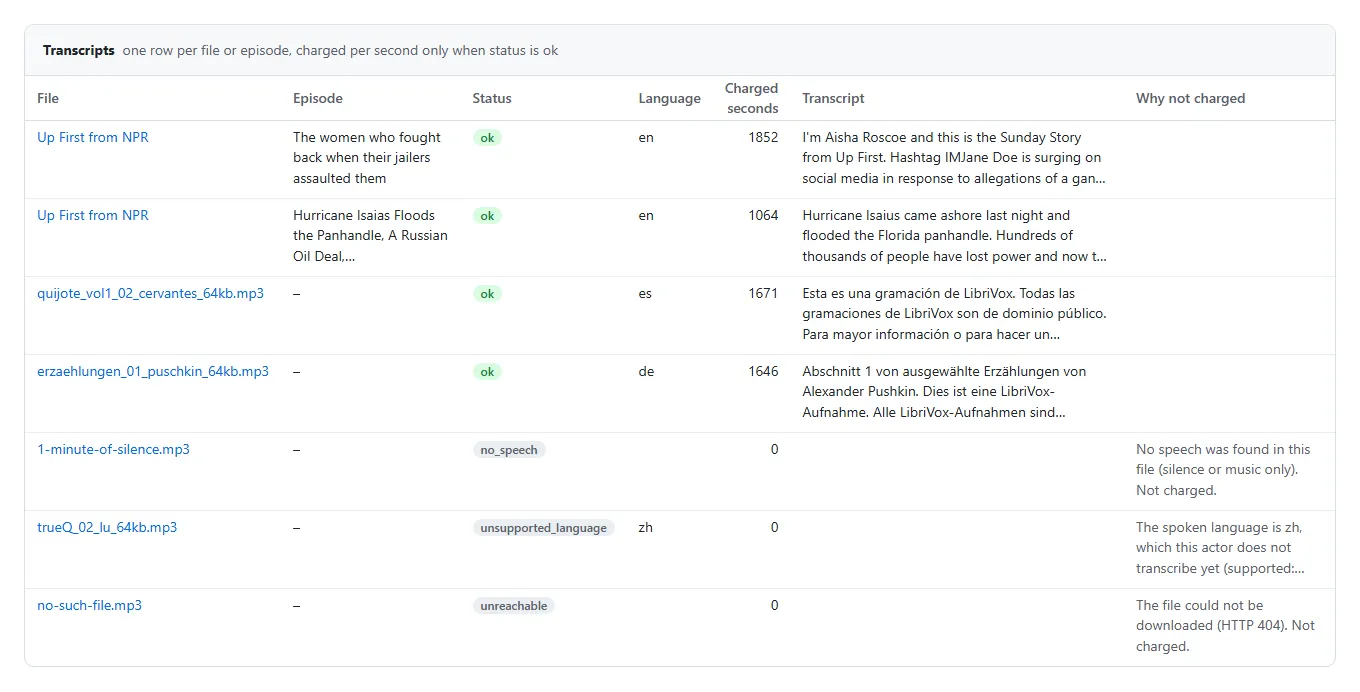
| outcome | status | charged |
|---|---|---|
| a transcript was produced | ok | yes, per second of audio |
| the file has no speech (silence, music only) | no_speech | no |
| the spoken language is not English, Spanish or German | unsupported_language | no |
| the download failed (404, 403, DNS, timeout after one retry) | unreachable | no |
| the link is not audio or video, or the file has no audio track | undecodable | no |
the file is longer than your maxFileMinutes | too_long | no |
| the file would push the run past your maximum cost per run | skipped_budget | no |
| the Actor hit an error of its own on that file | failed | no |
Every row that is not ok has an error field that says what happened in one plain sentence. The
other files in the run carry on.
What you get: podcast transcript and audio to text
One dataset row per file:
feedTitle,episodeTitleandpublishedAtare filled for episodes that came from an RSS feed.chargedSecondsis exactly what that file cost you, in seconds. It is 0 on every row that is notok.- Formats you leave out of
outputFormatsarenull, so every row has the same fields.
The run opens on a Transcripts table (status, language, duration, charged seconds, text). A Subtitles view has the SRT and VTT, and the full JSON has everything.
Input: podcast feeds and MP3 to text
| field | default | what it does |
|---|---|---|
urls | – | direct links to audio or video files: mp3, m4a, wav, ogg, opus, flac, mp4, webm and anything else ffmpeg reads |
rssFeeds | – | podcast feed URLs; each episode's audio file becomes one row |
maxEpisodesPerFeed | 5 | how many of the newest episodes to take from each feed |
language | auto | auto, en, es or de; setting it skips detection |
outputFormats | all four | any of text, segments, srt, vtt |
maxFileMinutes | 180 | longer files come back as too_long, free |
Give at least one URL or feed. Duplicate URLs are transcribed once.
Languages for audio to text transcription
English, Spanish and German, detected automatically or set by you. Detection listens to samples spread across the whole file, so an English ad at the start of a Spanish podcast does not switch the transcript to English.
Any other language is detected within seconds and returned as unsupported_language, free of
charge. We add a language once we have measured good transcripts for it at this price.
Speed and file length
Transcription runs about 9 times faster than real time: a one-hour episode takes about 7 minutes. Files up to 180 minutes are accepted; we test with a 130-minute podcast episode.
Files run one after another. For a long batch, split it across runs or raise the run timeout.
Use it from Make, n8n and Zapier
The Actor ships a dataset schema, so every field arrives named and typed in Make's and n8n's Apify
modules, with segments as a list you can iterate.
- Make: "Run an Actor" fills Input JSON from the defaults. Edit the
urlsorrssFeedsthere. - n8n: the Apify node's "Run an Actor" leaves Input JSON as
{}. Type your input there, for example{"urls": ["https://…/episode.mp3"]}, or the run has nothing to transcribe. The node offers 1024 MB of memory; Apify raises it to this Actor's 4096 MB minimum on its own.
What this cannot do
- Names and rare words are often misspelt. Whisper's
basemodel spells names by how they sound. Expect people, brands and places to need a proofread. - YouTube, TikTok, Instagram and other page links do not work. The URL must point at the media
file itself. A web page URL comes back as
undecodable, free. - No speaker labels. The transcript does not say who is talking.
- No translation. Each file is transcribed in the language it is spoken in.
- One language per file. A file that switches between languages is transcribed as one language.
- Three languages for now: English, Spanish, German.
Pricing
$0.00013 per second of transcribed audio, charged once per ok file, rounded to the nearest
second. Nothing else is charged.
| audio | cost |
|---|---|
| 10 minutes | $0.08 |
| 30-minute episode | $0.23 |
| 1-hour episode | $0.47 |
| 5 episodes × 45 minutes | $1.76 |
To cap a run, set its Maximum cost per run. Before transcribing each file, the Actor checks
whether that file's length fits under what is left. A file that would not fit is returned as skipped_budget,
free, and shorter files after it can still run. $1 covers about 128 minutes of audio.
FAQ
How do I generate a podcast transcript? Give the Actor a podcast RSS feed and choose how many newest episodes to transcribe.
Can I convert an MP3 to text?
Yes. Give it a direct MP3 file link. The Actor returns the transcript in text.
Which languages does it support? English, Spanish and German, either detected automatically or set in the input.
Can I use a YouTube or Instagram page link? The Actor requires a direct audio or video file link. Podcast RSS feeds also work.
Does it identify speakers? The transcript has no speaker labels.


