

Public Tenders API: EU TED, Find a Tender, Contracts Finder
Pricing
from $3.20 / 1,000 notice returneds
Public Tenders API: EU TED, Find a Tender, Contracts Finder
Public tenders API: EU tenders (TED) and UK tenders (Find a Tender, Contracts Finder). Open tenders and contract awards in one schema, no source API key. Filter by CPV, country, NUTS, value, deadline, keywords. Daily tender alerts. Not affiliated with the EU, TED, Find a Tender or Contracts Finder.
Pricing
from $3.20 / 1,000 notice returneds
Rating
0.0
(0)
Developer

Your Evenings
Maintained by CommunityActor stats
0
Bookmarked
2
Total users
1
Monthly active users
4 hours ago
Last modified
Categories
Share
Public Tenders API gives you EU tenders from TED and UK tenders from Find a Tender and Contracts Finder in one filterable dataset: open tenders, contract awards and contract changes. No TED or UK government API key is needed (you only need your Apify account). You can filter by CPV code, buyer country, NUTS/ITL region, value in EUR, deadline, buyer and keywords. Turn on monitor mode and schedule a daily run to get tender alerts for new and changed notices only.
Not affiliated with the EU, TED, Find a Tender or Contracts Finder. This is an independent Actor by Your Evenings Ltd, not an official EU or UK government product. It isn't affiliated with or endorsed by the European Union, the Publications Office of the European Union, TED (Tenders Electronic Daily), Find a Tender, Contracts Finder, the Cabinet Office or Crown Commercial Service. It uses the data these services publish for reuse under their open licences (see "Attribution and licences").
What is the Public Tenders API?
It's an Apify Actor that reads three official public procurement APIs live and returns every notice in the same normalised row: buyer, CPV, NUTS/ITL region, value (with a EUR conversion), deadline, lots and awards.
- EU and UK in one schema. TED (Tenders Electronic Daily, the EU Official Journal supplement), Find a Tender and Contracts Finder.
- Filters run before you're charged, and you can see how much matched. The run summary shows, for each source, the notices read, matched and returned, and why the rest were filtered out.
- Official open APIs only. No login, no browser and no HTML scraping. Requests are paced at one per second per service.
- Daily alerts for new and changed notices in monitor mode, when you schedule a daily run. Results land in your dataset; the Actor doesn't send emails itself.
- You're told when a source fails, is empty or was cut short. Each case gets a free status row.
- Award rows carry Companies House numbers when the UK notice publishes one (
supplierCompanyNumber).
Who it's for
- Bid and sales teams at public-sector suppliers, in the UK and across the EU.
- Bid writers and public-procurement consultants who watch several sectors or countries for clients.
- Market researchers looking at who buys what, from whom and for how much.
How do I get started?
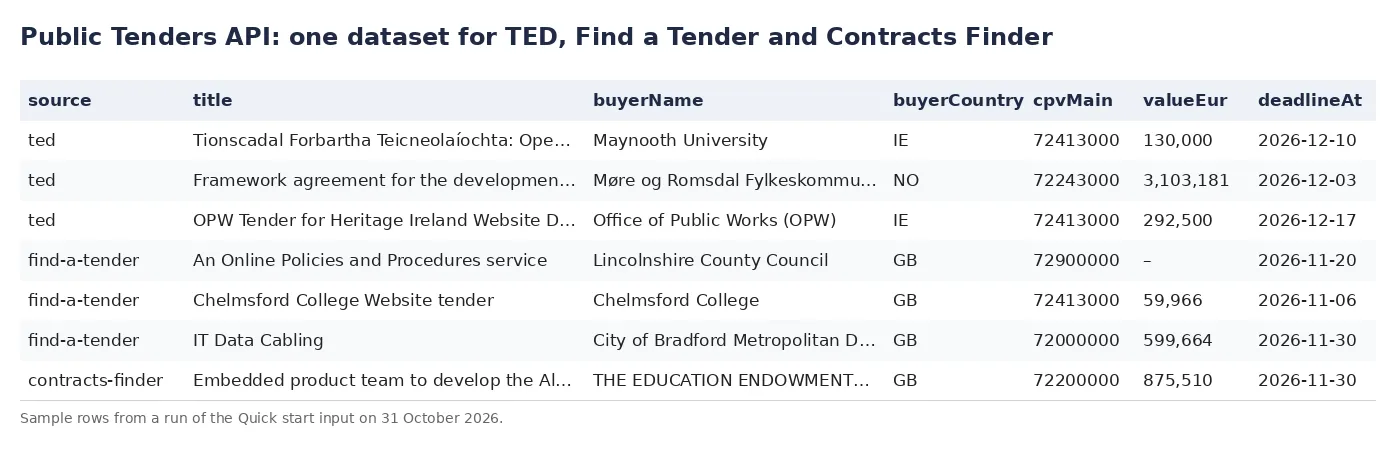
Paste this into the JSON view of the Input tab and press Start. It's also the form's prefilled input, so you can just press Start. It returns open IT-services tenders (CPV 72) published in the last 3 days, up to 30 per source, newest first.
We ran exactly this input on 31 October 2026 and it returned 47 notices: TED 30 (of 360 matching), Find a Tender 16, Contracts Finder 1. At the Free and Starter plan price, that's about $0.19 (see Pricing). Counts change daily with what's published.
What can I use it for?
- A daily tender alert for your bid team. For example, UK IT tenders (CPV 72), EU construction tenders (CPV 45) in chosen countries, or anything matching your keywords. Turn on
monitorModeand schedule a daily run. - Market research on public buyers. Pull a period of notices for a CPV code or region, then compare buyers, values, procedures and regions in a spreadsheet.
- Contract award tracking. Set
noticeStagestoawardto see who won and for how much. UK awards include Companies House numbers when the notice publishes one.
Where does the data come from?
| Source | What | How |
|---|---|---|
| TED | Notices in the Supplement to the Official Journal of the EU: EU, EEA and other buyers | TED Search API v3, anonymous, with iteration pagination. Reads up to maxScanPerSource notices (default 20,000) |
| Find a Tender | UK above-threshold notices and Procurement Act 2023 notices | Find a Tender OCDS release packages API |
| Contracts Finder | UK lower-value opportunities and awards (England and some UK-wide buyers) | Contracts Finder OCDS search API |
Currency. Values in other currencies are converted to EUR at the European Central Bank's latest euro reference rates (valueEur, rounded to whole euros). The original amount and currency stay on the row.
Pace and limits.
- Request rate: one request per second per service.
- TED: at most 60 requests a minute, well inside the 700 a minute that TED's fair usage policy allows.
- Find a Tender: its
Retry-Afterheader is honoured. It can be slow, so each UK source has a time budget (maxSecondsPerSource, default 210). - Contracts Finder: a "wait 5 minutes" response stops that source with a free
source_errorrow. - If the time budget runs out: notices are read newest first, so only the oldest part of the window is skipped, and a free
scan_truncatedrow tells you from when.
Input
All fields are optional. With no input, you get open tenders (stage tender, deadline today or later) published in the last 7 days from all three sources, up to 50 per source.
Sources (sources)
ted, find-a-tender, contracts-finder. Default: all three.
Notice stages (noticeStages)
planningtender: open opportunities (default)awardcontract: modifications and terminations
Keywords (keywords, keywordMode)
Whole words or phrases, matched in the title, description and lot titles, accent-insensitive. Use any (default) or all. The matches are listed in matchedKeywords.
CPV codes (cpvCodes)
CPV prefixes, 2 to 8 digits. For example, 72 = IT services and 45 = construction.
Buyer countries (countries)
ISO-2 codes (DE, IE, GB). The UK sources are skipped when GB isn't listed.
Regions (nutsCodes)
Place-of-performance region prefixes (DE21, UKI). When this is set, notices without a region code are filtered out. Contracts Finder often publishes region names rather than codes, so many of its notices drop out of a region filter.
Value in EUR (minValue, maxValue)
When either is set, notices without a value are filtered out. Many TED notices don't publish one.
Publication date (publishedWithinDays, publishedFrom, publishedTo)
A rolling window (default 7 days) or fixed dates. The rolling window counts from each run's date, so a scheduled task always covers the latest days.
Deadline (deadlineAfter, includePastDeadlines)
Tender-stage notices with a deadline before this date (default: today) are filtered out. Notices without a deadline are kept.
Buyer names (buyerNames)
Whole words or phrases in the buyer's name.
SME-suitable only (smeSuitableOnly)
Keeps only notices flagged as suitable for SMEs. The flag comes from Contracts Finder and some Find a Tender notices. TED search doesn't publish it.
Monitor mode (monitorMode, emitBaselineOnFirstRun, stateStoreName)
New and changed notice alerts. See "How do tender alerts work?" below.
Description (includeDescription)
Adds the notice description, up to 4,000 characters.
Contact details (excludeContactDetails)
On by default. See "What about personal data?" below.
Max results (maxResults)
The maximum number of notice rows per source, newest first. Default 50; 0 means up to 50,000.
Safety caps (maxScanPerSource, maxSecondsPerSource)
Limits on how much of each source a run reads.
Example: UK and Irish IT tenders worth at least €100,000:
What does the output look like?
You get one row per notice (recordType: "notice"), with these fields:
- Source and IDs:
source,sourceUrl,licencenoticeId,ocid(UK),procedureId
- Notice:
stage,noticeType,formType(TED),title,description(optional) - Buyer:
buyerName,buyerId,buyerCountry,buyerWebsite - Classification:
nutsCodes,cpvCodes,cpvMain - Value:
valueAmount,valueCurrency,valueEur - Dates and procedure:
publishedAt,deadlineAt,procedureType - Lots and awards:
lots[]smeSuitable,documentsUrlawards[]: supplierName, supplierId, supplierCompanyNumber, supplierCountry, valueAmount, valueCurrency, date (UK awards also have supplierScale and status)
- Matching and monitor mode:
matchedKeywordschangeType,firstSeenAt,lastSeenAt
- Duplicates:
alsoPublishedOn,duplicateOf - Retrieval:
retrievedAt
Sample rows from a test run of the Quick start input on 22 October 2026 (deadlines shown are from that day's notices):
| Source | Title | Buyer | Country | Main CPV | Value (EUR) | Deadline |
|---|---|---|---|---|---|---|
| ted | Zakup usługi serwisowej SAP Standard Support dla PKP S.A. na okres 24 m-cy | Polskie Koleje Państwowe S.A. | PL | 72000000 | – | 2026-11-05 |
| find-a-tender | Equals Trust - Provision of ICT Managed Services Stage 1 | Equals Trust | GB | 72000000 | 3,578,885 | 2027-02-26 |
| contracts-finder | GDPR Data Audit | Ryde Town Council | GB | 66170000 | – | 2026-10-26 |
Duplicates.
- Repeat releases: only the latest release per notice and stage is returned.
- Cross-posting: a notice on both Find a Tender and Contracts Finder is returned once, as the Find a Tender row, with
alsoPublishedOn. The Contracts Finder copy comes back as a freeduplicatestatus row (up to 200 of these rows per run; all duplicates are counted in the summary).
Free status rows (recordType: "status"): no_matches, source_error, source_empty_or_stale, scan_truncated, duplicate, baseline_saved. The SUMMARY record in the key-value store has the per-source counts.
How do tender alerts work?
Set monitorMode: true and schedule the task to run daily. The first run saves the matching notices as a baseline and returns no notices, so no notice charges (only the tiny Actor start fee), unless you set emitBaselineOnFirstRun. After that, each run returns only:
new: a notice you haven't seen before that matches your filtersamended: a later version of a notice you've already hadawarded: an award for a procedure you had at the planning or tender stagecancelled: a UK cancellation or termination
Use a different stateStoreName for each saved search.
Can I call it from code?
Yes. Like any Apify Actor, it runs from the Apify API, the API clients, Make, Zapier or n8n. Here's a run that waits and returns the dataset items:
How much does it cost?
It's priced per event. Prices below are for the Free and Starter plans:
| Event | Price |
|---|---|
| Notice row (each notice, or each new or changed notice in monitor mode) | $0.004 |
| Alert run with matches (monitor mode, once per run that returns at least one notice) | $0.01 |
| Actor start (per GB of run memory, so one charge at the default 256 MB) | $0.00005 |
On the Scale plan a notice row is $0.0036 and an alert run $0.009. On Business and above they are $0.0032 and $0.008.
Status rows, filtered-out notices and duplicates are free.
- Example: a daily monitor with 15 new matches costs 15 × $0.004 + $0.01 = $0.07 a day, plus the Actor start fee.
- Spending cap: set a maximum charge per run, and the Actor stops before going over it.
What about personal data?
- Contact names: this Actor never outputs contact people's names.
- With
excludeContactDetailson (the default):- contact emails and phone numbers are removed from descriptions
- identifiers that are really a phone number or email are dropped
- With it off:
- the buyer's published business contact email is added (
buyerContactEmail), plus the telephone (buyerContactTelephone) on UK notices - descriptions, URL fields and identifiers are returned as published, without the email and phone removal above
- the buyer's published business contact email is added (
Please don't use this Actor to build lists of people.
Attribution and licences
Every row has source, sourceUrl and licence.
- TED:
- © European Union, https://ted.europa.eu.
- Unless otherwise noted, procurement notices in the Supplement to the Official Journal of the EU can be freely reused, for commercial or non-commercial purposes, under the Commission's reuse policy (Commission Decision 2011/833/EU).
- TED's own editorial content is licensed CC BY 4.0.
- The TED logo isn't used.
- Find a Tender and Contracts Finder:
- Contains public sector information licensed under the Open Government Licence v3.0.
- Departmental logos and crests aren't used.
- Exchange rates: European Central Bank euro foreign exchange reference rates.
- Changes: rows are normalised by this Actor (fields renamed and restructured, values converted to EUR, contact details removed by default); they are not the official published notices.
If you republish the data, keep these attribution lines and link to sourceUrl for the official notice.
FAQ
Why do I get fewer TED rows with a value filter? Many TED notices don't publish an estimated value. When minValue or maxValue is set, those notices are filtered out and counted as noValue in the summary.
Does it cover the Scotland, Wales and Northern Ireland portals? Only the notices those buyers publish to Find a Tender or Contracts Finder. Public Contracts Scotland, Sell2Wales and eTendersNI aren't read.
How fresh is it? All three APIs are read live during the run.
Do I need a TED or Find a Tender API key? No. All three APIs are read anonymously.
Feedback
Found a notice that looks wrong or missing? Open an issue on the Actor's Issues tab with a link to the notice.


