

Etsy Rank Checker – SEO Tag Audit
DeprecatedPricing
from $50.00 / 1,000 listing auditeds
Etsy Rank Checker – SEO Tag Audit
DeprecatedStop guessing your Etsy SEO. Paste any shop or listing and see exactly which keywords each listing ranks for and where. Spot the dead tags earning you nothing, plus the relevance-safe tags Etsy already ties to your item. No login, works on any shop or listing.
Pricing
from $50.00 / 1,000 listing auditeds
Rating
0.0
(0)
Developer

Yakugusa Yumitori
Maintained by CommunityActor stats
0
Bookmarked
23
Total users
4
Monthly active users
0.55 hours
Issues response
4 days ago
Last modified
Categories
Share
Etsy Rank Checker — see exactly where your listings rank
You filled all 13 tags. You wrote a keyword-stuffed title. And your listing still isn't on page one. Or worse — it's pulling views and zero sales, and you have no idea why.
Etsy never actually tells you what's working. Shop Manager gives you a pile of impressions and a handful of "search terms" and calls it a day. It won't tell you where you rank for a keyword, which of your tags are earning their keep, or which ones are dead weight.
This does. Paste a shop or a listing link and you get the plain answer for every listing: the keywords it ranks for, what position, the tags that rank for nothing, and the searches Etsy already ties to your item that you forgot to tag.
No login. No connecting your account. No made-up "SEO score."
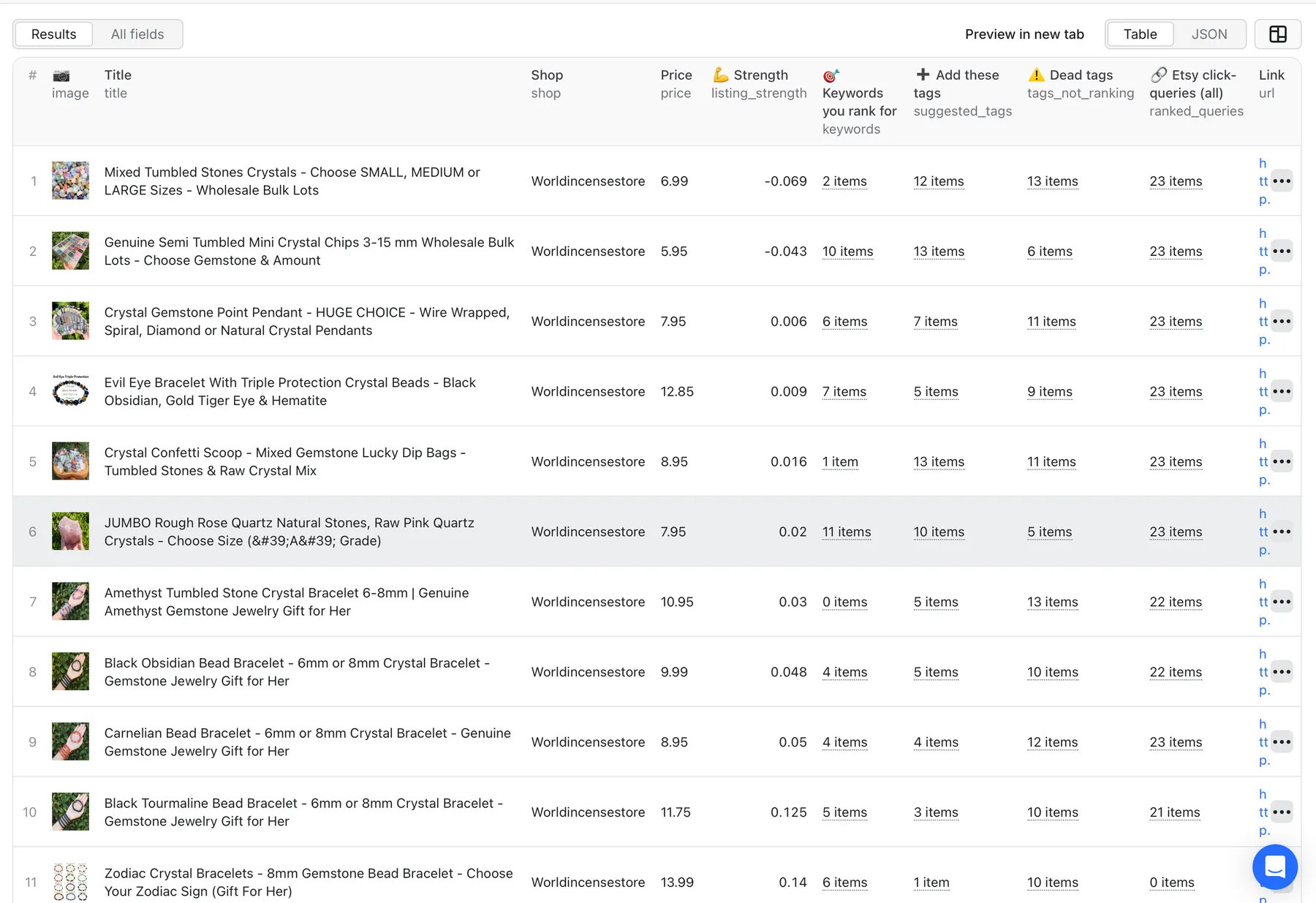
A whole shop at a glance. One row per listing: its strength score, how many keywords it ranks for, the tags to add, the dead ones to cut, and the searches Etsy links to it. Sort it, export it to a spreadsheet, done.
⚠️ Heads-up: the Add these tags and How buyers find you columns only fill in when the "Also show how buyers find each listing" option is turned on — and it is on by default, so you get them out of the box. Only turn it off if you want a faster, rankings-only run (about 2× quicker — see Two speeds below).
How it works
1. Paste a shop name or a listing link — one, a handful, or a whole shop.
2. We check every listing against live Etsy search — the same ranking data behind the real results, not a personalized incognito snapshot.
3. You get back, per listing:
- the keywords it ranks for, with exact position and how many listings it's up against
- tags to add — searches Etsy already ties to your item that you haven't claimed
- the dead tags ranking for nothing, ready to swap out
Two speeds: a quick check vs. the full picture
One toggle decides how much you get back — and how long it takes.
Fast (toggle off) — about 3 seconds a listing. Shows where your existing tags rank, and that's it. Good for a quick "where do I stand?" sweep across a whole shop.
Full (toggle on — the default) — about 12 seconds a listing. Everything above, plus the searches actually driving buyers to your listing and the relevance-safe tags to use instead of your dead ones. If you want to know what's pulling traffic and what to swap in — not just where your current tags sit — this is the mode you want.
Short version: off tells you where you rank; on tells you what to change. A 20-listing shop is about a minute on fast, a few minutes on full.
"But I just check my rank in incognito"
Everybody does this. Open a private window so your own history doesn't skew things, type your keyword, scroll until you spot yourself. Feels rigorous. It's basically useless, and here's why.
Incognito hides your history — not Etsy's personalization. A private window drops your cookies, fine. But Etsy still tailors results by location, currency, language, and device. You're seeing one shopper's view from one spot. Someone two states over sees something totally different.
Etsy re-ranks all day. It runs live A/B tests and reshuffles by time of day, season, and demand. Positions move within minutes. One incognito check is a photo of a moving river.
You can only check one keyword at a time. To really know a listing you'd have to search all 13 of its tags, hunt for your thumbnail each time, note where you land — then repeat that for every listing in the shop. Hundreds of searches. Nobody does it, so nobody actually knows.
You give up after two pages. So you never find out you're sitting at #47. "Didn't see myself" quietly becomes "I don't rank."
And you only ever check your best keyword. You search the one you're proud of, spot yourself, feel optimized, close the tab. Meanwhile twelve dead tags sit there doing nothing.
Incognito can't tell you your position, your competition, or whether Etsy even connects that search to your listing in the first place. You're squinting at one search result. This thing reads the whole scoreboard.
What you actually get
Every column points at the same thing: what to change to sell more.
The keywords you rank for — and where
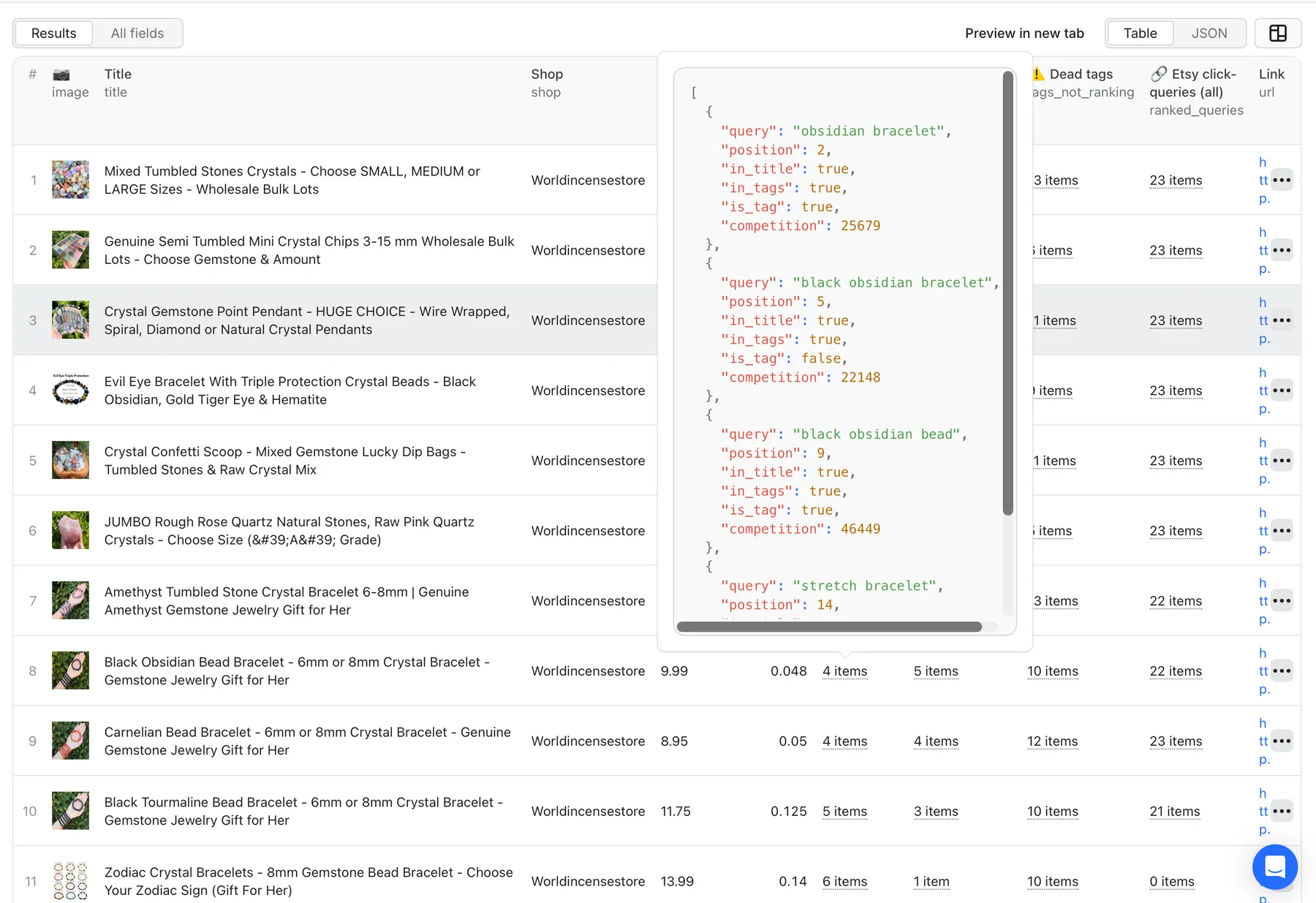
Click a listing's keywords and you get the real breakdown. This Black Obsidian bracelet is #2 for "obsidian bracelet" (against 25,679 other listings), #5 for "black obsidian bracelet," #9 for "black obsidian bead." Each line tells you if the term's already in your title and tags. That's the exact answer incognito will never give you.
What to do with it: if you rank #2 for "bead bracelet," get that exact phrase to the front of your title and into your first tags — doubling down on something you already win is the fastest way up. And if you rank for something that isn't in your title yet? That's free money sitting there. Add it.
Tags to add (the ones Etsy already trusts)
These are searches Etsy already connects to your listing that you never tagged — trimmed to fit the 20-character limit so they drop straight into an empty slot.
Why these instead of some random "high-volume" keyword? Because Etsy's own algorithm already decided they match your item. You're not guessing and hoping. You're picking up matches it handed you.
Dead tags
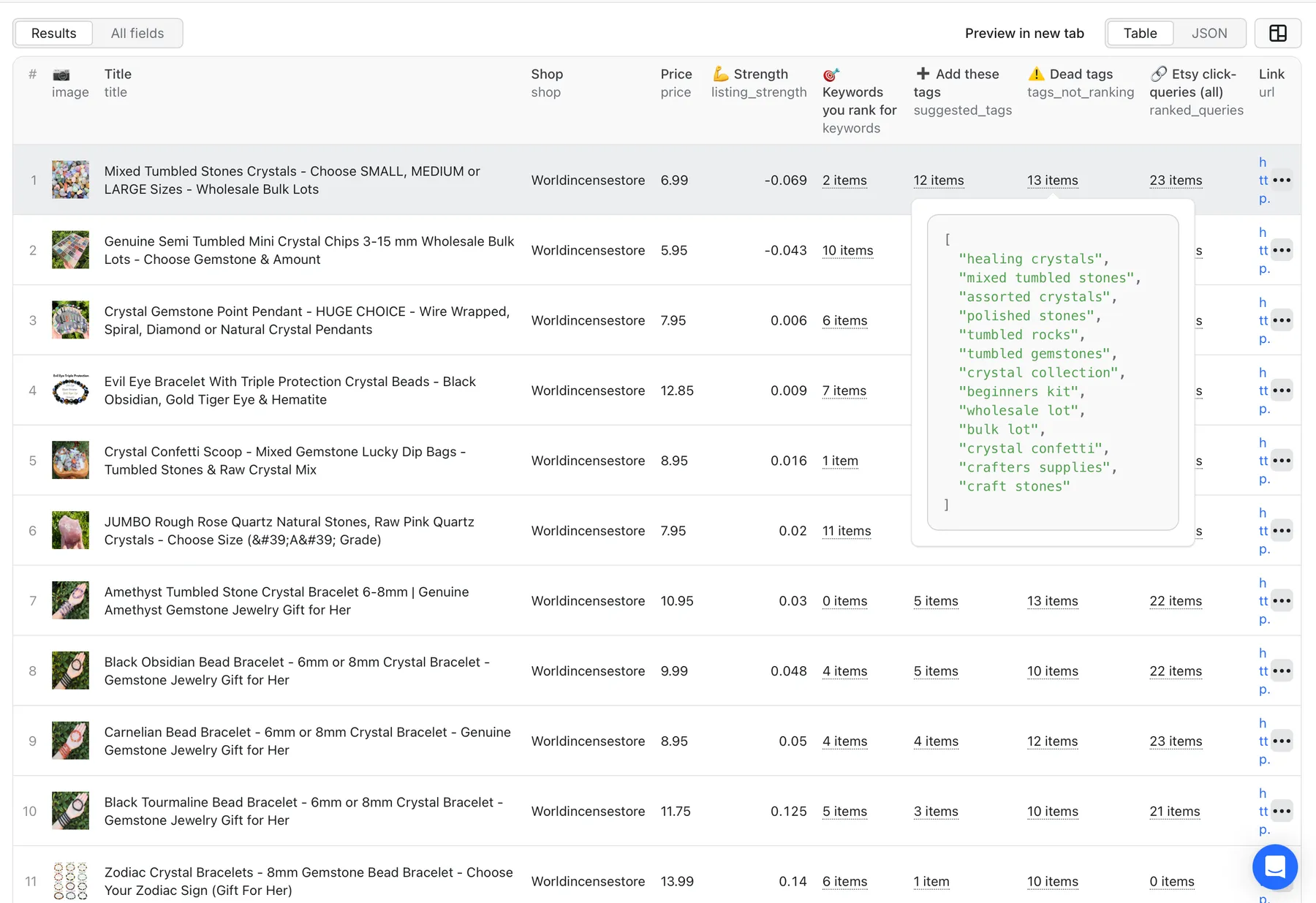
This "Mixed Tumbled Stones" listing has 13 dead tags — "healing crystals," "assorted crystals," "wholesale lot," "craft stones" and the rest — every one ranking for nothing. Thirteen wasted shots at being found.
What to do with it: you get 13 tag slots, that's the whole game, and a dead one is a wasted one. Swap it for a 2–5 word phrase people actually type ("custom leather wallet gift," not "wallet") — ideally one from the add-these list. Long-tail phrases have less competition and pull buyers who already know what they want.
How buyers find you
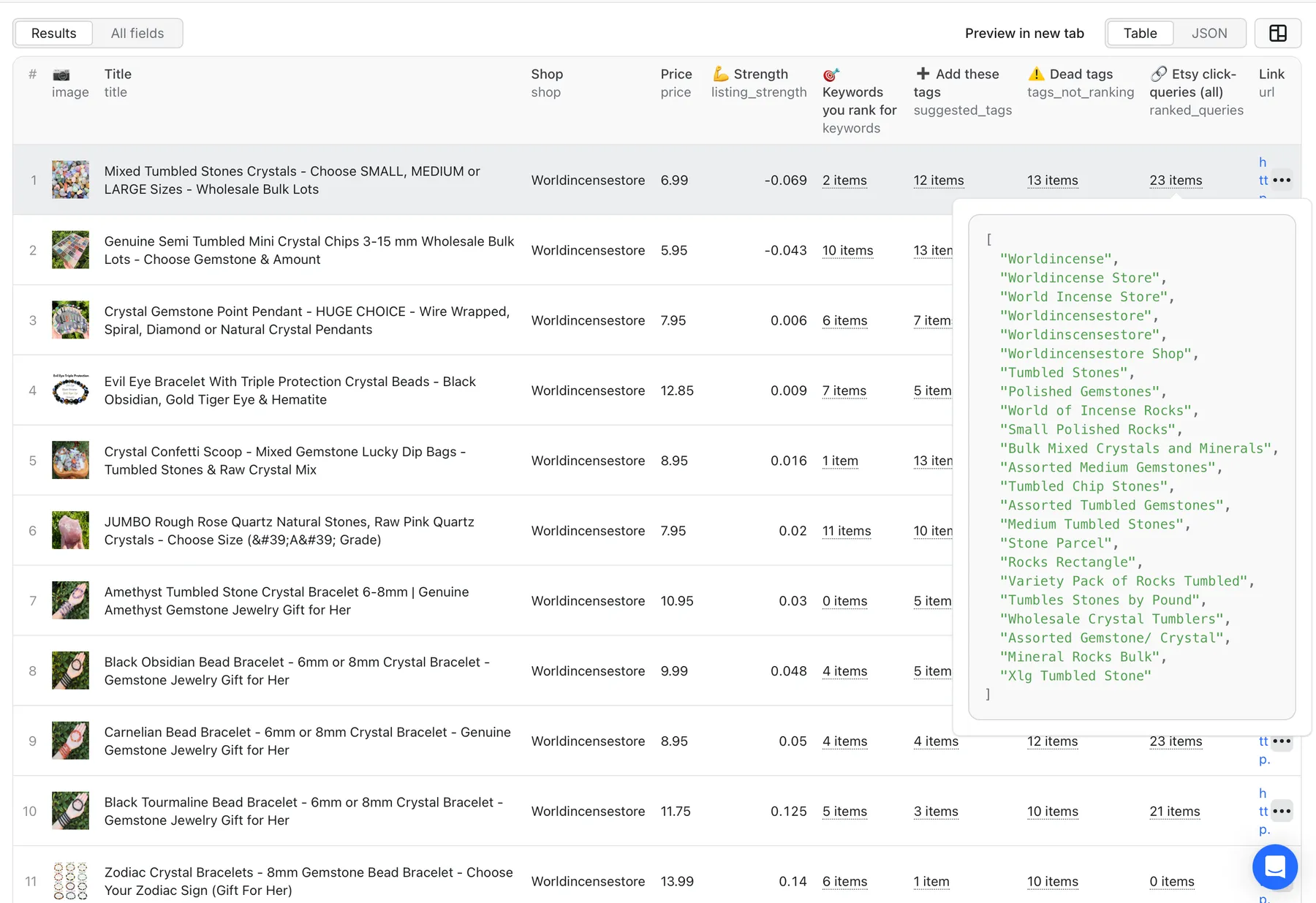
The ~23 searches Etsy ties to this listing — "World Incense Store," "Tumbled Stones," "Bulk Mixed Crystals and Minerals," "Wholesale Crystal Tumblers." This is Etsy telling you, in its own words, what it thinks you're selling.
What to do with it: if Etsy's associating you with phrases you'd never have written, that's your buyers' real language. Work the strong ones into your title and tags so you're matching what people actually type, not what you assume they type.
Strength
Etsy's own strength score for every listing. Run a whole shop and the weakest ones float to the top — so you fix the listings that are actually bleeding first, instead of spreading yourself thin across 200 of them.
What one listing actually returns
Here's the raw output for a single listing — a crystal bracelet that's doing well, ranking #2–3 for its main terms. One object like this comes back per listing (keywords and searches trimmed here so it fits on screen):
Read that like a to-do list:
- It's #2 for "crystal bracelet" against 683,273 other listings — but
is_tagisfalse. It's winning that spot without the phrase even being a tag. Add it and it climbs. - "beaded bracelet" is #2 too, but
in_titleisfalse. Get it into the title. tags_not_rankingis five tags doing nothing ("healing bracelet," "amethyst bracelet"…). Swap them for phrases fromsuggested_tags.- When you run a whole shop you also get a
listing_strengthscore on each row, and the weakest listings sort to the top.
Why keyword-stuffing stopped working
Quick reality check, because it changes how you should use this.
In 2026 Etsy started running an LLM over search that decides whether a listing really matches what someone typed — relevant, sort-of, or irrelevant — and it throws the irrelevant ones out before ranking even happens. (It's in their engineering blog, "How Etsy Uses LLMs to Improve Search Relevance," if you want to read it.)
What that means for you: cramming a popular-but-off-topic keyword into your tags won't help anymore. Etsy reads it, decides it doesn't fit, drops you. This is exactly why those "add these trending tags!" tools can quietly tank a shop.
It's also why every tag this suggests comes from searches Etsy already ties to your listing. It can't push you toward something off-topic, because Etsy already vouched for the match.
A few ways people use it
Views but no sales. You run your listing and find you're #1 for "boho wall art" — except you sell minimalist prints. Wrong buyers, wrong search. You rewrite the title around what you actually sell, and the clicks start converting.
A listing that's just invisible. You run it and the dead-tags column lights up with most of your 13 tags. There's your answer. Replace them with the relevance-safe ones and you finally start matching real searches.
Sales dropped and you can't tell where. Run the whole shop, sort weakest-first, and fix the ten cold listings instead of second-guessing all two hundred.
How to run it
One box. Paste a shop:
…or specific listings:
Mix them if you want. Hit Start. You get a sortable table you can dump to CSV, Excel, or Google Sheets.
There's one toggle — "also show how buyers find each listing." It's on by default; it pulls those ~23 Etsy searches and powers the tag suggestions, and it adds about 5–7 seconds per listing. Flip it off when you just want the rankings fast.
Common questions
How do I check what keywords my Etsy listing ranks for? Paste the listing link. You'll see every keyword it places for and its exact position — no Etsy login, works on any public listing, yours or a competitor's.
Is checking my rank in incognito accurate? Not really. It removes your own history, but Etsy still personalizes by location, currency, and device, and it re-ranks constantly. A private-window search is one snapshot from one place. This reads Etsy's actual ranking signals across every tag and listing, so you get the real picture.
What are the best tags to use on Etsy? The ones you can actually rank for and that Etsy sees as relevant. The add these tags column gives you exactly that — searches Etsy already ties to your item — and dead tags shows which of your current ones to swap out.
Why am I getting views but no sales? Usually you're ranking for searches that don't quite match your product, so people click and bounce. Check the keywords column — if you're placing for terms that aren't really what you sell, that's the leak.
Why isn't my listing showing up in search? Because the keywords you're targeting aren't ranking. The dead-tags column shows which tags rank for nothing, and add these tags shows relevance-safe ones to claim instead.
How does Etsy search actually work? It matches a shopper's search to your title and tags, ranks by relevance and listing quality, and since 2026 uses an LLM to filter out listings it judges irrelevant. So having the keyword isn't enough — your listing has to genuinely fit. This shows you where you actually land for each one.
My sales dropped — how do I find the problem? Run the whole shop. It sorts weakest-first, and the ranking-keyword count shows which listings went cold. Fix the low-strength, zero-keyword ones first.
Do I need to connect my Etsy account? No. It reads public listing data only, so you can check your own shop or anyone else's.
How long does it take? Roughly 7–13 seconds a listing depending on that toggle. Twenty listings is a few minutes; big shops run in the background on their own.
Not affiliated with, endorsed by, or sponsored by Etsy, Inc. "Etsy" is a trademark of Etsy, Inc. This tool reads public listing data only.


