

BASE Contract Opportunity Qualifier
Pricing
from $42.50 / 1,000 base contract opportunity qualifiers
BASE Contract Opportunity Qualifier
Unofficial, independent Actor; not affiliated with or endorsed by any named source publisher. Qualify official procurement notices against explicit customer capability rules.
Pricing
from $42.50 / 1,000 base contract opportunity qualifiers
Rating
0.0
(0)
Developer

Tim Zinin
Maintained by CommunityActor stats
0
Bookmarked
2
Total users
1
Monthly active users
2 months ago
Last modified
Categories
Share
Qualify official procurement notices against explicit customer capability rules.
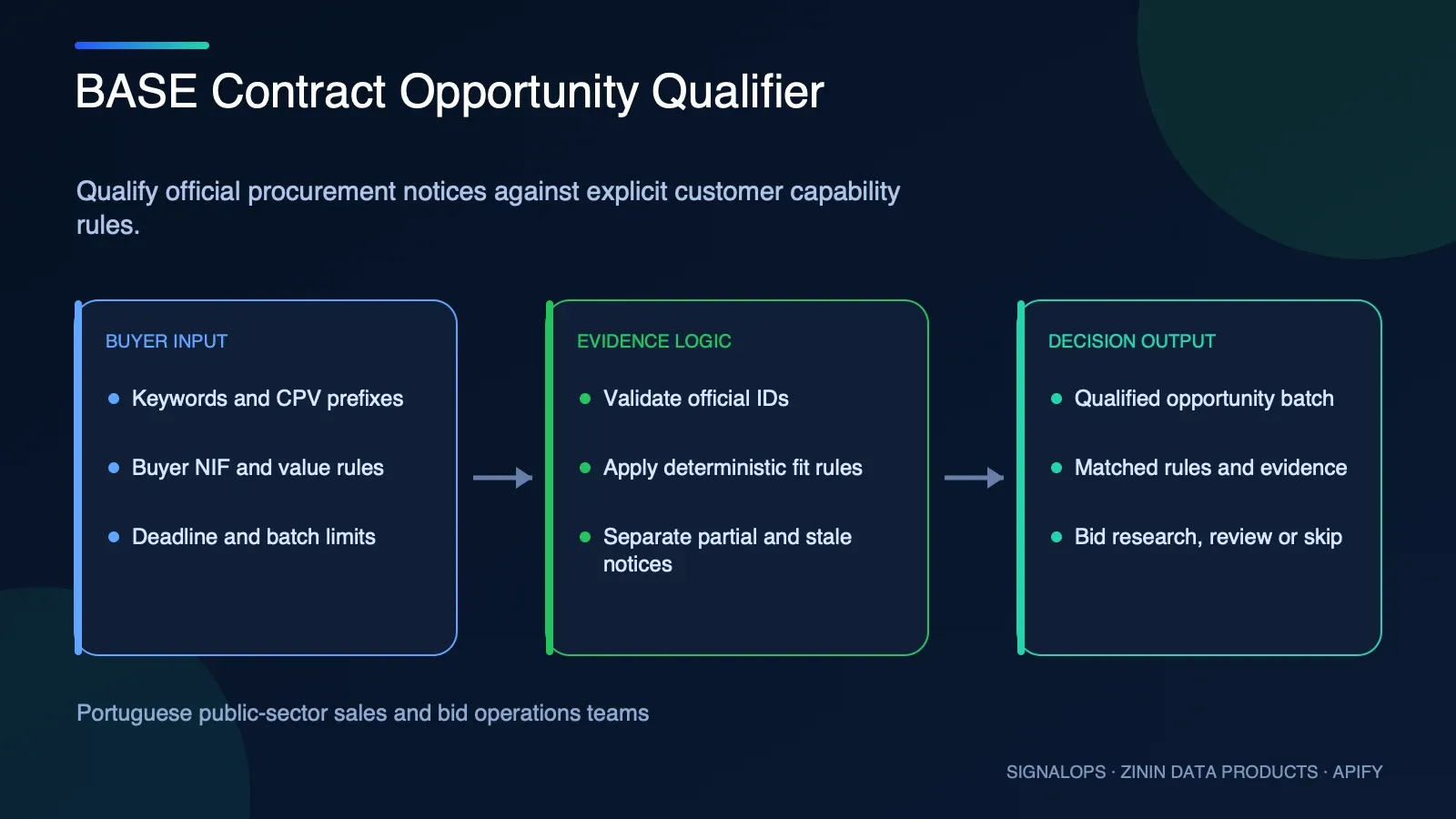
What you get
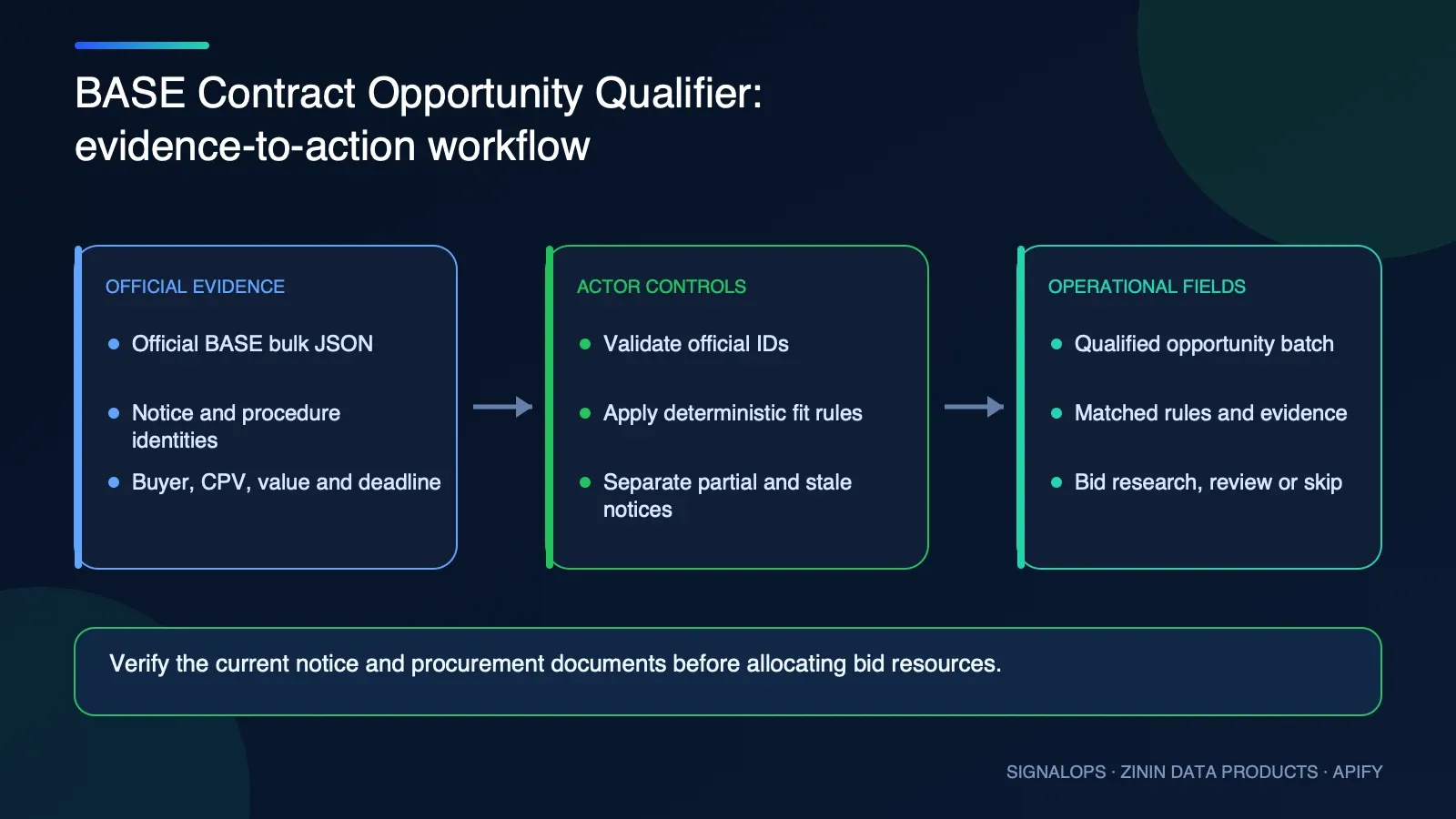
BASE Contract Opportunity Qualifier turns Official BASE bulk JSON, Notice and procedure identities, Buyer, CPV, value and deadline into a bounded qualified procurement opportunity batch. The useful product is not a country-labelled scrape. It is an evidence-to-action unit that can be scheduled, called from an API, or placed inside a monitored operations chain.
A successful row gives you Qualified opportunity batch, Matched rules and evidence, Bid research, review or skip. Its stable identity is based on nAnuncio + IdIncm + canonical revision fingerprint. Customer enrichment is limited to customer keywords, CPV prefixes, buyer NIFs, price and deadline rules. That separation matters: the source supplies observed facts; the buyer supplies criteria; the Actor supplies a reproducible rule application.
Product contract
- Country/source context: Portugal; official-public-domain-bulk.
- Buyer: Portuguese public-sector sales and bid operations teams.
- Primary decision noun: qualified procurement opportunity batch.
- Billable event:
qualified-opportunity-batch. - Price per verified event: $0.05.
- Stable identity: nAnuncio + IdIncm + canonical revision fingerprint.
- Accepted private run:
pvMmTUcsbqcV3RxTOon buildynzQwbcnX4CQAbAOz; Dataset rows 1; measured platform usage $0.000520. - Boundary: Verify the current notice and procurement documents before allocating bid resources.
The evidence chain
- Validate the fixed official/public source route and response semantics.
- Extract the named business identifiers and domain facts rather than arbitrary links or array positions.
- Normalize buyer inputs: Keywords and CPV prefixes, Buyer NIF and value rules, Deadline and batch limits.
- Apply Validate official IDs, Apply deterministic fit rules, Separate partial and stale notices.
- Deliver Qualified opportunity batch, Matched rules and evidence, Bid research, review or skip with source receipt and disclaimer.
- Link the Dataset delivery to the named PPE event and reconcile the run in OUTPUT.
The Actor does not convert an HTTP 200 response into a billable row by default. Source-specific type, marker, identity, row-count, unit, chronology, and completeness checks run before a decision can be delivered.
Who uses it
The primary users are Portuguese public-sector sales and bid operations teams. They usually have a concrete operational question: which item needs review, where an observed benchmark differs from policy, whether an official change deserves routing, or how to prioritize a bounded set without losing the supporting evidence.
Good fit
Use this Actor when the question can be expressed using Keywords and CPV prefixes, Buyer NIF and value rules, Deadline and batch limits and the intended downstream states align with Qualified opportunity batch, Matched rules and evidence, Bid research, review or skip. A good workflow can name its human owner, evidence-retention rule, acceptable source period, and response to monitor/review/action outcomes.
Not a good fit
Do not use it as a general-purpose crawler, unrestricted lead database, professional opinion, safety guarantee, credit or eligibility decision, valuation, or proof of customer intent. Do not expand the fixed source boundary with arbitrary URLs, authenticated pages, personal accounts, or silent residential-proxy fallback.
How to run
The workflow below belongs to execution: it maps the validated evidence chain into a run, reconciliation, and downstream automation.
Apify Console
- Open the Actor Input tab.
- Start from the bounded public example.
- Replace the durable
requestIdormonitorIdonly when you are creating a genuinely new operation. Keep it unchanged for safe retries. - Review source-specific criteria, thresholds, and maximum total charge.
- Run the Actor.
- Read both Dataset and KVS
OUTPUT. Dataset contains item evidence; OUTPUT contains delivery, payment, withholding, and replay truth.
Exact accepted private-canary input
The following input was read back from Apify KVS INPUT for accepted run pvMmTUcsbqcV3RxTO. Its canonical SHA-256 is 95d24f3da7ca9758dc5db7ae9e1f21872ddc6e784c27a351e5c8b78ef09e9296. IDs are synthetic campaign identities, not secrets.
API start
A successful POST only proves that a run was created. Always follow the returned run ID, wait for a terminal state, then read Dataset and OUTPUT. Do not resend an ambiguous POST with a new identity.
Scheduling
Schedule according to the upstream publication cadence, not an arbitrary high-frequency polling loop. Retain the same monitor identity for change products. For one-shot decision products, use a new request identity only for a new buyer decision, criteria set, or source observation that should be independently billed.
Pricing
This Actor uses Pay Per Event. The named result event is qualified-opportunity-batch, priced at $0.05 per verified qualified procurement opportunity batch. Apify also applies its standard Actor start event according to the published pricing record and memory rules.
What is paid
A result event is charged only when the corresponding verified Dataset row or batch is delivered through linked PPE delivery. The runtime checks the live pricing contract before work, compares both the Apify platform cap and customer input cap, and refuses a result it cannot afford.
What is free at result level
errorpartialduplicatewithheld
Baselines for stateful monitors are free. A duplicate committed request is free. A pending/uncertain claim is withheld rather than re-delivered. Source validation failures, zero qualifying decisions, and budget stops do not masquerade as paid successes.
Accepted economics evidence
Accepted run pvMmTUcsbqcV3RxTO reports usage $0.000519622 and event counts:
This is evidence for that bounded canary, not a promise of future cost, speed, volume, margin, or savings. Source size, platform pricing, memory, and result count can change. Use maxTotalChargeUsd and monitor your own runs.
Input contract
The Input schema rejects unknown fields. Every required field, enum, pattern, minimum, maximum, array bound, and description is part of the public contract. Do not rely on undocumented coercion.
| Field | Type | Required | Default | Bounds | Meaning |
|---|---|---|---|---|---|
| requestId | string | yes | none | pattern ^[A-Za-z0-9_-]{8,64}$ | Stable idempotency key without personal data. |
| year | integer | yes | none | min 2012; max 2100 | Annual anunciosYYYY.json resource to discover in the current official catalogue. |
| asOfDate | string | yes | none | pattern ^\d{4}-\d{2}-\d{2}$ | Explicit YYYY-MM-DD date used for deterministic deadline checks. |
| keywords | array | yes | none | minItems 1; maxItems 20 | At least one keyword must match notice, buyer, CPV, contract type or lot text. |
| excludedKeywords | array | no | [] | maxItems 20 | Any match removes the notice. |
| cpvPrefixes | array | no | [] | maxItems 20 | Optional numeric prefixes from 2 to 8 digits; when supplied at least one must match. |
| buyerNifs | array | no | [] | maxItems 50 | Optional exact nine-digit public entity NIF allowlist. |
| minPriceEur | number | no | 0 | min 0 | Notices with a known price below this are excluded. |
| maxPriceEur | number | no | 1000000000000 | min 0 | Notices with a known price above this are excluded. |
| minScore | number | no | 40 | min 0; max 100 | Transparent score from 0 to 100. |
| maxResults | integer | no | 10 | min 1; max 20 | Maximum rows embedded in one paid batch. |
| maxTotalChargeUsd | number | yes | 1 | min 0.005; max 100 | Maximum total run charge in addition to the platform cap. |
Input design rules
- IDs are idempotency controls, not labels to randomize on every retry.
- Thresholds must express an operational policy that a reviewer understands.
- Customer facts remain customer facts; the Actor does not pretend the source verified them.
- Lists are bounded to protect source terms, runtime, Dataset size, and customer spend.
maxTotalChargeUsdis a customer-side ceiling; the platform run option is authoritative when stricter.- Secrets do not belong in source URLs, criteria text, Dataset fields, or README examples.
Validation before automation
Run one bounded Console example, inspect every Dataset field and OUTPUT, then create the schedule or webhook. If the decision would cause a consequential action, require human approval after the Actor and before the action.
Real happy, partial, and failure output
Accepted Dataset example
The following is an exact Dataset example captured from accepted run pvMmTUcsbqcV3RxTO; Dataset SHA-256 is 3bf8733cc30968026eb3199dcfcf38e3f5e7706b382f04f31a637b10121a21fe.
Accepted terminal OUTPUT
This exact KVS OUTPUT was captured from the same accepted run; OUTPUT SHA-256 is 4b06c651c9e433611c340817baa105fdfdac5c2854a2a14805a40b6cd449b6bb.
Partial contract shape
The runtime uses a free partial/withheld state when source completeness or delivery certainty is insufficient. This is a contract illustration, not claimed as an additional accepted run:
Failure contract shape
A bounded source or input failure is free at result level and never claims replay safety unless the runtime can prove it. This is a contract illustration:
Reading terminal truth
deliveredmust reconcile to Dataset rows.paidmust reconcile to billable rows and the named event count.withheldsignals that a row or operation was intentionally not repeated or delivered.replaySafeis true only for states the runtime can safely replay.publicationAuthorizedis a release boundary, not a customer decision field.
Field dictionary
Dataset
| Dataset field | Type | Operational meaning |
|---|---|---|
| schemaVersion | string | Verified schemaVersion field in the accepted qualified procurement opportunity batch row. |
| product | string | Verified product field in the accepted qualified procurement opportunity batch row. |
| country | string | Verified country field in the accepted qualified procurement opportunity batch row. |
| stableId | string | Verified stableId field in the accepted qualified procurement opportunity batch row. |
| decision | string | Verified decision field in the accepted qualified procurement opportunity batch row. |
| year | integer | Verified year field in the accepted qualified procurement opportunity batch row. |
| asOfDate | string | Verified asOfDate field in the accepted qualified procurement opportunity batch row. |
| matchedCount | integer | Verified matchedCount field in the accepted qualified procurement opportunity batch row. |
| returnedCount | integer | Verified returnedCount field in the accepted qualified procurement opportunity batch row. |
| opportunities | array | Verified opportunities field in the accepted qualified procurement opportunity batch row. |
| source | object | Verified source field in the accepted qualified procurement opportunity batch row. |
| attribution | string | Verified attribution field in the accepted qualified procurement opportunity batch row. |
| disclaimer | string | Verified disclaimer field in the accepted qualified procurement opportunity batch row. |
| baseline | boolean | Verified baseline field in the accepted qualified procurement opportunity batch row. |
| billable | boolean | Verified billable field in the accepted qualified procurement opportunity batch row. |
Cross-product evidence fields
- stableId — domain identity derived from nAnuncio + IdIncm + canonical revision fingerprint; never a source array position.
- source — route, official IDs, period, byte/hash receipt, and retrieval time needed to audit the observation.
- action — the explicit routing result after applying buyer criteria to validated source facts.
- criteriaSha256 — integrity fingerprint for normalized criteria; it is not a score.
- baseline — true only when a stateful monitor stores its first comparable snapshot for free.
- billable — true only when the row is eligible for the named linked delivery event.
- attribution/disclaimer — reuse credit and decision boundary that downstream systems should retain.
KVS OUTPUT
OUTPUT is the authoritative run-level receipt. It should be stored beside a workflow execution ID. It does not replace Dataset evidence, and Dataset evidence does not replace OUTPUT billing/replay truth. A robust integration rejects mismatched counts rather than guessing.
Evidence and boundaries
Evidence preserved
The adapter retains the official identity and observed facts required for qualified procurement opportunity batch. It also retains source URL/route, source period or publication identity, retrieval timestamp, response or release hash, normalized criteria fingerprint, and the exact action reason exposed by the domain adapter.
Semantic source validation
The source contract is official-public-domain-bulk on route direct. Validation is domain-specific: expected content type, fixed host/path or official catalog relationship, required identifiers, bounded bytes, structural fields, chronology, duplicate identity, and semantic error bodies are checked before delivery. An upstream login page, generic app shell, consent page, empty report, or malformed file must fail closed.
Security boundary
Network destinations are fixed to approved official/public hosts. Redirects are either disabled or independently revalidated. DNS and address checks reject local/private targets. Responses are streamed under declared byte limits. Buyer input cannot turn the Actor into SSRF, an open proxy, an authenticated crawler, or a credential relay.
Interpretation boundary
Verify the current notice and procurement documents before allocating bid resources. The Actor reports observed evidence plus a deterministic rule application. It does not prove causality, future behavior, legal status beyond the cited publication, quality, solvency, safety, intent, or permission to contact.
Privacy boundary
Submit only operationally necessary criteria. Do not provide passwords, access tokens, private correspondence, sensitive personal data, or arbitrary URLs. If the official source exposes public entity facts, retain them only for the documented decision and according to your own legal basis and retention policy.
Decision routing
Route states
- Monitor — evidence is valid but does not cross a review threshold. Store the receipt and wait for the next comparable observation.
- Review — evidence crosses a bounded review rule or needs professional confirmation. Create a queue item with source and factors.
- Action-oriented state — the explicit rule crosses the action threshold. Require the owner and safeguards appropriate to the domain.
- Partial — source completeness is insufficient. Do not interpret missing rows as negative evidence.
- Withheld/uncertain — the runtime will not repeat a potentially delivered item. Reconcile by run ID.
- Failed — no decision claim was made. Fix the input/source boundary or wait for the official source; do not randomize the request ID.
Routing record
Every downstream task should carry stableId, action, factors, source identity, reference period, criteria fingerprint, run ID, Dataset ID, and a link to OUTPUT. This makes it possible to answer “what did we know, which rule ran, and what happened to delivery?” without reconstructing the workflow from logs.
Human review
Human review is not a vague disclaimer. Define the reviewer role, response time, evidence they must inspect, allowed dispositions, and whether a changed source observation is required before action. Keep the reviewer decision separate from the Actor row.
Commercial playbooks
1. Qualification desk
Use Keywords and CPV prefixes, Buyer NIF and value rules, Deadline and batch limits to decide which records deserve analyst time. Preserve the cited source fields beside the action so a reviewer can reproduce why the row was routed.
2. Scheduled monitor
Run on the cadence of the official source, keep the same durable request or monitor identity where the product supports state, and send only verified changes or decision rows downstream.
3. CRM enrichment
Map Qualified opportunity batch, Matched rules and evidence, Bid research, review or skip into evidence fields instead of overwriting customer master data. Keep the source URL, observation period, stable ID, and disclaimer visible.
4. Operational review queue
Treat “review” as a routing state. Assign an owner, retain the evidence receipt, confirm the current source state, and record the human disposition outside the Actor.
5. Portfolio comparison
Run the same bounded criteria over comparable customer items. Compare factors and source periods, not a bare score detached from its evidence and limitations.
6. Audit export
Export Dataset rows and the KVS OUTPUT receipt together. The Dataset explains each delivered item; OUTPUT explains paid, free, withheld, partial, and replay state for the run.
Integration recipes
JavaScript client
Python client
n8n
- Schedule Trigger or Webhook receives the bounded buyer criteria.
- HTTP Request starts the Actor with an Apify credential stored in n8n credentials, never in the input URL committed to source control.
- Wait/Poll follows the returned run ID to terminal state.
- Two HTTP Request nodes read Dataset and OUTPUT.
- Code checks delivered/paid counts, allowed status, stableId, source period, and action.
- Switch routes monitor, review, action, partial, withheld, and failed states separately.
- Destination nodes write to Sheets/CRM/ticketing while preserving evidence and disclaimer.
Google Sheets
Use one sheet for decision rows keyed by stableId, and a second run ledger keyed by runId. Recommended decision columns are source period, action, factors, source URL, criteria hash, observation time, and reviewer disposition. Recommended run columns are Dataset ID, delivered, paid, withheld, replaySafe, usage, and OUTPUT link.
CRM
Create an evidence/enrichment activity rather than replacing the CRM’s authoritative legal name, valuation, risk status, or account owner. Store the source identity and observation date. Route review/action states into a task with a named owner; leave monitor states as timeline evidence unless policy says otherwise.
Webhooks
Use an Apify run-succeeded webhook only as a wake-up signal. Fetch the terminal run, Dataset, and OUTPUT using their IDs, then reconcile. Do not trust arbitrary webhook body fields as the complete decision record, and make the receiver idempotent by run ID plus stableId.
Operating guide
Before launch
- Confirm the official source route and reuse boundary remain current.
- Validate public Input schema descriptions and bounded defaults in the rendered Console.
- Run the small example and retain INPUT, Dataset, OUTPUT, build ID, pricing events, and usage.
- Confirm the source observation period is appropriate for the buyer decision.
- Define downstream owners and allowed dispositions.
- Set a customer cap and monitor actual spend.
Daily or scheduled operation
Check terminal status, Dataset count, OUTPUT reconciliation, source period, source hash change, partial flags, and review backlog. When the source has not published a new comparable period, do not fabricate change by rotating an identity. When a source revision changes a prior period, keep both the revision evidence and customer decision history.
Incident runbook
- Stop automatic consequential actions while preserving monitor collection.
- Identify the exact run, build, INPUT hash, Dataset hash, OUTPUT hash, and source receipt.
- Determine whether the fault is input validation, source availability, semantic source drift, budget, linked delivery, or downstream mapping.
- For an ambiguous POST or pending delivery, reconcile the existing run; never start a replacement with a new identity merely to obtain a clean status.
- For source schema drift, update source-specific fixtures and validators, build a new immutable candidate, and rerun acceptance.
- Restore automation only after a bounded canary and replay test prove the corrected path.
Change management
Treat input/output schemas, identity basis, decision rules, source URLs, legal boundary, and pricing noun as product contracts. Version changes deliberately. A README-only edit must not silently redefine runtime behavior, and a runtime change must update examples and field dictionary before release.
Quality checklist
For this product the release gate verifies: Keywords and CPV prefixes, Buyer NIF and value rules, Deadline and batch limits; Official BASE bulk JSON, Notice and procedure identities, Buyer, CPV, value and deadline; Validate official IDs, Apply deterministic fit rules, Separate partial and stale notices; and Qualified opportunity batch, Matched rules and evidence, Bid research, review or skip. It also checks private candidate provenance, exact build source, PPE configuration, bounded accepted run, free error/duplicate behavior, replay and concurrency safety, two immutable diagrams, README length/sections, rendered Store/Input pages, and all-20 wave balance.
FAQ
Is this a generic country scraper?
No. It is the BASE Contract Opportunity Qualifier, designed around qualified procurement opportunity batch and the named official/public source contract. Geography explains the source, not the product category.
Does it crawl accounts or private pages?
No. The implementation is pinned to the source routes documented below. It does not log in, bypass an account, collect messages, or broaden itself to arbitrary customer URLs.
Can a customer supply an arbitrary URL?
No. Source hosts and paths are fixed or derived only through bounded official catalog routes. Buyer inputs select criteria and customer facts; they do not turn the Actor into an open proxy.
What is the primary billable unit?
The single pricing noun is qualified procurement opportunity batch, charged through the named event qualified-opportunity-batch only when a verified billable Dataset item is linked to delivery.
Are errors charged as result events?
No. The contract identifies error, partial, duplicate, withheld as free result states. Apify platform start charges are separate and visible in the run pricing record.
What makes an ID stable?
The identity basis is: nAnuncio + IdIncm + canonical revision fingerprint. Mutable ranking, source position, or array offset is not treated as the business identity.
Is the score a random hash?
No. The production adapter parses named source fields and applies the explicit rules described in the output. Hashes are used for integrity, criteria fingerprints, and idempotency—not as business scores.
Can I treat an action as a professional conclusion?
No. Verify the current notice and procurement documents before allocating bid resources.
How fresh is the data?
Freshness follows the official source and the observation/reference period in the Dataset row. The Actor does not invent a real-time claim when the upstream source is monthly, daily, or a published report.
Why preserve a source hash?
It proves which response or release was used and helps distinguish a changed upstream publication from a changed customer criterion. It does not replace the official source URL.
What happens on an upstream HTML challenge or error page?
Semantic validators reject the body before decision delivery. A 2xx status alone is not enough; required columns, identifiers, counts, content type, and source-specific markers must pass.
Does this require a local proxy?
The accepted product route is the route in the contract: direct. A proxy is never a silent fallback and cannot change a legal or reuse boundary.
How do retries work?
Reuse the same durable request/monitor identity. A committed request returns a free duplicate state; an uncertain pending delivery is withheld rather than repeated blindly. Inspect OUTPUT before authorizing any new request ID.
Can two concurrent runs double-deliver?
The runtime claims a tenant-scoped durable operation before linked delivery. A competing claim is returned as duplicate or withheld. The release gate separately stress-tests this behavior before publication.
Where is the authoritative run summary?
KVS record OUTPUT. Dataset rows carry item evidence; OUTPUT carries run-wide counts and replay safety. Store both when the workflow needs auditability.
Can I remove the disclaimer downstream?
Do not. Preserve attribution, the product disclaimer, source URL, reference period, and the human-review boundary in any CRM, report, or webhook payload.
Does the Actor predict the future?
No. It converts observed official/public evidence and customer criteria into an operational benchmark, monitor, or routing decision. It is not marketed as a forecast unless the product contract explicitly says so—which this one does not.
Does it contain personal data?
The product scope is limited to the documented public/aggregate fields and buyer-supplied operational criteria. Do not submit secrets or unnecessary personal data. Review Dataset examples before connecting another system.
How should I choose thresholds?
Start with the bounded public example, compare decisions against your own review policy, and change one rule at a time. The Actor exposes Qualified opportunity batch, Matched rules and evidence, Bid research, review or skip so threshold effects remain visible.
Why is publicationAuthorized false in canary OUTPUT?
Private acceptance runs deliberately hard-code the publication boundary. Public release is a separate all-20 transaction after source, billing, replay, visual, Store, and anonymous-page gates pass.
What sources are contacted?
https://dados.gov.pt/api/1/datasets/66d72fbc58cd7a63dae28712/
Can n8n or Make call it?
Yes. Start a run through the Apify API, wait for terminal status, read Dataset items and OUTPUT, then branch on explicit action/status fields. Never branch only on HTTP 201 from the run-start request.
Can I write results to Google Sheets?
Yes. Use stableId as the row key, source reference period as the observation column, and action as a review-routing column. Keep OUTPUT in a separate run ledger sheet.
Can I push into a CRM automatically?
Yes, but write evidence into a dedicated enrichment object or timeline entry. Do not silently overwrite authoritative customer fields, and require human review for consequential actions.
What should support requests include?
Provide the Actor name, run ID, build number, OUTPUT, source receipt/hash, and a redacted input. Never paste the Apify token or another secret.
How do I audit a threshold change?
Keep the old and new normalized criteria, their fingerprints, the same comparable source period, and both decision rows. Explain which of Keywords and CPV prefixes, Buyer NIF and value rules, Deadline and batch limits changed and why the new policy is authorized.
Can I compare different source periods?
Yes, when the domain adapter exposes comparable periods and units. Keep revision and seasonality caveats visible. Never compare ranks or scores across changed definitions without documenting the break.
What if the official source revises history?
Retain both source hashes and observation timestamps. A revision is new evidence, not proof that the earlier Actor run was defective. Re-run only under an authorized identity/revision policy.
What if the source removes a record?
A stateful product reports removal only when the source contract and completeness checks can distinguish a real removal from a partial response. Otherwise the run is partial or withheld.
Should I schedule it every minute?
Usually no. Match the upstream publication cadence and buyer response time. Excess polling adds cost and load without creating fresher official evidence.
Sources and rights
Exact source routes
The implementation uses only the route family defined in contract.json: kind official-public-domain-bulk, host dados.gov.pt, route direct. Source metadata, licence/reuse labels, attribution, and product-specific exclusions must be rechecked at production acceptance because public terms and endpoints can change.
Reuse and attribution
This is an unofficial Actor, not affiliated with or endorsed by any named source publisher. Preserve emitted attribution and official disclaimers. Do not broaden reuse rights to excluded content, accounts, listings, messages, or customer data.
Termos da fonte em português
Search/source terms: dados oficiais, prova da fonte, sinal de decisão, monitorizar, rever, agir.
Os registos da fonte são preservados como prova; o resultado não constitui parecer jurídico, financeiro ou garantia de resultado.
The local-language labels help operators find and verify the official source. The binding product contract, input schema, field dictionary, pricing noun, and safety boundary remain the English Store documentation above.
Product-specific boundary
- Source evidence: Official BASE bulk JSON; Notice and procedure identities; Buyer, CPV, value and deadline.
- Transformation: Validate official IDs; Apply deterministic fit rules; Separate partial and stale notices.
- Delivered fields: Qualified opportunity batch; Matched rules and evidence; Bid research, review or skip.
- Required interpretation: Verify the current notice and procurement documents before allocating bid resources.
- Excluded expansion: arbitrary URLs, account access, messages, private datasets, silent proxy fallback, and claims not supported by cited evidence.
Support evidence
When reporting a source or decision issue, provide run ID pvMmTUcsbqcV3RxTO-style identifiers, build number, redacted INPUT, Dataset and OUTPUT hashes, source period and source receipt. Never send an Apify token, password, private correspondence, or unnecessary personal data.


