

Restaurant Booking Gap Lead Finder for Agencies
Pricing
from $42.50 / 1,000 result founds
Restaurant Booking Gap Lead Finder for Agencies
Analyze submitted restaurant websites for evidence-backed reservation and contact gaps, booking providers, confidence, audit angles, and manual qualification actions.
Pricing
from $42.50 / 1,000 result founds
Rating
0.0
(0)
Developer

Tim Zinin
Maintained by CommunityActor stats
0
Bookmarked
1
Total users
0
Monthly active users
2 days ago
Last modified
Categories
Share
Restaurant Booking Gap Lead Finder
Analyze buyer-submitted restaurant websites for observable booking-channel gaps and return evidence-backed rows only when the submitted restaurant identity or a structured business identity is actually observed. The actor stays on each submitted host, reads public pages, and never invents missing booking evidence.
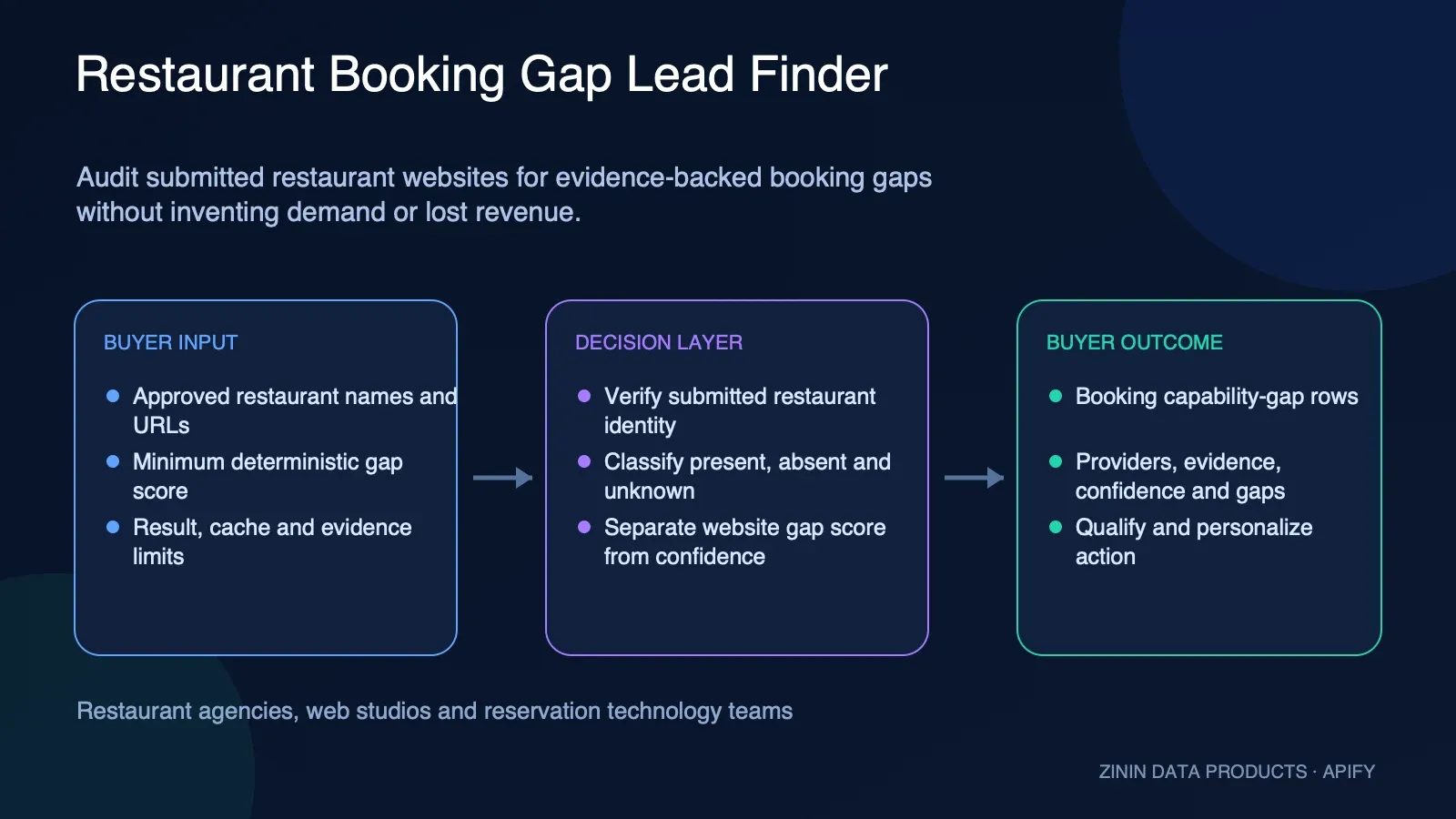
What you get
- One ranked row per qualifying submitted restaurant website.
- Observed booking, booking CTA, reservation schema, chat, contact form, and phone signals.
- Booking providers, public phone values, DOM/text excerpts, and structured identity evidence.
- Robots-first crawling, same-host redirect checks, DNS SSRF protection, body limits, retries, and deadlines.
- Request replay, conflict, freshness cache, compact OUTPUT, and bounded result delivery.
- Runs on Apify: schedule it, monitor it, call it from the API, and export JSON, CSV, or Excel.
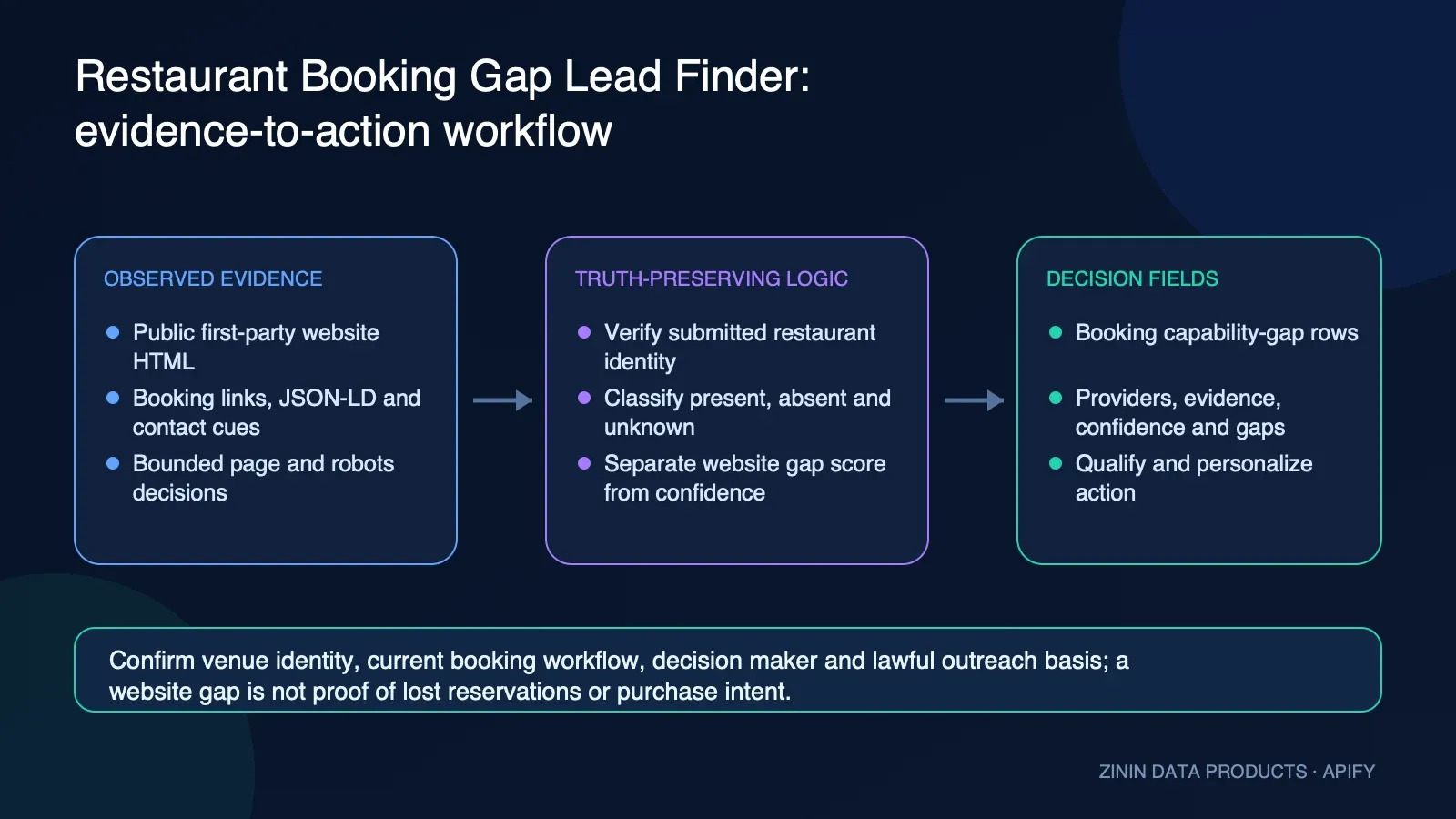
How to run it
- Click Try for free and open the Input tab.
- Submit restaurant records with recordId, name, and an absolute HTTP or HTTPS websiteUrl; address is optional.
- Click Start, then read useful rows from the Dataset and the run envelope from the OUTPUT key-value record.
Pricing
Pay-per-event with the currently published six-tier contract: $0.005–$0.004 per run start and $0.05–$0.04 per useful result, depending on the buyer's Apify tier. There is no monthly seat. Invalid inputs, source failures, generic pages without identity, budget stops, and undelivered rows are not useful-result charges. At the highest published result price, ten useful rows cost $0.50 in result events, plus the tier-specific start event. The live Pricing tab is authoritative.
Input
{"schemaVersion":"1.0","requestId":"restaurant-demo-001","maxResults":10,"freshnessMinutes":60,"detailLevel":"evidence","minGapScore":0,"restaurants":[{"recordId":"restaurant-001","name":"Dishoom","websiteUrl":"https://www.dishoom.com/","address":null}]}
The public prefill uses a zero score threshold so a healthy, evidence-backed observation remains visible in the Dataset. Raise minGapScore after validating your own restaurant cohort.
Output
The accepted 2026-08-09 canary on build zpZQHyUJ2RXW344g8 produced this compact OUTPUT excerpt:
Useful Dataset rows include restaurantName, websiteUrl, bookingProviders, signals, gapScore, evidenceCoverage, evidence, componentEvidence, and sourceMetrics.
The matching accepted Dataset row included this decision excerpt:
Related tools
Related tools for adjacent workflows in operational gap-lead generation.
| Actor | What it does |
|---|---|
| Clinic Reception Gap Lead Finder | Pair it in the operational gap-lead generation workflow: Analyze submitted clinic websites for reception-channel gaps with exact BYOD crawling and no discovery |
| EU Accessibility Privacy Lead Scanner | Pair it in the operational gap-lead generation workflow: BYOD compliance scanner for observed accessibility and privacy exposure signals on a submitted URL.... |
| EU AI Act Transparency Lead Scanner | Pair it in the operational gap-lead generation workflow: BYOD compliance scanner for observed AI transparency signals on a submitted URL. Deterministic,... |
| New Opening Permit Lead Radar | Pair it in the operational gap-lead generation workflow: Detect commercial permit and license openings from five fixed Socrata datasets and return evidence-backed... |
FAQ / Limitations
Does it discover restaurants? No. You provide the websites; it does not search maps, directories, reviews, or private systems.
Why did a page return no useful row? The page must be substantive and show either the submitted identity or a structured public business identity. Generic category text is not billable evidence.
Can it place reservations? No. It only reads public HTML, links, and structured data. It never logs in, submits forms, or books.
What is this not? It is not a reservation guarantee, a review service, or proof that a restaurant cannot accept bookings.
How is duplicate work controlled? Cloud runs use the named RequestQueue unique key; local storage tests verify persistence, while local RequestQueue concurrency remains a platform-specific residual.
Need help? Review OUTPUT.errors, confirm the website is public, and include the request ID when reporting a problem on the Actor page.
Commercial guide: Restaurant Booking Gap Lead Finder — Evidence-Based Website Prospecting
Analyze buyer-supplied restaurant websites for observable reservation and contact gaps, identified booking providers, evidence coverage, and responsible manual qualification.
This guide is written for buyers, operators, analysts, and automation builders. It explains what the Actor observes, how to turn the Dataset into a controlled workflow, and where human verification remains mandatory.
The decision this product supports
Which submitted restaurant websites show evidence-backed booking or contact gaps worth a personalized audit, and what demand, workflow, contact, and commercial facts remain unknown?
The Actor reduces collection and first-pass triage work. It does not remove responsibility for source verification or authorize an external business action. The commercial value comes from a structured, repeatable evidence layer: stable identity, observation time, source evidence, confidence, gaps, recommended action, and failure semantics travel with the raw facts.
Who uses it
| User | Value |
|---|---|
| Restaurant marketing agencies | Build a sourced website-improvement queue from an approved list of venues. |
| Reservation technology providers | Review observable booking, CTA, structured-data, chat, and form patterns before qualification. |
| Web studios | Identify page-level improvement topics and avoid unsupported claims about lost reservations or revenue. |
| Local business consultants | Compare a bounded restaurant cohort with transparent capability and evidence scores. |
| Sales operations | Route identity-matched rows by action priority while blocking automatic outreach. |
| Automation builders | Feed structured, evidence-linked restaurant audits into Sheets, Airtable, CRM staging, or webhooks. |
Input contract
| Input field | How to use it |
|---|---|
| schemaVersion | Required request-contract version; use the documented 1.0 contract. |
| requestId | Required correlation and idempotency key. A conflicting replay is rejected to protect delivery and billing integrity. |
| restaurants | Required buyer-supplied records with recordId, restaurant name, absolute public websiteUrl, and optional address. No venue discovery is performed. |
| minGapScore | Minimum deterministic booking/contact gap score required for a useful result. |
| maxResults | Maximum useful ranked rows delivered and billed. |
| freshnessMinutes | Cache-reuse interval for identical semantic input. |
| detailLevel | Compact or evidence-rich response setting; the Dataset retains source-aware decision fields. |
Recommended first Input
Start with this bounded example, inspect every Dataset field, and only then expand the scope. Input limits are product controls, not inconveniences: they make cost, completeness, and error handling visible.
Field dictionary
| Field or group | Meaning |
|---|---|
| entityId, dedupeKey, submittedRecordId, inputRef | Stable restaurant observation identity and submitted-record correlation. |
| restaurantName, websiteUrl, address, observedPublicPhone | Venue context and bounded public phone observation. |
| bookingProviders | Observed provider tokens such as OpenTable, Resy, Toast, SevenRooms, or Bookatable. |
| signals.booking, bookingCta, reservationSchema, chat, contactForm, phone | Present, absent, or unknown public website observations. |
| gapScore, scoreBand | Weighted website-gap strength, not conversion probability or revenue impact. |
| evidenceCoverage, confidenceScore, confidenceBand, confidenceConflict | Conclusive weighted coverage and explicit consistency handling. |
| missingCapabilities, offerAngles | Potential audit topics derived from observed absence, not evidence of purchase intent. |
| evidence, componentEvidence, sourceEvidence, sourceMetrics | Identity, capability, page, and collection evidence. |
| dataGaps, confidenceRisks, negativeSignals | Reservation volume, current workflow, verified contact, decision maker, budget, timing, and conflicts. |
| recommendedAction, actionPriority, safeToAutomate, failureType, retryable | Human-review routing and operational recovery semantics. |
Common decision fields
| Field | Operational meaning |
|---|---|
| recordType | The semantic row family. Use it to distinguish a business result from an advisory or terminal record. |
| schemaVersion | Version of the additive decision-intelligence contract. Pin or validate it in strict consumers. |
| entityId | Stable entity identity for deduplication and joins. It is not necessarily a legal identifier. |
| inputRef | The relevant submitted input reference after normalization. |
| observedAt | When the Actor observed or finalized the evidence. It is not necessarily the source publication time. |
| firstSeenAt and lastSeenAt | Always-emitted observation boundaries. Stateful monitors use the compatible baseline/current boundary. Stateless rows set both equal to observedAt for the current run; that equality does not establish historical tenure. |
| freshness | A structured statement about evidence age or availability, not a prediction. Its basis and age unit follow the source-specific field definition. |
| eventId | For monitors, the stable identity of one observed transition or monitor outcome. It is distinct from entityId. |
| before and after | For monitors, the bounded comparable snapshots used for the decision. Null means that side of a comparison was not honestly available. |
| changedFields and changeFlags | Machine-readable monitor deltas and normalized change labels. Empty arrays mean no supported changed field was established, not that every possible real-world fact stayed constant. |
| materialityScore and materialityBand | Magnitude of an observed monitor change when the Actor can calculate it. Materiality is separate from evidence confidence and may be unknown when the source lacks the required facts. |
| confidenceScore | Evidence support on a 0–100 scale. It is separate from materiality, lead score, or business value. |
| confidenceBand | Readable high/medium/low/unknown grouping of evidence support. |
| confidenceReasons | Observed facts that raise confidence. |
| confidenceRisks | Missing, partial, ambiguous, inferred, or conflicting aspects that reduce confidence. |
| confidenceConflict | Explicit consistency warning when structured evidence does not reconcile. |
| sourceEvidence | Source-linked observations supporting the row. Preserve this during export. |
| dataGaps | Important evidence the Actor did not observe or cannot establish. Keep these gaps visible in CRM, spreadsheet, and automation exports. |
| negativeSignals | Machine-readable risks or gaps. A negative signal is not automatically a negative business outcome. |
| recommendedAction | Bounded review label produced from the available evidence. |
| actionPriority | Suggested queue priority, not urgency guaranteed by the source. |
| actionReason | Plain-language explanation for the recommended action. |
| safeToAutomate | Whether the narrow recommended action is deterministic enough for automation. Organizational policy still applies. |
| failureType | Normalized terminal or partial failure classification. Null means no classified failure. |
| retryable | Whether a later retry may legitimately change an operationally incomplete result. |
| recommendation | Human-readable handling guidance, especially for terminal rows. |
Evidence, confidence, and honest boundaries
What the evidence supports
- Every restaurant is supplied by the buyer; the Actor does not search maps, delivery marketplaces, reviews, private reservation systems, or directories.
- A useful row requires substantive identity evidence, completed bounded page collection, sufficient conclusive evidence coverage, and the configured gap threshold.
- Booking-provider names are observed from public HTML and links and retained separately from the booking-present/absent classification.
- A provider-versus-booking conflict is exposed through confidenceConflict and negativeSignals rather than hidden.
- Signals and scores use deterministic rules that can be inspected in component evidence.
What this Actor never claims
- The Actor does not prove a restaurant cannot take reservations, loses bookings or revenue, has poor service, needs software, has budget, or intends to buy.
- It does not access reservation inventory, table availability, customer data, analytics, POS systems, messages, authenticated pages, or internal workflows.
- It does not verify that a phone belongs to a decision maker or that outreach is permitted.
- It does not place a reservation, submit a form, open a chat, publish a review, or modify the website.
- A high gapScore is a website-audit signal, not evidence of commercial harm or conversion likelihood.
Reading data gaps correctly
A data gap is part of the result. Nulls, partial flags, confidence risks, source failures, and unavailable fields must survive export. Removing these fields makes the remaining facts look more complete than they are. When two sources conflict or a required identity cannot be proven, lower confidence and keep safeToAutomate=false.
Source evidence is not permission
A public source proves only that a value or statement was observable at the recorded time and URL. It does not establish consent, contractual rights, legal status, accuracy after observation, or authorization for a downstream action. Your organization remains responsible for source terms, privacy rules, outreach policy, retention, and human review.
Decision policy and action routing
| Action | How to use it |
|---|---|
| QUALIFY_AND_PERSONALIZE_RESTAURANT_OUTREACH | Verify venue identity, current booking workflow, public contact, fit, evidence, and outreach policy before action. |
| REVIEW_BOOKING_SIGNAL_CONFLICT | Inspect provider and page evidence when the observed provider conflicts with the booking classification. |
| RETRY_SOURCE_CHECK | Retry only a classified temporary collection failure. |
Confidence is not attractiveness
confidenceScore answers “how strongly does the available evidence support this factual classification?” It does not answer “how valuable is this lead, property, account, or address?” A high-confidence negative fact may be commercially uninteresting; a low-confidence positive signal may deserve research but not action. Keep the concepts separate in dashboards, exports, and CRM fields.
Why safeToAutomate is conservative
safeToAutomate is intentionally false whenever the next step could amplify an uncertain inference. It may be true only for narrow deterministic actions explicitly supported by the row, such as suppressing an email with invalid syntax. A true value does not waive legal, privacy, consent, contractual, or organizational rules.
Retry policy
- Retry when
retryable=trueand the failure is operational, such as a temporary source or DNS problem. - Do not endlessly retry deterministic invalid input, policy refusal, or confirmed absence.
- A retry must preserve the original input reference and must not create duplicate downstream actions.
- Budget exhaustion is not negative evidence about the entity. Resume only the unprocessed scope with an authorized budget.
- A failed Actor run is an operational event. Never transform it into “no listing,” “no contact,” “bad lead,” or “invalid email.”
Commercial use-case playbooks
1. Agency booking audit
Goal. Analyze an approved venue list, review each capability excerpt, and prepare a personalized audit for human approval.
Recommended runbook.
- Define the submitted cohort and write down why it is in scope.
- Start with the smallest useful Input and preserve the exact run ID.
- Inspect the Dataset overview before exporting anything.
- Check
failureType,retryable, completeness indicators, andconfidenceBand. - Open the relevant
sourceEvidenceor source URL for material rows. - Apply the recommended action as a review label, not as an instruction to contact, buy, delete, accuse, or publish.
- Record the analyst's final disposition in the destination system.
Do not skip. A row proves an identity-matched public restaurant website had the stated booking/contact observations during a completed bounded check. It is an audit lead, not proof of lost reservations, revenue impact, demand, budget, or buyer intent.
2. Reservation-platform research
Goal. Filter booking=absent with high coverage, then manually verify off-site booking links and the current reservation workflow.
Recommended runbook.
- Define the submitted cohort and write down why it is in scope.
- Start with the smallest useful Input and preserve the exact run ID.
- Inspect the Dataset overview before exporting anything.
- Check
failureType,retryable, completeness indicators, andconfidenceBand. - Open the relevant
sourceEvidenceor source URL for material rows. - Apply the recommended action as a review label, not as an instruction to contact, buy, delete, accuse, or publish.
- Record the analyst's final disposition in the destination system.
Do not skip. A row proves an identity-matched public restaurant website had the stated booking/contact observations during a completed bounded check. It is an audit lead, not proof of lost reservations, revenue impact, demand, budget, or buyer intent.
3. Booking CTA optimization
Goal. Find sites with booking evidence but no clear CTA, inspect mobile and client-rendered behavior manually, and avoid revenue claims.
Recommended runbook.
- Define the submitted cohort and write down why it is in scope.
- Start with the smallest useful Input and preserve the exact run ID.
- Inspect the Dataset overview before exporting anything.
- Check
failureType,retryable, completeness indicators, andconfidenceBand. - Open the relevant
sourceEvidenceor source URL for material rows. - Apply the recommended action as a review label, not as an instruction to contact, buy, delete, accuse, or publish.
- Record the analyst's final disposition in the destination system.
Do not skip. A row proves an identity-matched public restaurant website had the stated booking/contact observations during a completed bounded check. It is an audit lead, not proof of lost reservations, revenue impact, demand, budget, or buyer intent.
4. Structured-data audit
Goal. Use reservationSchema observations as one implementation clue, not a general SEO or booking-performance conclusion.
Recommended runbook.
- Define the submitted cohort and write down why it is in scope.
- Start with the smallest useful Input and preserve the exact run ID.
- Inspect the Dataset overview before exporting anything.
- Check
failureType,retryable, completeness indicators, andconfidenceBand. - Open the relevant
sourceEvidenceor source URL for material rows. - Apply the recommended action as a review label, not as an instruction to contact, buy, delete, accuse, or publish.
- Record the analyst's final disposition in the destination system.
Do not skip. A row proves an identity-matched public restaurant website had the stated booking/contact observations during a completed bounded check. It is an audit lead, not proof of lost reservations, revenue impact, demand, budget, or buyer intent.
5. Provider migration research
Goal. Group observed provider tokens, confirm them at source, and research fit without assuming dissatisfaction or contract timing.
Recommended runbook.
- Define the submitted cohort and write down why it is in scope.
- Start with the smallest useful Input and preserve the exact run ID.
- Inspect the Dataset overview before exporting anything.
- Check
failureType,retryable, completeness indicators, andconfidenceBand. - Open the relevant
sourceEvidenceor source URL for material rows. - Apply the recommended action as a review label, not as an instruction to contact, buy, delete, accuse, or publish.
- Record the analyst's final disposition in the destination system.
Do not skip. A row proves an identity-matched public restaurant website had the stated booking/contact observations during a completed bounded check. It is an audit lead, not proof of lost reservations, revenue impact, demand, budget, or buyer intent.
6. CRM staging
Goal. Deduplicate on entityId, store offerAngles as research context, and require verified contact and human approval before enrollment.
Recommended runbook.
- Define the submitted cohort and write down why it is in scope.
- Start with the smallest useful Input and preserve the exact run ID.
- Inspect the Dataset overview before exporting anything.
- Check
failureType,retryable, completeness indicators, andconfidenceBand. - Open the relevant
sourceEvidenceor source URL for material rows. - Apply the recommended action as a review label, not as an instruction to contact, buy, delete, accuse, or publish.
- Record the analyst's final disposition in the destination system.
Do not skip. A row proves an identity-matched public restaurant website had the stated booking/contact observations during a completed bounded check. It is an audit lead, not proof of lost reservations, revenue impact, demand, budget, or buyer intent.
7. Client market sample
Goal. Report the exact submitted cohort, evidence coverage, and source limitations rather than calling it a complete city market.
Recommended runbook.
- Define the submitted cohort and write down why it is in scope.
- Start with the smallest useful Input and preserve the exact run ID.
- Inspect the Dataset overview before exporting anything.
- Check
failureType,retryable, completeness indicators, andconfidenceBand. - Open the relevant
sourceEvidenceor source URL for material rows. - Apply the recommended action as a review label, not as an instruction to contact, buy, delete, accuse, or publish.
- Record the analyst's final disposition in the destination system.
Do not skip. A row proves an identity-matched public restaurant website had the stated booking/contact observations during a completed bounded check. It is an audit lead, not proof of lost reservations, revenue impact, demand, budget, or buyer intent.
8. Quality exception queue
Goal. Quarantine incomplete pages, identity failures, signal conflicts, robots restrictions, and source errors before delivery.
Recommended runbook.
- Define the submitted cohort and write down why it is in scope.
- Start with the smallest useful Input and preserve the exact run ID.
- Inspect the Dataset overview before exporting anything.
- Check
failureType,retryable, completeness indicators, andconfidenceBand. - Open the relevant
sourceEvidenceor source URL for material rows. - Apply the recommended action as a review label, not as an instruction to contact, buy, delete, accuse, or publish.
- Record the analyst's final disposition in the destination system.
Do not skip. A row proves an identity-matched public restaurant website had the stated booking/contact observations during a completed bounded check. It is an audit lead, not proof of lost reservations, revenue impact, demand, budget, or buyer intent.
Integration recipes
All examples use placeholders. Keep the Apify token in a secret manager and never write it into a Dataset, README, screenshot, or client-side application.
cURL: start a run and wait briefly
The run response includes defaultDatasetId. Read clean JSON rows with:
JavaScript with apify-client
Python with apify-client
Apify MCP call
Generic webhook consumer policy
- Trigger on a terminal Actor run event.
- Confirm the run status is
SUCCEEDEDbefore reading business rows. - Retrieve rows from
defaultDatasetId. - Reject or quarantine rows whose
failureTypeis non-null unless your policy explicitly handles that failure. - Send
safeToAutomate=falserows to a human-review queue. - Store
entityId,observedAt,sourceEvidence, confidence, action, and the Apify run ID together. - Make retries idempotent by keying the destination on the stable entity ID plus the intended observation or event identity.
Where this fits in a practical stack
| Destination | Recommended pattern |
|---|---|
| Apify Console | Use the visual Input form, start the run, then open the default Dataset overview. This is the fastest path for a one-off review and the best place to inspect evidence before automating anything. |
| Apify API | POST JSON input to the Actor run endpoint, wait or poll for completion, then read the default Dataset through the URL returned by the run object. |
| JavaScript client | Use apify-client from a Node.js service, pass the same JSON object as the Console Input, and preserve the returned run and Dataset IDs in your own audit log. |
| Python client | Use apify-client in a Python enrichment job, iterate Dataset items, and route rows by recommendedAction, confidenceBand, failureType, and retryable. |
| Make | Start the Actor from a scenario, wait for the run, retrieve Dataset items, filter unsafe or low-confidence rows, then insert review-ready rows into the destination application. |
| Zapier | Use an Apify run action or webhook trigger, fetch Dataset items, apply a Filter step, and send only review-approved fields into the next sales or operations step. |
| n8n | Use HTTP Request or Apify nodes, branch on failureType and retryable, keep a manual-review lane for safeToAutomate=false, and write sourceEvidence together with the business fields. |
| Google Sheets | Export the Dataset directly or append rows from an automation. Keep stable entityId as a hidden key so reruns update the correct record instead of creating ambiguous duplicates. |
| Airtable | Map entityId to a primary or deduplication field, store confidence and evidence in separate columns, and expose recommendedAction as the triage view. |
| Webhook | Configure an Apify webhook for terminal run states, retrieve the Dataset after SUCCEEDED, and treat FAILED or TIMED-OUT runs as operational events rather than negative business evidence. |
A safe automation shape
The Actor is a collection and decision-support component. A production workflow should keep raw evidence, decision metadata, and business action in distinct layers:
- Collect: run the Actor with explicit bounded input.
- Validate: require a successful run and schema-valid Dataset rows.
- Triage: branch on
failureType,retryable,confidenceBand, andsafeToAutomate. - Review: open source evidence for rows that may affect a person, campaign, investment, compliance decision, or customer record.
- Act: execute only the action approved by your own policy and authorized operator.
- Audit: retain run ID, Dataset ID, observation time, input reference, source evidence, and the final human decision.
This separation prevents a common automation error: turning “data was observed” into “a business action is justified.”
Operating guide
Before the first production run
- Write the business question in one sentence: Which submitted restaurant websites show evidence-backed booking or contact gaps worth a personalized audit, and what demand, workflow, contact, and commercial facts remain unknown?
- Confirm every submitted input is within your authorized scope.
- Use the prefilled small example and review all returned row types.
- Map stable identifiers, confidence, evidence, actions, gaps, failure, and retry fields into the destination.
- Establish a human owner for review exceptions.
- Set a run budget and output bound appropriate to the test.
- Verify that secrets are stored only in the platform or workflow secret manager.
After every scheduled run
- Check terminal run status and logs.
- Compare the number of submitted entities, produced business rows, and advisory rows.
- Review partial, unknown, conflict, and low-confidence buckets.
- Inspect a sample of source evidence, including at least one positive and one negative result.
- Confirm the destination deduplicated on the intended stable key.
- Verify that no downstream action was triggered from an error row.
- Track cost per useful reviewed row rather than cost per raw request alone.
Production monitoring signals
Monitor source-unavailable rate, partial-row rate, low-confidence share, missing evidence, retry volume, run duration, Dataset row count, and spend. A sudden shift may indicate source drift, input drift, or an upstream outage. Stop automation and investigate before accepting a new pattern as business truth.
Cost control
Start with one or two known public restaurant sites and maxResults=2. Review provider detection, identity evidence, gap/coverage separation, conflicts, and live useful-result billing before scaling.
Use maxTotalChargeUsd when calling a monetized Actor if your workflow supports it. Treat a buyer-set cap as a hard safety boundary. If the cap stops work, the unfinished items remain unprocessed; they do not become negative results.
Review templates and quality reporting
Row-review worksheet
For every material row, an analyst should be able to answer the following without relying on memory or an unstated assumption:
- What submitted entity or query does this row refer to?
- Is it a business result, a baseline/advisory row, a partial observation, or a failure?
- Which exact source evidence supports the headline fact?
- When was the evidence observed, and is there a different source publication time?
- Which fields are direct observations, which are normalized, and which are deterministic derivations?
- What important evidence is null, missing, partial, ambiguous, or conflicting?
- Does confidence describe evidence support only, or has someone incorrectly treated it as business value?
- What recommended action is present, and what additional verification does its reason require?
- Is the narrow action marked safe to automate? If yes, does organizational policy also permit it?
- What final human disposition was made, by whom, and from which run and Dataset item?
Field-group review prompts
1. entityId, dedupeKey, submittedRecordId, inputRef
Contract meaning: Stable restaurant observation identity and submitted-record correlation.
Reviewer prompts: Is the value present? Does its type match the schema? Is it supported by sourceEvidence or a documented deterministic transformation? Is any null being silently converted into a default? Would the value still mean the same thing after CSV export? Does the destination preserve the related confidence and gap fields?
2. restaurantName, websiteUrl, address, observedPublicPhone
Contract meaning: Venue context and bounded public phone observation.
Reviewer prompts: Is the value present? Does its type match the schema? Is it supported by sourceEvidence or a documented deterministic transformation? Is any null being silently converted into a default? Would the value still mean the same thing after CSV export? Does the destination preserve the related confidence and gap fields?
3. bookingProviders
Contract meaning: Observed provider tokens such as OpenTable, Resy, Toast, SevenRooms, or Bookatable.
Reviewer prompts: Is the value present? Does its type match the schema? Is it supported by sourceEvidence or a documented deterministic transformation? Is any null being silently converted into a default? Would the value still mean the same thing after CSV export? Does the destination preserve the related confidence and gap fields?
4. signals.booking, bookingCta, reservationSchema, chat, contactForm, phone
Contract meaning: Present, absent, or unknown public website observations.
Reviewer prompts: Is the value present? Does its type match the schema? Is it supported by sourceEvidence or a documented deterministic transformation? Is any null being silently converted into a default? Would the value still mean the same thing after CSV export? Does the destination preserve the related confidence and gap fields?
5. gapScore, scoreBand
Contract meaning: Weighted website-gap strength, not conversion probability or revenue impact.
Reviewer prompts: Is the value present? Does its type match the schema? Is it supported by sourceEvidence or a documented deterministic transformation? Is any null being silently converted into a default? Would the value still mean the same thing after CSV export? Does the destination preserve the related confidence and gap fields?
6. evidenceCoverage, confidenceScore, confidenceBand, confidenceConflict
Contract meaning: Conclusive weighted coverage and explicit consistency handling.
Reviewer prompts: Is the value present? Does its type match the schema? Is it supported by sourceEvidence or a documented deterministic transformation? Is any null being silently converted into a default? Would the value still mean the same thing after CSV export? Does the destination preserve the related confidence and gap fields?
7. missingCapabilities, offerAngles
Contract meaning: Potential audit topics derived from observed absence, not evidence of purchase intent.
Reviewer prompts: Is the value present? Does its type match the schema? Is it supported by sourceEvidence or a documented deterministic transformation? Is any null being silently converted into a default? Would the value still mean the same thing after CSV export? Does the destination preserve the related confidence and gap fields?
8. evidence, componentEvidence, sourceEvidence, sourceMetrics
Contract meaning: Identity, capability, page, and collection evidence.
Reviewer prompts: Is the value present? Does its type match the schema? Is it supported by sourceEvidence or a documented deterministic transformation? Is any null being silently converted into a default? Would the value still mean the same thing after CSV export? Does the destination preserve the related confidence and gap fields?
9. dataGaps, confidenceRisks, negativeSignals
Contract meaning: Reservation volume, current workflow, verified contact, decision maker, budget, timing, and conflicts.
Reviewer prompts: Is the value present? Does its type match the schema? Is it supported by sourceEvidence or a documented deterministic transformation? Is any null being silently converted into a default? Would the value still mean the same thing after CSV export? Does the destination preserve the related confidence and gap fields?
10. recommendedAction, actionPriority, safeToAutomate, failureType, retryable
Contract meaning: Human-review routing and operational recovery semantics.
Reviewer prompts: Is the value present? Does its type match the schema? Is it supported by sourceEvidence or a documented deterministic transformation? Is any null being silently converted into a default? Would the value still mean the same thing after CSV export? Does the destination preserve the related confidence and gap fields?
Weekly quality report
Create a recurring internal report with these measures. The report is about pipeline health, not market demand unless the source contract explicitly measures demand.
| Metric | Why it matters | Investigate when |
|---|---|---|
| Submitted inputs | Defines the actual denominator and scope of the run. | The count differs from the approved batch or schedule. |
| Business result rows | Shows how many usable observations were produced. | The rate changes sharply without an input explanation. |
| Advisory/failure rows | Prevents operational failures from disappearing in a results-only dashboard. | Any terminal class grows or is unmapped. |
| Partial-result rate | Measures incomplete source coverage or configured truncation. | It rises, or analysts stop seeing the partial warning. |
| Low-confidence rate | Shows the share of rows requiring more evidence. | It rises by source, cohort, or input pattern. |
| Retryable failure rate | Distinguishes temporary operational issues from deterministic outcomes. | Retries repeat without improving evidence. |
| Evidence-link coverage | Confirms material facts remain traceable after export. | Links or evidence objects are missing from delivered records. |
| Safe-automation share | Shows how little or much of the workflow can be deterministic. | A mapping change makes unsafe actions appear safe. |
| Manual-review backlog | Measures whether human verification capacity matches collection volume. | Rows age beyond the campaign or decision window. |
| Duplicate destination writes | Tests idempotency and stable identity mapping. | The same entity/run creates multiple external actions. |
| Cost per reviewed useful row | Relates platform spend to approved, decision-useful output. | Raw volume rises but reviewed utility falls. |
| Source-drift exceptions | Detects changed markup, response shape, policy, or source availability. | A new unknown pattern survives more than one bounded check. |
Client-facing delivery note template
Use a note like this when delivering exports to a client or another team:
This Dataset contains bounded public-source observations produced by the Apify Actor for the submitted Input. Each row includes observation time, evidence confidence, recommended review action, and explicit gaps where available. A positive row is not proof of buyer intent, permission, legal status, future outcome, or any fact listed in the Actor's “never claims” section. Partial and failure rows are included so coverage is not overstated. Validate material rows at their source before acting.
Add the Actor URL, run URL, Dataset URL, build/version, exact Input scope, observation window, pricing model observed for the run, reviewer name, and date of approval.
CRM disposition vocabulary
Keep collection results and sales dispositions separate. A practical downstream vocabulary is:
needs_evidence_review: useful signal exists but a reviewer has not approved it.needs_identity_review: entity or ownership association is not sufficiently proven.needs_policy_review: contact, privacy, suppression, legal, or contractual policy must be checked.approved_for_research: an analyst may perform more research; this is not approval for outreach.approved_for_authorized_action: a named operator approved one specific action under the organization's policy.retry_operational_failure: the source or infrastructure failed and a bounded retry is appropriate.closed_no_supported_signal: the completed bounded check found no supported signal; this is not a universal negative fact.closed_out_of_scope: the input should not have entered this workflow.
Never overwrite recommendedAction with the CRM disposition. The first is Actor-produced decision support; the second is your organization's accountable decision.
Sampling plan
For a new workflow, review every row in the first small run. When the contract is understood, sample all failure and partial rows plus a representative set of high-, medium-, and low-confidence results. Re-expand to full review whenever the source changes, the schema version changes, a new input cohort is introduced, the error distribution shifts, or a downstream user reports an unexplained result.
Change-management record
When you change field mappings or automation policy, record:
- Previous mapping or rule.
- New mapping or rule.
- Actor build/version and schemaVersion used for validation.
- Test run and Dataset URLs.
- Positive, negative, partial, retry, and budget fixtures inspected.
- Security and privacy review outcome.
- Approver and activation time.
- Rollback condition and responsible operator.
This makes a commercial data workflow supportable. Without the record, a later operator cannot distinguish a real source change from an undocumented mapping change.
Delivery patterns for marketing and small-business teams
One-off research
Run the Actor in Console, inspect the overview table, open evidence for each material row, and export only the approved subset. Record the run URL in the client or campaign notes.
Recurring watch or hygiene job
Use an Apify schedule. Write rows into a staging table keyed by entityId. Compare current and previous observations only when the Actor supplies valid state or your own pipeline implements an explicit comparable baseline. Never infer a change from a failed run.
Agency client delivery
Deliver three views: business results, evidence/quality exceptions, and operational failures. Include the run URL, observation time, configured scope, and a plain-language statement of what the Actor does not prove. This makes the deliverable auditable and reduces disputes caused by overclaiming.
CRM enrichment
Write into staging fields first. A human or approved policy promotes values into canonical CRM fields. Keep raw source values separate from normalized and decision fields, and do not replace a verified value with a lower-confidence observation.
AI-assisted review
An LLM can summarize rows, but it must receive the evidence, confidence risks, negative signals, and limitations. Require citations to sourceEvidence and prohibit invented identity, intent, legal, funding, mailbox, valuation, or availability facts.
Buyer and operator acceptance checklist
Use this checklist before calling the workflow production-ready.
Product fit
- The business question matches: Which submitted restaurant websites show evidence-backed booking or contact gaps worth a personalized audit, and what demand, workflow, contact, and commercial facts remain unknown?
- The submitted entities were selected through an authorized process.
- A human owner understands the positive, negative, partial, and failure row types.
- The team accepts the boundaries listed in “What this Actor never claims.”
- The destination keeps evidence confidence separate from business scoring.
Input and run controls
-
schemaVersionis explicitly reviewed and bounded. -
requestIdis explicitly reviewed and bounded. -
restaurantsis explicitly reviewed and bounded. -
minGapScoreis explicitly reviewed and bounded. -
maxResultsis explicitly reviewed and bounded. -
freshnessMinutesis explicitly reviewed and bounded. -
detailLevelis explicitly reviewed and bounded. - The first production-like run uses a small representative sample.
- A maximum charge or internal spend alert is configured where appropriate.
- The workflow records Actor ID, build/version, run ID, Dataset ID, and input hash.
Data handling
-
entityIdis mapped to an idempotent destination key. -
observedAtand source-specific time fields remain distinct. -
sourceEvidence, gaps, and nulls are preserved. - Advisory and failure rows cannot enter the positive-results lane.
- Low-confidence and partial rows have a visible manual-review view.
- Retention and deletion rules match the type of data collected.
Action safety
-
recommendedActionis treated as a review label. -
safeToAutomate=falseblocks automatic external action. - Consent, suppression, legal, contractual, and platform rules are evaluated downstream.
- A reviewer can trace a material action back to source evidence and run metadata.
- Retry logic cannot duplicate a downstream action.
Ongoing quality
- The team monitors failure, retry, partial, low-confidence, and empty-result rates.
- A source-drift threshold pauses the workflow for inspection.
- Sample evidence is manually reviewed on a recurring basis.
- Cost per useful reviewed row is measured.
- Documentation and field mappings are updated when schemaVersion changes.
Frequently asked questions
Is this a database?
No. It is an on-demand observation tool. Each run collects or evaluates the submitted scope and records evidence at that time.
Does a found row prove commercial interest?
No. A found row proves only the factual observation described by its fields. Buyer intent is never inferred.
Can I automatically contact every result?
No. Use recommendedAction as triage, verify the evidence and identity, and apply your own consent, privacy, suppression, and outreach rules.
Why is safeToAutomate often false?
Because a useful observation can still require identity, context, legal, or source verification before action. Conservative routing prevents false certainty from scaling.
What should I do with low confidence?
Open confidenceRisks and sourceEvidence, close the important gap, or keep the row in a manual queue. Do not hide the confidence field.
What does partial mean?
The Actor obtained some usable evidence but could not support a complete observation of the configured scope. Partial is not the same as empty.
What is a confirmed zero?
Only an explicit source or deterministic rule can support a confirmed absence. An outage, truncation, or unreadable response is not a zero.
Should I retry every failure?
No. Retry only when retryable is true. Invalid input, policy refusal, or deterministic classification should be corrected or handled, not looped.
Can I delete failure rows?
You can exclude them from a business-results view, but retain them in operational logs so Dataset completeness and retry decisions stay explainable.
How should I deduplicate?
Use entityId for the entity and, for stateful monitors, eventId for the observed transition. Also retain the Apify run ID.
Can I treat confidence as conversion probability?
No. Confidence measures evidence support, not purchase probability, revenue, suitability, or expected return.
Can I change the recommended action?
Yes. It is an explainable default. Your downstream policy can be stricter, and should encode organization-specific authorization and risk tolerance.
How do I estimate cost?
Run the smallest representative input, inspect live event prices and run usage in Apify, then model the number of billable result events. The live pricing panel is authoritative.
Why use a small prefill?
It produces a cheap, fast, inspectable first run and reduces the chance of scaling a wrong input or workflow assumption.
Can I schedule it?
Yes. Use an Apify schedule, but make the destination idempotent and review changes in failure, partial, and confidence rates.
Can I export CSV or Excel?
Yes. Apify Datasets support common export formats. JSON is recommended when you need nested evidence and decision fields.
Can I send results to Sheets or Airtable?
Yes. Preserve entityId, confidence, evidence, gaps, actions, and failure fields instead of mapping only the headline value.
Can I use it from Make, Zapier, or n8n?
Yes. Start the Actor, wait for a successful terminal state, read Dataset items, then branch on decision and failure fields.
Can an LLM consume the output?
Yes, but pass the structured evidence and limitations together. Instruct the model not to invent missing facts and to cite sourceEvidence.
What happens when a source changes?
The run may become partial, unavailable, or fail validation. Monitor these rates and inspect logs before treating changed output as a real-world shift.
Does public mean unrestricted?
No. Public visibility does not remove source terms, privacy obligations, retention rules, or the need for a legitimate downstream purpose.
Is a source URL permanent?
Not necessarily. Store observation time and material facts because web content can change or disappear.
Can I rely on one row for a high-stakes decision?
No. High-stakes legal, financial, employment, compliance, safety, or personal decisions require appropriate primary evidence and qualified review.
How do I report a suspected parsing issue?
Provide the Actor run ID, a redacted input, affected field, expected source evidence, and whether the issue reproduces. Never include tokens or private data.
What does success mean?
A row proves an identity-matched public restaurant website had the stated booking/contact observations during a completed bounded check. It is an audit lead, not proof of lost reservations, revenue impact, demand, budget, or buyer intent.
Support information to include with an issue
Provide the public Actor name, Apify run ID, Dataset item index or stable entity ID, a redacted Input, the relevant source URL, expected behavior, observed behavior, and whether retrying produced the same result. Do not include an Apify token, API key, private customer record, or unnecessary personal data.
Final interpretation rule
A row proves an identity-matched public restaurant website had the stated booking/contact observations during a completed bounded check. It is an audit lead, not proof of lost reservations, revenue impact, demand, budget, or buyer intent.


![B2B 🟢 Leads Finder [NO COOKIES] - like apollo, linkedIn avatar](https://images.apifyusercontent.com/pmNk2HVEQxnz9G6TI30r99fkbrtzL1pwMtXpGuv-Kjw/rs:fill:76:76/cb:1/aHR0cHM6Ly9hcGlmeS1pbWFnZS11cGxvYWRzLXByb2QuczMudXMtZWFzdC0xLmFtYXpvbmF3cy5jb20va2FzMWhZNXVSNFlvaUpRaXUtYWN0b3ItSkExZTVCWGIxNzR3S0NpcWotUWpza0JIb2Ziby1TY3JlZW5fU2hvdF8yMDI1LTA4LTE0X2F0XzIuMDAuNTRfUE0ucG5n.webp)


