

Rug Pull Risk Scorer
Pricing
from $2.55 / 1,000 normalized token risk records
Rug Pull Risk Scorer
Normalize authorized or licensed token risk records into provenance-linked review rows with stable identity, freshness, visible gaps, human actions, and current-run settlement. Zero external source requests or automated business decisions.
Pricing
from $2.55 / 1,000 normalized token risk records
Rating
0.0
(0)
Developer

Tim Zinin
Maintained by CommunityActor stats
0
Bookmarked
2
Total users
1
Monthly active users
a month ago
Last modified
Categories
Share
Authorized Token Risk Evidence Normalizer
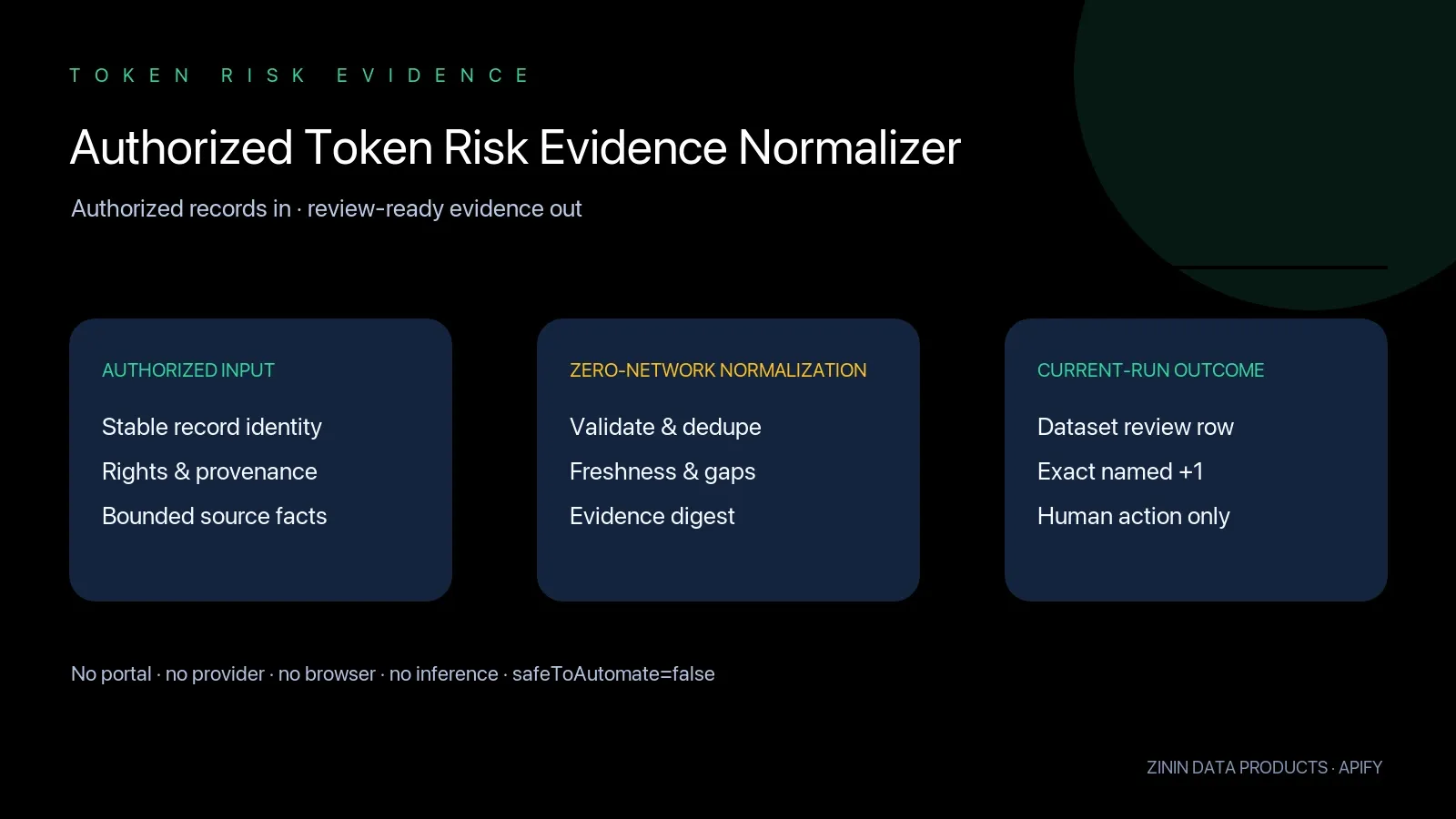
Normalize token risk records that you own or are authorized or licensed to use. Get stable IDs, explicit provenance, freshness, confidence gaps, conservative review actions, and exact current-run Dataset/PPE reconciliation without contacting any marketplace, publisher, employer, blockchain provider, portal, or other external source.
Commercial unit: one delivered normalized token risk record. Actor start is separate. Legacy inputs, invalid records, and duplicates can produce free diagnostics.
What you get
- one stable normalized row per accepted unique record;
- the familiar legacy top-level fields needed by existing exports;
- explicit source name, URL, licence statement, retrieval time, and changes made;
- freshness, change boundary, confidence score and visible gaps;
- a human-review decision with
safeToAutomate=false; - settlement-neutral Dataset billing intent;
- authoritative current-run KVS
OUTPUTwith exact named-event counters; - free migration, validation, and duplicate diagnostics;
- zero source, browser, proxy, DNS, provider, or child-Actor requests.
Who uses it
Operations analysts, data teams, compliance reviewers, marketplace operators, research teams, and automation builders use this Actor after they already possess a lawful structured export. It is not a collector, crawler, verification provider, financial adviser, employment decision engine, valuation service, or source of legal permission.
Evidence-to-action workflow
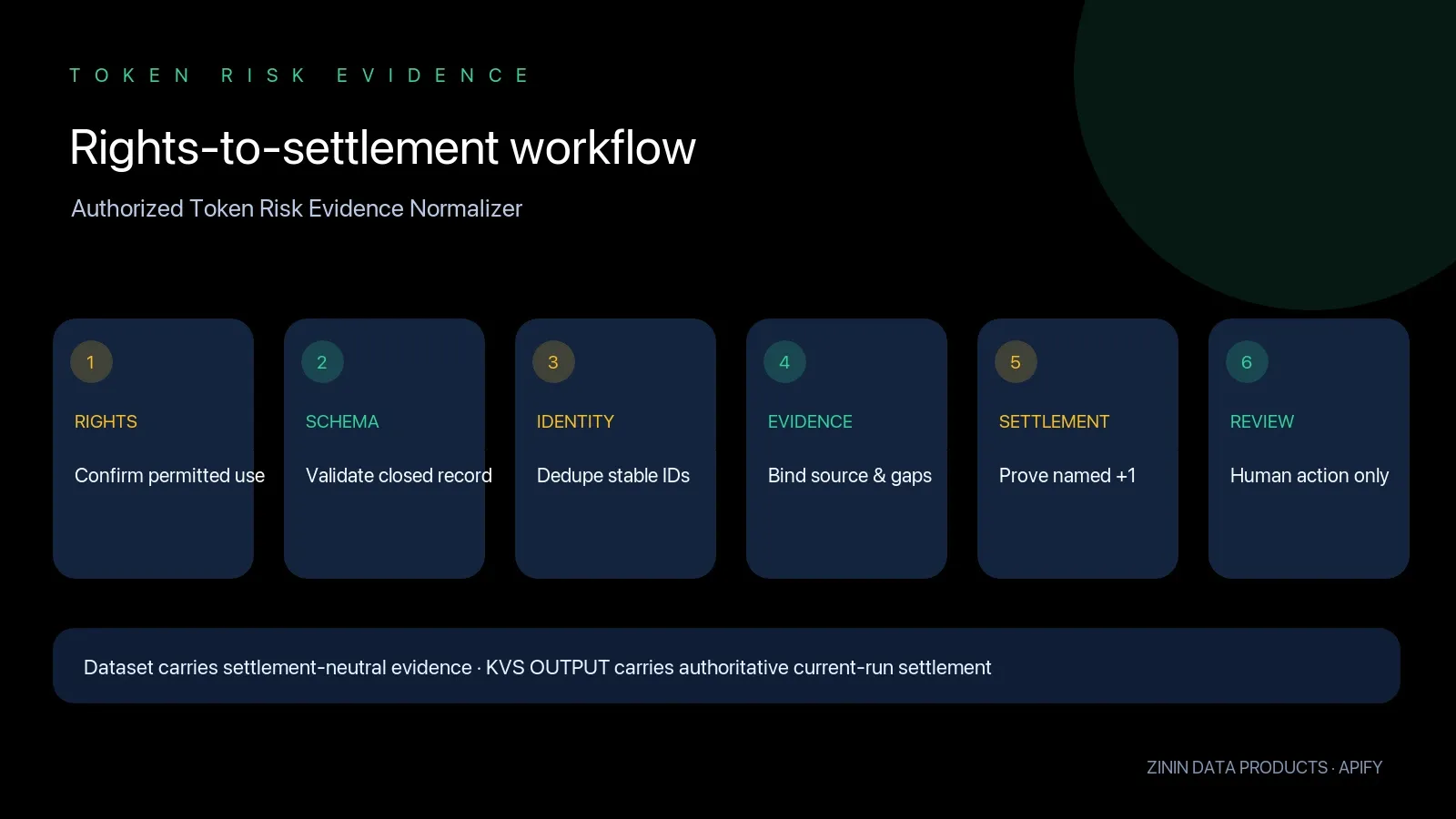
- Obtain a buyer-owned, authorized, or licensed export.
- Keep credentials and unnecessary personal data out of the payload.
- Submit bounded records with source and licence context.
- Validate the closed contract and suppress duplicates before billing.
- Normalize deterministic fields without fetching or inference.
- Deliver each accepted row with linked
result-found. - Reconcile named counter +1 and aggregate receipt.
- Persist current-run
OUTPUTand route every decision to a human.
How to run
Legacy migration mode
The historical input remains accepted:
It performs no old source request. Instead, one free diagnostic explains how to move to records. This keeps old Tasks observable and operational without silently continuing an unauthorized or unreliable fetch path.
Input contract
authorizationis an explicit buyer confirmation, not independent legal proof.sourceContextseparates owned, owner-authorized, licensed-feed, and other authorized exports.recordscontains 1–100 bounded objects.sourceRecordIdplussourceNameforms the duplicate key.- URLs must be credential-free HTTPS with no fragment or custom port.
sourceRetrievedAtis buyer-supplied and drives freshness.sourceLicenseandchangesMadetravel with every row.- Unknown properties fail closed; invalid rows become explicit free diagnostics when other valid work exists.
Pricing
The paid unit is one delivered normalized authorized record. Actor start is separate. The live Apify pricing panel is authoritative for the current tier. Legacy, invalid, and duplicate diagnostics emit no result-found.
Happy, partial, and failure output
| Outcome | Dataset | result-found | Meaning |
|---|---|---|---|
| accepted unique record, exact settlement | one row | +1 | paid result |
| legacy migration diagnostic | one row | 0 | free guidance |
| invalid or duplicate diagnostic | one row | 0 | free quality evidence |
| budget stop before push | none | 0 | withheld work |
| push returned but counter unreadable | known when receipt proves write | unknown | reconcile |
| push threw | unknown | unknown | no blind retry |
Dataset fields describe candidate evidence and billing intent. Only current-run KVS OUTPUT is authoritative for paid/free/withheld/unknown settlement. Every new run incurs a new start event and can produce new paid rows; replaySafe=false after any push attempt.
Illustrative accepted run binding:
Illustrative reconciled review binding:
Field dictionary
recordType
This field is part of the closed review contract. Preserve it with the current run ID, source context, observation time, and row digest. A missing value means unknown or not supplied; never coerce it into a business conclusion. Before downstream use, compare it with evidence, decisionConfidence.gaps, and the authoritative KVS OUTPUT settlement.
stableId
This field is part of the closed review contract. Preserve it with the current run ID, source context, observation time, and row digest. A missing value means unknown or not supplied; never coerce it into a business conclusion. Before downstream use, compare it with evidence, decisionConfidence.gaps, and the authoritative KVS OUTPUT settlement.
found
This field is part of the closed review contract. Preserve it with the current run ID, source context, observation time, and row digest. A missing value means unknown or not supplied; never coerce it into a business conclusion. Before downstream use, compare it with evidence, decisionConfidence.gaps, and the authoritative KVS OUTPUT settlement.
sourceRecordId
This field is part of the closed review contract. Preserve it with the current run ID, source context, observation time, and row digest. A missing value means unknown or not supplied; never coerce it into a business conclusion. Before downstream use, compare it with evidence, decisionConfidence.gaps, and the authoritative KVS OUTPUT settlement.
title
This field is part of the closed review contract. Preserve it with the current run ID, source context, observation time, and row digest. A missing value means unknown or not supplied; never coerce it into a business conclusion. Before downstream use, compare it with evidence, decisionConfidence.gaps, and the authoritative KVS OUTPUT settlement.
summary
This field is part of the closed review contract. Preserve it with the current run ID, source context, observation time, and row digest. A missing value means unknown or not supplied; never coerce it into a business conclusion. Before downstream use, compare it with evidence, decisionConfidence.gaps, and the authoritative KVS OUTPUT settlement.
entityName
This field is part of the closed review contract. Preserve it with the current run ID, source context, observation time, and row digest. A missing value means unknown or not supplied; never coerce it into a business conclusion. Before downstream use, compare it with evidence, decisionConfidence.gaps, and the authoritative KVS OUTPUT settlement.
category
This field is part of the closed review contract. Preserve it with the current run ID, source context, observation time, and row digest. A missing value means unknown or not supplied; never coerce it into a business conclusion. Before downstream use, compare it with evidence, decisionConfidence.gaps, and the authoritative KVS OUTPUT settlement.
occurredAt
This field is part of the closed review contract. Preserve it with the current run ID, source context, observation time, and row digest. A missing value means unknown or not supplied; never coerce it into a business conclusion. Before downstream use, compare it with evidence, decisionConfidence.gaps, and the authoritative KVS OUTPUT settlement.
url
This field is part of the closed review contract. Preserve it with the current run ID, source context, observation time, and row digest. A missing value means unknown or not supplied; never coerce it into a business conclusion. Before downstream use, compare it with evidence, decisionConfidence.gaps, and the authoritative KVS OUTPUT settlement.
attributes
This field is part of the closed review contract. Preserve it with the current run ID, source context, observation time, and row digest. A missing value means unknown or not supplied; never coerce it into a business conclusion. Before downstream use, compare it with evidence, decisionConfidence.gaps, and the authoritative KVS OUTPUT settlement.
token
This field is part of the closed review contract. Preserve it with the current run ID, source context, observation time, and row digest. A missing value means unknown or not supplied; never coerce it into a business conclusion. Before downstream use, compare it with evidence, decisionConfidence.gaps, and the authoritative KVS OUTPUT settlement.
symbol
This field is part of the closed review contract. Preserve it with the current run ID, source context, observation time, and row digest. A missing value means unknown or not supplied; never coerce it into a business conclusion. Before downstream use, compare it with evidence, decisionConfidence.gaps, and the authoritative KVS OUTPUT settlement.
riskLabel
This field is part of the closed review contract. Preserve it with the current run ID, source context, observation time, and row digest. A missing value means unknown or not supplied; never coerce it into a business conclusion. Before downstream use, compare it with evidence, decisionConfidence.gaps, and the authoritative KVS OUTPUT settlement.
riskScore
This field is part of the closed review contract. Preserve it with the current run ID, source context, observation time, and row digest. A missing value means unknown or not supplied; never coerce it into a business conclusion. Before downstream use, compare it with evidence, decisionConfidence.gaps, and the authoritative KVS OUTPUT settlement.
isHoneypot
This field is part of the closed review contract. Preserve it with the current run ID, source context, observation time, and row digest. A missing value means unknown or not supplied; never coerce it into a business conclusion. Before downstream use, compare it with evidence, decisionConfidence.gaps, and the authoritative KVS OUTPUT settlement.
confidence
This field is part of the closed review contract. Preserve it with the current run ID, source context, observation time, and row digest. A missing value means unknown or not supplied; never coerce it into a business conclusion. Before downstream use, compare it with evidence, decisionConfidence.gaps, and the authoritative KVS OUTPUT settlement.
buyTax
This field is part of the closed review contract. Preserve it with the current run ID, source context, observation time, and row digest. A missing value means unknown or not supplied; never coerce it into a business conclusion. Before downstream use, compare it with evidence, decisionConfidence.gaps, and the authoritative KVS OUTPUT settlement.
sellTax
This field is part of the closed review contract. Preserve it with the current run ID, source context, observation time, and row digest. A missing value means unknown or not supplied; never coerce it into a business conclusion. Before downstream use, compare it with evidence, decisionConfidence.gaps, and the authoritative KVS OUTPUT settlement.
liquidityUsd
This field is part of the closed review contract. Preserve it with the current run ID, source context, observation time, and row digest. A missing value means unknown or not supplied; never coerce it into a business conclusion. Before downstream use, compare it with evidence, decisionConfidence.gaps, and the authoritative KVS OUTPUT settlement.
checksSkipped
This field is part of the closed review contract. Preserve it with the current run ID, source context, observation time, and row digest. A missing value means unknown or not supplied; never coerce it into a business conclusion. Before downstream use, compare it with evidence, decisionConfidence.gaps, and the authoritative KVS OUTPUT settlement.
riskFlags
This field is part of the closed review contract. Preserve it with the current run ID, source context, observation time, and row digest. A missing value means unknown or not supplied; never coerce it into a business conclusion. Before downstream use, compare it with evidence, decisionConfidence.gaps, and the authoritative KVS OUTPUT settlement.
sourceName
This field is part of the closed review contract. Preserve it with the current run ID, source context, observation time, and row digest. A missing value means unknown or not supplied; never coerce it into a business conclusion. Before downstream use, compare it with evidence, decisionConfidence.gaps, and the authoritative KVS OUTPUT settlement.
sourceUrl
This field is part of the closed review contract. Preserve it with the current run ID, source context, observation time, and row digest. A missing value means unknown or not supplied; never coerce it into a business conclusion. Before downstream use, compare it with evidence, decisionConfidence.gaps, and the authoritative KVS OUTPUT settlement.
sourceLicense
This field is part of the closed review contract. Preserve it with the current run ID, source context, observation time, and row digest. A missing value means unknown or not supplied; never coerce it into a business conclusion. Before downstream use, compare it with evidence, decisionConfidence.gaps, and the authoritative KVS OUTPUT settlement.
sourceRetrievedAt
This field is part of the closed review contract. Preserve it with the current run ID, source context, observation time, and row digest. A missing value means unknown or not supplied; never coerce it into a business conclusion. Before downstream use, compare it with evidence, decisionConfidence.gaps, and the authoritative KVS OUTPUT settlement.
changesMade
This field is part of the closed review contract. Preserve it with the current run ID, source context, observation time, and row digest. A missing value means unknown or not supplied; never coerce it into a business conclusion. Before downstream use, compare it with evidence, decisionConfidence.gaps, and the authoritative KVS OUTPUT settlement.
observedAt
This field is part of the closed review contract. Preserve it with the current run ID, source context, observation time, and row digest. A missing value means unknown or not supplied; never coerce it into a business conclusion. Before downstream use, compare it with evidence, decisionConfidence.gaps, and the authoritative KVS OUTPUT settlement.
freshness
This field is part of the closed review contract. Preserve it with the current run ID, source context, observation time, and row digest. A missing value means unknown or not supplied; never coerce it into a business conclusion. Before downstream use, compare it with evidence, decisionConfidence.gaps, and the authoritative KVS OUTPUT settlement.
change
This field is part of the closed review contract. Preserve it with the current run ID, source context, observation time, and row digest. A missing value means unknown or not supplied; never coerce it into a business conclusion. Before downstream use, compare it with evidence, decisionConfidence.gaps, and the authoritative KVS OUTPUT settlement.
decisionConfidence
This field is part of the closed review contract. Preserve it with the current run ID, source context, observation time, and row digest. A missing value means unknown or not supplied; never coerce it into a business conclusion. Before downstream use, compare it with evidence, decisionConfidence.gaps, and the authoritative KVS OUTPUT settlement.
evidence
This field is part of the closed review contract. Preserve it with the current run ID, source context, observation time, and row digest. A missing value means unknown or not supplied; never coerce it into a business conclusion. Before downstream use, compare it with evidence, decisionConfidence.gaps, and the authoritative KVS OUTPUT settlement.
decision
This field is part of the closed review contract. Preserve it with the current run ID, source context, observation time, and row digest. A missing value means unknown or not supplied; never coerce it into a business conclusion. Before downstream use, compare it with evidence, decisionConfidence.gaps, and the authoritative KVS OUTPUT settlement.
recommendedAction
This field is part of the closed review contract. Preserve it with the current run ID, source context, observation time, and row digest. A missing value means unknown or not supplied; never coerce it into a business conclusion. Before downstream use, compare it with evidence, decisionConfidence.gaps, and the authoritative KVS OUTPUT settlement.
priority
This field is part of the closed review contract. Preserve it with the current run ID, source context, observation time, and row digest. A missing value means unknown or not supplied; never coerce it into a business conclusion. Before downstream use, compare it with evidence, decisionConfidence.gaps, and the authoritative KVS OUTPUT settlement.
safeToAutomate
This field is part of the closed review contract. Preserve it with the current run ID, source context, observation time, and row digest. A missing value means unknown or not supplied; never coerce it into a business conclusion. Before downstream use, compare it with evidence, decisionConfidence.gaps, and the authoritative KVS OUTPUT settlement.
failureDiagnostics
This field is part of the closed review contract. Preserve it with the current run ID, source context, observation time, and row digest. A missing value means unknown or not supplied; never coerce it into a business conclusion. Before downstream use, compare it with evidence, decisionConfidence.gaps, and the authoritative KVS OUTPUT settlement.
billing
This field is part of the closed review contract. Preserve it with the current run ID, source context, observation time, and row digest. A missing value means unknown or not supplied; never coerce it into a business conclusion. Before downstream use, compare it with evidence, decisionConfidence.gaps, and the authoritative KVS OUTPUT settlement.
rowDigest
This field is part of the closed review contract. Preserve it with the current run ID, source context, observation time, and row digest. A missing value means unknown or not supplied; never coerce it into a business conclusion. Before downstream use, compare it with evidence, decisionConfidence.gaps, and the authoritative KVS OUTPUT settlement.
Evidence and boundaries
Submitted evidence is structurally validated but not externally verified. Freshness measures time since the buyer-supplied retrieval time. Confidence measures contract completeness and visible gaps, not factual truth or predicted outcome.
Sources and rights
This Actor contacts no external source. You must have the right to submit, process, retain, and commercially use every record and every embedded field. Public accessibility alone does not prove redistribution rights. Do not submit cookies, API keys, signed URLs, credentials, private notes, unnecessary personal data, sensitive classifications, or secrets. Configure Dataset/KVS retention and access controls. Hashes are integrity aids, not anonymization.
For Token risk evidence, treat identity, availability, completeness, accuracy, legal status, commercial relevance, and future outcomes as unverified unless a separate authorized process proves them. Never infer protected traits, intent, guilt, financial suitability, employment suitability, property value, token safety, or causality from a normalized row.
Decision routing
The only successful decision is review_required. Its recommended action is to review evidence, licence, freshness, and gaps. The Actor never sends messages, changes campaigns, buys or sells assets, ranks people, makes hiring decisions, edits source records, or publishes allegations. Keep human approval and an audit trail before any external action.
Commercial playbooks
1. analyst review queue
Read KVS OUTPUT first, require the current runId, then read Dataset rows. Route review_required to a human with source licence, gaps, freshness, and row digest attached. Never treat safeToAutomate=false as permission to message, trade, publish, score a person, change a listing, or modify an external system. If delivery or settlement is unknown, reconcile the original run; do not rerun blindly.
2. warehouse ingestion
Read KVS OUTPUT first, require the current runId, then read Dataset rows. Route review_required to a human with source licence, gaps, freshness, and row digest attached. Never treat safeToAutomate=false as permission to message, trade, publish, score a person, change a listing, or modify an external system. If delivery or settlement is unknown, reconcile the original run; do not rerun blindly.
3. CRM staging
Read KVS OUTPUT first, require the current runId, then read Dataset rows. Route review_required to a human with source licence, gaps, freshness, and row digest attached. Never treat safeToAutomate=false as permission to message, trade, publish, score a person, change a listing, or modify an external system. If delivery or settlement is unknown, reconcile the original run; do not rerun blindly.
4. scheduled batch review
Read KVS OUTPUT first, require the current runId, then read Dataset rows. Route review_required to a human with source licence, gaps, freshness, and row digest attached. Never treat safeToAutomate=false as permission to message, trade, publish, score a person, change a listing, or modify an external system. If delivery or settlement is unknown, reconcile the original run; do not rerun blindly.
5. webhook routing
Read KVS OUTPUT first, require the current runId, then read Dataset rows. Route review_required to a human with source licence, gaps, freshness, and row digest attached. Never treat safeToAutomate=false as permission to message, trade, publish, score a person, change a listing, or modify an external system. If delivery or settlement is unknown, reconcile the original run; do not rerun blindly.
6. n8n workflow
Read KVS OUTPUT first, require the current runId, then read Dataset rows. Route review_required to a human with source licence, gaps, freshness, and row digest attached. Never treat safeToAutomate=false as permission to message, trade, publish, score a person, change a listing, or modify an external system. If delivery or settlement is unknown, reconcile the original run; do not rerun blindly.
7. Make scenario
Read KVS OUTPUT first, require the current runId, then read Dataset rows. Route review_required to a human with source licence, gaps, freshness, and row digest attached. Never treat safeToAutomate=false as permission to message, trade, publish, score a person, change a listing, or modify an external system. If delivery or settlement is unknown, reconcile the original run; do not rerun blindly.
8. Zapier handoff
Read KVS OUTPUT first, require the current runId, then read Dataset rows. Route review_required to a human with source licence, gaps, freshness, and row digest attached. Never treat safeToAutomate=false as permission to message, trade, publish, score a person, change a listing, or modify an external system. If delivery or settlement is unknown, reconcile the original run; do not rerun blindly.
9. MCP tool call
Read KVS OUTPUT first, require the current runId, then read Dataset rows. Route review_required to a human with source licence, gaps, freshness, and row digest attached. Never treat safeToAutomate=false as permission to message, trade, publish, score a person, change a listing, or modify an external system. If delivery or settlement is unknown, reconcile the original run; do not rerun blindly.
10. data-quality audit
Read KVS OUTPUT first, require the current runId, then read Dataset rows. Route review_required to a human with source licence, gaps, freshness, and row digest attached. Never treat safeToAutomate=false as permission to message, trade, publish, score a person, change a listing, or modify an external system. If delivery or settlement is unknown, reconcile the original run; do not rerun blindly.
11. licence review
Read KVS OUTPUT first, require the current runId, then read Dataset rows. Route review_required to a human with source licence, gaps, freshness, and row digest attached. Never treat safeToAutomate=false as permission to message, trade, publish, score a person, change a listing, or modify an external system. If delivery or settlement is unknown, reconcile the original run; do not rerun blindly.
12. retention review
Read KVS OUTPUT first, require the current runId, then read Dataset rows. Route review_required to a human with source licence, gaps, freshness, and row digest attached. Never treat safeToAutomate=false as permission to message, trade, publish, score a person, change a listing, or modify an external system. If delivery or settlement is unknown, reconcile the original run; do not rerun blindly.
Integration recipes
Use API, Tasks, schedules, webhooks, n8n, Make, Zapier, or an Apify MCP integration only as transport. Always read current-run KVS OUTPUT before Dataset rows.
API example
After terminal completion, read OUTPUT from the default Key-Value Store and verify its runId, status, delivery counters, errors, replay state, and terminal writes before consuming Dataset rows.
Operating guide
- Confirm source rights and purpose before every batch.
- Keep record identity stable and source-specific.
- Review stale timestamps and missing optional evidence.
- Treat duplicate suppression as an input fact, not proof of source uniqueness.
- Check budget before expecting all records to be delivered.
- Reconcile the original run after any unknown delivery or settlement.
- Never retry a possibly delivered paid row blindly.
- Retain KVS and Dataset under the same access and deletion policy.
- Review every action because
safeToAutomate=false. - Use the live Apify pricing panel as the current price authority.
FAQ
1. Can this Actor verify submitted token risk record facts?
No. It validates structure, normalizes bounded values, records buyer-asserted provenance, calculates deterministic digests, exposes freshness and gaps, and settles one delivered row. It makes zero external requests. Verification requires a separate authorized source workflow and human review.
2. Can this Actor verify submitted token risk record facts?
No. It validates structure, normalizes bounded values, records buyer-asserted provenance, calculates deterministic digests, exposes freshness and gaps, and settles one delivered row. It makes zero external requests. Verification requires a separate authorized source workflow and human review.
3. Can this Actor verify submitted token risk record facts?
No. It validates structure, normalizes bounded values, records buyer-asserted provenance, calculates deterministic digests, exposes freshness and gaps, and settles one delivered row. It makes zero external requests. Verification requires a separate authorized source workflow and human review.
4. Can this Actor verify submitted token risk record facts?
No. It validates structure, normalizes bounded values, records buyer-asserted provenance, calculates deterministic digests, exposes freshness and gaps, and settles one delivered row. It makes zero external requests. Verification requires a separate authorized source workflow and human review.
5. Can this Actor verify submitted token risk record facts?
No. It validates structure, normalizes bounded values, records buyer-asserted provenance, calculates deterministic digests, exposes freshness and gaps, and settles one delivered row. It makes zero external requests. Verification requires a separate authorized source workflow and human review.
6. Can this Actor verify submitted token risk record facts?
No. It validates structure, normalizes bounded values, records buyer-asserted provenance, calculates deterministic digests, exposes freshness and gaps, and settles one delivered row. It makes zero external requests. Verification requires a separate authorized source workflow and human review.
7. Can this Actor verify submitted token risk record facts?
No. It validates structure, normalizes bounded values, records buyer-asserted provenance, calculates deterministic digests, exposes freshness and gaps, and settles one delivered row. It makes zero external requests. Verification requires a separate authorized source workflow and human review.
8. Can this Actor verify submitted token risk record facts?
No. It validates structure, normalizes bounded values, records buyer-asserted provenance, calculates deterministic digests, exposes freshness and gaps, and settles one delivered row. It makes zero external requests. Verification requires a separate authorized source workflow and human review.
9. Can this Actor verify submitted token risk record facts?
No. It validates structure, normalizes bounded values, records buyer-asserted provenance, calculates deterministic digests, exposes freshness and gaps, and settles one delivered row. It makes zero external requests. Verification requires a separate authorized source workflow and human review.
10. Can this Actor verify submitted token risk record facts?
No. It validates structure, normalizes bounded values, records buyer-asserted provenance, calculates deterministic digests, exposes freshness and gaps, and settles one delivered row. It makes zero external requests. Verification requires a separate authorized source workflow and human review.
11. Can this Actor verify submitted token risk record facts?
No. It validates structure, normalizes bounded values, records buyer-asserted provenance, calculates deterministic digests, exposes freshness and gaps, and settles one delivered row. It makes zero external requests. Verification requires a separate authorized source workflow and human review.
12. Can this Actor verify submitted token risk record facts?
No. It validates structure, normalizes bounded values, records buyer-asserted provenance, calculates deterministic digests, exposes freshness and gaps, and settles one delivered row. It makes zero external requests. Verification requires a separate authorized source workflow and human review.
13. Can this Actor verify submitted token risk record facts?
No. It validates structure, normalizes bounded values, records buyer-asserted provenance, calculates deterministic digests, exposes freshness and gaps, and settles one delivered row. It makes zero external requests. Verification requires a separate authorized source workflow and human review.
14. Can this Actor verify submitted token risk record facts?
No. It validates structure, normalizes bounded values, records buyer-asserted provenance, calculates deterministic digests, exposes freshness and gaps, and settles one delivered row. It makes zero external requests. Verification requires a separate authorized source workflow and human review.
15. Can this Actor verify submitted token risk record facts?
No. It validates structure, normalizes bounded values, records buyer-asserted provenance, calculates deterministic digests, exposes freshness and gaps, and settles one delivered row. It makes zero external requests. Verification requires a separate authorized source workflow and human review.
16. Can this Actor verify submitted token risk record facts?
No. It validates structure, normalizes bounded values, records buyer-asserted provenance, calculates deterministic digests, exposes freshness and gaps, and settles one delivered row. It makes zero external requests. Verification requires a separate authorized source workflow and human review.
17. Can this Actor verify submitted token risk record facts?
No. It validates structure, normalizes bounded values, records buyer-asserted provenance, calculates deterministic digests, exposes freshness and gaps, and settles one delivered row. It makes zero external requests. Verification requires a separate authorized source workflow and human review.
18. Can this Actor verify submitted token risk record facts?
No. It validates structure, normalizes bounded values, records buyer-asserted provenance, calculates deterministic digests, exposes freshness and gaps, and settles one delivered row. It makes zero external requests. Verification requires a separate authorized source workflow and human review.
Contract summary
The product is intentionally narrow: normalize authorized structured evidence, preserve provenance and familiar fields, expose uncertainty, deliver one bounded paid row per accepted unique input, and record exact current-run settlement. Collection, external verification, enrichment, adjudication, and automatic business action remain outside the Actor.


