

Structured Data Competitor Gap Prioritizer
Pricing
from $17.00 / 1,000 priority plan delivereds
Structured Data Competitor Gap Prioritizer
Prioritize supplied structured-data competitor gaps with transparent impact, effort, confidence, and equal-domain coverage math.

Turn one marketer-supplied comparison into one deterministic, auditable implementation queue. The Actor performs no crawl and sends no domain to a network service.
What you get
One default-Dataset row containing every supplied opportunity, equal-domain competitor medians, coverage gaps, all score components, decision bands, queue dispositions, ranks, fixed human-review actions, limitations, and billing identity.
Who uses it
SEO leads, ecommerce teams, publishers, local-search teams, and agencies that already have comparable coverage estimates and need a transparent order of work. It is not a scanner or a substitute for validating visible facts and current search policies.
How to run
Use the Console input form or the public Task prioritize-structured-data-competitor-gaps (Structured Data Competitor Gap Priority Plan — Example). Supply one canonical target domain, 1–10 canonical competitor domains, and 1–8 unique fixed opportunities. Each competitor coverage array must follow the declared domain order.
The public Task is bounded to 128 MB, 90 seconds, and a maximum total charge of $0.025000. Exact-build examples are bundled as prefill-input.json, all-below-threshold-input.json, eight-candidate-cap-input.json, and invalid-positional-input.json.
Pricing
The paid unit is one complete delivered plan, not one candidate. Exact event prices are:
| Tier | Start | Complete plan | Maximum successful run |
|---|---|---|---|
| FREE | $0.005000 | $0.020000 | $0.025000 |
| BRONZE | $0.004750 | $0.019000 | $0.023750 |
| SILVER | $0.004500 | $0.018000 | $0.022500 |
| GOLD | $0.004250 | $0.017000 | $0.021250 |
| PLATINUM | $0.004100 | $0.016400 | $0.020500 |
| DIAMOND | $0.004000 | $0.016000 | $0.020000 |
At 128 MB, the platform minimum is one Actor Start event. The Task's $0.025000 charge cap therefore covers the maximum successful FREE run; every paid tier is lower. Invalid, budget-blocked, and storage-conflict runs do not emit result-found.
Input contract
Input contains exactly seven keys after default insertion: schemaVersion, assessmentId, targetDomain, competitorDomains, opportunities, minimumGapBps, and maxPriorities. The last two default to 1,000 and 3. Domains must already be lowercase canonical registrable ASCII domains. Coverage is an integer from 0 to 10,000 basis points; business impact and effort are integers from 1 to 5; confidence is LOW, MEDIUM, or HIGH.
Priority math
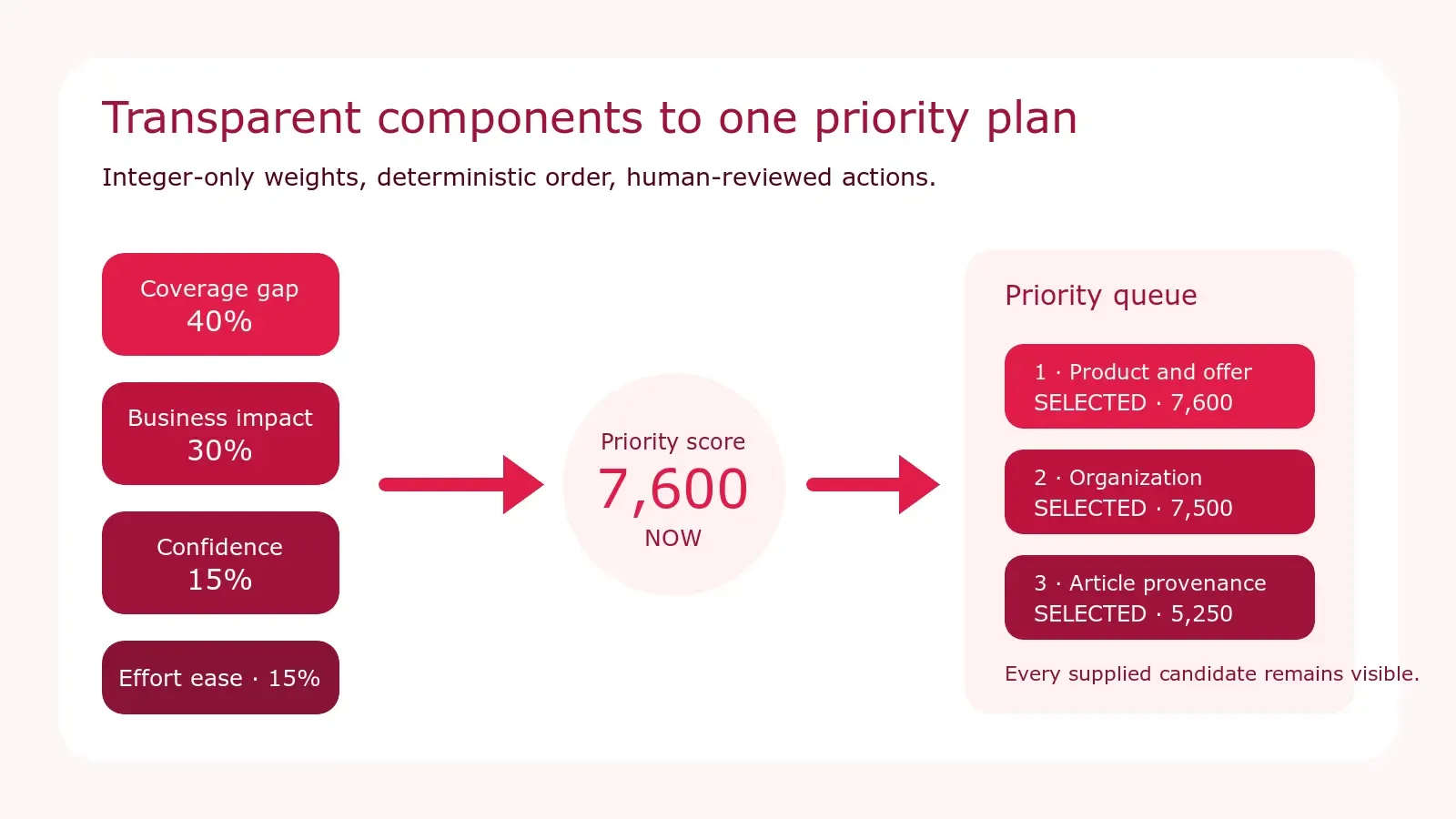
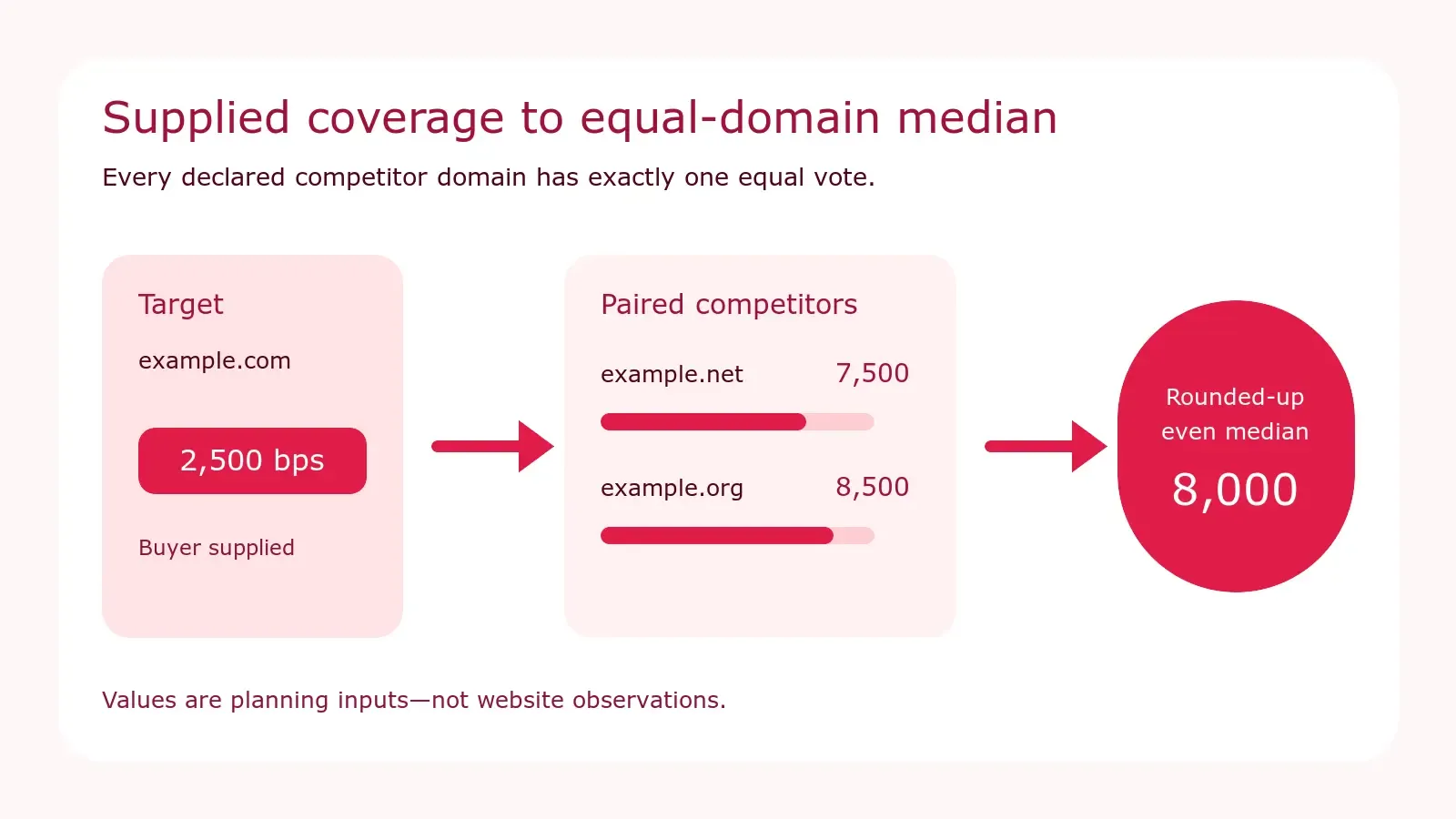
Every competitor domain has equal weight. For even competitor counts, the median is floor((leftMiddle + rightMiddle + 1) / 2). The nonnegative gap is median minus target. The exact score is:
Eligible decisions sort by score descending, then gap descending, then the fixed opportunity order. Ineligible decisions follow in fixed opportunity order.
Real output
The bundled prefill yields four decisions in this exact order:
Field dictionary
The 15 top-level fields identify the plan, repeat its native target/assessment identity, preserve sorted competitors, reconcile candidate/eligible/selected counts, record the queue settings, contain every decision and disposition count, state four fixed limitations, and identify the one billable result unit. Each decision exposes raw buyer inputs, median/gap, four score components, eligibility/band/disposition/rank, one fixed action, and domain-paired competitor values.
Decision bands and actions
Eligible scores of at least 7,500 are NOW; scores of at least 5,000 are NEXT; lower eligible scores are LATER. Ineligible rows are always NO_MATERIAL_GAP. Selected rows are capped by maxPriorities; other eligible rows are DEFERRED_BY_CAP. All fixed actions require human review and every row has safeToAutomate:false.
Evidence and limitations
Coverage, impact, effort, confidence, and page counts are buyer declarations. The Actor does not observe websites, reconstruct samples, or verify comparability. A gap does not establish search eligibility, visibility, citation, ranking, traffic, conversion, revenue, or causation. Apply markup only for truthful visible facts under current policies.
You must own or be authorized to use the supplied assessment inputs. The Actor transfers no input outside Apify and grants no rights to the underlying measurements or website facts.
Integration recipes
Use {{links.apiDefaultDatasetUrl}}/items to fetch the one plan after a successful run. The API, Python, and JavaScript clients can start the Actor with the same seven-key JSON object and then read the run's default Dataset. The Apify CLI can call the Actor with a file containing that object. Through Apify MCP, invoke the Actor tool and inspect its Dataset resource. In n8n and Make, use the authenticated Apify Actor module, map only the seven accepted keys, wait for completion, and read the default Dataset item. Keep platform credentials in each integration's credential store—never in Actor Input.
Route SELECTED rows into a ticketing review, retain score components for approval notes, and preserve competitorDomainValues so each estimate remains attached to its owner. Treat the default Dataset plus the named result-found count as delivery truth.
Operating guide
Use one comparable sampling and measurement method for every supplied domain. Keep assessmentId stable for the assessment, revise it for a materially new measurement, and review every action against visible page facts. A restart that finds a nonempty default Dataset stops instead of appending or charging a replacement.
FAQ
Does it crawl sites? No. Does it call an LLM, OpenRouter, search engine, browser, DNS, proxy, child Actor, or webhook? No. Can an all-below-threshold assessment succeed? Yes; its complete negative plan is still the purchased result. Will it repair malformed input? No; it rejects the whole assessment.
Other public tools
Use a dedicated audit or benchmark Actor when you need site observation or Schema.org extraction. This product begins only after a marketer has prepared comparable coverage estimates; it is materially separate from audit-row source adapters and per-gap benchmark rows.


