

USPTO Scraper [$5/1K💰] | US Patents | Prior Art Search
Pricing
from $4.85 / 1,000 patents
USPTO Scraper [$5/1K💰] | US Patents | Prior Art Search
Search USPTO patents and published applications by keyword, inventor, assignee or field code — keyless. Get titles, dates, classifications, family IDs and optional abstract and claims text. Built for prior-art research, patent landscapes and competitor monitoring. $5 per 1,000 patents.
Pricing
from $4.85 / 1,000 patents
Rating
0.0
(0)
Developer

Ahmed Jasarevic
Maintained by CommunityActor stats
0
Bookmarked
2
Total users
1
Monthly active users
6 days ago
Last modified
Categories
Share
USPTO Patent Scraper
Search USPTO patents and published applications by keyword, inventor, assignee or field-coded query — without a login or API key — and get structured patent records with dates, parties, classifications and family IDs, plus optional abstract, claims and description text.
Built for:
- Patent landscape and prior-art research
- Competitor and technology monitoring by assignee or keyword
- Building patent databases for analytics, search or ML
- Tracking newly published applications and grants in a technology area
- Enriching R&D and legal workflows with structured patent metadata
Search US Patents & Prior Art Without an API Key
The actor queries three USPTO collections in one run — granted patents (USPAT), published applications (US-PGPUB) and OCR patents (USOCR) — using the same fast JSON interface as the official Patent Public Search web app. Queries accept plain keywords and USPTO field codes (7557042.pn., microsoft.as., black.in., lithium battery AND @pd>=20240101). Each result row carries the patent number and GUID, title, database, kind code, publication/filing/priority dates, application number, assignee, applicants, inventors, CPC/IPC/USPC classifications and the USPTO family ID. With details enabled, the actor also fetches the full document record: abstract, claims and/or description as plain text, examiner and attorney names, government-interest statement, priority country and claim counts. Results page through up to 20,000 documents per query — the Patent Public Search limit.
How It Works
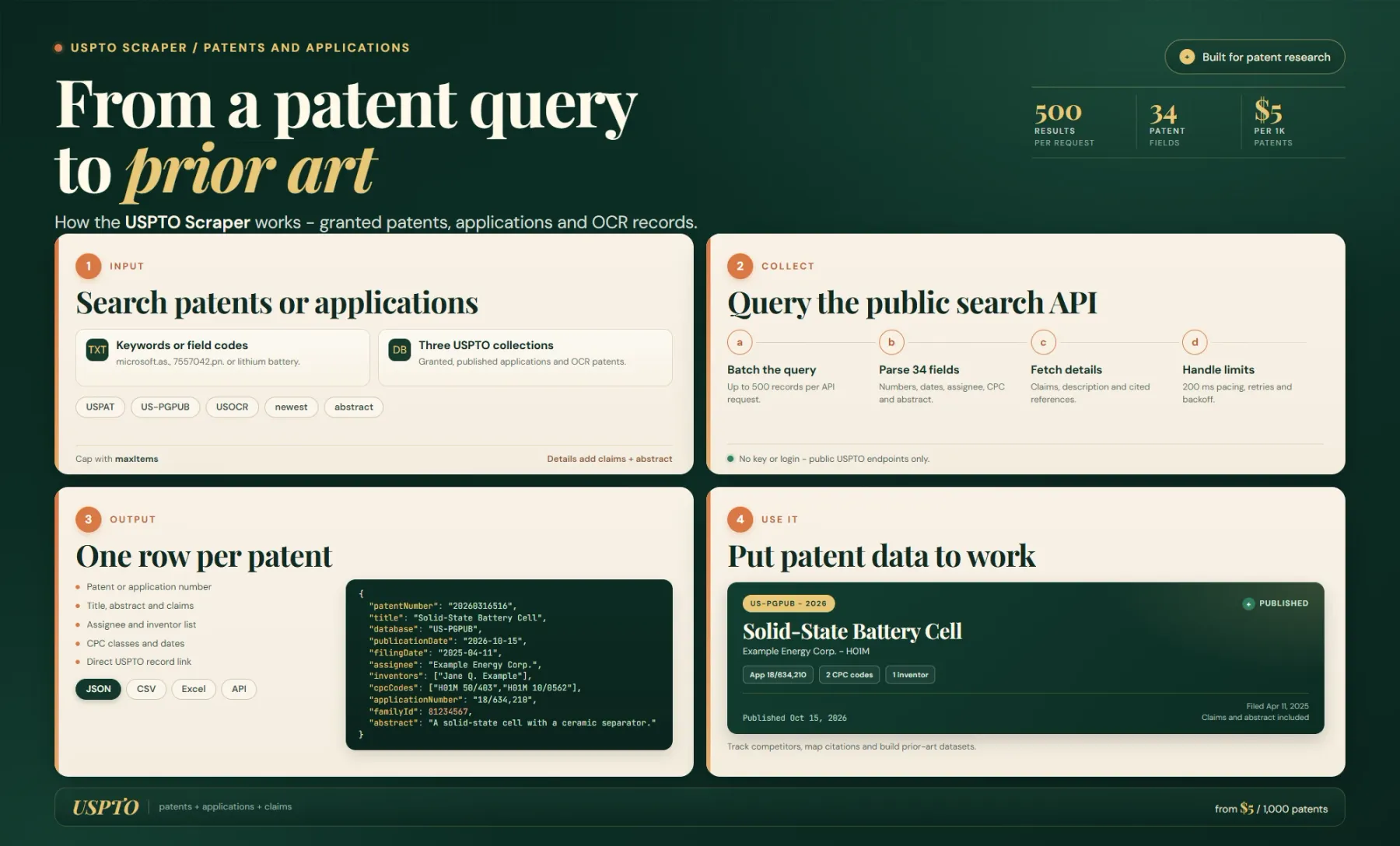
The Actor sends each query to the same internal JSON endpoint used by Patent Public Search, 500 results per request. With details enabled it fetches the full document and selected text sections; request starts are serialized and HTTP 429 responses trigger a global cooldown.
Each row covers one patent document with number, title, database, dates, assignee, inventors, CPC and IPC classes, and optional abstract, claims and description.
- The search runs in batches of 500 results per request against the same internal JSON endpoint the official Patent Public Search application calls.
- Each result row is pushed according to your
pushMode(incremental,pageorend), so you can watch results appear or collect them in bulk. - If
fetchDetailsis enabled, one extra request per patent retrieves the full document record and selected text sections. - Request starts are serialized with a configurable minimum delay (default 200 ms), network errors and 5xx responses are retried, and the USPTO session is rotated automatically; on HTTP 429 the actor applies a global cooldown.
- A 100-patent run takes roughly 30–40 seconds with details enabled; with
fetchDetails: falseonly one request per 500 results is needed.
Input Parameters
| Field | Type | Required | Default | Notes |
|---|---|---|---|---|
searchQuery | string | Yes | — | USPTO Patent Public Search query. Plain keywords or field suffixes: litium battery, 7557042.pn., microsoft.as., lithium battery AND @pd>=20240101. |
maxItems | integer | No | 100 | Patents written to the dataset (1–20,000; Patent Public Search caps any query at 20,000). |
sort | enum | No | newest | newest, oldest or relevance. |
databases | array | No | all three | US-PGPUB (published applications), USPAT (granted patents), USOCR (OCR patents). |
defaultOperator | enum | No | OR | How words combine when no explicit operator: OR (broader) or AND (all words). |
fetchDetails | boolean | No | true | Fetch the full document record per patent — adds inventors, examiners, attorney and selected text sections; one extra request (and one detail charge) per successfully fetched document. |
pushMode | enum | No | incremental | incremental (row by row), page (per 500-result page), end (single batch at the end; more memory). |
textSections | array | No | ["abstract"] | Which text sections to include when details are fetched: abstract, claims, description (description can be very large). |
concurrency | integer | No | 8 | Parallel detail requests (1–20); the minimum request delay is still enforced. |
requestDelayMs | integer | No | 200 | Minimum delay between USPTO request starts, 100–10,000 ms. The default is tuned for reliable detail runs. |
Output Fields
One dataset item per patent document — 34 fields:
- Identity:
guid,patentNumber,documentId,title,database,documentType,kindCode,applicationNumber,familyId,detailsFetched - Dates:
publicationDate,filingDate,priorityDate,priorityCountryCode* - Parties:
assignee,assigneeCity,assigneeState,assigneeCountry,applicants,inventors,inventorsShort,primaryExaminer,assistantExaminer,attorneyName* - Classifications:
cpcCodes,cpcAdditionalCodes,ipcCodes,uspcCodes - Text (when the section is selected):
abstract,claims,description - Other:
governmentInterest,numberOfClaims,exemplaryClaimNumber*
* Requires fetchDetails: true.
Example Input
Fast metadata-only variant:
Example Output
Automate Patent Monitoring With Schedules & Webhooks
- Weekly new-publications feed: schedule a query such as
microsoft.as. AND @pd>=20260101(adjust the date each run) and keep rows whosepatentNumberhas not appeared before — a lightweight new-patent alert system. - Competitor tracking: one scheduled run per assignee, with a dataset webhook pushing matches to Slack, email or your warehouse.
- Landscape snapshots: run broad keyword searches monthly with
fetchDetails: falseandpushMode: "page"for cheap, fast classification data (cpcCodes) to chart technology trends. - Scheduled runs are the intended pattern and improve this actor's Store recommendation signals.
Related Actors
- Google Patents Scraper — Search, Citations, Family Graph — the most-used patent actor on the Store, useful for citation and family-graph views.
- Google Patents Scraper — Search, Citations, Family Graph — same coverage from a different developer, a solid cross-check.
- Google Patents Scraper — lighter Google Patents alternative.
- USPTO Patent Search Scraper — No Login — direct USPTO-side extraction with a different field set.
- USPTO Patent Scraper — another USPTO-focused option for redundancy.
Frequently Asked Questions
Why use this actor instead of the official API?
USPTO's Open Data Portal (data.uspto.gov) does offer official APIs, but access has become heavyweight: since June 18, 2026 you need a signed-in USPTO.gov account with multi-factor authentication, and API keys for accounts missing the required profile fields were deactivated on October 8, 2026. The PatentsView APIs have been interrupted since their March 20, 2026 migration with no published relaunch date. This actor sidesteps all of that: it uses the same JSON interface as the official Patent Public Search web app, needs no account, key or registration, and returns structured metadata with optional abstract/claims/description — with keyless access being the point.
Is there a USPTO API?
Yes — the Open Data Portal provides patent search and bulk dataset APIs, but they require a USPTO.gov account, MFA and an API key. PatentsView's legacy APIs are in transition (interrupted since March 20, 2026, relaunch unannounced). Third-party PatentsView-compatible gateways also exist (e.g. patentgrep). This actor offers the keyless route through the public search interface the official web app itself uses.
How can I search patents without an API key?
Run this actor with a query — that is all that is required. It talks to the same public endpoint the official Patent Public Search application uses, rotates its session, and paces requests so large detail runs stay under USPTO's HTTP 429 limit.
What are the alternatives to this data source?
- USPTO Open Data Portal — official APIs and bulk datasets, with account/MFA/key requirements.
- Google Patents — broad coverage (actors linked above) including citations and family graphs.
- PatentsView-compatible gateways — third-party services that mirror PatentsView's API shape.
- Espacenet / EPO — international coverage beyond US documents.
Can I get patent abstracts, claims and full descriptions?
Yes — keep fetchDetails: true and pick sections in textSections (abstract, claims, description). The description section can be very large, so it is excluded by default; each successfully fetched detail adds one extra request and, with pay-per-event pricing, one detail charge.
Does it require a USPTO login?
Not currently — the actor uses the anonymous session endpoint of Patent Public Search. USPTO has announced a sign-in requirement for the Patent Public Search web app from November 7, 2026 (per the actor's documentation); if the anonymous endpoint begins returning 401, the actor reports a clear error instead of failing silently.
For AI Agents & LLM Apps
Purpose: returns USPTO patent records (identity, dates, parties, classifications, family ID) with optional abstract/claims/description text for a given search query — keyless.
Minimal input:
Metadata-only (fast/cheap) variant:
Output fields: guid, patentNumber, documentId, title, database, documentType, kindCode, publicationDate, filingDate, priorityDate, priorityCountryCode, applicationNumber, assignee, assigneeCity, assigneeState, assigneeCountry, applicants, inventors, inventorsShort, cpcCodes, cpcAdditionalCodes, ipcCodes, uspcCodes, familyId, abstract, claims, description, primaryExaminer, assistantExaminer, attorneyName, governmentInterest, numberOfClaims, exemplaryClaimNumber, detailsFetched.
Behaviors an agent should know:
searchQueryis the only required input;maxItemsdefaults to 100 and can never exceed 20,000 (Patent Public Search's per-query ceiling).fetchDetailsdefaults totrue— each detail adds one request and aPatent detailcharge; set it tofalsefor metadata-only runs at one request per 500 results.- Detail-only fields (inventors, examiners, attorney, text sections, city/state/country) are populated only when
fetchDetailsis on; checkdetailsFetchedto confirm. pushMode: "end"buffers everything in memory — preferincrementalorpagefor large runs.- Rate limiting is built in: serialized request starts with a 200 ms default delay, automatic session rotation and a global cooldown on HTTP 429. Lower
requestDelayMsonly if you accept 429 risk.
Billing: pay-per-event — Patent at $0.005 per patent result and Patent detail at $0.001 per successfully fetched document, plus a run-start event.
Legal & Compliance Disclaimer
This actor is an independent tool and is not affiliated with, endorsed by, or sponsored by the United States Patent and Trademark Office (USPTO). It queries only USPTO's public Patent Public Search interface — no account credentials are used — and paces requests to stay under USPTO's rate limits. Patent documents and bibliographic data are public records; users are responsible for their own compliance with USPTO's terms of use and applicable law when storing, republishing or automating access to the data. This actor is a data tool, not legal advice.
SEO Keywords
uspto scraper, uspto patent scraper, patent scraper, patent search api, uspto api, patentsview alternative, prior art search, patent data api, google patents alternative, patent database, us patent search, patent full text, patent abstract data, patent classification data, cpc codes, patent landscape analysis, freedom to operate data, patent monitoring, newly published patents, patent research tool


