

Google Patents Scraper
Pricing
from $2.00 / 1,000 results
Google Patents Scraper
Scrape data from Google Patents including priority date, expiration date, title, status (e.g., pending), assignee, inventor, source url
Pricing
from $2.00 / 1,000 results
Rating
5.0
(1)
Developer

Sarah Kapelner
Maintained by CommunityActor stats
0
Bookmarked
21
Total users
2
Monthly active users
3 months ago
Last modified
Categories
Share
This Actor extracts data from Google Patents.
It is designed for scraping patent/publication numbers directly or finding patents by keyword and returning structured metadata in an Apify dataset.
What it extracts
For each patent or publication number, the Actor can extract:
- Patent number (when determinable)
- Publication number
- Application number
- Title
- Inventor
- Assignee
- Legal status
- Priority date
- Publication date
- Expiration date (including adjusted expiration where available)
- Abstract
- Claims
- Related parent applications
- Related child applications
- Other family members
- PTAB proceedings (
IPR/PGRtrial metadata)
The fields returned are configurable via Actor input.
Input
patentOrPublicationNumbers or keywords or search_filters
You can provide one or more of:
patentOrPublicationNumbers: a list of issued patent numbers and/or pre-grant/publication numberskeywords: one or more keyword queries that will be searched on Google Patents, e.g., (fraud detection OR theft detection) (bank)- search_filters: inventor, assignee, patent office, and priority-date filters
The Actor resolves Google Patents search filters to patent/publication numbers first, then fetches the same metadata fields for the resulting documents.
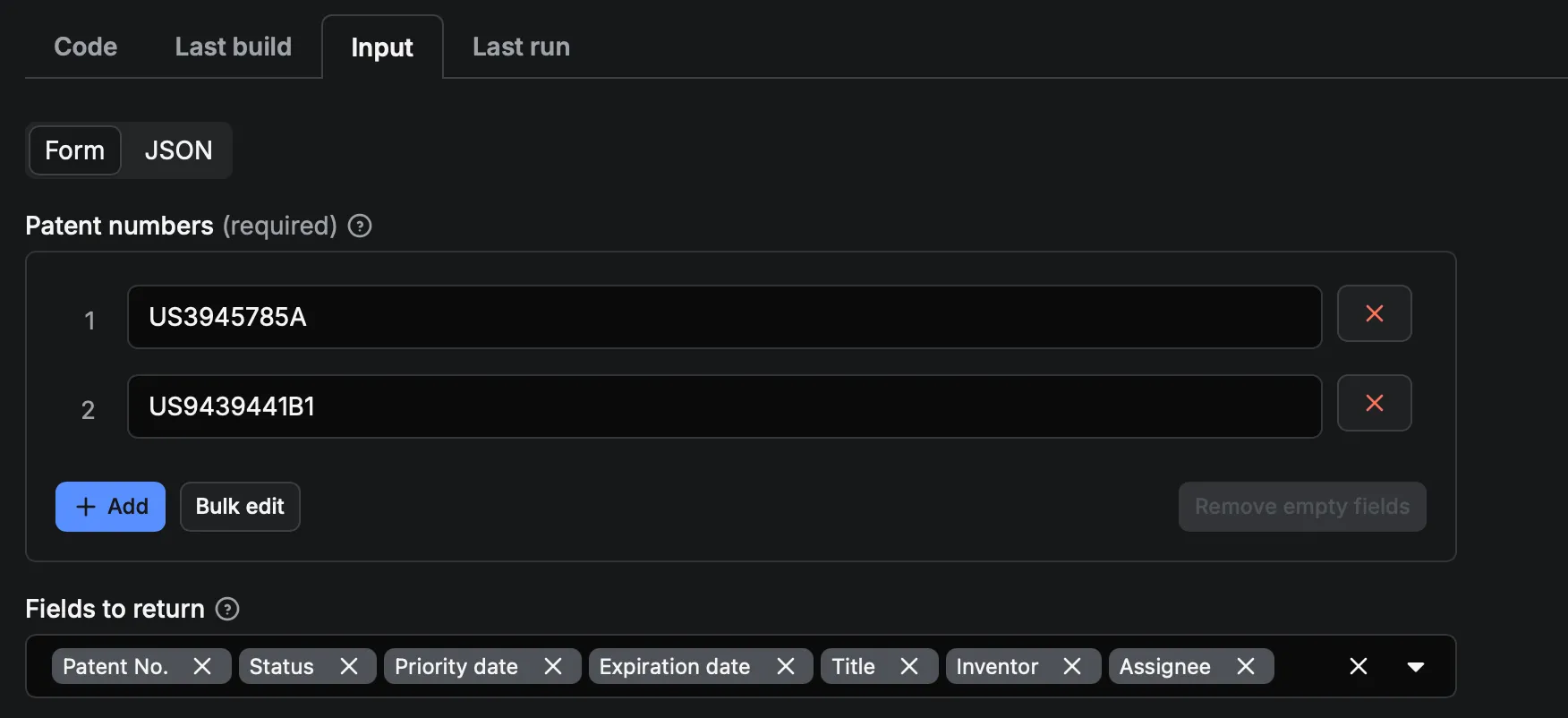
You provide via the Form under the Input tab a list of patent/publication numbers and/or keywords and/or search filters and specify the fields you want to fetch for each result (title, inventor, assignee, priority date, expiration date, status):
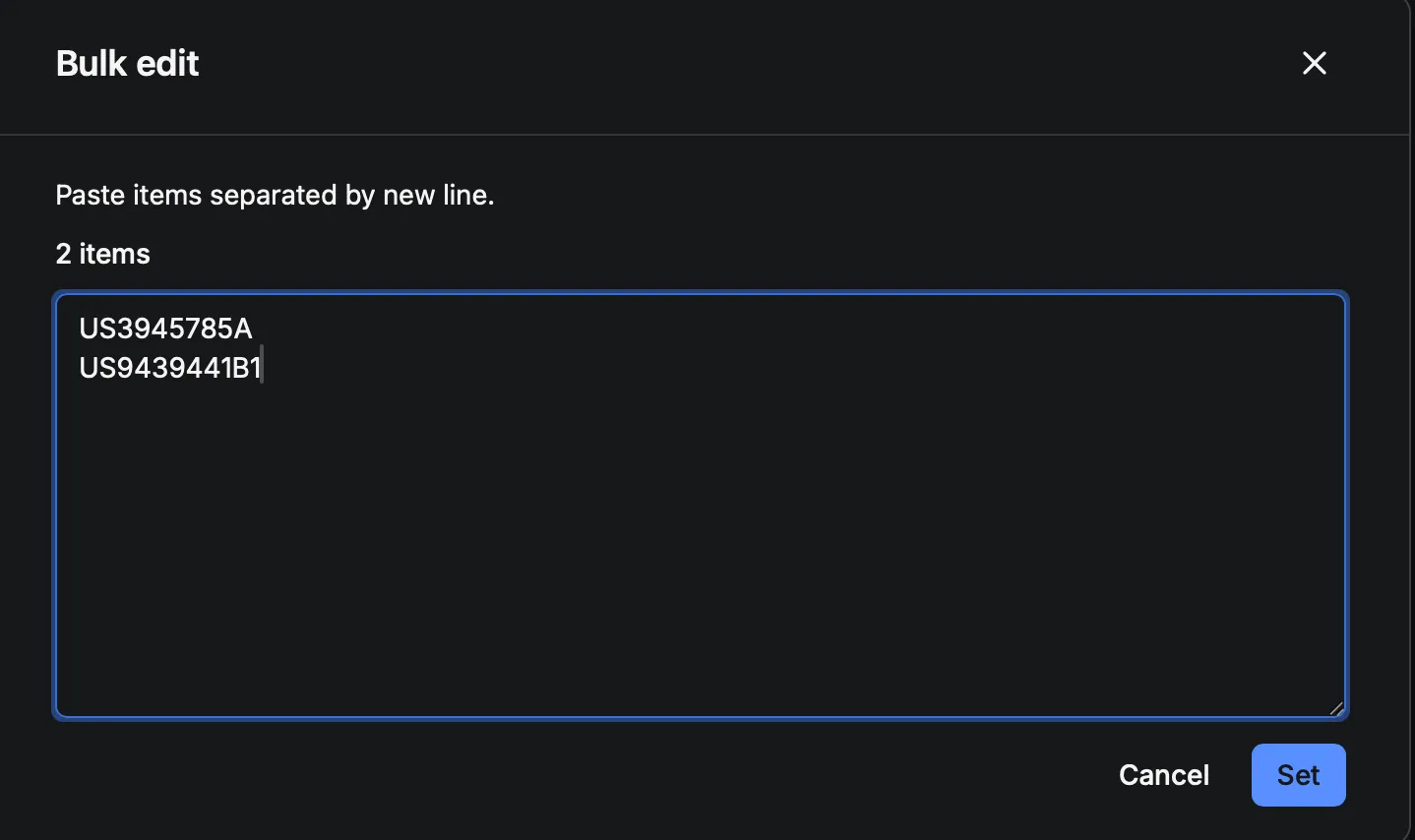
Alternatively, you may provide JSON specifying the patent numbers, keywords, and fields:
For Google Patents searches, the Actor derives how many search pages to visit from maxKeywordResults and then keeps at most that many resolved patent/publication numbers per search combination.
Example output is shown below:
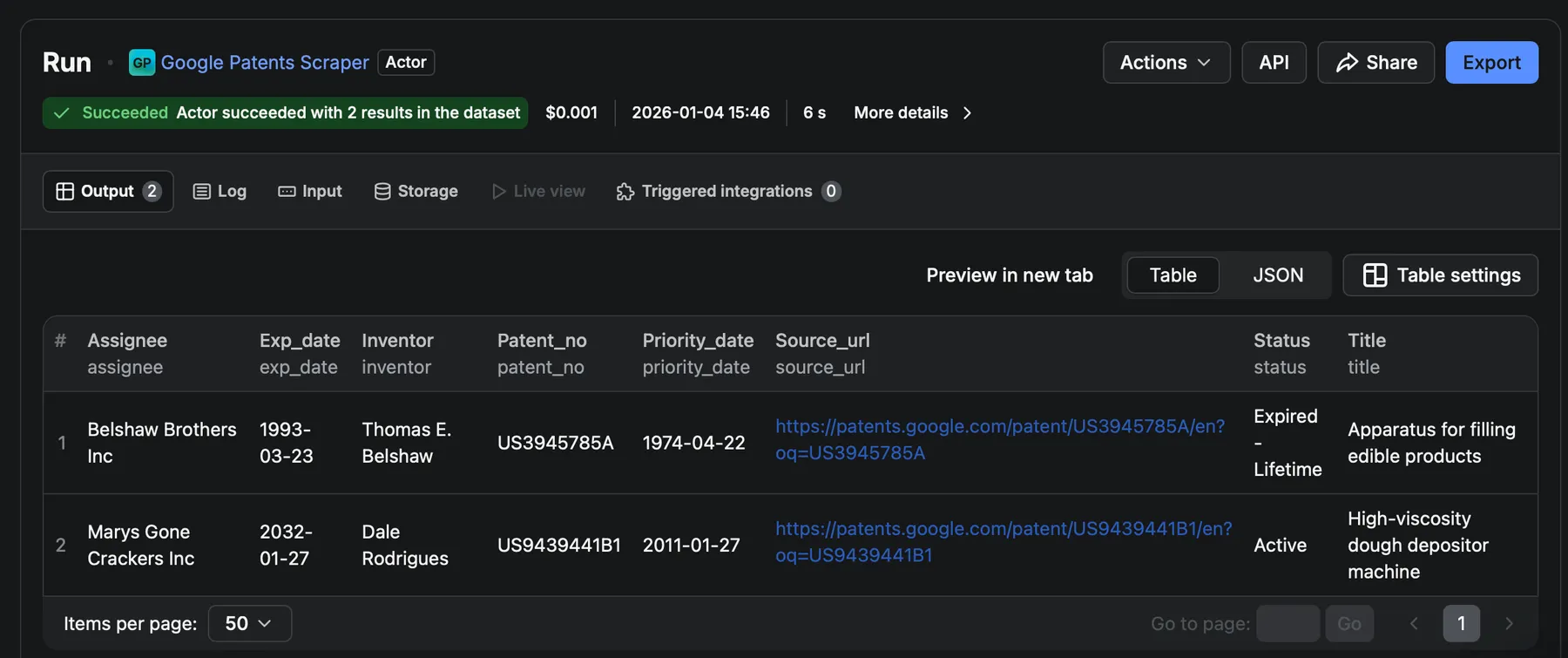
When claims is selected, the Actor returns an array of claim objects for each patent, with:
numbertype(independentordependent)text
When parent_apps or child_apps is selected, the Actor returns an array of related application objects with:
application_numberpublication_numberrelationpriority_datefiling_datetitleurl
The related-family fields use both identifiers where available:
application_numberpublication_number
When other_family_members is selected, the Actor returns family applications from the Family Applications Before and Family Applications After sections, with the same fields plus:
direction(beforeorafter)
The identifier fields behave as follows:
patent_nois the issued patent identifier when one can be determinedpublication_numberis the publication identifier shown on the Google Patents page when one is available (for exampleUS20250157242A1orUS12361740B2)
When these fields are selected, the Actor keeps them separate:
- for a granted patent page such as
US9439441B1,patent_nois populated with the granted identifier - for a pre-grant publication such as
US20250157242A1,publication_numberis populated with that publication identifier - if Google Patents exposes both versions, the Actor fills both fields in the same output row
This means a publication-number input can still produce a populated patent_no when Google Patents exposes the granted counterpart, and a patent-number input can still produce a populated publication_number when Google Patents exposes the publication counterpart.
When ptab_proceedings is selected, the Actor looks up matching IPR and PGR trial numbers from a PTAB proceedings database using the derived issued patent number. This means:
- granted patent identifiers such as
US9439441B1can be matched directly - pre-grant publications such as
US20250157242A1can be matched when Google Patents exposes a granted counterpart inOther versions - if no issued patent number can be determined,
ptab_proceedingsis returned as an empty list
Each ptab_proceedings item includes:
trial_numberpetitionerstatuslast_modified_datetime


