
Google News Scraper | Real Article URLs, Only New
Pricing
from $2.10 / 1,000 news articles
Google News Scraper | Real Article URLs, Only New
Scrape Google News by keyword or topic in 50 country and language editions: headline, publisher, publication time and the real article URL instead of a Google redirect. Go past the 100-result limit with date ranges. Turn on 'Only new articles' to monitor news on a schedule.

Google News Scraper: real article URLs, only new articles, 50 editions
Collect news from Google News by keyword or by topic, in 50 country and language editions. For every article you get the headline, the publisher, the publication time and the publisher's real article URL, not a news.google.com redirect link that you would have to open one by one.
Google shows at most 100 results per search. Ask for more and the scraper splits your time range into single days and searches each one, so you can pull hundreds or thousands of articles on a topic.
Run it on a schedule with Only new articles turned on and you get just what was published since your last run.
Pay per result · No login, no API key · Public data only · Tested daily · LLM-ready JSON for AI agents (MCP)
🛠️ What does Google News Scraper do?
- 🔗 Real publisher URLs, not
news.google.comredirect links you would have to open one by one. - 🌍 50 country and language editions. Search by keyword or follow a topic.
- 📅 More than Google's 100 results per search. The time range is split into single days and each day is searched.
- 🆕 Only new articles mode. Schedule it and get just what was published since your last run.
- 🛡️ Built to get through blocking. Requests go out with a real browser fingerprint through rotating proxies, and a blocked request is retried from a fresh IP. A result that could not be completed is never charged.
What people use it for
- Media monitoring. Track your brand, competitors, products or people in the news, hourly or daily, and send only new articles to Slack, email, Google Sheets or your own app.
- Market and trend research. Pull every article on a topic for a date range and see how coverage changes over time and across countries.
- News feeds for AI and RAG. Feed fresh, deduplicated article links with real URLs into your pipeline, ready for a content extractor.
- PR and SEO reporting. See which publishers covered a story and when.
📊 What data can you extract?
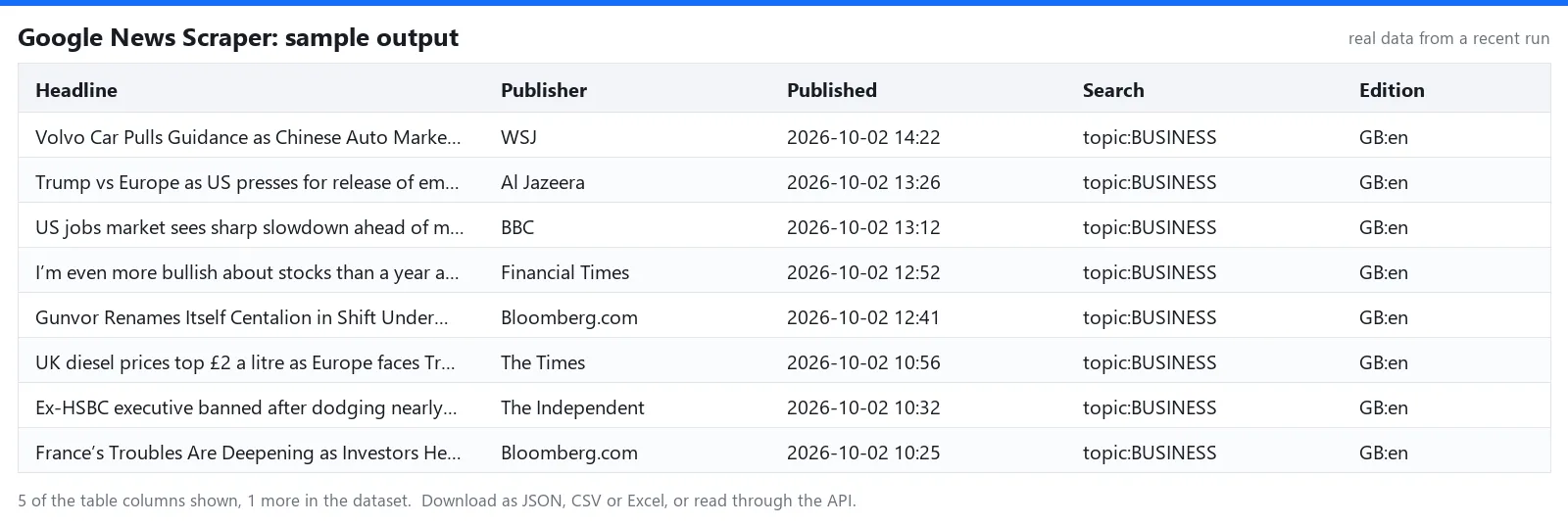
Every result is one JSON object (one row in CSV or Excel) with these fields:
| Field | Meaning |
|---|---|
title | Headline, without the " - Publisher" suffix Google adds |
publisher, publisherUrl | News outlet name and its website |
publishedAt | Publication time (ISO, UTC) |
url | The publisher's own article URL. If a link could not be resolved, this holds the Google News link and urlResolved is false |
googleNewsUrl, articleId | The Google News link and Google's ID for the article |
related | In topic feeds, other outlets' coverage of the same story: headline, publisher and Google News link |
search | The query that found the article, or topic:NAME for a topic feed |
edition | Country and language edition, for example US:en |
🚀 How to use Google News Scraper
- Create a free Apify account and open this Actor.
- Add one or more search queries, for example
electric vehicles. Google operators work:"exact phrase",site:reuters.com,intitle:tesla,OR,-exclude. - Or pick one or more topics (Top stories, World, Business, Technology and so on) to collect the current headlines of that section.
- Choose the country and language edition.
- Set Published within, or a From date and To date, to limit the time window.
- Raise Max articles per query above 100 if you want deep coverage of the time window.
- Turn on Only new articles and add a schedule to monitor a topic.
- Run it and download the results as JSON, CSV, Excel, or connect them through the API.
📥 Input example (JSON)
📤 Sample output (JSON)
🤖 Use it with AI agents, MCP and the API
The output is clean JSON with stable field names, ready for LLM pipelines, RAG and agent tools without extra parsing.
- AI agents and MCP (Claude, ChatGPT, Cursor and others). Add the Apify MCP server with this Actor as a tool:
https://mcp.apify.com?tools=akatra/google-news-scraper. The agent can then run it and read the results by itself. - API. Start a run and get the results in a single call:
- No-code tools and SDKs. Works with Make, n8n, Zapier and LangChain through Apify's integrations, and with the Apify clients for Python and JavaScript. Schedule it and send the results to a webhook, Google Sheets or your own database.
💰 Pricing: pay per result
You pay per article, nothing for empty runs beyond a tiny start fee. See the price on the Pricing tab. Real article URLs are included at no extra charge. There is no subscription or rental fee. New to Apify? The free plan includes $5 of platform credit every month, enough for about 1,600 articles with this Actor, and no credit card is needed.
🚦 Run status and error messages
Every run ends with a plain status message, so automated workflows (API, Make, n8n, AI agents) can tell what happened without reading the log:
| Situation | What you get |
|---|---|
| Finished normally | Saved N articles. |
| Nothing matched | The run succeeds with No articles saved. Try a broader query, a longer time range, or turn off 'Only new articles'. You pay only the start fee. |
| Missing or unsupported input | The run fails at once and the log names the field to fix. Nothing is scraped. |
| The site kept blocking some pages | Some pages stayed blocked, so the results are incomplete; run again to get the rest. |
| Your maximum charge is reached | Stops cleanly with Stopped at your maximum charge limit. Everything saved so far stays in the dataset. |
ℹ️ Good to know
- One search returns up to 100 articles, which is Google's own limit. Above 100 the scraper searches day by day, newest day first, and stops when it reaches your maximum. With no time window set, it goes back 30 days.
- A single very busy day can still have more than 100 matching articles. To get them all, split the topic into narrower queries, for example one per
site:or per keyword. - Google ranks search results by relevance, so articles inside one day are not in strict time order. The output is sorted newest first within each search.
- An article is delivered once per run, even when it matches several of your queries. If you set a maximum charge for a run, the scraper stops as soon as that limit is reached.
- Day-by-day search covers at most the 366 most recent days of your date range.
- Topic feeds return the current headlines of that section, usually 30 to 70 stories, and ignore the time filters.
- Only new articles remembers what it delivered per query and edition. The first run is your baseline. From the second run on you get articles published since the previous run (with a two-day safety margin), so older articles that did not fit into an earlier run are not sold to you as new. Changing the query or the edition starts a fresh memory.
- The scraper returns headlines and links, not the article text. Pass the
urlvalues to a content extractor if you need full text. - No personal data: the output has no author names or contact details.
📝 Changelog
- 2026-10-02 'Only new articles' now returns articles published since the previous run; unfinished searches are retried on the next run. README restructured: data table, API and MCP examples, run status messages.
- 2026-10-02 Sturdier parsing, protection against endless paging, maximum charge limit respected, after two independent audits.
- 2026-10-02 First release: keyword and topic feeds, real article URLs, day-by-day deep search, only-new mode.
⚖️ Legal and privacy
This scraper is an independent tool and is not affiliated with, endorsed by, or sponsored by Google. "Google News" is a trademark of its owner and is used here only to show which website the tool works with. Headlines and articles belong to their publishers. Use the data in line with the laws that apply to you and the source site's terms.
The source site's name and logo are trademarks of their owner and appear here only to identify the website this tool works with. The Actor reads only pages that are public without logging in. How you store and use the data is your responsibility: follow the laws that apply to you, such as GDPR and CCPA.
🔗 More scrapers from Akatra
- Indeed Jobs Scraper: 💼 job ads from Indeed in 30 countries, with yearly salary and only-new mode.
- Google Trends Scraper: 📈 interest over time, by region, and rising related queries.
- Google Ads Transparency Scraper: 🔎 every ad a company runs on Google, with regions and dates.
- YouTube Transcript Scraper: 🎬 video transcripts as clean text and timestamped lines.
💬 Support
Found a bug or need a field that is missing? Open an issue on the Issues tab and we usually reply within a day.


