

Temu Product Scraper | $3/1K | Prices & Sold Count
Pricing
from $3.00 / 1,000 product scrapeds
Temu Product Scraper | $3/1K | Prices & Sold Count
Scrape Temu product listings in real-time — title, price, original price, rating, reviews, sold count, shop, images. Perfect for dropshipping research.
Pricing
from $3.00 / 1,000 product scrapeds
Rating
5.0
(1)
Developer

Apivault Labs
Maintained by CommunityActor stats
1
Bookmarked
320
Total users
72
Monthly active users
11 hours
Issues response
2 hours ago
Last modified
Categories
Share
Temu Product Scraper — Search, Compare & Export
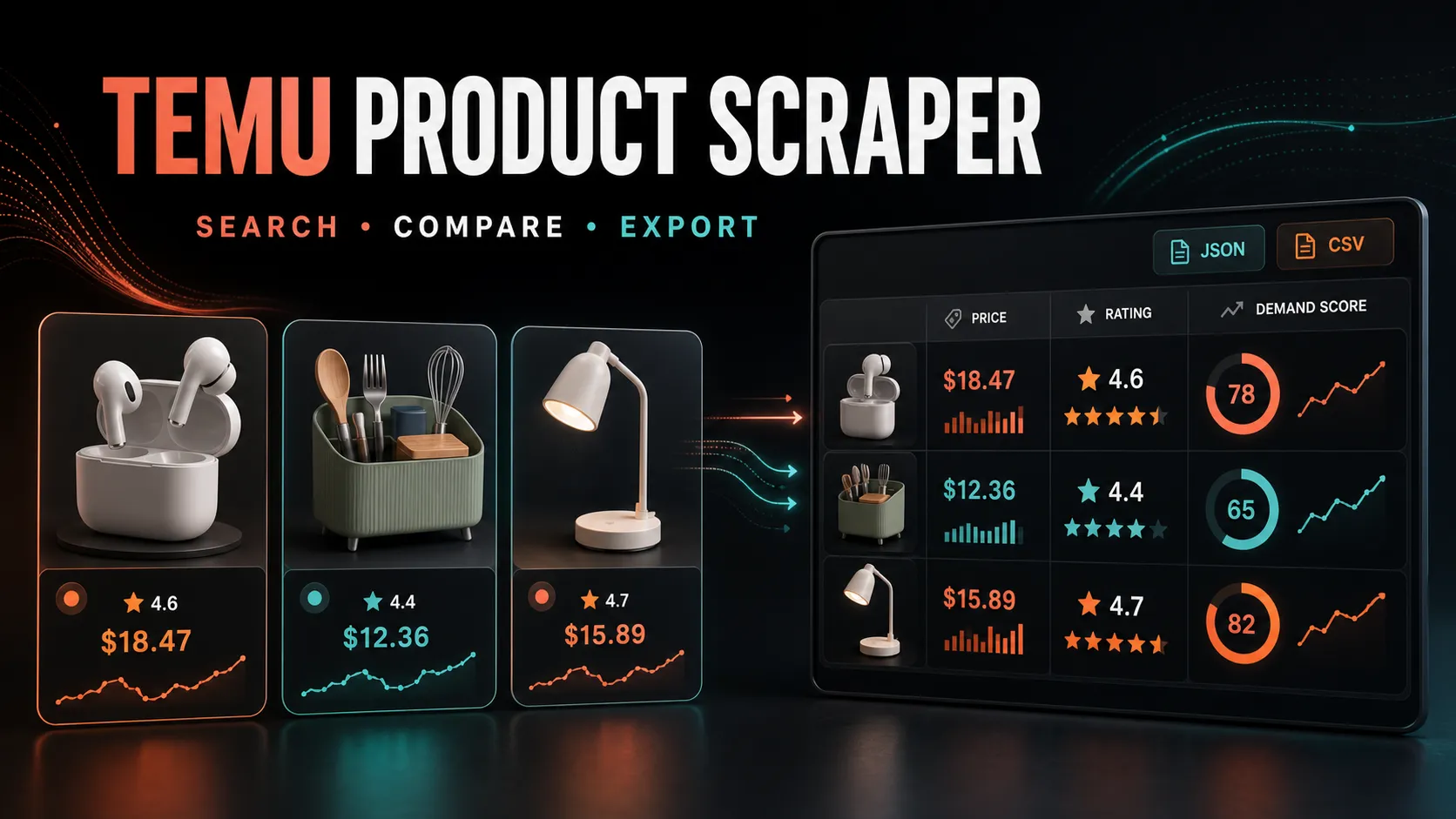



Search Temu by keyword or collect data from specific product URLs. Compare prices, ratings, reviews, availability, seller information, media, and market signals in one structured dataset.
Built for product research, catalog discovery, competitive analysis, and marketplace monitoring — without manually opening hundreds of listings.
Quick start in Apify Console
- In What to collect, enter one keyword or product URL/ID per line. Alternatively, leave both lists empty and enable Also collect featured products.
- Choose a country and a small product limit. Leave optional filters and advanced settings at their defaults for the first run.
- Click Start. Open the Dataset for products and Run summary for delivered rows, source failures and limits. Temu may return no products; an empty run can still incur platform usage costs.
- For export, select a row layout in Results and export before running, then download the Dataset in the appropriate format. Review Shopify/Merchant rows before importing or submitting them.
The remaining sections let you choose product fields, research estimates, and advanced runtime settings. Paid experimental sources are disabled by default; enabling them does not guarantee results.
What you can do
- Target keyword requests to one of 20 selectable regions; discovered snippets may not carry region-specific prices or stock information.
- Collect specific listings from Temu product URLs or product IDs.
- Collect featured products with
trendingNow: true. This is a separate feed, not a substitute for keyword search; the source chooses items and currency. - Sort search results by relevance, top sales, newest, or price.
- When a discovery source does not expose a publication date, the
newestoption preserves that source's order instead of inventing recency. - Filter by price, demand score, hot-product score, shipping, or trend status.
- Compare normalized product data across one dataset.
- Export results through Apify as JSON, CSV, Excel, XML, or RSS.
- Produce Shopify-oriented and Google Merchant-oriented output shapes.
Data you can collect
| Category | Example fields |
|---|---|
| Product | title, productId, productUrl, category, description |
| Pricing | priceUsd, priceLocal, currency, originalPriceUsd, discountPct |
| Social proof | rating, reviewsCountInt, soldCountText, soldCountInt |
| Seller | shopName, shopUrl, mallId |
| Delivery | shippingText, freeShipping, shippingDaysMin, shippingDaysMax |
| Media | imageUrl, images, videoUrl, variants |
| Research signals | demandScore, hotProductScore, isTrending, riskCount |
| Retail estimates | estimatedRetailUsd, estimatedGrossProfitUsd, estimatedProfitMarginPct |
Fields depend on what is publicly available for each listing and region. Missing source data is not fabricated.
Keyword runs use a bounded source waterfall. Metered search discovery is off by
default and can be enabled with usePaidSearchDiscovery: true; it does not
guarantee verified commerce data. Duplicate products
across keywords are delivered once. The free RUN_SUMMARY record reports
delivered, filtered, failed, and duplicate counts plus whether the runtime budget
was reached or paid discovery was enabled.
Quick start
When ordinary discovery is incomplete, matching featured-feed products may be
returned with source: temu_feed_keyword_match. All query words must match the
product title. This covers only the small featured subset, not the full catalog;
many keywords can still return no results. Product URL fallback likewise requires
an exact product ID in that feed.
An empty or unavailable feed is not a successful product collection. Check
RUN_SUMMARY.sourceIssues, delivered and featuredFeedRequests; process status
SUCCEEDED alone does not mean products were returned. A source returning only
a trust module is stopped for that run rather than repeatedly fetched.
useResidentialFeedFallback is an experimental, metered option and is off by
default. Cloud testing did not establish that it restores an unavailable feed;
enabling it can increase costs without returning products.
Search by keyword:
Or collect specific products:
You can combine keyword search and product URLs in the same run.
For a low-cost featured-products run:
The feed reports its actual currency. USD estimates are produced only for supported currencies and use approximate conversion rates; unsupported currencies retain local prices without inventing a USD value. Shopify and Google Merchant-oriented rows require a USD estimate, so sold-only records without one are excluded from those exports.
Example output
The example below is fictional and shows the typical structure. Returned fields vary by listing.
Understanding sold count
Sold count is returned only when the listing or search result exposes that signal.
- A label such as
10K+ soldbecomessoldCountInt: 10000. - That number is the displayed lower bound, not an exact lifetime-sales total.
soldCountIsBucket: trueidentifies bucketed values.- Some products may not include sold count at all.
Use sold count as a comparison signal together with rating, reviews, price, and listing quality — not as audited sales data.
Product research scores
Optional enrichment turns available listing signals into sortable research fields:
demandScoreanddemandTiersummarize visible demand indicators.hotProductScorecombines demand, margin, shipping, media, and risk signals.isTrendingflags products that meet the Actor's current trend criteria.riskCounthighlights conditions such as limited reviews or a weak rating.- Retail and profit fields apply your chosen markup to the collected product price.
These are research heuristics, not guarantees of demand, profitability, resale eligibility, or future performance. Profit estimates do not automatically include advertising, marketplace fees, taxes, returns, duties, or fulfillment costs.
Useful presets
Find stronger candidates
Prepare Shopify-oriented rows
Prepare Google Merchant-oriented rows
Always review generated catalog fields, images, pricing, availability, and policy compliance before importing or publishing products.
Shopify-oriented rows are imported as drafts with zero assumed inventory. A product should be published and stock quantities set only after you verify supplier availability and fulfillment rights. Merchant-oriented rows treat unknown availability as out of stock rather than guessing.
Regions
Supported region presets include the United States, United Kingdom, Germany, France, Spain, Italy, Netherlands, Australia, Canada, Brazil, Mexico, Japan, South Korea, Poland, Sweden, Austria, Belgium, Portugal, Czech Republic, and Ireland.
Prices, availability, rankings, and visible listing fields can differ by region and over time.
Pricing
The active price is $0.003 per successful dataset item:
| Results | Usage charge |
|---|---|
| 1 | $0.003 |
| 100 | $0.30 |
| 1,000 | $3.00 |
| 10,000 | $30.00 |
A small Apify Actor Start charge may also apply according to the platform pricing shown before each run. Failed or filtered-out records are not charged as successful dataset items.
For economical keyword monitoring, keep maxFallbackDetails at its default of
1 or set it to 0. maxRunTimeSeconds preserves already collected results and
prevents a long fallback tail from consuming an unbounded run.
n8n automation
Use the community package n8n-nodes-apivault-temu to add this Actor to an n8n workflow. It can send an input, start a run, and pass the resulting dataset to the next workflow step.
FAQ
Do I need a Temu account?
No. The Actor collects data available from public product listings.
Can every field be guaranteed?
No. Marketplace pages vary by product, region, session, and time. The Actor returns the fields available for a given result and does not invent missing values.
Are normalized prices and profit estimates exact?
They are research aids. Currency conversion and retail estimates should be independently verified before commercial use.
Can I use the output for a store catalog?
The Actor can prepare Shopify-oriented or Google Merchant-oriented rows, but you remain responsible for product rights, marketplace policies, listing accuracy, fulfillment, and legal compliance.
Where are the results stored?
Results are saved to the run's Apify Dataset. Aggregate summaries and top-product records can also be written to the run's Key-Value Store.
Related Actors
Support
Open an issue on the Actor page with a sample input and run ID. Do not include passwords, API tokens, or private customer data.
Temu is a trademark of its respective owner. This Actor is an independent data tool and is not endorsed by or affiliated with Temu.


