

Bitcoin Network Scraper: Hashrate, Fees & Mempool
Pricing
from $0.56 / 1,000 snapshot scrapeds
Bitcoin Network Scraper: Hashrate, Fees & Mempool
Scrape Bitcoin network statistics: hash rate, difficulty, block count, mempool size, transaction fees, block interval and total value transacted. Network fundamentals.
Pricing
from $0.56 / 1,000 snapshot scrapeds
Rating
0.0
(0)
Developer

Arman Hossain
Maintained by CommunityActor stats
0
Bookmarked
1
Total users
0
Monthly active users
2 months ago
Last modified
Categories
Share
Agent skill: SKILL.md
What it does
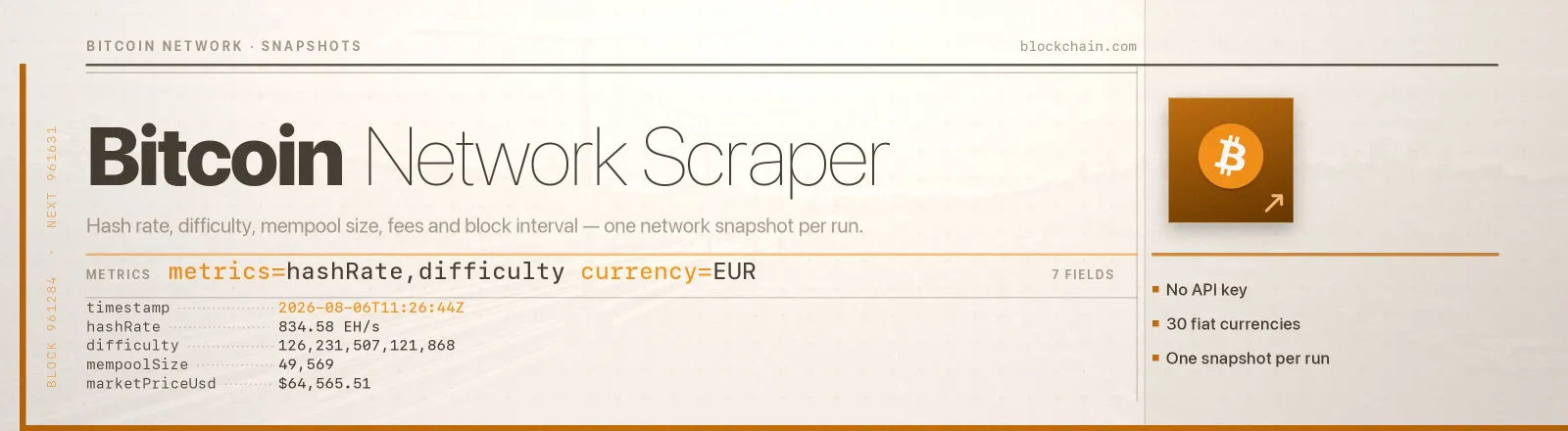
Scrape Bitcoin network statistics: hash rate, difficulty, block count, mempool size, transaction fees, block interval and total value transacted. Network fundamentals. Give it metrics and it returns one structured record per snapshot.
Each run is one snapshot, a single dataset record capturing the state of the Bitcoin network at that moment. Run it on a schedule and the dataset becomes a time series: hash rate against difficulty, mempool backlog against block interval, fee pressure against price.
It reads three public Blockchain.com endpoints: the network stats aggregate, the live unconfirmed-transaction count, and the fiat ticker used to convert USD values into your reporting currency.
Input
| Field | Type | Default | Notes |
|---|---|---|---|
metrics | array | [] | Restrict the record to these metric names. timestamp, currency and scrapedAt are always kept. Empty = every metric. An unrecognised name fails the run immediately with the valid list. |
includeMempool | boolean | true | Fetch the live unconfirmed-transaction count into mempoolSize. One extra request; turn it off for the daily aggregates only. |
currency | string | "USD" | Fiat currency for the converted value block. One of the 30 currencies Blockchain.com's ticker quotes. |
Valid metrics values: marketPriceUsd, hashRate, difficulty, totalBtcMined, blocksSize, minutesBetweenBlocks, totalTransactions, transactionsPerSecond, mempoolSize, minerRevenueUsd, totalFeesBtc, estimatedTransactionVolumeUsd.
Which combinations make sense
metricsandincludeMempool: false: ifmempoolSizeis inmetricsbut the mempool is disabled, the field is present andnull. Ask for one or the other consistently.metricsandcurrency: asking for a USD metric keeps its fiat twin too, requestmarketPriceUsdand you also getmarketPriceandfxRateUsd. Metrics you did not ask for do not drag their twins along.currency: "USD"skips the ticker request entirely,fxRateUsdis1and the fiat fields mirror the USD ones.- No input at all is a valid, complete run: all 19 fields, mempool included, in USD.
Example input
Output
One dataset item per snapshot. A real record, exactly as produced by a live run:
Fields ending in Usd are always USD, whatever currency you set. The five-field block from currency to estimatedTransactionVolume carries the converted view, with the exact rate used so the numbers are auditable.
Known source quirks
These are Blockchain.com's numbers, passed through faithfully rather than patched:
totalFeesBtccan come back negative (-415.625in the sample above, the exact negation of the 24h BTC issuance). The upstreamtotal_fees_btcfield is occasionally sign-flipped. TakeMath.abs()if you need a magnitude, but be aware you are working around a source bug.minerRevenueUsdis often0. Blockchain.com does not always populate it. Derive revenue from issuance × price if you need it reliably.totalTransactionsis a 24-hour count, not the all-time total. Same forblocksSizeandestimatedTransactionVolumeUsd.
RUN_SUMMARY
Written to the default key-value store at the end of every run:
blockHeight and nextRetargetBlock are bonus context: the difference tells you how many blocks remain until the next difficulty adjustment. failures holds one { source, error } entry per degraded source.
Use cases
1. Monitor mining economics
Hash rate against difficulty against price is the whole miner-margin picture. Poll hourly and you can see hashprice compress in real time.
RUN_SUMMARY.nextRetargetBlock minus blockHeight tells you how many blocks until difficulty adjusts, the number miners actually watch.
2. Time transactions around fee pressure
Mempool backlog is the leading indicator of what you will pay. A tight, cheap snapshot every few minutes is enough to spot the windows.
A rising mempoolSize with minutesBetweenBlocks above 10 means the backlog is growing faster than blocks are clearing it, wait. Both falling means the window is open.
3. Network-health research
Take everything, in your reporting currency, once a day, and build a longitudinal dataset.
All 19 fields, converted, with the FX rate stored alongside so the series stays reproducible even as rates move.
Limits and behaviour
- Fast. The stats endpoint answered in 98 ms on probe, the fastest in the whole survey. A full three-source run finishes in well under a second, which makes high-frequency scheduling practical.
- No published rate limit. Blockchain.com advertises no rate-limit headers on these endpoints. Polling every few minutes is comfortable; sub-minute polling is not something the Actor is built to pace, and there is no useful new data at that resolution anyway.
- Graceful degradation. If the mempool or ticker endpoint fails, the snapshot is still saved,
mempoolSizeisnull, or values stay in USD withcurrencyreported as"USD", and the failure is recorded inRUN_SUMMARY.failures. Only a failure of the primary/statsendpoint aborts the run, because then there is no snapshot to save. - Transient errors are retried. 429 and 5xx get three attempts with linear backoff (1 s, 2 s). Malformed responses fail fast rather than being retried into the timeout.
?currency=on the source endpoint does nothing. Blockchain.com accepts the parameter but returns USD regardless, so this Actor converts explicitly againstblockchain.info/tickerand shows you the rate. That is whyfxRateUsdexists.- Public data only. No authentication, no personal data, no access-control bypass.
FAQ
Do I need a proxy? No. Proxy configuration is not required to run this Actor.
Do I need a Blockchain.com account or API key? No. You supply no credentials.
What happens if a source is unavailable? The mempool and ticker sources degrade gracefully, the snapshot still saves, with the gap noted in RUN_SUMMARY.failures. If the core stats endpoint is down after three retries the run errors out, since there would be nothing to record.
Can I schedule it? Yes, that is the point. One run = one snapshot; a schedule turns the dataset into a time series.
What unit is hashRate in? GH/s, as Blockchain.com reports it. Divide by 1e9 for EH/s: 834575299886 GH/s = 834.58 EH/s.
Why is totalFeesBtc negative? An upstream sign bug in Blockchain.com's total_fees_btc. The Actor reports what the API returns rather than silently correcting it, see "Known source quirks" above.
Can I get historical data? Not from this Actor, /stats is a live snapshot with no history parameter. Schedule it and accumulate your own series; timestamp and scrapedAt are your time keys.
Can I get individual transactions or blocks? No. This Actor covers network-level aggregates only.
Can I integrate it with something else? Yes, Apify API, client libraries, webhooks, scheduled runs, dataset exports (JSON/CSV/Excel) or MCP. Output is structured JSON.
API example
JavaScript example


