
DOAJ Scraper: Open Access Journals & Articles
Pricing
from $0.37 / 1,000 record scrapeds
DOAJ Scraper: Open Access Journals & Articles
Scrape the Directory of Open Access Journals: journal title, ISSN, publisher, subject, licence, article processing charges and peer-review process. For OA policy analysis.
Pricing
from $0.37 / 1,000 record scrapeds
Rating
0.0
(0)
Developer

Arman Hossain
Maintained by CommunityActor stats
0
Bookmarked
1
Total users
0
Monthly active users
2 months ago
Last modified
Categories
Share
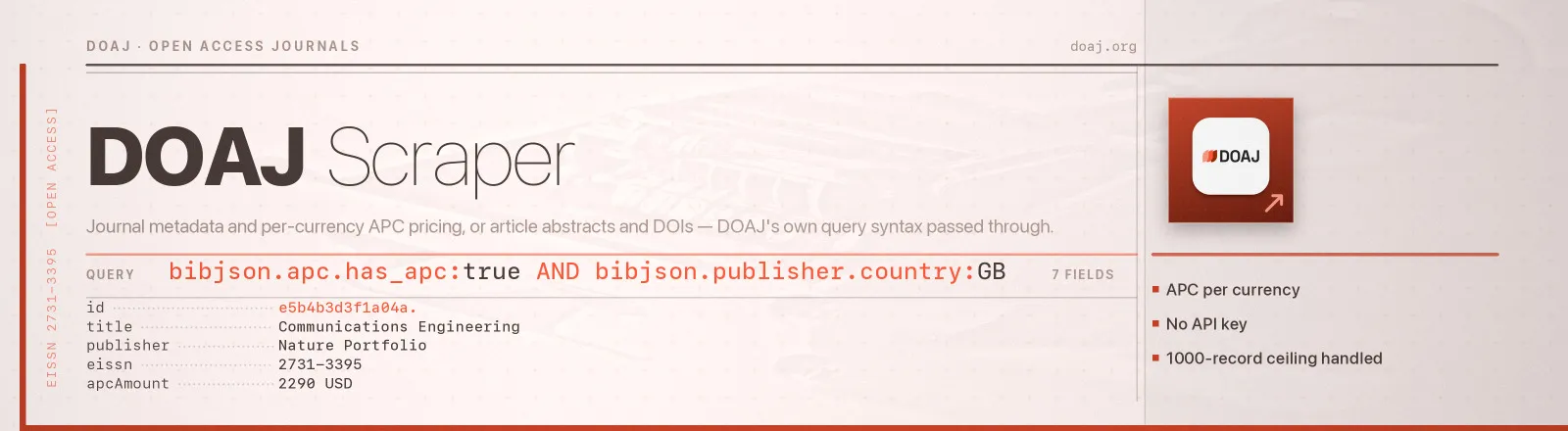
DOAJ Scraper pulls vetted open-access journals out of the Directory of Open Access Journals, title, ISSN, publisher, country, subject classification, licence, article processing charges and peer-review process. Flip one switch and it searches DOAJ's article index instead, returning abstracts, DOIs and full-text links.
APC data is the reason people come here. Very few sources publish article processing charges in structured, per-currency form; DOAJ does, and this Actor hands it to you as a number and a currency code rather than a sentence buried in a PDF.
Agent skill: SKILL.md
What you get
Journals (resourceType: "journals": the default)
| Output field | Meaning |
|---|---|
id | DOAJ internal journal ID |
title | Journal title |
issn, eissn | Print ISSN and electronic ISSN (either may be null) |
publisher, country | Publisher name and its ISO-2 country code |
subjects | Library of Congress subject labels, e.g. ["Physics"] |
language | Publication languages as ISO codes |
license | Licence types, e.g. ["CC BY", "CC BY-NC-ND"] |
apcAmount, apcCurrency | Headline article processing charge and its currency |
apcPrices | Every published price/currency pair, not just the headline one |
hasApc | true / false, does the journal charge at all |
peerReviewProcess | e.g. ["Anonymous peer review"] |
oaStartYear | Year the journal became fully open access |
url | The journal's own homepage |
lastUpdated | When DOAJ last revised the record |
resourceType, query, scrapedAt | Which index, which query produced the row, and the run timestamp |
Articles (resourceType: "articles")
id, title, doi, issn, eissn, journalTitle, publisher, country, subjects, language, keywords, authors, abstract, year, month, volume, issue, url (full-text link), lastUpdated, plus the same resourceType / query / scrapedAt.
A RUN_SUMMARY record in the key-value store holds per-run counts, the filters used, any query that failed, and how many queries hit DOAJ's 1000-record API ceiling.
Common use cases
1. Compare publishing costs across journals. Pull everything that charges, then sort on apcAmount.
2. Check OA compliance for a funder mandate. Funders that require CC BY and no reader-side paywall can be checked directly against license and hasApc.
3. Analyse the open-access landscape. Diamond OA, free to both author and reader, is hasApc: false.
Quick start
Simplest possible run:
Two subject-filtered queries, capped:
Article metadata for a RAG corpus:
Input
| Field | Type | Default | Notes |
|---|---|---|---|
searchQueries | array | - | Required. One search per entry. Plain words or DOAJ field syntax. Each entry is paginated independently, so three queries can return up to 3000 records. |
resourceType | string | journals | journals or articles. One run searches one index, the output shape differs between them. |
subjects | array | [] | Client-side filter on the subjects field, case-insensitive substring. Empty = keep everything. |
maxResults | integer | 200 | Total cap across all queries. 0 = no cap, but see the 1000-record API ceiling below. |
Which combinations make sense. subjects is a post-filter, so it can only narrow what a query already returned, if you want subject-scoped results from the server, put it in the query itself as bibjson.subject.term:"Physics" and DOAJ will do the filtering before pagination. Use the input filter when you want one broad query sliced several ways. maxResults is applied across queries in order, so put your most important query first.
DOAJ query syntax
| Query | Finds |
|---|---|
* | Everything (capped at 1000) |
bibjson.title:"Nature" | Title match |
bibjson.publisher.name:"Elsevier" | All journals from a publisher |
bibjson.apc.has_apc:false | Journals with no author-side charge |
bibjson.subject.term:"Physics" | Subject-classified journals |
issn:2731-3395 | Lookup by ISSN |
bibjson.apc.has_apc:true AND bibjson.publisher.country:GB | Boolean combination |
Output example
RUN_SUMMARY:
Limits and behaviour
- DOAJ caps the API at 1000 records per query. Ask for record 1001 and DOAJ answers HTTP 400 and points you at its public data dump. The Actor stops one page short of that boundary, logs a warning naming the query and its true total, and counts it in
RUN_SUMMARY.queriesTruncatedByApiCeiling. To go deeper, split one broad query into several narrower ones, three subject-scoped queries fetch 3000 records where one broad query fetches 1000. For a full mirror of DOAJ, use their public data dump instead of any API. - A bad query doesn't kill the run. Malformed query syntax gets HTTP 400 from DOAJ; that query is recorded in
RUN_SUMMARY.failuresand the rest continue. The Actor only errors out if every query fails. - Partial results are kept. If a query fails on page 4, the 300 records from pages 1-3 stay in the dataset and the failure is still reported.
- Transient errors are retried. 429 and 5xx get three attempts with linear backoff. Malformed queries and 404s are treated as fatal immediately, since retrying them cannot help.
- APC prices are per-currency. DOAJ publishes a list, so
apcAmount/apcCurrencycarry the preferred single price (USD, then EUR, then GBP, then whatever is first) andapcPricescarries the complete list. Never compareapcAmountacross journals without checkingapcCurrency. - Public data only. No authentication, no personal data, no access-control bypass.
API example
JavaScript example
FAQ
Do I need a proxy? No. Proxy configuration is not required to run this Actor.
Do I need a DOAJ account or API key? No. You supply no credentials.
What happens if DOAJ is unavailable? 429s and 5xx errors are retried with backoff. If a query still fails. It is recorded in RUN_SUMMARY.failures and the run continues with the remaining queries.
Can I schedule it? Yes. DOAJ records carry lastUpdated, so a scheduled run plus a diff on id + lastUpdated gives you a clean change feed.
Why is issn null on some journals? Many journals are electronic-only and have no print ISSN. Use eissn, one of the two is always present.
Why is apcAmount null when hasApc is true? A handful of DOAJ records flag a charge without publishing the figure. apcPrices will be an empty array in that case; the journal's own url is the place to look.
Can I get more than 1000 records for one search? Not through the API, that's DOAJ's limit, not this Actor's. Split the search into narrower queries, or use DOAJ's public data dump.
Can I integrate it with something else? Yes, Apify API, client libraries, webhooks, scheduled runs, dataset exports (JSON/CSV/Excel) or MCP. Output is structured JSON.


