
Wikidata Scraper: Structured Entity Facts & Claims
Pricing
from $0.37 / 1,000 entity scrapeds
Wikidata Scraper: Structured Entity Facts & Claims
Scrape Wikidata entities: labels, descriptions, aliases and every property claim with qualifiers, in any language. The structured knowledge graph behind Wikipedia.
Pricing
from $0.37 / 1,000 entity scrapeds
Rating
0.0
(0)
Developer

Arman Hossain
Maintained by CommunityActor stats
0
Bookmarked
1
Total users
0
Monthly active users
2 months ago
Last modified
Categories
Share
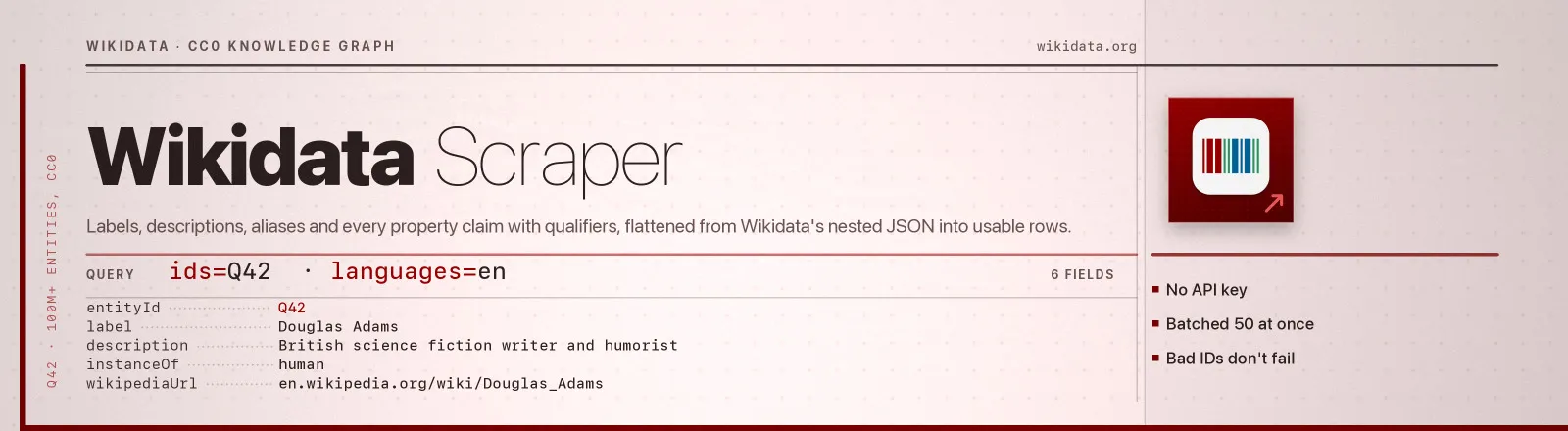
Wikidata Entities Scraper pulls entities out of Wikidata, labels, descriptions, aliases and every property claim with its qualifiers, and flattens the deeply nested claim structures into rows you can actually use.
Wikidata is the machine-readable knowledge graph behind Wikipedia: 100M+ entities, CC0-licensed, with a public API built for programmatic access. This Actor reads that API directly: no proxy setup, no browser, no credentials to manage. Entities are fetched 50 at a time, and identifiers inside claims are resolved to human-readable labels for you.
Agent skill: SKILL.md
What you get
| Output field | Meaning |
|---|---|
entityId | Wikidata identifier, e.g. Q42 |
label, description | Preferred label and short description in your requested language |
aliases | Alternative names in the same language |
instanceOf | The P31 values as { id, label }, the entity's type, pulled out for convenience |
claims | Every property, keyed by P-id, with its label, datatype and flattened values |
qualifiers | Statement-level detail for the claims that carry qualifiers (start/end dates, roles, sources) |
sitelinks | Map of every linked Wikimedia project → URL |
wikipediaUrl | Direct Wikipedia link in your first requested language |
modified | Last edit timestamp of the entity |
scrapedAt | Run timestamp |
A RUN_SUMMARY record in the key-value store holds per-run counts, the filters used, and any entity that failed.
Common use cases
- Entity resolution. Turn free-text names into stable Q-ids and canonical identifiers.
- Knowledge graphs. Extract typed facts (birth dates, coordinates, parent companies) as clean rows.
- Record enrichment. Attach VIAF, ISNI, GRID, IMDb, MusicBrainz and 6,000 other external IDs to your own data.
- AI agents and RAG. A fast, licence-clean fact layer that does not hallucinate.
- Media and entertainment analysis. Cast, crew, awards, franchises and release data, already structured.
Quick start
Three entities, everything they have:
Resolve names, then keep only the facts you care about:
German labels, raw identifiers, minimal payload:
Input
| Field | Type | Default | Notes |
|---|---|---|---|
entityIds | array | [] | Q-identifiers (Q42), full wikidata.org/wiki/… URLs or entity URIs. Anything that is not an identifier is treated as a search term. |
searchTerms | array | [] | Names resolved to entities via wbsearchentities before fetching. |
properties | array | [] | Keep only these P-properties. Empty = every claim on the entity. |
languages | array | ["en"] | Fallback chain for labels, descriptions and aliases, first language with a value wins. |
resolveLabels | boolean | true | Resolve referenced P-ids and Q-ids to labels (P31 → instance of, Q5 → human). |
includeSitelinks | boolean | true | Include the site → URL map. A popular entity carries 300+ sitelinks. |
resultsPerSearchTerm | integer | 1 | Entities kept per search term. Raise it when names are ambiguous. |
Provide entityIds, searchTerms, or both, at least one entity must be resolvable or the run errors out immediately.
Output example
How claims are flattened
Raw Wikidata claims are five levels deep and every datatype nests differently. Each one is unwrapped explicitly:
| Datatype | Flattened to |
|---|---|
wikibase-item, wikibase-property | { id, label } |
time | { time, precision, calendar, raw }, trimmed to the stated precision, so a year-precision date stays "1952" rather than pretending to be 1 January |
quantity | { amount, unit: { id, label }, lowerBound, upperBound }, amount is a real number, not "+1.96" |
globe-coordinate | { latitude, longitude, altitude, precision, globe } |
monolingualtext | { text, language } |
string, url, external-id, math, geo-shape | plain string |
commonsMedia | { file, url }, the resolvable Commons URL, not just a file name |
| no value / unknown value | { "special": "novalue" } / { "special": "somevalue" } |
claims is the flat digest of every statement. qualifiers carries the statements that have qualifiers, with rank and the qualifier snaks flattened the same way, so nothing is lost, and the common case stays readable.
API example
JavaScript example
Limits and behaviour
- Bad ids don't kill the run.
wbgetentitiesrejects an entire 50-id batch when one id does not exist. The Actor reads the offending id out of the error, drops it intoRUN_SUMMARY.failuresand retries the remaining 49. You never lose good entities to one typo. - Batched by design. Entities are fetched 50 per request, and label lookups are batched and cached across the whole run.
mullabels are handled. Wikidata has moved Latin-script labels and aliases to the sharedmullanguage, so asking forenalone returns an empty label on a large share of entities. This Actor sendslanguagefallback=1and addsmulto the chain, which is whyQ42still comes back as "Douglas Adams".- Transient errors are retried. 429 and 5xx get four attempts with exponential backoff and jitter.
- Descriptive user agent. Wikimedia throttles generic clients within a handful of requests; every request identifies this Actor.
- Public data only. Wikidata is CC0. No authentication, no personal data, no access-control bypass.
FAQ
Do I need a proxy? No. Proxy configuration is not required to run this Actor.
Do I need an account on Wikidata? No. You supply no credentials.
What happens if an entity is unavailable? It is recorded in RUN_SUMMARY.failures and the run continues. The Actor only errors out if nothing at all could be fetched.
Can I schedule it? Yes, it is designed for scheduled runs. Diff on modified to detect changed entities cheaply.
How do I find a Q-id? Put the name in searchTerms and let the Actor resolve it, or read it from the Wikipedia sidebar under Wikidata item.
Why is a claim value { "special": "novalue" }? Wikidata distinguishes "we know there is no value" (novalue) from "we know there is one but not which" (somevalue). Both are preserved rather than silently becoming null.
Can I get lexemes or properties? Yes, L and P identifiers are accepted in entityIds alongside Q items.
Can I integrate it with something else? Yes, Apify API, client libraries, webhooks, scheduled runs, dataset exports (JSON/CSV/Excel) or MCP. Output is structured JSON.


